The Altman Z-Score: The Bankruptcy Prediction Formula That Warns You Before a Stock Collapses — How Smart Indian Investors Use This 50-Year-Old Model to Avoid Value Traps and Protect Their Capital

Markets Roar Back +2.8% as Iran De-escalation Hopes Ignite FY27 — What Value Investors Must Know
April 1, 2026
Share Buybacks: The Hidden Signal That India’s Smartest Companies Use to Create Wealth — Why Understanding Buyback Programs Can Help You Identify Multibaggers Before the Market Catches On
April 1, 2026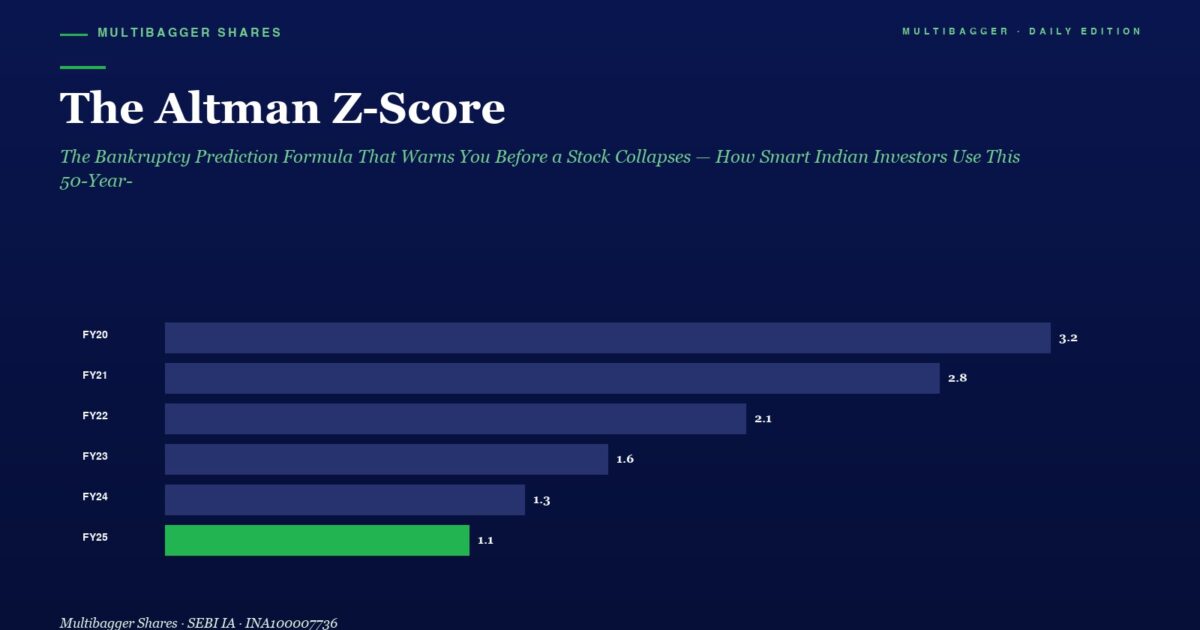
Published: April 1, 2026 | By Manish Goel
Every experienced value investor has a horror story — a stock that looked cheap on every ratio, had low P/E, decent dividends, and an impressive order book — yet went to zero. The company quietly drowned in debt, failed to meet its obligations, and eventually collapsed. The investors who held on till the bitter end wish they had seen it coming.
What if there was a single formula that could predict corporate bankruptcy up to two years in advance — with over 80% accuracy?
That formula exists. It was created in 1968 by Professor Edward Altman at New York University, and after more than five decades of real-world validation, it remains one of the most powerful risk-screening tools available to investors. It is called the Altman Z-Score.
What Is the Altman Z-Score?
The Altman Z-Score is a quantitative credit-strength model that combines five financial ratios — each drawn from a company’s balance sheet and income statement — into a single composite number. That number tells you whether a company is financially healthy, in a danger zone, or heading toward bankruptcy.
The formula is elegantly simple:
Z = 1.2×A + 1.4×B + 3.3×C + 0.6×D + 1.0×E
Where:
- A = Working Capital ÷ Total Assets — measures short-term liquidity. Companies that cannot meet near-term obligations are in trouble.
- B = Retained Earnings ÷ Total Assets — measures cumulative profitability. Companies that have built retained earnings over years are more resilient.
- C = EBIT ÷ Total Assets — measures operating efficiency. This is the most heavily weighted factor (3.3×) because operating earnings power is the truest test of business viability.
- D = Market Value of Equity ÷ Total Liabilities — measures the market’s confidence relative to the company’s obligations. A declining share price relative to debt is an early warning.
- E = Sales ÷ Total Assets — measures asset utilization. Companies that generate more revenue per rupee of assets are fundamentally stronger.
The Three Zones: Reading Your Z-Score Result
Once you calculate the Z-Score, the interpretation is straightforward:
- Z > 2.99 — Safe Zone (Green): The company is financially healthy. Bankruptcy risk is minimal. This is where you want your portfolio companies to be.
- 1.81 < Z < 2.99 — Grey Zone (Yellow): The company is in a warning zone. Not immediately dangerous, but requires careful monitoring. Many companies that eventually collapsed spent time in this zone before deteriorating further.
- Z < 1.81 — Distress Zone (Red): The company is in serious financial distress. The probability of bankruptcy within two years is statistically very high. If you own this stock, you need to investigate immediately.
Why the Altman Z-Score Matters for Indian Investors in 2026
The Indian stock market has over 5,000 listed companies, many of which are small-caps and micro-caps with limited analyst coverage. In the current environment — with geopolitical tensions, rising input costs, and tighter credit conditions — the risk of corporate failures is real and growing. The Z-Score gives you an objective, data-driven way to screen out companies that are silently heading toward disaster.
Consider some real-world Indian examples where the Z-Score would have flashed red well before the stock collapsed:
Case 1 — The Classic Value Trap: A mid-cap manufacturing company trades at a P/E of 6 and a P/B of 0.7. Looks cheap, right? But its working capital is deeply negative, retained earnings have been eroding for three years, and EBIT barely covers interest. Its Z-Score: 1.2. This is deep distress territory. The “cheap” valuation is actually the market correctly pricing in terminal risk. Buying this stock thinking it is undervalued is like picking up a coin on the railway track — the apparent bargain can cost you everything.
Case 2 — The Hidden Strength: A small-cap company in the specialty chemicals space trades at what appears to be a rich P/E of 25. Many value screeners would ignore it. But its working capital is robust, retained earnings have grown every year for a decade, EBIT margins are expanding, and it has almost zero debt. Its Z-Score: 4.8. This is an exceptionally strong company that the simple P/E screen misses. The “expensive” stock is actually the safer investment.
Step-by-Step: How to Calculate the Altman Z-Score for Any Indian Stock
Here is exactly how to do it, using data freely available on Screener.in and Trendlyne:
Step 1: Go to Screener.in and enter the company name. Under the Balance Sheet section, note down: Total Assets, Current Assets, Current Liabilities, Total Liabilities, and Retained Earnings (Reserves & Surplus). Under the Profit & Loss section, note EBIT (you can approximate this as Operating Profit). Under the Ratios section, check the Market Cap.
Step 2: Calculate each ratio:
- A = (Current Assets − Current Liabilities) ÷ Total Assets
- B = Retained Earnings ÷ Total Assets
- C = EBIT ÷ Total Assets
- D = Market Cap ÷ Total Liabilities
- E = Revenue ÷ Total Assets
Step 3: Plug into the formula: Z = 1.2A + 1.4B + 3.3C + 0.6D + 1.0E
Step 4: Interpret the result using the three zones described above.
The Five Components: A Deeper Understanding
Let us look deeper at why each component matters and what it reveals about a company’s health:
Working Capital / Total Assets (Weight: 1.2×) — This measures liquidity. A company with shrinking working capital relative to assets is burning through cash faster than it can generate it. In Indian markets, watch out for companies where receivables are ballooning while cash is shrinking — this is a classic pre-distress signal. Companies like Titan Biotech (BSE: 524200), which consistently maintain healthy working capital, demonstrate the kind of operational discipline this ratio rewards.
Retained Earnings / Total Assets (Weight: 1.4×) — This is Professor Altman’s way of measuring the cumulative track record. A young company with no retained earnings is inherently riskier than one that has been profitable for decades. This is why you see many newly listed SME IPOs with dangerously low Z-Scores — they simply have not built the financial cushion that protects against downturns.
EBIT / Total Assets (Weight: 3.3×) — This is the most heavily weighted component for good reason. It strips out tax structures and capital structures to reveal pure operating efficiency. A company that generates strong EBIT relative to its asset base is fundamentally sound regardless of its debt structure. This is the component that most directly measures whether the business model works.
Market Cap / Total Liabilities (Weight: 0.6×) — This is the only market-based input. It acts as a real-time barometer of collective market intelligence. When a company’s market cap drops below its total liabilities, the market is telling you that it believes the business is worth less than what it owes. That is a powerful signal that should not be ignored.
Sales / Total Assets (Weight: 1.0×) — This measures how efficiently the company uses its assets to generate revenue. Asset-heavy companies that produce little revenue are capital destroyers. This ratio rewards lean, efficient business models.
Practical Rules for Using the Z-Score in Your Investment Process
Based on decades of academic research and practical application, here are the rules I recommend for Indian investors:
Rule 1 — Never Buy a Z-Score Below 1.5: Unless you are a turnaround specialist with deep industry knowledge, stocks in the distress zone are not bargains — they are traps. The odds are heavily against you.
Rule 2 — Require Z > 3.0 for Core Holdings: Your core portfolio — the stocks you hold for 5-10 years — should all score comfortably above 3.0. These are the companies that will survive recessions, market panics, and industry disruptions.
Rule 3 — Track Z-Score Trends, Not Just Snapshots: A company moving from 3.5 to 2.5 over three years is deteriorating even though it is still technically in the grey zone. The trend matters more than the absolute number. Calculate the Z-Score for each of the last five years and watch for sustained declines.
Rule 4 — Use It as a Filter, Not a Verdict: The Z-Score is a screening tool, not a complete investment thesis. A high Z-Score does not guarantee good returns — it simply confirms financial stability. Combine it with valuation analysis, competitive position assessment, and management evaluation for a complete picture.
Rule 5 — Be Cautious with Financial Companies: The original Z-Score was designed for manufacturing companies. For banks, NBFCs, and insurance companies, the model requires modifications (Altman developed a separate version for this). Do not blindly apply the manufacturing formula to financial institutions.
The Z-Score and Value Investing: Perfect Companions
The beauty of the Altman Z-Score is that it addresses the single biggest risk in value investing: the value trap. When Benjamin Graham taught investors to buy stocks trading below their intrinsic value, he assumed the company would survive long enough for the market to recognize that value. But what happens when the company goes bankrupt before the market catches on? You lose everything.
The Z-Score is your safety net. By screening out companies in financial distress before you buy, you dramatically reduce the risk of permanent capital loss — which Warren Buffett calls the only real risk in investing. A disciplined value investor who applies the Z-Score as a first filter will avoid the vast majority of value traps that destroy wealth in Indian markets.
Your Action Plan
Tonight, before the markets open tomorrow, do this:
- Open Screener.in and pull up the financial data for every stock in your current portfolio.
- Calculate the Z-Score for each company using the five-component formula.
- Flag any stock scoring below 1.81 for immediate review — these are the silent threats in your portfolio.
- For stocks in the grey zone (1.81-2.99), check if the trend is improving or deteriorating over the last 3-5 years.
- For your future buy decisions, make Z > 2.5 a minimum requirement before any position.
This exercise takes 30 minutes and could save you lakhs in avoided losses. The Altman Z-Score will not find you your next multibagger — but it will protect you from the stocks that destroy everything you have built.
📩 Join our Telegram channel @longtermequityy for daily value investing insights.
🎓 Watch our Complete Value Investing Course on YouTube.
Disclaimer: This article is for educational purposes only and does not constitute financial advice. The author may hold positions in stocks mentioned. Always conduct your own research and consult a SEBI-registered financial advisor before making investment decisions. Stock market investments are subject to market risks. Past performance does not guarantee future returns.