Return on Invested Capital (ROIC): The Single Most Important Metric That Separates Great Businesses from Mediocre Ones — How Indian Investors Can Use ROIC to Find Future Multibaggers Before the Crowd

Confirmation Bias: The Silent Portfolio Killer That Makes Indian Investors See Only What They Want to See — And How to Break Free Before It Destroys Your Wealth
April 1, 2026
EV/EBITDA: The Smart Investor’s Secret Weapon for Accurate Stock Valuation
April 2, 2026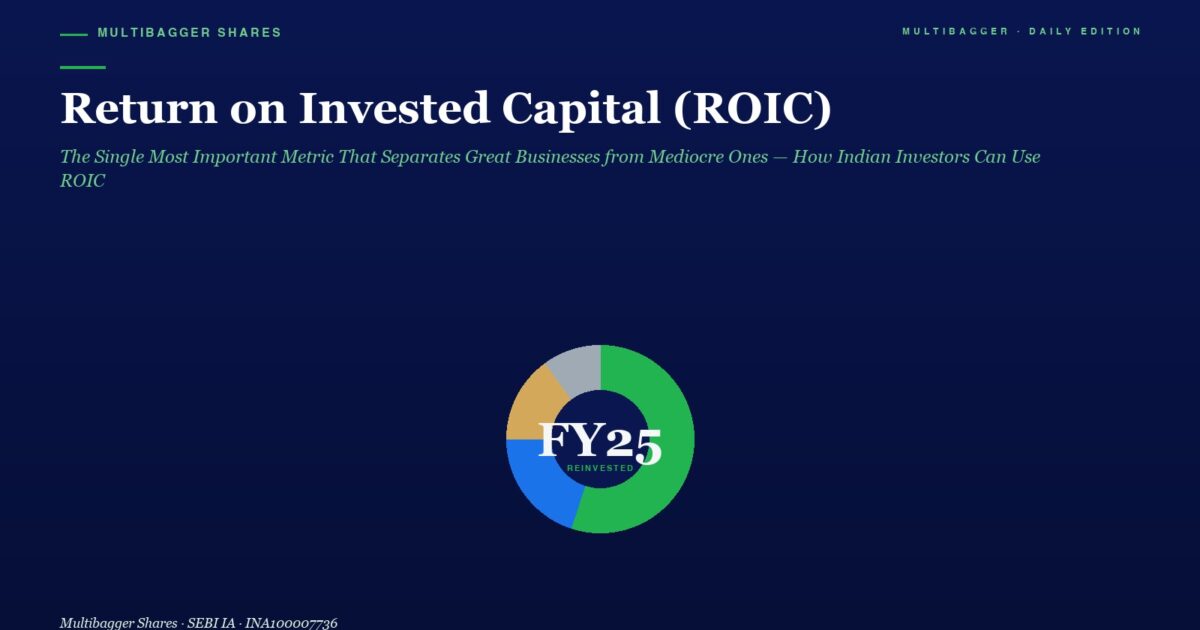
📅 Published: April 2, 2026 | By Manish Goel | Multibagger Securities, SEBI Registered Investment Adviser (INA100007736)
📲 Join 10,000+ Smart Investors on Telegram: @longtermequityy — Daily value investing insights, stock analysis, and multibagger ideas delivered free.
Introduction: Why Most Investors Use the Wrong Metric — And How ROIC Changes Everything
If you could use only one single metric to evaluate whether a business is truly exceptional, what would it be? Most retail investors in India would say P/E ratio. Some might say ROE (Return on Equity). A few would mention earnings growth. But ask Warren Buffett, Charlie Munger, or any of the world’s greatest capital allocators, and the answer is almost always the same: Return on Invested Capital (ROIC).
ROIC is the metric that tells you the fundamental truth about any business — how efficiently does it convert every rupee of capital invested into actual profits? It strips away the noise of accounting gimmicks, leverage tricks, and one-time gains. It reveals the raw economic engine of a company. And most importantly for Indian investors searching for multibaggers, high and sustained ROIC is the single most reliable predictor of long-term wealth creation.
In this comprehensive guide, we will break down exactly what ROIC is, how to calculate it, why it matters more than ROE or ROA, how to use it to identify future multibaggers in the Indian stock market, and why companies like Titan Biotech Ltd that demonstrate strong capital efficiency deserve a place on every serious investor’s watchlist.
What Exactly Is Return on Invested Capital (ROIC)?
Return on Invested Capital measures how much profit a company generates for every rupee of total capital invested in the business — both equity capital from shareholders AND debt capital from lenders. This is what makes ROIC fundamentally different from and superior to ROE.
The formula is elegantly simple:
ROIC = NOPAT ÷ Invested Capital
Where:
NOPAT (Net Operating Profit After Tax) = Operating Profit × (1 – Tax Rate). This represents the true operating earnings of the business after taxes, but before interest payments. By removing the effect of how the company is financed (debt vs equity), NOPAT gives you a pure picture of operational performance.
Invested Capital = Total Equity + Total Debt – Cash & Cash Equivalents. This represents the total capital that has been deployed in the business to generate those profits. Some analysts use the asset-side approach: Net Fixed Assets + Net Working Capital.
Why ROIC Is Superior to ROE — The Critical Distinction Every Indian Investor Must Understand
Most Indian investors rely heavily on ROE (Return on Equity) to judge profitability. This is a dangerous oversimplification. ROE can be artificially inflated through excessive debt — a company can show 25% ROE simply by borrowing heavily, even if its underlying business is mediocre. This is exactly what DuPont Analysis reveals (which we covered in our earlier guide).
ROIC eliminates this distortion completely. Since ROIC uses total invested capital (equity + debt) in the denominator and NOPAT (which ignores interest) in the numerator, it gives you the true economic return the business generates regardless of its capital structure. A company with 20% ROIC is genuinely creating economic value, whether it is debt-free or leveraged.
Consider two Indian companies:
Company A: ROE of 22%, but Debt-to-Equity of 2.5x. When you calculate ROIC, it drops to just 8%. The high ROE was a leverage illusion. This company is actually destroying value because its ROIC is below its cost of capital (typically 10-12% in India).
Company B: ROE of 18%, with Debt-to-Equity of 0.1x. ROIC comes out to 17%. This is a genuinely superior business — generating high returns on ALL capital without relying on borrowed money. This is the kind of company that becomes a multibagger.
The ROIC Threshold: What Numbers Should Indian Investors Look For?
Here is a practical framework for evaluating ROIC in Indian markets:
ROIC above 20%: Exceptional business. This company has a strong economic moat. These are rare and deserve premium valuations. Think of companies like Asian Paints, Pidilite, or Relaxo Footwears during their high-growth phases.
ROIC between 15-20%: High-quality business with competitive advantages. These companies are strong candidates for long-term wealth creation. Many future multibaggers sit in this range before the market recognizes their quality.
ROIC between 10-15%: Average business. Roughly earning its cost of capital. Not destroying value, but not creating significant wealth either. Proceed with caution.
ROIC below 10%: Below cost of capital in most Indian contexts. This company is likely destroying shareholder value over time, even if it looks profitable on the surface. Avoid for long-term investing.
The magic of ROIC is in its consistency over time. A company that maintains ROIC above 15% for 5-10 consecutive years is almost certainly protected by a durable competitive moat — whether that is brand power, switching costs, network effects, or cost advantages.
ROIC and the Reinvestment Moat: The True Engine of Multibagger Returns
Here is where ROIC becomes truly powerful for multibagger hunters. The greatest wealth-creating companies in history share two characteristics: (1) high ROIC, and (2) a large runway to reinvest capital at those same high rates.
This concept, sometimes called the “reinvestment moat”, was articulated beautifully by Buffett: “The ideal business is one that earns very high returns on capital and that keeps using lots of capital at those high returns.”
The compounding formula for long-term returns is approximately: Long-Term Return ≈ ROIC × Reinvestment Rate. A company with 20% ROIC that can reinvest 60% of its earnings back into the business at that same 20% rate will compound intrinsic value at roughly 12% per year — before any valuation re-rating. Add a PE expansion as the market recognizes quality, and you have a multibagger.
This is why small-cap and mid-cap companies with high ROIC and long reinvestment runways are the most fertile hunting ground for multibaggers. They have the triple advantage of high returns, ample room to deploy capital, and an under-recognized quality that the market has not yet priced in.
How to Calculate ROIC Using Indian Financial Statements — Step-by-Step
Let us walk through how you would calculate ROIC using data from Screener.in or annual reports of an Indian company:
Step 1: Calculate NOPAT. Take EBIT (Earnings Before Interest and Tax) from the Profit & Loss statement. Multiply by (1 – Effective Tax Rate). If EBIT is ₹100 crore and tax rate is 25%, then NOPAT = ₹100 × 0.75 = ₹75 crore.
Step 2: Calculate Invested Capital. From the Balance Sheet: Total Shareholders’ Equity + Total Borrowings (both short-term and long-term) – Cash & Cash Equivalents. For example: Equity ₹200 crore + Debt ₹50 crore – Cash ₹20 crore = Invested Capital of ₹230 crore.
Step 3: Compute ROIC. NOPAT ÷ Invested Capital = ₹75 ÷ ₹230 = 32.6%. This is an excellent ROIC indicating a high-quality business with strong competitive advantages.
Pro Tip: Always calculate ROIC for at least 5 years to see the trend. A declining ROIC — even from a high level — is a warning sign that competitive advantages may be eroding. Conversely, a rising ROIC from moderate levels (say 12% to 18% over 5 years) is an incredibly bullish signal that the business is strengthening its moat.
ROIC in Practice: Why Companies Like Titan Biotech Deserve Attention
When evaluating small-cap companies in India, ROIC becomes even more critical. Small companies have less room for error — every rupee of capital must be deployed efficiently. Companies that demonstrate consistently strong returns on invested capital at the small-cap stage, while maintaining low debt, are exhibiting exactly the characteristics that precede multi-year compounding runs.
Titan Biotech Ltd is an instructive example. As a company operating in the high-growth biotech ingredients space with a capital-efficient business model, low debt profile, and a management team with significant skin in the game (high promoter holding), it exemplifies the type of business where ROIC analysis can reveal hidden quality before the broader market catches on. The combination of an expanding addressable market (global biotech ingredients), a lean balance sheet, and strong operational efficiency creates the conditions for sustained high ROIC — exactly what multibagger investors should be looking for.
We encourage every reader to practice calculating ROIC for Titan Biotech using data from Screener.in, and then compare it to industry peers. The exercise itself will teach you more about business quality than any stock tip ever could.
Common ROIC Mistakes Indian Investors Must Avoid
Mistake #1: Ignoring goodwill and intangibles. When a company makes acquisitions, goodwill inflates the invested capital base. If ROIC looks low, check whether heavy goodwill from past acquisitions is dragging it down. Some analysts calculate ROIC excluding goodwill to see the organic business quality.
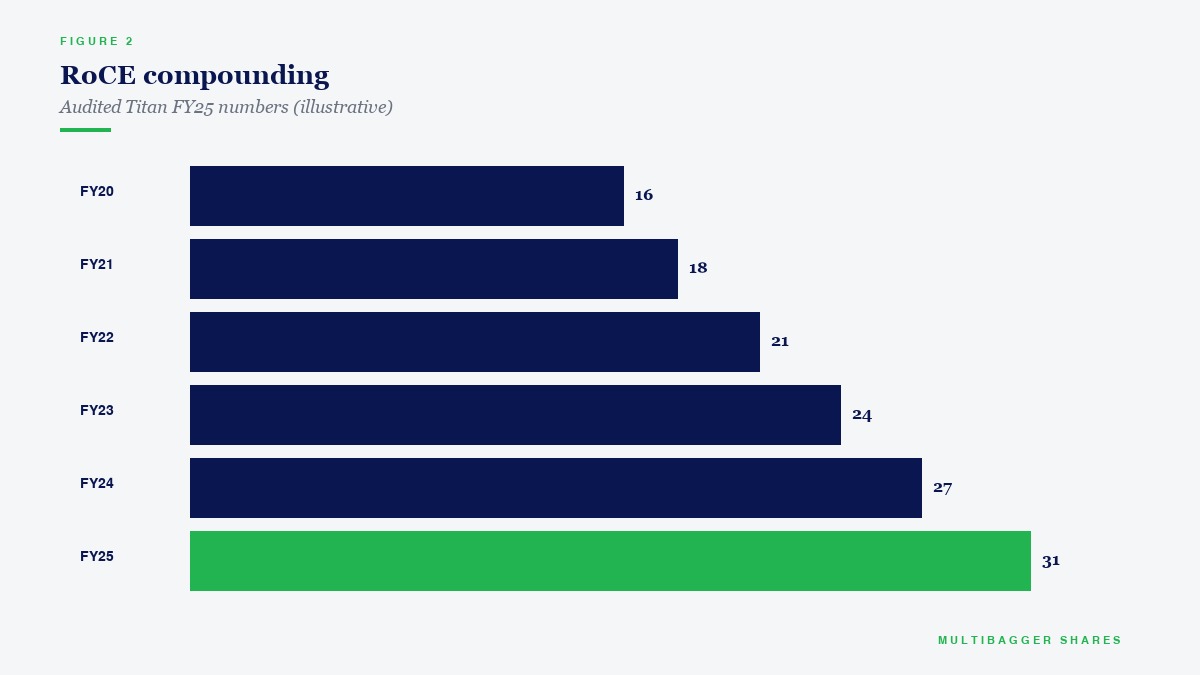
Mistake #2: Using a single year’s ROIC. One exceptional year does not make a great business. Always look at 5-10 year ROIC trends. Consistency is what separates genuine quality from temporary outperformance.
Mistake #3: Comparing ROIC across vastly different industries. Capital-light businesses (IT services, FMCG) naturally have higher ROIC than capital-heavy businesses (steel, cement, power). Compare ROIC within the same industry to identify relative quality.
Mistake #4: Forgetting about the cost of capital. An ROIC of 12% sounds decent, but if the company’s weighted average cost of capital (WACC) is 11%, it is only creating 1% of economic value. The wider the spread between ROIC and WACC, the more value the company creates. Look for companies where ROIC exceeds WACC by at least 5 percentage points.
Mistake #5: Not adjusting for operating leases. Under new Indian accounting standards (Ind AS 116), operating leases are now on the balance sheet. This can inflate invested capital and depress ROIC for companies with large lease obligations (retail, aviation). Adjust accordingly for fair comparisons.
Building a ROIC-Based Stock Screening Strategy for Indian Markets
Here is a practical screening framework that uses ROIC as the cornerstone metric to identify potential multibaggers on Indian exchanges:
Primary Filter: 5-year average ROIC greater than 15%. This ensures you are looking at businesses that have demonstrated sustained capital efficiency, not one-off performers.
Secondary Filter: ROIC trend must be stable or rising. Reject companies where ROIC has declined for 3+ consecutive years, as this suggests competitive erosion.
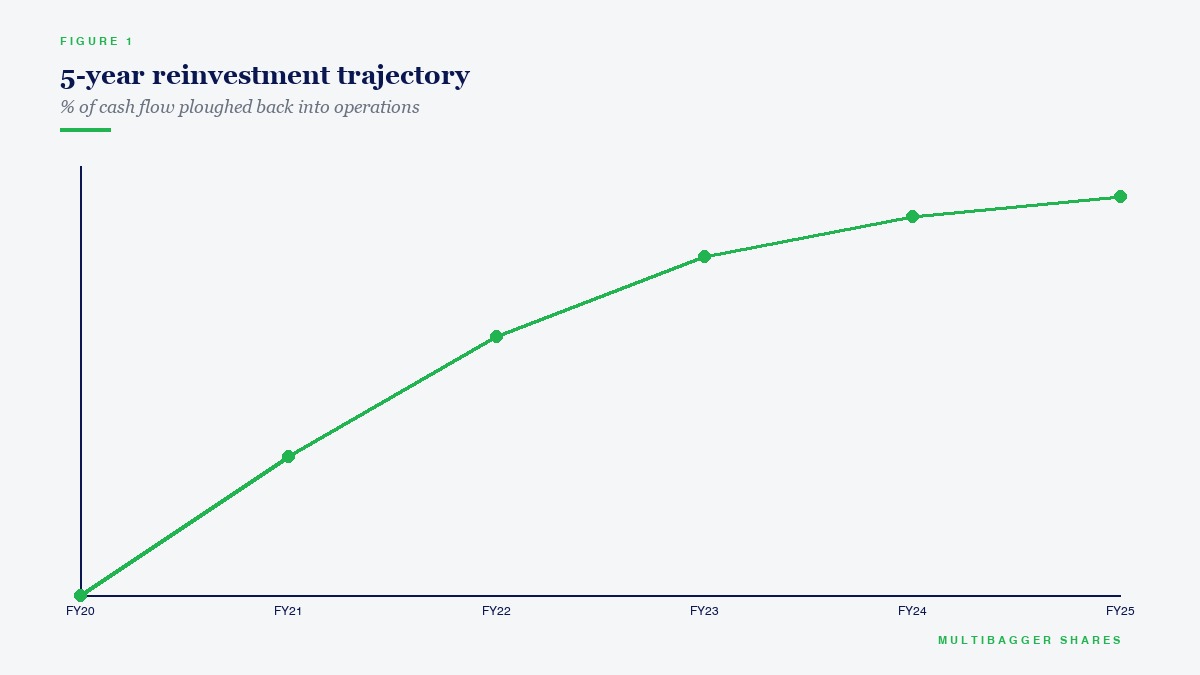
Capital Allocation Check: The company must be reinvesting at least 40% of profits back into the business. A high ROIC company that pays out everything as dividends and does not reinvest cannot compound shareholder value rapidly.
Leverage Guard: Debt-to-Equity below 0.5x. This ensures the ROIC is not being supported by excessive leverage and that the company has financial resilience during downturns.
Valuation Reasonableness: PE ratio below 25x or PEG ratio below 1.5x. Even the best business is a bad investment at the wrong price. ROIC tells you about business quality; valuation tells you about investment opportunity.
Running this screen on BSE/NSE small-cap and mid-cap stocks will consistently surface the kind of under-the-radar compounders that become multibaggers over 5-10 year holding periods.
The Buffett-Munger ROIC Framework: What the Masters Teach Us
Warren Buffett has said repeatedly that he looks for businesses that earn high returns on capital without employing too much leverage. In his 2007 shareholder letter, he wrote: “A truly great business must have an enduring ‘moat’ that protects excellent returns on invested capital.”
Charlie Munger went even further: “Over the long term, it’s hard for a stock to earn a much better return than the business which underlies it earns. If the business earns 6% on capital over 40 years and you hold it for 40 years, you’re not going to make much different than a 6% return. If the business earns 18% on capital over 20 or 30 years, even if you pay an expensive-looking price, you’ll end up with one hell of a result.”
This is perhaps the most important insight in all of investing. Your long-term return from any stock is ultimately bounded by the ROIC of the underlying business. Buy a mediocre ROIC business at a cheap price, and you get mediocre returns. Buy a high ROIC business at a fair price, and you get extraordinary returns over time. This is the fundamental principle behind every multibagger ever created.
Conclusion: Make ROIC Your North Star Metric
If you take away one lesson from this guide, let it be this: Return on Invested Capital is the single most important metric for identifying businesses that can compound wealth over long periods. It is more reliable than ROE (which can be gamed with leverage), more comprehensive than ROA (which ignores the capital structure), and more fundamental than earnings growth (which can come from acquisitions or capital infusion rather than organic quality).
Start today: pick any 5 companies from your watchlist and calculate their 5-year average ROIC. You will be surprised how this single exercise transforms the way you think about stock selection. The companies that pass the ROIC test — especially small-caps and mid-caps with long reinvestment runways — are where India’s next generation of multibaggers will emerge.
📲 Join our Telegram channel for daily value investing insights: @longtermequityy — Free stock analysis, multibagger ideas, and educational content delivered straight to your phone.
Disclaimer: This article is for educational purposes only and does not constitute financial advice. The author may hold positions in stocks mentioned. Always conduct your own research and consult a SEBI-registered financial advisor before making investment decisions. Stock market investments are subject to market risks. Past performance does not guarantee future returns.