
Recency Bias: Why Indian Investors Always Chase Recent Winners and Miss the Biggest Multibaggers — The Market Timing Trap That Destroys Wealth

The Cash Conversion Cycle: The Hidden Metric That Reveals Whether a Company’s Growth Is Real or Just an Illusion — A Complete Guide for Indian Investors
March 27, 2026
Holding Company Discount in India: How Smart Investors Find Hidden Value in Parent Companies — A Complete Guide for Indian Value Investors
March 27, 2026
March 27, 2026
(Friday)
Today, the Sensex has fallen over 1,366 points to 73,906. The Nifty is sitting below 22,924. Rupee has touched a fresh all-time low of ₹94.70 to the dollar. Panic is spreading. Social media is full of predictions that markets will fall “much further.” And right on cue — thousands of Indian retail investors are about to make the exact same mistake they made in 2020, in 2016, and in every correction before that.
They are going to sell. Because right now, markets feel like they will only go down. This feeling has a name. It is called Recency Bias — and it is quietly one of the most wealth-destroying forces in the Indian retail investor’s mind.
What Is Recency Bias?
Recency bias is a cognitive phenomenon where our brains give disproportionate weight to recent events while ignoring long-term historical patterns. In other words — whatever happened last is what feels most “real,” most permanent, and most likely to continue.
When markets have rallied for 6 months, your brain says: “Markets only go up. I should buy more — even overvalued stocks.”
When markets have fallen for 3 months, your brain says: “Markets only go down. I should sell — even quality stocks at bargain prices.”
Neither conclusion is correct. Both are driven by your brain’s hardwired tendency to use the most recent data points as a proxy for the future.
🧠 Definition: Recency Bias — The tendency to think that trends and patterns we have observed in the recent past will continue into the future, while ignoring long-term base rates and historical evidence to the contrary.
The Indian Investor’s Recency Bias Cycle — A Painful Pattern
Here is how this plays out in the Indian stock market — over and over and over again:
Phase 1: Bull Market Euphoria (2023–2024)
NIFTY surged from ~16,800 in 2023 to a peak of ~26,277 in September 2024 — a 56% rally in under two years. What happened? Retail investors, seeing this recent performance, flooded into equity markets. SIP amounts hit all-time highs. IPO subscriptions went through the roof. Demat accounts crossed 17 crore. Everyone was confident. Everyone expected more gains.
That confidence was not based on valuation analysis. It was based on recency bias — “the market has been going up, so it will keep going up.”
Phase 2: Correction Panic (Late 2024–2026)
From its September 2024 highs, NIFTY corrected over 15%. Mid-caps and small-caps fell 25–35% from their peaks. FIIs sold relentlessly. Geopolitical tensions rose. Today, Sensex is at 73,906 — down significantly from those highs.
The same investors who were confidently buying at peak valuations in 2024 are now paralyzed with fear or selling at losses. Why? Recency bias, reversed — “the market has been going down, so it will keep going down.”
Phase 3: The Missing the Recovery (Always happens)
This is the phase that happens after the panic-selling. Markets recover — sometimes violently. The very investors who sold at the bottom miss the biggest up-days. And research shows that missing just the 10 best trading days in a decade can reduce your total returns by 50% or more.
The cycle then repeats. New high. Recency bias kicks in. Overconfident buying. Correction. Recency bias reverses. Panic selling. Recovery missed. Wealth destroyed. SEBI’s own data confirms that 91% of F&O traders lose money — and behavioral biases like recency bias are a primary driver of this destruction.
Recency Bias and the “Performance Chasing” Trap
One of the most dangerous manifestations of recency bias in the Indian market is performance chasing — buying whatever went up the most recently.
Think about the classic examples from Indian market history:
- Infrastructure stocks (2007): Infrastructure was the hottest sector. Everyone bought infra stocks near peak valuations. The 2008 crash wiped out 70–90% of those gains in many infra stocks.
- Telecom stocks (2017): After Jio disrupted the market, telecom stocks like RCOM and TCOM soared briefly. Recency chasers bought. Both eventually went to near-zero.
- PSU stocks (2023–2024): After Railway stocks, Defence PSUs, and Power PSUs tripled or quadrupled, retail investors poured in near peak prices — chasing recent performance. Many are now sitting on 30–40% losses.
- SME IPOs (2024): After seeing certain SME IPOs list at 2x or 3x, retail investors applied blindly to nearly every SME IPO. The majority of those companies had poor fundamentals. Recency bias made recent listing pops feel like a reliable pattern.
In each of these cases, the recent past performance was used as a guide to the future — and investors paid a steep price.
How Recency Bias Steals Your Returns — The Numbers
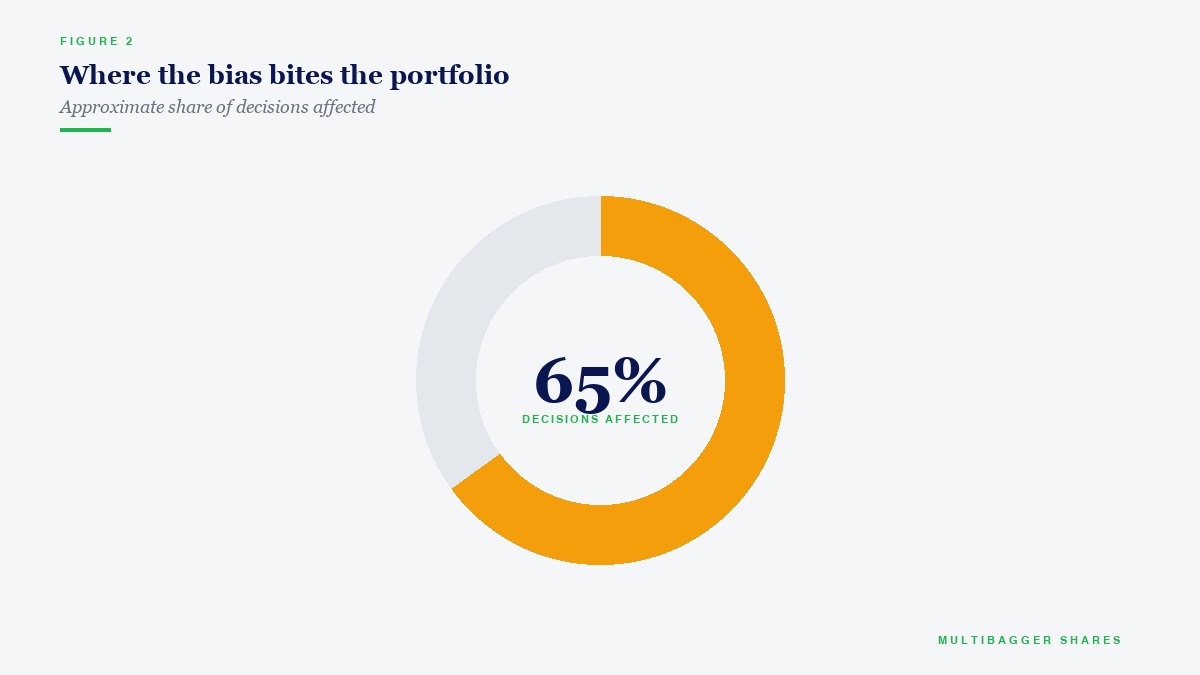
Research in behavioral finance quantifies the damage. Studies estimate that recency bias alone causes approximately a 5% annual drag on investor returns in markets like India. When combined with herd mentality (7% drag) and overconfidence (6% drag), behavioral biases collectively rob investors of 15–20% in returns annually versus what a calm, disciplined value investor would earn.
To put this in perspective: if the market compounds at 12% annually, a behavioral-bias-driven investor might only see 7–9% effective returns — destroying lakhs of rupees in long-term wealth creation.
💡 The Titan Biotech Example: In November 2024, when Manish Goel identified Titan Biotech Ltd. (BSE: 524717) at ~₹55, most investors had recency bias working against the stock. It hadn’t recently shot up. There was no buzz. It was quiet, under-the-radar, fundamentally exceptional. Today, Titan Biotech trades around ₹368–400 — a gain of 200%+ in roughly 15 months. The investors who bought based on fundamentals, not recent hype, built real wealth. The ones chasing PSU hype or SME IPO pops during the same period are nursing losses.
Why Our Brains Are Wired for Recency Bias
Recency bias is not a character flaw — it is a survival instinct. For our prehistoric ancestors, if a predator attacked from the river last week, assuming it would attack again from the river this week was a correct survival strategy. Recent events were often the best predictor of immediate dangers.
But financial markets are not a savanna. In investing, the exact opposite of a survival instinct is often correct. When fear is highest and recent performance is worst — that is often the best time to buy. When optimism is highest and recent performance is best — that is often the worst time to buy.
This is why legendary investors like Warren Buffett say: “Be fearful when others are greedy, and greedy when others are fearful.” He is, in essence, describing the antidote to recency bias.
5 Powerful Ways to Overcome Recency Bias
1. Study Long-Term Market History Before Making Any Decision
NIFTY has corrected 15% or more at least 8 times since 2001 — and has recovered every single time, typically making new all-time highs within 2–3 years. The Indian economy’s long-term growth trajectory has not changed. Before selling in a panic, ask yourself: “What does a 30-year chart tell me?” Not what does this week’s news tell you.
2. Maintain an Investment Journal
Write down why you bought every stock you own. Include the fundamental thesis — earnings growth, ROCE, balance sheet strength, competitive advantage. When markets fall and recency bias screams “sell,” your journal will remind you that your thesis was not based on the last 3 months of price performance. It was based on the next 5–10 years of business fundamentals.
3. Use Systematic SIPs — Never Lump-Sum Chase Performance
Systematic Investment Plans (SIPs) are one of the most powerful recency-bias antidotes available to Indian investors. By investing a fixed amount every month regardless of market levels, you automatically buy more units when prices are low (after a fall) and fewer units when prices are high. Research consistently shows that 30-year SIP returns on NIFTY have outperformed lump-sum investors who tried to time the market.
4. Focus on Business Fundamentals, Not Price Charts
The stock price chart is the most powerful trigger of recency bias — a falling line activates fear; a rising line activates greed. The antidote is to focus instead on the business: Is revenue growing? Are margins expanding? Is the management trustworthy? Is debt low? A business that is fundamentally improving but has a recently falling stock price is often an opportunity, not a danger. Titan Biotech at ₹55 was exactly this scenario.
5. Create Rules and Pre-Commitments
Define your rules before the market moves. For example: “I will never sell a quality stock just because it has fallen more than 20% from my purchase price without a fundamental change in the business.” Or: “I will add to my position in quality stocks if they fall 30%+ and no fundamental change has occurred.” These pre-commitments override real-time recency bias when the emotional pressure is highest.
Recency Bias vs. Value Investing: The Core Conflict
Value investing is, at its core, a systematic assault on recency bias. Every principle of value investing pushes you to do the opposite of what recent price trends tell you to do:
- Buy when stocks have recently fallen (not recently risen)
- Sell or reduce when stocks have recently surged to overvalued levels
- Focus on 10-year fundamentals, not 10-day price action
- Be most cautious when optimism is highest, most opportunistic when fear is highest
This is why value investing is hard. Not because the analysis is impossibly complex — but because it requires you to constantly override deeply hardwired cognitive biases. The market always feels most dangerous when it is actually most attractive, and most safe when it is actually most expensive.
Today, with the Sensex down 1,366 points, the India rupee at ₹94.70, and every news channel predicting doom — recency bias is at its loudest. This is precisely the moment that requires the most discipline, the clearest thinking, and the greatest courage.
The 90-10 Rule for Indian Investors
SEBI’s research tells us that 91% of F&O traders lose money. The derivatives market is the purest expression of recency bias in action — traders constantly extrapolating the last 5 minutes of price action into the next 5 minutes. Every shorted Nifty position on a down day is a direct consequence of recency bias. The money that 91% of F&O traders lose does not disappear — it transfers to the 9% who are disciplined, systematic, and patient.
Long-term equity investors who focus on business fundamentals are on the right side of this wealth transfer. While F&O traders churn through capital chasing recent trends, quality-focused investors like those who identified Titan Biotech early — continue to compound quietly and surely.
📊 Key Data Points (March 27, 2026):
• Sensex: ~73,906 (-1,366 pts, -1.82% today)
• Nifty 50: ~22,924 (-382 pts, -1.64% today)
• Rupee: ₹94.70/USD (all-time low)
• Titan Biotech (BSE: 524717): ~₹368–400 (200%+ gain from ₹55 pick)
• SEBI Data: 91% of F&O traders lose money (FY2024–25)
• Recency bias: estimated 5% annual drag on investor returns
Conclusion: The Investor Who Ignores Recency Wins
The greatest wealth in the Indian stock market has been built by people who did one simple, extraordinarily difficult thing: they made decisions based on fundamentals and long-term business quality — not on whether markets went up or down last week.
Asian Paints was not a popular buy in the 1990s. HDFC Bank was not glamorous in the early 2000s. Titan Company was not trending in 2002. Bajaj Finance was not exciting in 2010. And Titan Biotech was not in the news when it was at ₹55 in 2023.
The investors who built generational wealth bought all of these when they were out of the recent spotlight — and held patiently through every recency-bias-driven panic along the way.
The market is falling today. News is frightening. But India’s economic story — a growing middle class, rising corporate earnings, expanding consumption, and world-class companies like Titan Biotech — has not changed. What has changed is only the recent price action. Do not let that recency drive your decisions.
Master your mind, master recency bias — and let compounding do the rest.
📚 Continue your value investing education: Watch our full Value Investing Course Playlist →
Disclaimer: This article is for educational purposes only and does not constitute financial advice. The author may hold positions in stocks mentioned. Always conduct your own research and consult a SEBI-registered financial advisor before making investment decisions. Stock market investments are subject to market risks. Past performance does not guarantee future returns.