The Gordon Growth Model: How to Calculate the True Intrinsic Value of Dividend-Paying Stocks — A Complete Valuation Guide for Indian Investors

SME IPO Traps: 7 Deadly Red Flags Every Indian Investor Must Know Before Applying — Why 90% of SME IPOs Destroy Wealth and How to Protect Your Capital
March 27, 2026
Episode 5: Warren Buffett’s India Connection — Why He Would Love Indian Small-Caps | Complete Value Investing Course
March 28, 2026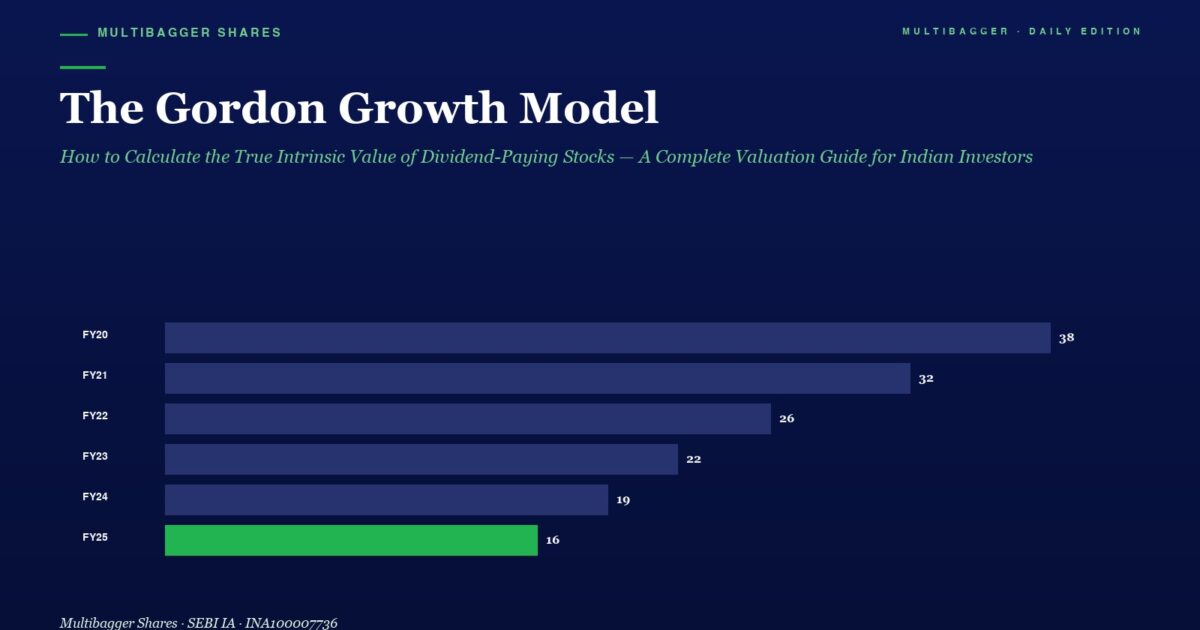
March 27, 2026
(Friday)
What Is the Gordon Growth Model?
In 1956, Professor Myron J. Gordon and economist Eli Shapiro published one of the most elegant equations in all of finance — a formula that could estimate the intrinsic value of any stock that pays a growing dividend. Known today as the Gordon Growth Model (GGM), this deceptively simple equation has been used by professional fund managers, institutional investors, and value investing legends for nearly seven decades.
The formula is beautifully simple:
Where: V₀ = Intrinsic Value | D₁ = Next Year’s Expected Dividend | r = Required Rate of Return | g = Constant Dividend Growth Rate
But don’t let the simplicity fool you. Behind this formula lies a profound truth about stock valuation — the value of any asset is the present value of all future cash flows it will generate for you. For dividend-paying stocks, those cash flows are dividends, growing at a steady rate, stretching into infinity.
Why Indian Investors Need the Gordon Growth Model in 2026
With the Sensex trading near 75,273 and the Nifty 50 at 23,306 as of late March 2026, many Indian investors are struggling to determine whether blue-chip dividend payers are fairly valued, overvalued, or still bargains.
The Gordon Growth Model provides a disciplined, mathematical framework to answer this question — instead of relying on gut feeling or market hype. In an era where SEBI has reported that over 90% of F&O traders lose money, the GGM is a reminder that patient, dividend-focused investing backed by rigorous valuation is the path to sustainable wealth.
Breaking Down the Three Variables
1. D₁ — The Expected Dividend Next Year
This is the dividend per share you expect to receive in the next 12 months. If a company paid ₹10 per share this year and has been growing dividends at 12% annually, then D₁ = ₹10 × 1.12 = ₹11.20.
For Indian stocks, you can find the current dividend per share on Screener.in, Moneycontrol, or directly from the company’s annual report. Always use the most recent full-year dividend, adjusted for any special/interim dividends.
2. r — Required Rate of Return
This represents the minimum annual return you expect for taking the risk of owning this stock instead of a risk-free government bond. Most Indian value investors use a required return between 12% to 15%, depending on the company’s risk profile.
A practical approach: Start with the current 10-year Indian Government Bond yield (around 7.0-7.2% in March 2026), then add an equity risk premium of 5-7% depending on the company’s size, stability, and track record. For large, stable companies like ITC or Coal India, 12% may be appropriate. For smaller, higher-growth companies, 14-15% is more suitable.
3. g — The Dividend Growth Rate
This is the rate at which dividends are expected to grow forever. This is the most sensitive variable and requires the most careful estimation. Look at the company’s historical dividend growth over 5, 10, and 15 years. A company that has grown dividends at 15% per year for a decade has a strong track record.
However, remember that “g” must always be less than “r”. If g ≥ r, the formula breaks down mathematically — the intrinsic value becomes infinite or negative, which makes no practical sense. This is one of the model’s key limitations.
A Real-World Example: Valuing ITC Using the Gordon Growth Model
Let’s apply the GGM to one of India’s most popular dividend stocks — ITC Limited.
Suppose ITC paid a dividend of ₹15.50 per share in FY2025, and historically has grown dividends at approximately 10% per year. Our required return for a stable, large-cap company is 13%.
Step 2: V₀ = ₹17.05 / (0.13 − 0.10) = ₹17.05 / 0.03 = ₹568.33
Interpretation: If ITC can sustain 10% dividend growth and you require a 13% return, the stock’s intrinsic value is approximately ₹568. If the current market price is below this, the stock may be undervalued. If above, it may be overvalued.
Notice how sensitive the formula is: if we change the growth rate from 10% to 11%, the value jumps to ₹17.05 / (0.13 − 0.11) = ₹852.50 — a massive increase from just a 1% change in growth assumptions! This sensitivity is both the model’s power and its danger.
When Does the Gordon Growth Model Work Best?
The GGM is most reliable for companies that exhibit these characteristics: mature businesses with long operating histories, consistent and growing dividend payments over many years, stable and predictable earnings growth, strong cash flow generation that supports dividends, and low debt levels that ensure dividend sustainability.
In the Indian context, think of companies like Coal India, Power Grid Corporation, ITC, Hindustan Zinc, NMDC, and Infosys — all consistent dividend payers with track records spanning decades.
The Five Limitations Every Indian Investor Must Know
Limitation 1: The “Constant Growth” Assumption. No company grows at exactly the same rate forever. The Indian economy itself goes through cycles. Companies may grow dividends at 20% during boom years and 5% during slowdowns. The GGM assumes this rate never changes, which is unrealistic for most companies.
Limitation 2: Extreme Sensitivity to Inputs. As we saw in the ITC example, changing growth from 10% to 11% nearly doubled the intrinsic value. Small estimation errors lead to wildly different valuations. Always run sensitivity analysis with multiple scenarios.
Limitation 3: Doesn’t Work for Non-Dividend Stocks. Many of India’s fastest-growing companies — from IT firms reinvesting aggressively to pharma companies building R&D pipelines — pay little or no dividends. For these companies, you need alternative valuation methods like DCF or earnings-based models.
Limitation 4: Ignores Special Situations. Demergers, buybacks, bonus issues, rights offerings — the Indian market is full of corporate actions that affect shareholder returns but aren’t captured by a simple dividend growth model.
Limitation 5: Growth Rate Must Be Below Required Return. If a company’s dividend growth rate exceeds your required return, the formula produces nonsensical results. This is a mathematical constraint that limits the model’s applicability to high-growth companies.
The Two-Stage Gordon Growth Model: A More Realistic Approach
To overcome the constant growth limitation, professional analysts use a Two-Stage GGM. In the first stage (typically 5-10 years), you project dividends growing at a higher, unsustainable rate. In the second stage, you assume the company matures and grows at a lower, sustainable “terminal” rate.
For example, a fast-growing Indian FMCG company might grow dividends at 18% for the next 7 years, then settle into a 9% terminal growth rate. You calculate the present value of each stage separately and add them together. This gives a far more realistic intrinsic value than the single-stage model.
How Titan Biotech Ltd Fits Into the Dividend Story
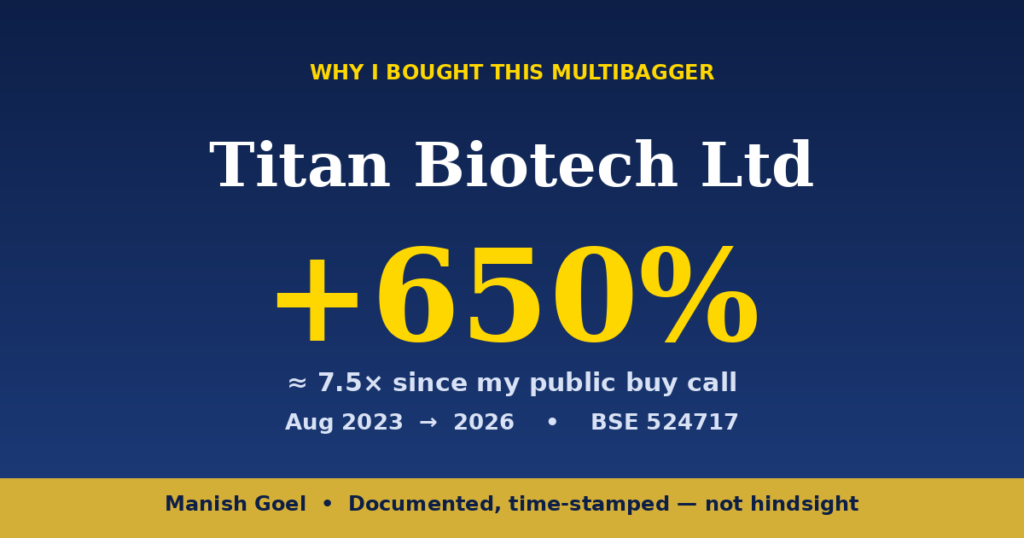
Consider Titan Biotech Ltd (BSE: 524717), currently trading around ₹368.55 with a market cap of approximately ₹1,230 crore. This debt-free company has delivered extraordinary returns — up over 326% in just one year.
While Titan Biotech is still in a high-growth phase and may not have the long dividend history needed for a pure GGM application, the principles behind the model still apply. As the company matures and generates increasing free cash flow, its ability to initiate and grow dividends will become a key value driver. Smart investors are positioning themselves now in quality companies like Titan Biotech, knowing that today’s growth companies become tomorrow’s dividend champions.
The lesson from the Gordon Growth Model is clear: the value of any stock ultimately depends on the cash it returns to shareholders over time. Companies with strong fundamentals, zero debt, and growing earnings — like Titan Biotech — are building the foundation for decades of shareholder wealth creation.
Practical Tips for Applying the GGM to Indian Stocks
Tip 1: Use Conservative Growth Estimates. When in doubt, use a lower growth rate. It’s better to underestimate and find bargains than to overestimate and overpay. Use the lowest of the 5-year, 10-year, and 15-year historical dividend growth rates.
Tip 2: Always Run Sensitivity Tables. Create a table with different combinations of growth rates (g) and required returns (r). This gives you a range of intrinsic values instead of a single point estimate, which is far more useful for decision-making.
Tip 3: Compare With Other Valuation Methods. Never rely on a single model. Cross-check your GGM valuation with P/E ratio analysis, DCF models, and Price-to-Book ratios. When multiple methods point to undervaluation, your conviction should be highest.
Tip 4: Focus on Dividend Sustainability. A high dividend today means nothing if the company can’t sustain it. Check the payout ratio (dividends as a percentage of earnings). A payout ratio below 60% generally indicates sustainable dividends with room for growth.
Tip 5: Watch for Dividend Traps. Some Indian companies offer extremely high dividend yields (8-10%) because their stock price has collapsed due to deteriorating fundamentals. A high yield with declining earnings is a trap, not an opportunity. The GGM assumes growth — if growth turns negative, the model breaks.
Building Your Dividend Valuation Toolkit
The Gordon Growth Model is one tool in your valuation toolkit, not the only tool. Use it alongside DCF analysis, relative valuation (P/E, EV/EBITDA), and qualitative analysis of management quality and competitive advantages. The best investors combine multiple approaches to triangulate the true value of a stock.
As you continue your value investing education, remember that models are maps, not the territory. They simplify reality to help us make better decisions, but they can never capture every nuance of a business. The GGM teaches us to think about intrinsic value in terms of cash flows, growth, and risk — and that discipline alone makes you a better investor than 90% of the market participants who are gambling on price movements.
Key Takeaways
The Gordon Growth Model (V₀ = D₁ / (r − g)) is a powerful tool for valuing mature, dividend-paying stocks. Its strength lies in its simplicity and its foundation in present value theory. However, it requires careful input estimation and works best for stable, established companies. Indian investors can use it to evaluate blue-chip dividend stocks, run sensitivity analysis, and build conviction in their valuations. Combined with other methods and applied with conservative assumptions, the GGM can be a valuable weapon in your long-term wealth creation arsenal.
Stop gambling in F&O — SEBI data confirms over 90% of traders lose money. Start building real wealth through disciplined value investing and dividend analysis.
Want to learn value investing from scratch? Watch our complete free course: Value Investing Course Playlist
Disclaimer: This article is for educational purposes only. The author, Manish Goel, is an investor in Titan Biotech Ltd. This is not SEBI-registered investment advice. Please consult a qualified financial advisor before making investment decisions. Stock market investments are subject to market risk. Past performance is not indicative of future results.
📢 Join Our Telegram Channel
Get daily value investing lessons, stock analysis & Titan Biotech updates — delivered straight to your phone!
✈️ Join @longtermequityy on Telegram
🔔 Free • No spam • Value investing insights daily