The Dunning-Kruger Effect in Investing: Why Beginners Think They Are Stock Market Experts and How It Destroys Wealth

Iran War Impact on Indian Stock Market 2026: Why Smart Value Investors Are Buying While Others Panic — Complete Guide for Indian Investors
March 28, 2026
Pledged Shares: The Hidden Time Bomb in Indian Stocks — Why Promoter Pledging Destroys Shareholder Wealth and How to Protect Your Portfolio
March 28, 2026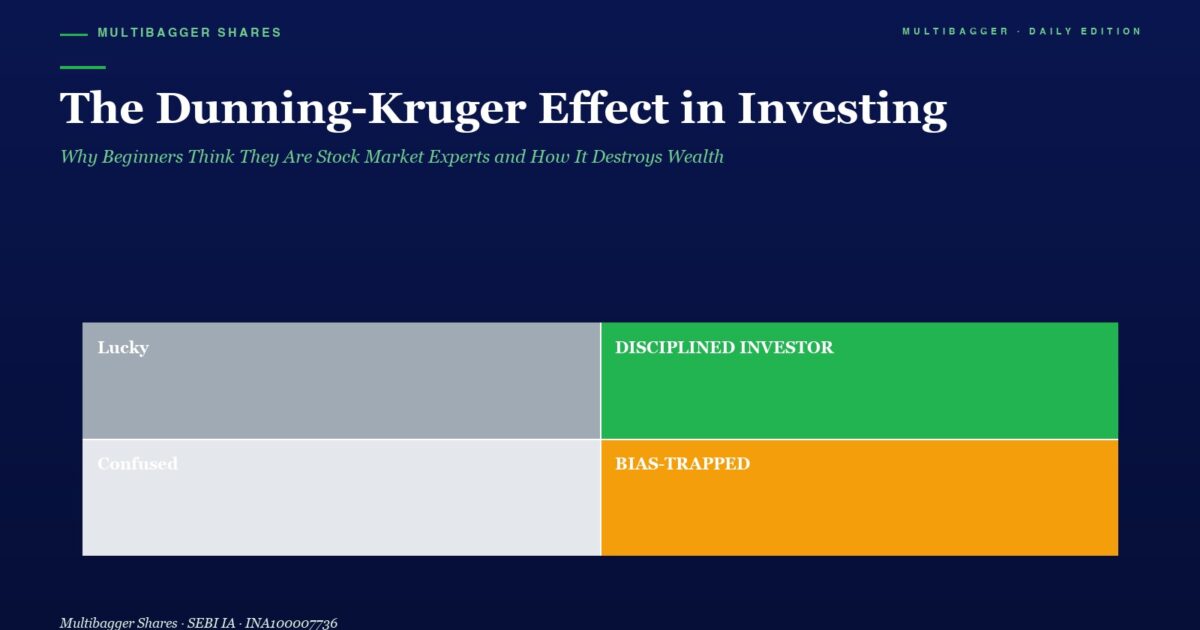
March 28, 2026
(Saturday)
Introduction: The Most Dangerous Investor Is the One Who Doesn’t Know What They Don’t Know
In 1999, two Cornell University psychologists — David Dunning and Justin Kruger — published a groundbreaking paper that would forever change how we understand human cognition. Their research revealed a startling paradox: people with the least knowledge in a subject tend to overestimate their abilities the most, while genuine experts tend to underestimate theirs.
This cognitive bias, now known as the Dunning-Kruger Effect, is arguably the single most destructive psychological trap in the Indian stock market today. With the Sensex at 73,583 and the Nifty at 22,819 (as of March 27, 2026), millions of new Indian investors are entering the market — many of them armed with a few YouTube videos, a Zerodha account, and the dangerous belief that they have already mastered the art of stock picking.
Today’s lesson is one that could save you lakhs of rupees — or even your entire financial future.
Understanding the Dunning-Kruger Curve: The Four Stages of Investor Competence
The Dunning-Kruger Effect follows a distinctive pattern that every investor passes through — or gets permanently stuck in. Understanding these four stages is essential:
Stage 1: “Mount Stupid” — Peak of Overconfidence (The Beginner)
This is where a new investor reads two blog posts about P/E ratios, makes one lucky trade that doubles their money, and suddenly believes they have cracked the code of the stock market. They start giving stock tips to friends and family. They dismiss Warren Buffett’s methods as “too slow.” They believe they can consistently beat the market. SEBI’s own data shows that over 90% of individual F&O traders lose money — and the overwhelming majority of them are stuck at this stage, not realizing what they don’t know.
Stage 2: “Valley of Despair” — The Crash of Reality (The Humbled Investor)
After suffering significant losses — often 30% to 50% of their capital — the overconfident beginner finally realizes how little they actually understand. This is actually the most important stage, because it creates the motivation to genuinely learn. Many investors, unfortunately, quit the market entirely at this point, concluding that “the stock market is gambling” rather than admitting that their approach was flawed.
Stage 3: “Slope of Enlightenment” — The Serious Student
The investor who survives the Valley of Despair begins to study fundamental analysis, reads books by Benjamin Graham, Peter Lynch, and Warren Buffett, learns about financial statements, and develops a disciplined investment process. Their confidence grows again — but this time, it’s backed by genuine knowledge and experience.
Stage 4: “Plateau of Sustainability” — The Mature Investor
After years of study and practice, the investor reaches a level of competence where they understand both what they know and what they don’t know. They are humble, disciplined, and focused on long-term wealth creation. They know that consistent 15-20% annual returns over decades is far more valuable than trying to double money every month.
Five Deadly Signs You Are Stuck on “Mount Stupid”
Here are five warning signs that the Dunning-Kruger Effect is actively destroying your investment returns. Be brutally honest with yourself:
Sign #1: You Think You Can Time the Market
If you believe you know exactly when to buy and when to sell — when the Sensex will crash and when it will rally — you are almost certainly suffering from the Dunning-Kruger Effect. Even the greatest investors in history admit they cannot time the market. Warren Buffett has repeatedly said: “I have no idea what the market will do tomorrow, next week, or next year.” If Buffett can’t time the market, neither can you. The recent 1,700-point Sensex crash on March 27, 2026 caught even professional fund managers off guard.
Sign #2: You Trade F&O Because You Think It’s “Easy Money”
Futures and Options trading is the single largest wealth destroyer for Indian retail investors. SEBI’s landmark 2024 study revealed that over 93% of individual F&O traders incurred losses, with the average loss being ₹2 lakh per person per year. Yet millions of young Indians continue to pour money into F&O because they watched a few trading strategy videos and believe they belong to the 7% who profit. This is the Dunning-Kruger Effect in its most dangerous form — the less you understand about derivatives pricing, Greeks, and volatility, the easier it looks.
Sign #3: You Dismiss Fundamental Analysis as “Boring”
If you think analyzing balance sheets, income statements, cash flow patterns, and business models is unnecessary — if you prefer to make investment decisions based on charts, tips, or social media buzz — you are operating with a dangerous blind spot. The greatest wealth creators in Indian market history (Infosys, HDFC Bank, Asian Paints, Titan Company) were all identified through rigorous fundamental analysis, not through technical patterns or Telegram tips.
Sign #4: You Can’t Explain WHY a Stock Will Go Up (Beyond “It’s Going Up”)
Ask yourself this question about every stock in your portfolio: Can you explain, in clear language, what the company does, why its business model is sustainable, what competitive advantages protect it, and why its current price represents good value? If your answer is “someone recommended it” or “the chart looks bullish” or “it’s been going up” — you are investing on faith, not knowledge.
Sign #5: You’ve Never Read a Single Annual Report
This is perhaps the most telling indicator. Annual reports are the single most important source of information about any publicly listed company. They contain the management’s own commentary on business performance, detailed financial statements, risk factors, and future outlook. If you own stocks but have never read even one annual report, you are essentially driving blindfolded on a highway.
Real-World Case Study: How the Dunning-Kruger Effect Plays Out in India
Consider a real scenario that plays out thousands of times every day in India. Rahul, a 25-year-old software engineer, opens a trading account in 2024. He watches a few YouTube videos about “making ₹1 lakh per day from trading.” He starts with ₹2 lakh and makes ₹15,000 in his first week through intraday trading. His confidence soars. He believes he has a “gift” for the market.
He increases his capital to ₹5 lakh. He starts trading F&O for bigger leverage. For a month, he makes money — not because of skill, but because the market is in a broad uptrend and almost everyone is making money. He doesn’t understand the difference between a bull market lifting all boats and his own analytical ability.
Then the correction comes. The market drops 15% in three weeks. Rahul’s leveraged F&O positions amplify his losses. In 45 days, he loses ₹4.2 lakh — 84% of his capital. He is devastated, not just financially but psychologically. He never imagined this was possible because he never studied risk management, position sizing, or the mathematics of leverage.
This is the Dunning-Kruger Effect in action. Rahul’s initial success — which was pure luck in a rising market — convinced him he was an expert. His lack of knowledge prevented him from recognizing how much he didn’t know.
The Antidote: How Value Investing Cures the Dunning-Kruger Effect
The greatest antidote to the Dunning-Kruger Effect is value investing — the disciplined approach of buying high-quality businesses at reasonable prices and holding them for the long term. Here’s why:
Value investing demands intellectual humility. You must admit that you don’t know what the market will do tomorrow. Instead, you focus on what you CAN know: the quality of a business, its financial health, its competitive position, and its long-term prospects.
Value investing requires deep study. You can’t practice value investing by watching 5-minute videos. You need to read annual reports, understand financial ratios, analyze industry dynamics, and develop genuine expertise. This process naturally moves you from “Mount Stupid” to the “Slope of Enlightenment.”
Value investing rewards patience over cleverness. The value investor doesn’t try to outsmart the market every day. They identify great businesses, buy them at fair prices, and let compounding do the heavy lifting over years and decades.
Consider Titan Biotech (BSE: 524717), currently trading at approximately ₹369. This Delhi-based company, specializing in biological peptones, microbiological culture media, and agar products, is an example of what happens when you do deep fundamental research rather than following the crowd. While millions of investors were busy day-trading and losing money in F&O, patient value investors who studied Titan Biotech’s business fundamentals, its strong market position in a niche segment, and its consistent growth — they identified it when it was trading at much lower levels. With a 326% gain over the past year, it demonstrates the power of fundamental research over overconfident speculation.
Seven Practical Steps to Overcome the Dunning-Kruger Effect
Step 1: Start with the assumption that you know less than you think. This single mindset shift can save you more money than any stock tip ever will. Approach every investment with humility and curiosity.
Step 2: Read at least 5 classic investing books before investing a single rupee. Start with “The Intelligent Investor” by Benjamin Graham, “One Up on Wall Street” by Peter Lynch, “The Little Book That Beats the Market” by Joel Greenblatt, “Common Stocks and Uncommon Profits” by Philip Fisher, and “The Dhandho Investor” by Mohnish Pabrai.
Step 3: Maintain a decision journal. Before every investment, write down WHY you are buying, what you expect to happen, and what could go wrong. Review these notes every quarter. You will be shocked at how often your reasoning was flawed — and this awareness is the first step toward genuine competence.
Step 4: Study your losses more carefully than your wins. Every loss contains a valuable lesson. But the Dunning-Kruger Effect makes us attribute losses to “bad luck” and wins to “skill.” Reverse this default. Assume your wins might be luck and your losses might be skill deficiency.
Step 5: Never invest in a business you can’t explain to a 10-year-old. If you can’t describe what the company does, who its customers are, and why they keep coming back — you don’t understand the business well enough to invest in it.
Step 6: Completely avoid F&O trading. SEBI’s data is crystal clear: 93% of individual F&O traders lose money. These are not just beginners — this includes experienced traders. F&O is a negative-sum game after brokerage, taxes, and slippage. Quality stock investing in fundamentally strong companies is the proven path to wealth creation.
Step 7: Build a free education habit. Visit our free value investing video course at Value Investing with Manish Goel on YouTube. Consistent learning is the only cure for the blind spots that the Dunning-Kruger Effect creates.
The Wisdom of Knowing What You Don’t Know
Charlie Munger, Warren Buffett’s legendary partner, once said: “Knowing what you don’t know is more useful than being brilliant.” This single sentence captures the antidote to the Dunning-Kruger Effect perfectly.
The Indian stock market — with the Sensex having corrected significantly from its highs — is at a moment where this lesson is especially important. In volatile times like these, with geopolitical tensions driving oil to $107/barrel and markets swinging hundreds of points daily, the overconfident beginner makes impulsive decisions. The wise investor stays patient, stays humble, and stays focused on business quality.
Remember: the goal is not to be the smartest person in the room. The goal is to be the most disciplined, the most patient, and the most honest about what you know and what you don’t know. That is the foundation of lasting wealth creation in the Indian stock market.
Disclaimer: This article is for educational purposes only and does not constitute financial advice. The author may hold positions in stocks mentioned. Always conduct your own research and consult a SEBI-registered financial advisor before making investment decisions. Stock market investments are subject to market risks. Past performance does not guarantee future returns.
📢 Join Our Telegram Channel
Get daily value investing lessons, stock analysis — delivered straight to your phone!
✈️ Join @longtermequityy on Telegram
🔔 Free • No spam • Value investing insights daily