Loss Aversion: Why the Pain of a Market Crash Feels 2X Worse Than the Joy of a Rally — And How to Rewire Your Investment Brain for Multibagger Returns

Return on Assets (ROA): The Underrated Efficiency Metric That Reveals Whether Indian Companies Are Truly Creating Wealth — A Complete Guide for Smart Investors
March 29, 2026
Working Capital Management: The Hidden Operational Metric That Reveals True Business Quality — How Smart Indian Investors Use This to Find Multibaggers Before the Crowd
March 29, 2026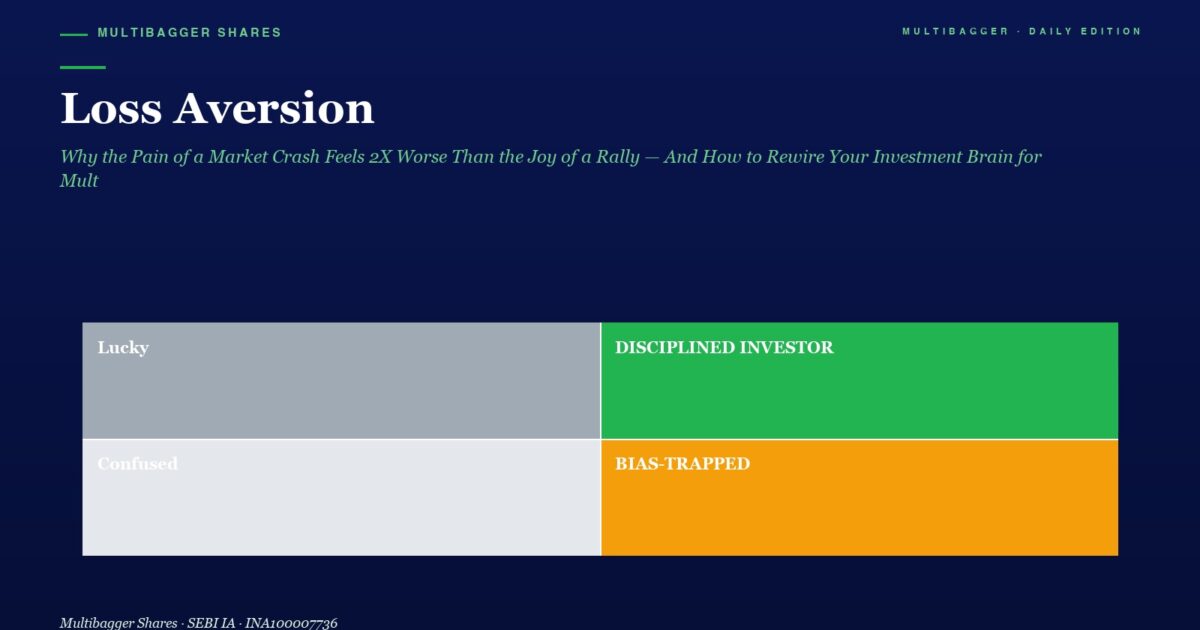
March 29, 2026
(Sunday)
Introduction: The 1,715-Point Shock — Why You Felt So Bad
On Friday, March 27, 2026, the BSE SENSEX crashed 1,715 points — closing at 73,558. Goldman Sachs slashed India’s GDP forecast to 5.9%. Iran tensions rattled global markets. Your portfolio turned red.
And here is the question I want you to ask yourself: How did that feel?
Now think back to the last time the SENSEX rallied 1,700 points in a single day. Markets surged on peace hopes, your stocks were all green, and Titan Biotech Ltd (BSE: 524717) was flying high — up over 326% in the last year alone, from a 52-week low of ₹74.73 to a high of ₹400.
Here is the uncomfortable truth that Nobel Prize-winning psychologists Daniel Kahneman and Amos Tversky discovered: The pain of losing ₹10,000 hurts EXACTLY TWICE as much as the joy of gaining ₹10,000 feels good.
This asymmetry has a name: Loss Aversion. And it is the single most powerful behavioral force destroying Indian investor wealth today — not bad stock picks, not high valuations, not even F&O gambling (though SEBI’s own data shows 90% of F&O traders lose money). It is the irrational, hard-wired fear of loss that makes intelligent people make terrible investment decisions.
Today, in this Prime Time lesson, I am going to teach you everything about loss aversion: what it is, why our brains are wired this way, how it specifically destroys Indian investor wealth in the stock market, and — most importantly — how to overcome it to become a true value investor who builds multibagger wealth.
What Is Loss Aversion? The Science of Pain
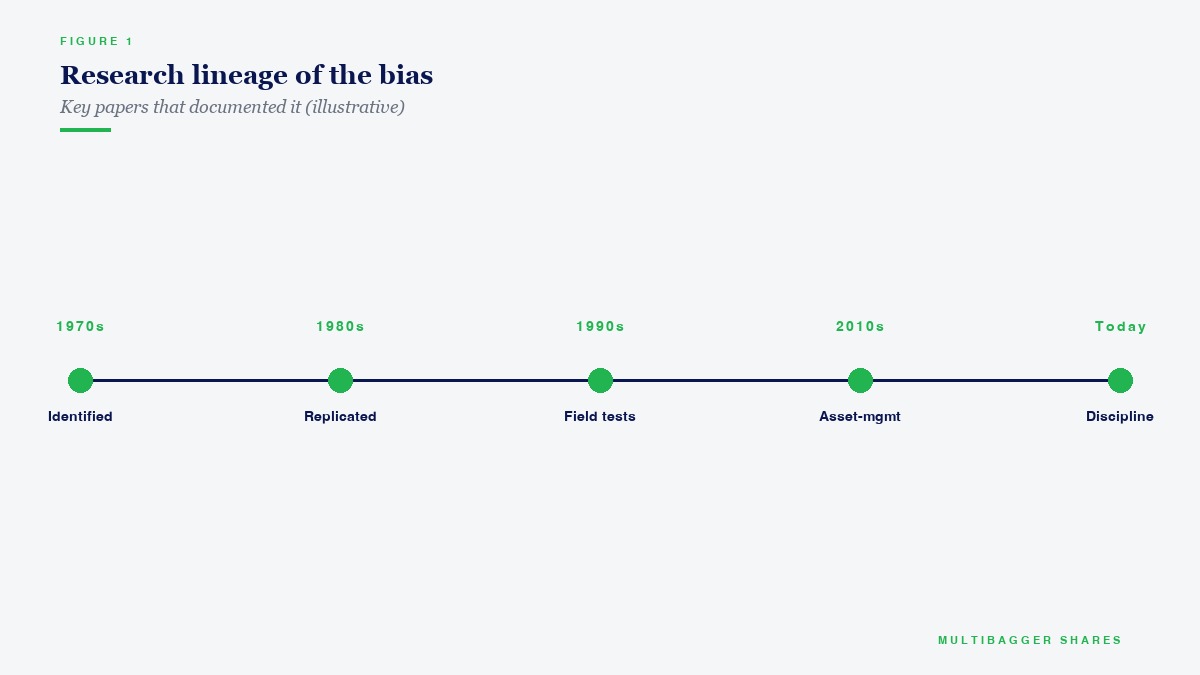
In 1979, Kahneman and Tversky published their landmark paper on Prospect Theory — work that would eventually win Kahneman the Nobel Prize in Economics in 2002. Their central finding was revolutionary:
“Losses loom larger than gains. The psychological impact of a loss is approximately twice as powerful as the impact of an equivalent gain.”
In simple terms: if you gain ₹10,000, you feel a certain level of happiness. But if you lose ₹10,000, you feel approximately twice as much pain as that happiness was pleasurable. The asymmetry is not small or marginal — it is 2:1.
This is not logic. This is not rational. This is biology. Our brains evolved on the African savanna where avoiding threats (predators, starvation) was far more important than pursuing rewards. The brain circuits that process loss are wired deeper, older, and more powerful than those that process gain.
Now transplant those same circuits into a modern investor sitting at a computer watching SENSEX crash 1,715 points — and you have a recipe for financial disaster.
The 5 Ways Loss Aversion Destroys Indian Investor Wealth
1. Selling Quality Stocks During Panic Falls
This is the most common and costly manifestation of loss aversion in Indian markets. When the SENSEX falls sharply — as it did on Friday — loss-averse investors experience physical pain. The brain’s amygdala (our primitive fear center) activates, cortisol floods the system, and the overwhelming urge is to make the pain stop by selling.
But here is what intelligent value investing tells us: a falling price on a fundamentally strong company is an opportunity, not a threat.
Consider Titan Biotech Ltd (BSE: 524717). This company manufactures biological peptones, extracts, and dehydrated culture media — critical inputs for India’s booming biopharma sector. Over the past year, Titan Biotech delivered 326% returns — from ₹74.73 to a high of ₹400. Every single investor who sold during a dip because of loss aversion missed this life-changing wealth creation.
Loss aversion tells you: “Sell now — stop the pain.” Value investing wisdom says: “Hold quality. The price is temporary. The business is permanent.”
2. The Paralysis of New Investment
Loss aversion does not just make investors sell — it also prevents them from buying in the first place. When markets are falling, loss-averse investors freeze. They have cash. They know stocks are cheaper. But the fear of buying and seeing prices fall further is so overwhelming that they do nothing.
This is called the “wait for the bottom” trap. Nobody rings a bell at the market bottom. The investors who bought when the SENSEX was at 70,000 during the Iran panic of early 2026 are now sitting on healthy gains. Those who waited for the “perfect entry” are still waiting — and the opportunity cost is massive.
3. Never Averaging Down on Quality
One of Warren Buffett’s most famous principles: “Be greedy when others are fearful.” This means buying MORE of a quality company when its price falls — because you are getting the same business at a better price.
But loss aversion makes this psychologically impossible for most investors. When a stock they own falls 20%, every instinct screams “danger!” — not “opportunity!” Adding more capital to a falling position triggers the same brain circuits as putting your hand back in fire after being burned.
Yet this is precisely what smart value investors do. Companies like HDFC Bank, Asian Paints, and Titan Biotech have all gone through significant corrections during their multi-decade wealth creation journeys. Each correction was a chance to average down. Loss aversion stopped most investors from capitalizing on these moments.
4. Breaking Out of Long-Term SIP Discipline
Systematic Investment Plans (SIPs) are one of the most powerful wealth creation tools available to Indian investors. The mathematics is clear: regular investment across market cycles harnesses rupee cost averaging, buying more units when prices are low and fewer when prices are high.
But loss aversion routinely causes investors to stop SIPs precisely at the worst possible moment — when markets have fallen 20-30% and valuations are most attractive. The pain of watching NAVs fall overcomes the intellectual understanding that falling prices mean more units at lower cost.
SEBI research consistently shows that most SIP investors who stop during corrections do so near market bottoms — and then resume when markets have recovered significantly, defeating the entire purpose of rupee cost averaging.
5. The F&O Trap: When Loss Aversion Escalates to Gambling
Here is perhaps the most insidious consequence of loss aversion: it pushes investors from long-term wealth creation into short-term speculation and ultimately F&O gambling.
The psychological sequence goes like this: An investor buys a quality stock. It falls 10%. The pain of loss aversion is so intense that instead of waiting (which requires tolerating ongoing pain), they try to “recover” the loss quickly through F&O trading. SEBI’s own data is devastating — 90% of F&O traders lose money. The average F&O trader loses ₹50,000+ per year. The attempt to escape the pain of loss through speculation creates catastrophically larger losses.
This is why building genuine wealth through quality stock investing — understanding that losses are temporary in good businesses — is not just financially superior. It is psychologically essential.
Prospect Theory in Practice: The Real Math of Loss Aversion
Let us make this concrete with a simple example relevant to Indian investors today.
Scenario A: You receive ₹5,000 unconditionally. Done.
Scenario B: You flip a fair coin. Heads: you receive ₹10,000. Tails: you receive nothing.
Both scenarios have the same expected value: ₹5,000. Yet most people choose Scenario A. Why? Because the fear of getting nothing (a “loss” relative to the potential gain) outweighs the logic of equal expected value.
Now apply this to the stock market: You own a quality stock. You are up 25% — ₹2,50,000 gain on a ₹10,00,000 investment. Loss aversion says: “Book the profit now. Lock in the gain.” But what if this is an Infosys in 1995, an HDFC Bank in 2000, or a Titan Biotech at the start of its growth journey? Selling to avoid the pain of a potential reversal costs you tenfold returns over the long term.
Value investing wisdom: Do not let the fear of losing a gain prevent you from making a much larger gain.
The Working Capital-Loss Aversion Connection: A Metric Investors Miss
Interestingly, loss aversion affects not just when investors buy or sell — it affects which metrics they focus on. Loss-averse investors obsess over share price movements (visible, immediate, painful) and ignore fundamental business metrics that actually predict long-term value creation.
Take Working Capital efficiency. A company that efficiently manages its working capital — collecting receivables quickly, managing inventory tightly, paying suppliers on reasonable terms — generates superior cash flows. This is a leading indicator of business quality that shows up in share prices later.
Titan Biotech, for example, operates in a sector (biological culture media for pharma companies) where working capital discipline is critical. The company’s ability to maintain strong receivables days while growing revenues demonstrates genuine operational excellence — the kind of quality that creates sustained, multi-year wealth.
But loss-averse investors, focused on daily price movements, completely miss this. They see a red day and panic. They miss the business fundamentals that make the company worth holding through every correction.
How to Overcome Loss Aversion: 7 Practical Techniques for Indian Investors
1. Reframe: You Are Buying Businesses, Not Renting Prices
The single most powerful mental reframe is this: You do not own a stock. You own a piece of a business. When the price of Titan Biotech falls on a red market day, the company’s laboratories are still running, the scientists are still working, the pharmaceutical clients are still ordering biological peptones, and the business is still generating cash.
Price fluctuations are the stock market’s voting machine. Business fundamentals are the weighing machine. Long-term wealth is created by the weighing machine.
2. Pre-Commit Your Investment Rules in Writing
Before you invest in any stock, write down: At what fundamental deterioration will I sell? Not: “At what price will I panic?” At what business deterioration? This forces you to focus on business quality rather than price movements, and gives you a rational framework that overrides emotional responses during crashes.
3. Do Not Check Your Portfolio Every Day
Research shows that the more frequently investors check their portfolios, the more likely they are to see losses (because markets are volatile short-term) and the more loss aversion triggers irrational decisions. Check your portfolio quarterly — aligned with quarterly earnings results — not daily.
4. Keep a Long-Term Returns Diary
Write down where your portfolio was one year ago. Compare to today. Seeing long-term returns in black and white overrides the short-term pain of current drawdowns. If you had invested in Titan Biotech’s 52-week low of ₹74.73, your investment would have grown to near ₹368 today — a 393% return — despite every volatility event along the way.
5. Use Automation to Override Emotions
Set up automatic SIPs for quality companies or quality mutual funds. When the investment is automatic, your emotional brain does not get a chance to interfere. You buy more units precisely when prices are lower — the mathematically correct action that loss aversion prevents manual investors from taking.
6. Study Market History
Every major market correction in Indian history — the 2008 global financial crisis, the 2016 demonetization shock, the 2020 COVID crash, the 2022 FII selloff, the 2025-26 Iran tensions — has been followed by strong recoveries. Understanding this historically gives your rational brain ammunition to fight your emotional brain during the next correction.
7. Choose Quality Stocks and Hold
Loss aversion is least damaging when you invest in genuinely high-quality businesses. If you own a company with excellent fundamentals, strong management, growing revenues, and a genuine competitive advantage, the probability that any given price fall represents permanent capital loss is low. Quality reduces the legitimacy of loss aversion signals.
The Titan Biotech Lesson: Rewarding Those Who Overcame Fear
Titan Biotech Ltd (BSE: 524717) is currently trading around ₹368 per share, against a 52-week low of ₹74.73. The company has delivered exceptional returns to investors who held through every volatile day, every market crash, every Iran-related news panic.
How many investors bought Titan Biotech near its 52-week lows and then sold at the first 15-20% gain because loss aversion made them fear giving back profits? How many never bought at all because the market was falling and “it might fall more”? This is the invisible, uncalculated cost of loss aversion — the wealth not created by investors who let fear override their analysis.
The investors who studied the business — its role in India’s booming biopharma sector, its manufacturing capabilities, its growing client base among pharmaceutical companies needing high-quality biological culture media — understood that quality businesses create wealth over time. They held. They were rewarded.
This is not about predicting the price. This is about understanding the business and refusing to let irrational loss aversion override rational business analysis.
Loss Aversion vs. Legitimate Risk Management
An important caveat: not all fear of loss is irrational loss aversion. Legitimate risk management — avoiding permanently loss-inducing situations — is intelligent investing, not emotional weakness.
The distinction is critical:
- Loss Aversion (bad): Selling a quality business at a temporary price low because the paper loss is psychologically painful.
- Risk Management (good): Avoiding companies with deteriorating fundamentals, high promoter pledging, weak working capital metrics, or poor corporate governance — because these represent risks of permanent capital loss.
The value investor’s job is to distinguish between temporary price volatility (which should be ignored or used as a buying opportunity) and genuine business deterioration (which is a legitimate signal to exit). Loss aversion conflates these two very different situations — treating a temporary price drop exactly like a genuine business problem. This conflation is where the wealth destruction happens.
Key Takeaways: Rewiring Your Investment Brain
Let me summarize the most important lessons from today’s deep dive:
- Loss aversion is biological, not rational — our brains feel losses 2X more intensely than equivalent gains. Acknowledge this wiring without being controlled by it.
- Price falls on quality businesses are opportunities, not threats — the SENSEX falling 1,715 points did not change Titan Biotech’s laboratories or pharmaceutical client relationships.
- The invisible cost of loss aversion is wealth not created — the Titan Biotech shareholders who sold at ₹100, ₹150, or ₹200 because they feared further losses missed 200-400% returns.
- F&O gambling is loss aversion on steroids — the attempt to quickly recover losses through derivatives is the most reliable path to catastrophic financial ruin. SEBI confirms: 90% of F&O traders lose money.
- Build quality stock SIPs and review quarterly, not daily — this single discipline eliminates most of the damage done by loss aversion in individual investor portfolios.
- Study businesses, not prices — when you deeply understand the company you own, temporary price fluctuations generate business questions (“Has something changed?”) rather than emotional responses (“I need to sell!”).
Disclaimer: This article is for educational purposes only and does not constitute financial advice. The author may hold positions in stocks mentioned. Always conduct your own research and consult a SEBI-registered financial advisor before making investment decisions. Stock market investments are subject to market risks. Past performance does not guarantee future returns.
📢 Join Our Telegram Channel
Get daily value investing lessons, stock analysis — delivered straight to your phone!
✈️ Join @longtermequityy on Telegram
🔔 Free • No spam • Value investing insights daily