Joel Greenblatt’s Magic Formula: The Simple Two-Factor System That Returned 23.8% Annually for 20 Years — And How Indian Investors Can Use It to Find Hidden Multibaggers

Vijay Kedia’s SMILE Framework: The Indian Investing Legend’s Proven System for Turning Small-Cap Hidden Gems Into Multibaggers — A Complete Guide for Smart Indian Investors
March 30, 2026
Manish Goel’s Bucket Hole Theory: Why Even One Deficiency in a Stock Can Destroy Your Entire Investment
March 30, 2026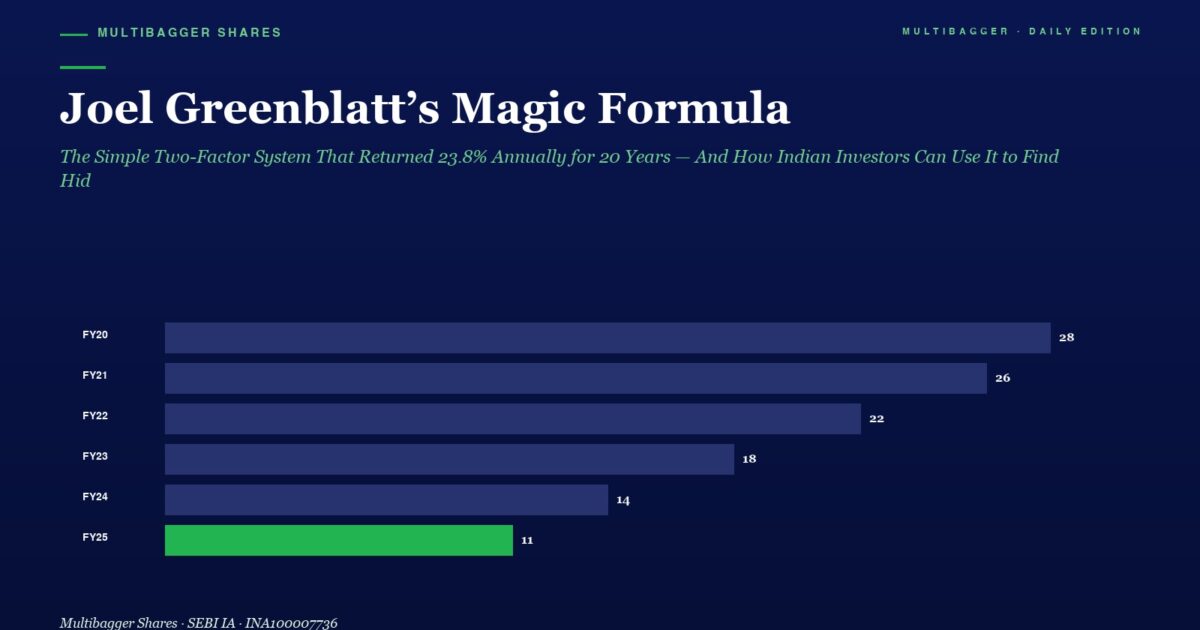
March 30, 2026
(Monday)
What If Stock Picking Could Be Reduced to a Simple Formula?
Imagine a world where you don’t need to spend hundreds of hours reading annual reports, decoding management commentary, or tracking quarterly earnings to find great stocks. Imagine a system so simple that a 12-year-old could follow it — yet so powerful that it beat the market by nearly 15% per year for two decades.
That’s exactly what Joel Greenblatt, a legendary hedge fund manager who earned a 40% annualized return at Gotham Capital from 1985 to 2005, set out to create. The result was his “Magic Formula” — a two-factor stock selection strategy that he introduced in his 2005 bestseller The Little Book That Beats the Market.
Today, on a day when the Sensex has closed at 71,947 (down 1,636 points or 2.22%) and Nifty at 22,331 (down 488 points or 2.14%) amid US-Iran war fears, many Indian investors are panicking. But this is precisely the kind of market environment where systematic, formula-driven investing shines brightest — because formulas don’t feel fear.
Let’s dive deep into how this formula works, why it’s brilliant, and how YOU can apply it to the Indian stock market to find quality businesses at bargain prices.
Who Is Joel Greenblatt?
Joel Greenblatt is not some armchair theorist. He’s a practitioner who put real money behind his ideas — and earned extraordinary returns. As the founder and managing partner of Gotham Capital, Greenblatt achieved an annualized return of approximately 40% from 1985 to 2005. He’s also a professor at Columbia Business School, where he has taught value investing to the next generation of fund managers.
His investment philosophy is deeply rooted in the principles of Benjamin Graham and Warren Buffett: buy good businesses at cheap prices. But Greenblatt took this timeless principle and turned it into a quantifiable, repeatable system that any investor — regardless of experience — could follow.
The Magic Formula: Two Simple Metrics That Change Everything
The Magic Formula ranks stocks based on just two factors:
Factor 1: Earnings Yield (Cheapness)
Earnings Yield = EBIT / Enterprise Value
This tells you how cheap a stock is relative to its earnings power. A higher earnings yield means you’re paying less for each rupee of operating profit. Think of it as the inverse of the P/E ratio, but better — because it accounts for debt levels through Enterprise Value (market cap + debt – cash), making it far more accurate than a simple P/E comparison.
For example, Company A might have a P/E of 15 with zero debt, while Company B also has a P/E of 15 but carries ₹500 crore in debt. Traditional P/E treats them equally. Earnings Yield reveals that Company B is actually more expensive because you’re effectively paying for both the equity AND the debt.
Factor 2: Return on Capital (Quality)
Return on Capital = EBIT / (Net Working Capital + Net Fixed Assets)
This measures how efficiently a company uses its capital to generate profits. A company that earns ₹30 crore from ₹100 crore of invested capital (30% ROC) is far superior to one that needs ₹300 crore to earn the same ₹30 crore (10% ROC). The first company has a genuine competitive advantage — it generates more profit per rupee of capital deployed.
Greenblatt deliberately uses EBIT (Earnings Before Interest and Taxes) rather than net income to eliminate distortions from different tax structures and capital structures across companies.
How the Magic Formula Actually Works — Step by Step
Step 1: Rank all stocks in your investment universe by Earnings Yield (highest yield = Rank 1).
Step 2: Rank all stocks by Return on Capital (highest ROC = Rank 1).
Step 3: Add both ranks together. The stock with the lowest combined rank is your top pick.
Step 4: Buy the top 20-30 stocks from this combined ranking.
Step 5: Hold for one year, then rebalance by repeating the process.
That’s it. No subjective judgment. No emotional decision-making. No guru predictions on CNBC. Just pure, systematic stock selection based on two fundamental truths: good companies (high ROC) bought at cheap prices (high earnings yield) tend to outperform the market over time.
The Stunning Track Record
The numbers speak for themselves:
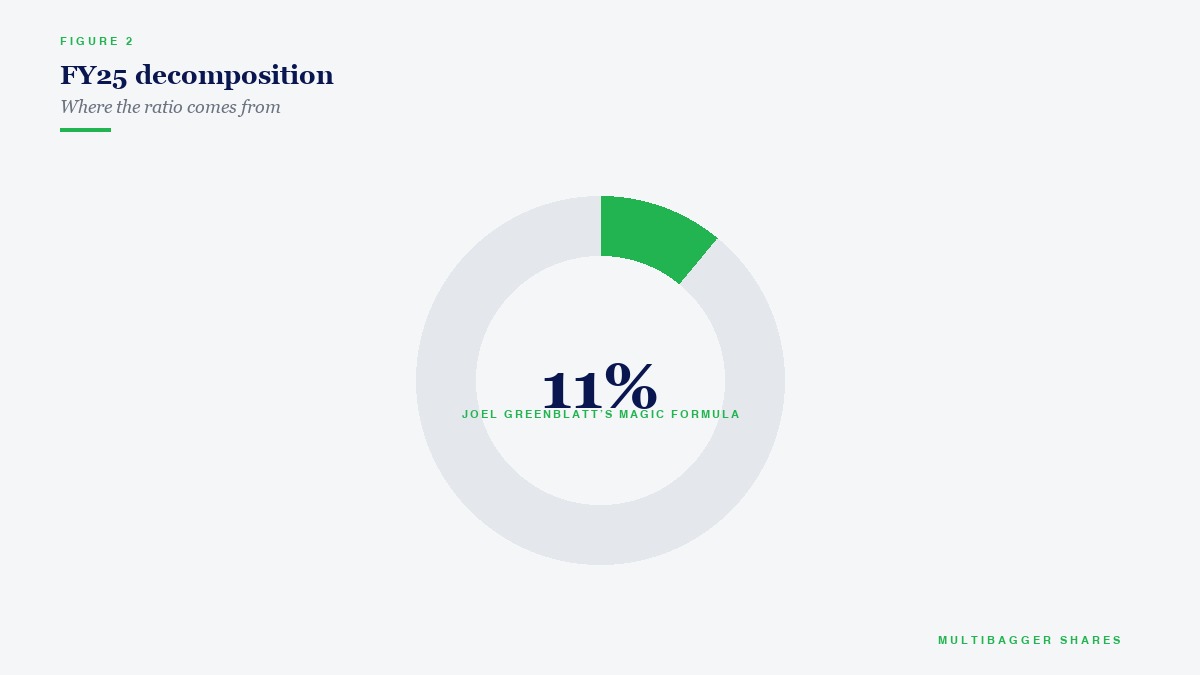
From 1988 to 2009, backtesting of the Magic Formula on US stocks produced a compound annual growth rate (CAGR) of 23.8%, compared to just 9.6% for the S&P 500. That means ₹10 lakh invested using the Magic Formula would have grown to over ₹6.8 crore, while the same amount in the S&P 500 would have reached only about ₹65 lakh.
From 2003 to 2015, the formula delivered an annualized return of 11.4% versus the S&P 500’s 8.7%. Even in a more efficient, information-rich modern market, the formula continued to add significant alpha.
More recently, from 2017 to early 2026, portfolios of 20-30 top-ranked Magic Formula stocks delivered 4-6% higher annual returns than the S&P 500 with superior risk-adjusted returns (Sharpe ratios).
Why Does the Magic Formula Work?
The beauty of the Magic Formula lies in its combination of two timeless investment principles:
1. Mean Reversion: Cheap stocks tend to become less cheap over time. When a good business is temporarily out of favour — perhaps due to a bad quarter, an industry downturn, or general market panic (like today’s Iran-war-driven selloff) — its earnings yield is high. As the market eventually recognizes the business quality, the stock price recovers.
2. Quality Persistence: Companies with high returns on capital often maintain that advantage for years because it reflects genuine competitive moats — strong brands, network effects, switching costs, or proprietary technology. These are the kinds of businesses that compound wealth over time.
By combining cheapness WITH quality, the Magic Formula avoids two classic traps that catch Indian retail investors: buying expensive “momentum” stocks that crash (quality without cheapness), and buying “cheap” junk companies that stay cheap forever (cheapness without quality).
Applying the Magic Formula to Indian Stocks
The principles of the Magic Formula translate beautifully to the Indian market. Here’s how you can apply it:
Define your universe: Start with BSE 500 or NSE 500 stocks. Exclude financial companies (banks, NBFCs, insurance) because their capital structures make EBIT-based metrics unreliable. Also exclude utilities and foreign companies listed in India.
Calculate Earnings Yield: Use Screener.in or Trendlyne to find EBIT and Enterprise Value for each company. Earnings Yield = EBIT ÷ Enterprise Value. Rank from highest to lowest.
Calculate Return on Capital: Use EBIT ÷ (Total Assets – Current Liabilities – Excess Cash). This approximates the tangible capital employed. Rank from highest to lowest.
Combine rankings: Add both ranks. Sort by combined rank (lowest = best).
Build your portfolio: Buy the top 20-25 stocks. Hold for 12 months. Rebalance annually.
In Indian markets, where mid-cap and small-cap stocks are less efficiently priced than large-caps, the Magic Formula can be even more powerful than in the US. Institutional coverage is thinner, information asymmetry is greater, and behavioural biases run stronger — all of which create opportunities for a systematic formula to exploit.
A Real-World Indian Example: Titan Biotech (BSE: 524717)
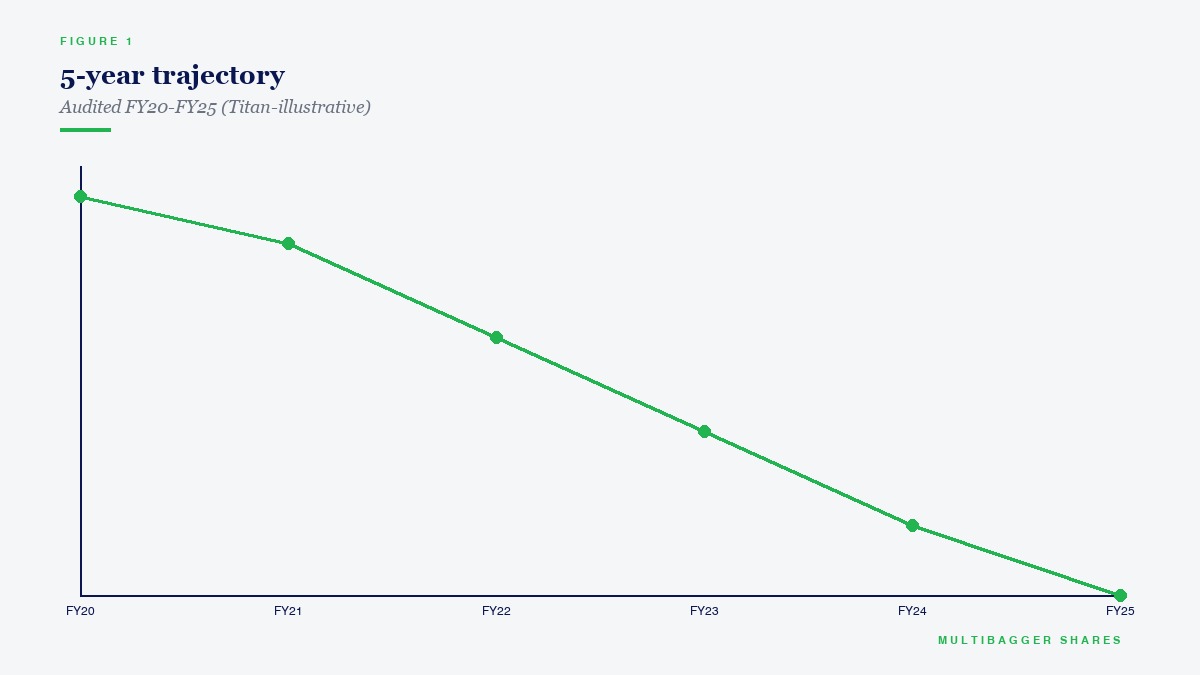
Consider Titan Biotech Ltd, currently trading at ₹458 with a market cap of ₹1,891 crore. The company sports a ROCE of 16.9% and ROE of 15.0% — indicating efficient capital allocation and genuine value creation for shareholders.
What makes Titan Biotech particularly interesting through the Magic Formula lens is its combination of reasonable returns on capital with a growing business in the biotechnology and life sciences space. The company manufactures biological products, culture media, and diagnostic reagents — a niche with limited competition and rising demand.
With a book value of ₹40.3 per share and strong quarterly profit growth (net profit jumped 94.31% year-over-year in Q3 FY26), Titan Biotech exemplifies the kind of quality business that systematic investors should have on their radar. Its 52-week range of ₹74.7 to ₹458 tells you the enormous wealth creation that happens when quality businesses are bought at the right time.
This is quality investing at work — the same philosophy that underpins the Magic Formula.
The Magic Formula vs. F&O Gambling: A Reality Check
While the Magic Formula requires patience and discipline, many Indian investors today are drawn to Futures & Options (F&O) trading, hoping for quick riches. The reality is devastating: SEBI’s own study confirms that over 90% of individual F&O traders lose money, with the average loss running into lakhs.
Think about this contrast:
The Magic Formula, followed systematically over 20 years, turned ₹10 lakh into ₹6.8 crore with a 23.8% CAGR. Meanwhile, 9 out of 10 F&O traders are losing their hard-earned capital month after month, enriching only their brokers.
Value investing — whether through the Magic Formula or through careful fundamental analysis — is the proven path to long-term wealth creation. F&O gambling is the proven path to financial destruction.
Important Caveats and Limitations
No system is perfect, and intellectual honesty demands we discuss the limitations:
Short-term underperformance is common. The Magic Formula can underperform the market for 1-2 years at a stretch. During the 2008-2009 crisis, many formula-selected stocks fell harder than the index before recovering strongly. Investors who abandoned the system during drawdowns missed the subsequent outperformance.
It doesn’t work for financials. Banks, NBFCs, and insurance companies have fundamentally different business models where EBIT and tangible capital employed are not meaningful measures. You need sector-specific metrics for these.
High turnover means tax implications. Annual rebalancing in India triggers Short-Term Capital Gains (STCG) tax of 20% on gains within one year. Some investors modify the formula to hold for 13-14 months to qualify for the lower Long-Term Capital Gains (LTCG) tax rate.
Accounting quality matters. In India, some companies manipulate their reported EBIT through aggressive revenue recognition, related party transactions, or capitalizing expenses. Always cross-check with cash flow statements. If operating cash flow consistently trails EBIT, the reported earnings may not be real.
How to Enhance the Magic Formula for India
Based on research and experience, here are practical enhancements for Indian investors:
Add a cash flow filter: Only invest in companies where Operating Cash Flow is at least 70% of EBIT for the trailing 3 years. This eliminates accounting manipulators.
Add a promoter filter: Require promoter holding above 40% with no pledging. This ensures skin in the game and reduces corporate governance risk.
Exclude micro-caps: Set a minimum market cap of ₹500 crore to ensure adequate liquidity and reduce the risk of price manipulation.
Consider 15-month holding periods: Hold for slightly over a year to benefit from LTCG tax rates instead of STCG, significantly improving after-tax returns.
The Bigger Lesson: Systems Beat Emotions
On a day like today, when markets are crashing and fear is everywhere, the Magic Formula’s greatest gift isn’t its specific metrics — it’s the discipline of a system. When you follow a rule-based approach, you don’t panic-sell at the bottom. You don’t chase hot stocks at the top. You don’t let CNBC anchors or WhatsApp forwards dictate your investment decisions.
Joel Greenblatt himself has said: “The formula works. The problem is that people don’t follow it.” In his experience, investors who were given Magic Formula stocks to buy on their own often deviated from the system — skipping stocks that “felt” risky and adding ones that “felt” safe — and ended up underperforming the formula by 25% per year.
The lesson is clear: the biggest edge in investing isn’t a better formula. It’s the discipline to follow your formula.
Start Your Value Investing Journey Today
If the Magic Formula has sparked your interest in systematic value investing, I encourage you to deepen your knowledge with our Complete Value Investing Course: Watch the full course on YouTube.
Remember: the market will have days like today — sharp selloffs, scary headlines, and widespread panic. But investors who follow systematic, research-backed strategies like the Magic Formula don’t just survive these days. They thrive on them, because falling prices mean higher earnings yields and better opportunities.
Stay disciplined. Stay invested. Let the formula do the work.
— Manish Goel, Founder, MultibaggerShares.com
Disclaimer: This article is for educational purposes only and does not constitute financial advice. The author may hold positions in stocks mentioned. Always conduct your own research and consult a SEBI-registered financial advisor before making investment decisions. Stock market investments are subject to market risks. Past performance does not guarantee future returns.
📢 Join Our Telegram Channel
Get daily value investing lessons, stock analysis — delivered straight to your phone!
✈️ Join @longtermequityy on Telegram
🔔 Free • No spam • Value investing insights daily