The Endowment Effect: Why Indian Investors Overvalue Stocks They Already Own — And How This Hidden Bias Is Silently Destroying Your Portfolio Returns

Howard Marks’ Market Cycles: How to Read the Temperature of the Market and Know When to Be Aggressive or Defensive — A Complete Guide for Indian Investors
March 30, 2026
OPPORTUNITY ALERT: Rs 50.82 Lakh Crore Wiped Out in March — Why This Is When Multibaggers Are Born
March 31, 2026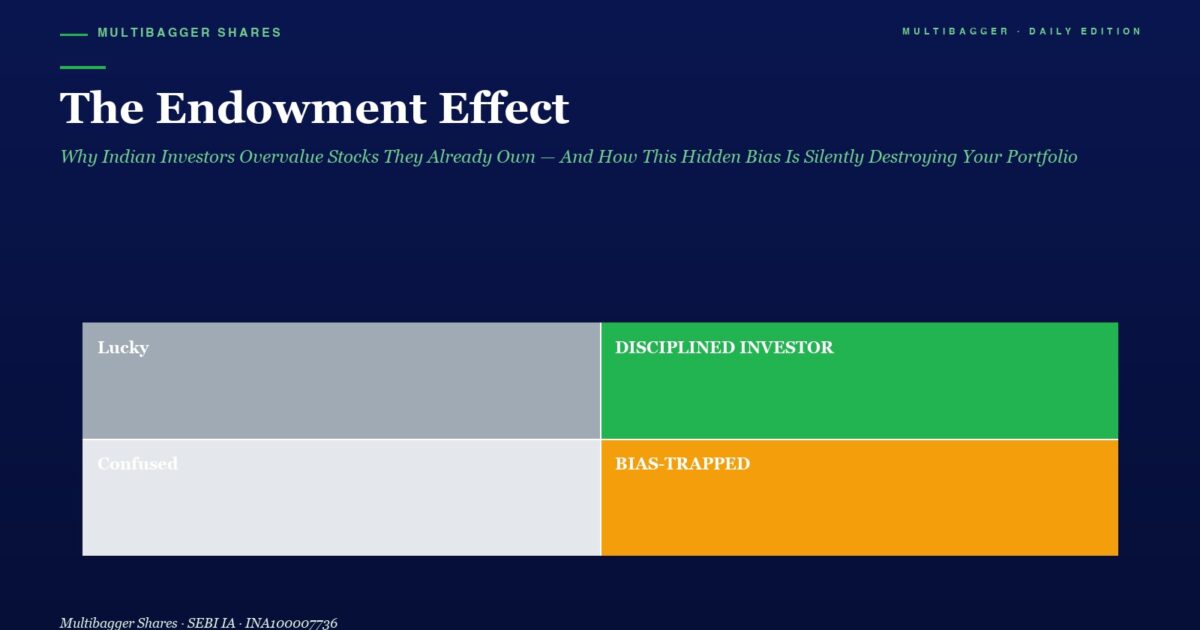
March 31, 2026
(Tuesday)
The Most Dangerous Bias You’ve Never Heard Of
Imagine this scenario. You bought shares of a mid-cap Indian company two years ago at ₹150. Today, the stock trades at ₹120. A friend shows you another company in the same sector — better margins, stronger management, higher ROCE — also trading at ₹120. Would you sell your stock and buy the better one?
If you’re like 90% of investors, you won’t. Not because the numbers don’t make sense. But because of a powerful psychological force called the Endowment Effect — the irrational tendency to overvalue things simply because you own them.
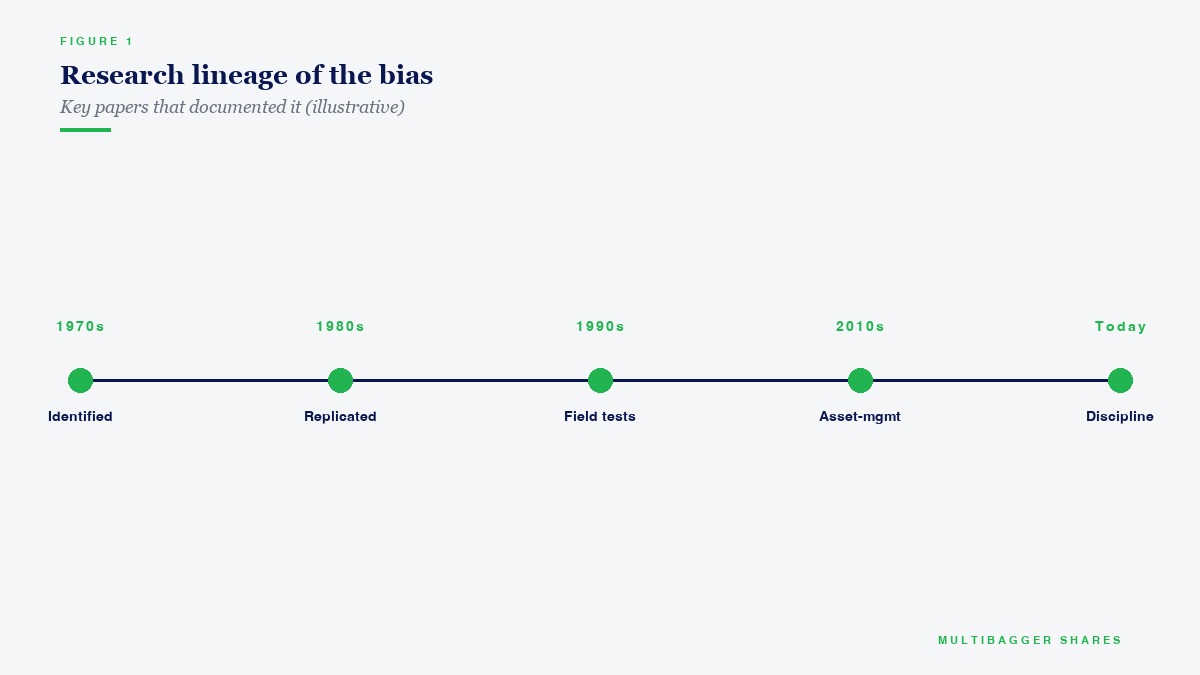
Nobel Prize-winning economist Richard Thaler first documented this bias in 1980, and decades of research at institutions like Wharton have confirmed that it silently destroys billions of rupees in investor wealth every year. Today, with the Sensex at 71,948 and the Nifty 50 at 22,331 (as of March 30, 2026 — markets are closed today for Mahavir Jayanti), and with the US-Iran conflict driving unprecedented volatility, understanding this bias is more critical than ever.
What Exactly Is the Endowment Effect?
The endowment effect is a cognitive bias where people assign a higher value to objects they own compared to identical objects they don’t own — simply because they own them.
In a classic 1990 experiment by Kahneman, Knetsch, and Thaler at Cornell University, students were randomly given coffee mugs. Those who received mugs demanded roughly twice as much to sell them as non-owners were willing to pay. The mugs were identical. The only difference was ownership.
In investing, this manifests in three devastating ways:
1. Holding losers too long: You refuse to sell a stock trading below your purchase price because selling would mean “confirming” the loss. You tell yourself, “It will come back.” Meanwhile, your capital remains trapped in an underperformer.
2. Overvaluing your portfolio: When asked what their portfolio is worth, investors consistently estimate values 20-30% higher than the actual market price. They anchor to purchase prices, peak prices, or “what it should be worth” rather than what the market actually says.
3. Refusing better alternatives: Even when presented with objectively superior investments, endowment-affected investors stick with what they have. The mere act of ownership creates an emotional premium that distorts rational analysis.
The Neuroscience Behind the Endowment Effect
This isn’t just psychology — it’s hard-wired into your brain. Neuroscience research using fMRI scans has shown that when people contemplate selling something they own, the brain’s insula — the same region associated with physical pain and disgust — lights up. Your brain literally experiences selling a stock you own as a form of pain.
Meanwhile, the ventromedial prefrontal cortex, which processes value and reward, assigns higher subjective value to owned items. This means your brain is doing two things simultaneously: making the object feel more valuable AND making the act of parting with it feel painful.
For Indian investors, this creates a dangerous double bind. You overestimate what your stocks are worth, and you experience actual psychological distress when trying to sell them. No wonder so many portfolios are filled with mediocre stocks that investors “can’t bring themselves to sell.”
How the Endowment Effect Manifests in Indian Markets
Let me give you specific examples that every Indian investor will recognize:
The “Family Stock” Syndrome: In India, many families pass down stock holdings across generations. “Papa ne yeh shares khareed rakhe hain” becomes a reason to never sell — regardless of whether the company’s fundamentals have deteriorated. I’ve seen families hold shares of companies that haven’t grown earnings in 15 years simply because “grandfather bought them.”
The IPO Attachment: Investors who get IPO allotments develop an outsized attachment to those shares. Even when the stock lists at a premium and starts declining, they hold on because “I got it at IPO price” feels like a special status. The IPO allotment itself creates an endowment.
The “I Did the Research” Trap: If you spent 40 hours analyzing a stock before buying it, you’ve invested not just money but intellectual effort. The endowment effect now extends beyond the stock itself to your analysis. Selling feels like admitting your research was wrong — an attack on your identity as a smart investor.
Refusing to Exit Sectoral Positions: Many Indian investors loaded up on IT stocks during 2020-21, real estate stocks during the 2023 boom, or defense stocks during the 2024 rally. When these sectors correct, the endowment effect prevents timely exit. “But IT is a good sector” becomes the justification for holding stocks that have fallen 40% from their peaks.
The Real Cost: A Mathematical Illustration
Let’s quantify the damage with a realistic example.
Suppose Investor A holds Stock X, which has delivered 8% annual returns over the last 5 years. The endowment effect prevents them from selling. Meanwhile, a quality compounder like Titan Biotech (BSE: 524717) — currently at ₹458 with a market cap of ₹1,891 crore, ROCE of 16.9%, ROE of 15.0%, and an almost debt-free balance sheet — has been compounding wealth for its shareholders at a significantly higher rate. Titan Biotech’s stock has surged over 326% in the last year alone, moving from its 52-week low of ₹74.7 to its current all-time high.
On a ₹10 lakh portfolio held for 10 years:
– At 8% (held due to endowment effect): ₹21.6 lakhs
– At 15% (switched to quality compounder): ₹40.5 lakhs
– The endowment effect cost: ₹18.9 lakhs — nearly 2x your original investment!
This is why quality-focused investing matters. Companies like Titan Biotech, with superior ROCE, virtually zero debt (only ₹3 crore in borrowings), and strong operating margins of 17%, deserve capital allocation over mediocre holdings that investors cling to simply because they own them.
Five Proven Strategies to Defeat the Endowment Effect
Strategy 1: The “Clean Slate” Test
Every quarter, ask yourself this question for each stock in your portfolio: “If I had cash instead of this stock today, would I buy it at the current price?”
If the answer is no, you are holding it only because of the endowment effect. Be honest. If you wouldn’t buy Reliance at ₹1,200 today with fresh capital, why are you holding it just because you bought it at ₹900?
Strategy 2: The Opportunity Cost Framework
Instead of thinking “Should I sell Stock X?”, reframe the decision as “Is Stock X the BEST use of this capital?” This shifts your brain from a loss-frame (selling = losing) to a gain-frame (optimizing = winning).
Every rupee locked in a mediocre stock is a rupee that cannot be deployed in a quality compounder. When SEBI data shows that 90% of F&O traders lose money, the real wealth is built by patiently holding quality businesses — but that means being willing to upgrade from lower-quality holdings.
Strategy 3: Set Pre-Commitment Rules
Before you buy any stock, write down the specific conditions under which you will sell. This could be:
– If ROCE drops below 12% for two consecutive years
– If promoter pledging exceeds 20%
– If a better opportunity in the same sector emerges with 30%+ higher quality metrics
When the trigger hits, sell. No exceptions. The pre-commitment eliminates the endowment effect because the decision was made when you were rational, not when you were emotionally attached.
Strategy 4: The “Stranger’s Portfolio” Exercise
Print your portfolio without company names — just the financials. ROCE, ROE, debt-to-equity, margin trends, earnings growth, PE ratio. Now hand it to a knowledgeable friend and ask: “Which of these would you buy today?” The stocks they reject are the ones you’re holding purely due to the endowment effect.
Strategy 5: Use the Value Investing Course Framework
A structured education in value investing helps create a systematic approach to stock evaluation that overrides emotional biases. I’ve created a comprehensive Value Investing Course that teaches you how to evaluate businesses on their merits — not on your emotional attachment to them.
The Endowment Effect in Today’s Market Context
Right now, with the Iran-US war entering its fifth week and the Sensex down over 1,600 points in a single session on March 30, many investors are experiencing the endowment effect in reverse — they’re holding stocks that are falling sharply because selling during a crash “feels worse” than holding.
But here’s the nuance: the endowment effect doesn’t mean you should sell everything during a crash. For quality businesses with strong fundamentals, holding through volatility is the right approach. The endowment effect becomes dangerous only when it prevents you from distinguishing between quality businesses worth holding and mediocre businesses that deserve to be sold.
A stock like Titan Biotech — with its P/E of 69.5 reflecting the market’s confidence in its growth trajectory, its almost debt-free status, and its dominant position in biological products serving pharma, nutraceutical, and agricultural sectors — is a business where conviction during volatility is justified by fundamentals. The endowment effect becomes a problem when you apply the same conviction to stocks that DON’T have these quality characteristics.
The Indian Cultural Dimension
In India, the endowment effect is amplified by cultural factors that Western behavioral finance research doesn’t fully capture:
The “Shubh” Factor: Stocks bought on auspicious dates or during festivals carry extra emotional weight. Selling them feels like discarding good fortune.
Family Legacy: Joint family investment decisions mean that selling requires consensus — and nobody wants to be the person who sold “Papa’s stock.”
The Demat Statement as Status Symbol: In many social circles, the number of stocks you hold (not their performance) is a marker of sophistication. Selling reduces the count.
Tax Aversion: LTCG tax (12.5% on gains above ₹1.25 lakh) creates an additional barrier. But remember: paying 12.5% tax on a gain is infinitely better than holding a stock that declines 30%. Tax efficiency should never override capital efficiency.
Practical Exercise: Audit Your Portfolio Today
Here’s what I want you to do right now, on this Mahavir Jayanti holiday when the markets are closed:
Step 1: Open your demat statement. List every stock you hold.
Step 2: For each stock, write the honest answer to: “If I had the cash, would I buy this stock at today’s price?” Mark Yes or No.
Step 3: For every “No,” write down exactly WHY you’re still holding it. If the reason is anything emotional (“I’ve held it too long,” “It was my first stock,” “I feel it will come back”), that’s the endowment effect talking.
Step 4: For the emotional holds, research one objectively better alternative. Compare ROCE, debt levels, margin trends, and earnings growth side by side.
Step 5: Make a plan. You don’t have to sell everything tomorrow. But having a written plan to transition from emotional holdings to quality businesses is the first step toward defeating this bias.
The Bottom Line
The endowment effect is perhaps the most insidious bias in investing because it masquerades as conviction. “I believe in this company” sounds like deep research. But often, it’s just the brain’s irrational attachment to ownership speaking.
True value investing — as practiced by Buffett, Munger, and the world’s greatest investors — requires the courage to constantly evaluate your holdings as if you were seeing them for the first time. No emotional attachment. No sunk cost reasoning. Just cold, hard analysis of quality metrics.
The wealthiest investors in India didn’t get rich by clinging to mediocre stocks. They got rich by having the discipline to concentrate their capital in the highest-quality businesses and the courage to let go of the rest.
Build your portfolio around quality. Invest in businesses with high ROCE, low debt, strong management, and durable competitive advantages. And when a holding no longer meets these criteria, have the wisdom to let it go — no matter how long you’ve owned it.
Stop gambling in F&O where 90% of traders lose money. Start building real wealth through quality value investing. Your future self will thank you.
Disclaimer: This article is for educational purposes only and does not constitute financial advice. The author may hold positions in stocks mentioned. Always conduct your own research and consult a SEBI-registered financial advisor before making investment decisions. Stock market investments are subject to market risks. Past performance does not guarantee future returns.
📢 Join Our Telegram Channel
Get daily value investing lessons, stock analysis — delivered straight to your phone!
✈️ Join @longtermequityy on Telegram
🔔 Free • No spam • Value investing insights daily