
Revenue Growth Trajectory: How to Read 10-Year Revenue CAGR Like a Pro — Why Consistent Top-Line Growth Is the #1 Signal of a Future Multibagger (Titan Biotech Case Study)

Free Cash Flow Yield: The One Metric That Separates Real Wealth Creators from Accounting Illusions in Indian Markets — A Complete Guide for Value Investors
April 1, 2026
DuPont Analysis: The X-Ray Machine That Reveals the TRUE Quality of ROE — Why High Return on Equity Can Be Dangerous and How Smart Indian Investors Decode It to Find Genuine Multibaggers
April 1, 2026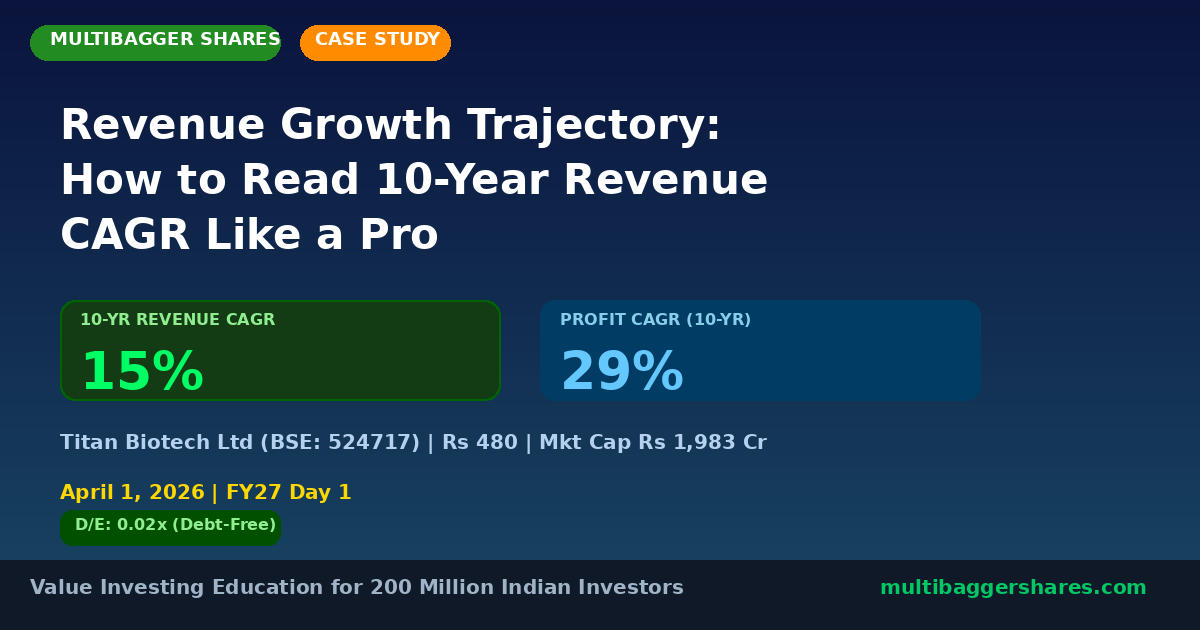
April 1, 2026 (Tuesday — New Financial Year FY27 Begins!)
THE F&O GAMBLING EPIDEMIC
SEBI’s own study confirms: 93% of individual F&O traders lost money — the average loss was Rs 2 lakh per person per year. Meanwhile, quality fundamental investors who identified consistent revenue growers early have created generational wealth.
Today, as FY27 begins, we teach you the single most important fundamental analysis metric: 10-Year Revenue CAGR.
Today’s Lesson: Revenue Growth Trajectory — The Foundation of Every Multibagger
Happy New Financial Year, investors! As FY27 begins today (April 1, 2026), the Indian markets have opened strong — SENSEX at 73,478 (+2.13%) and NIFTY 50 at 22,755 (+1.90%) — signaling renewed optimism. What better day to start a fresh fundamental analysis learning journey?
Today’s lesson focuses on the single most important line item on any company’s financial statements: Revenue (also called Sales or Top Line). Specifically, we will learn why the 10-Year Revenue CAGR (Compound Annual Growth Rate) is the #1 screening metric that separates future multibaggers from mediocre companies — and how Titan Biotech Ltd (BSE: 524717) exemplifies this principle brilliantly.
What Is Revenue CAGR and Why Does It Matter?
Revenue CAGR measures the average annual growth rate of a company’s sales over a specified period, accounting for compounding. Unlike simple average growth (which can be misleading), CAGR smooths out year-to-year volatility and gives you the true compounding rate of the business.
CAGR = (Ending Value / Beginning Value)^(1/n) – 1
Where n = number of years
Why 10 years? Because a decade is long enough to encompass at least one full business cycle — including recessions, commodity booms, pandemics, and geopolitical shocks. Any company that can grow revenue consistently over 10 years through all these disruptions has a genuinely durable business model.
Why Revenue Growth Is More Important Than Profit Growth (Initially)
Many beginner investors jump straight to profit numbers. But experienced fundamental analysts know: revenue is much harder to manipulate than profit. Companies can temporarily boost profits through cost-cutting, one-time gains, or accounting adjustments — but consistently growing revenue over a decade requires genuine demand, expanding market share, and a scalable business model.
Case Study: Titan Biotech’s Revenue Growth Trajectory
LIVE DATA — APRIL 1, 2026
| Current Price | Rs 480 |
| Market Cap | Rs 1,983 Cr |
| 10-Year Revenue CAGR | 15% |
| 10-Year Profit CAGR | 29% |
| ROCE / ROE | 16.9% / 15.0% |
| Debt-to-Equity | 0.02x (Almost Debt-Free) |
| Promoter Holding | 55.87% (Zero Pledge) |
| Latest Quarter OPM | 19.16% |
Titan Biotech’s 10-year revenue CAGR of 15% tells a powerful story:
1. Consistency Through Adversity
Between 2015 and 2025, India experienced demonetization (2016), GST implementation (2017), the IL&FS credit crisis (2018), COVID-19 (2020-21), global supply chain disruptions (2021-22), and rising interest rates (2022-23). Through ALL of these disruptions, Titan Biotech continued growing its revenue at 15% per year. This is not luck — this is a structurally sound business with genuine demand for its products.
2. Revenue CAGR of 15% + Profit CAGR of 29% = Operating Leverage
When a company’s profit grows nearly twice as fast as its revenue, it signals powerful operating leverage. Titan Biotech’s cost structure is largely fixed — as revenue scales up, a disproportionately larger portion flows to the bottom line. The OPM expansion from approximately 10% a decade ago to 19.16% in the latest quarter confirms this.
3. Organic Growth — No Acquisitions, No Dilution
Titan Biotech’s entire revenue growth has been organic. The company has never issued additional equity (zero dilution), never made large debt-funded acquisitions, and has funded all expansion from internal accruals. A 15% revenue CAGR achieved organically with a D/E ratio of just 0.02x indicates a genuinely well-run business.
Peer Benchmarking — How Titan Biotech Compares
Key insight: Many companies show impressive 3-year or 5-year revenue CAGRs, but the list shrinks dramatically when you extend to 10 years. A decade-long 15% revenue CAGR puts Titan Biotech in the top tier of Indian small-caps.
Why Titan Biotech’s Revenue Growth Is Structurally Durable
Essential Products: Biological peptones, dehydrated culture media, and yeast extracts are essential inputs for pharmaceutical manufacturing, vaccine production, and clinical diagnostics — consumed regardless of economic cycles.
Global Pharma Tailwind: The global pharmaceutical market continues expanding. As a critical raw material supplier, Titan Biotech rides this multi-decade tailwind without direct drug development risk.
Export Diversification: Titan Biotech serves pharma and biotech companies across multiple countries, reducing geographic dependence.
End-User Diversification: Revenue comes from pharma, nutraceuticals, food and beverage, biotech, cosmetics, veterinary, and agriculture — a natural hedge against cyclicality.
Niche Market Sweet Spot: The biological peptones market is too small for global MNCs to focus on, yet too complex for small players to enter.
Red Flags to Watch in Revenue CAGR Analysis
Revenue growing but receivables growing faster — could mean credit terms inflation. (Titan Biotech: receivable days healthy.)
Revenue growing but cash flow declining — the Satyam/Manpasand warning sign. (Titan Biotech CFO/Operating Profit: 103%.)
Revenue CAGR from single product/customer — concentration risk. (Titan Biotech: diversified portfolio.)
Revenue growing only via acquisitions — organic growth is more valuable. (Titan Biotech: 100% organic.)
How to Screen for Revenue Growth — Your Action Plan
Step 1: Go to Screener.in and create a new screen
Step 2: Filter for Sales growth 10Years greater than 12
Step 3: Add Debt to equity less than 0.5
Step 4: Add Return on capital employed greater than 15
Step 5: Add Promoter holding greater than 50
Step 6: Review survivors for consistent year-over-year revenue progression
Key Takeaways
1. 10-Year Revenue CAGR is the #1 fundamental screening metric — it reveals genuine business durability through multiple economic cycles.
2. Revenue is harder to manipulate than profit — consistent top-line growth requires real demand and a scalable business model.
3. Titan Biotech’s 15% revenue CAGR over 10 years — achieved organically, with D/E of 0.02x, zero dilution, and expanding OPM to 19.16% — is the textbook quality compounder.
4. Profit CAGR (29%) at nearly 2x Revenue CAGR (15%) signals powerful operating leverage and pricing power.
5. Quality stock picking beats F&O gambling every time. While 93% of F&O traders lose money (SEBI data), patient investors in quality revenue compounders build generational wealth.
Watch today’s full video lesson on our YouTube channel. Watch the Full Course Playlist Here
SEBI Disclaimer: 9 out of 10 individual traders in the equity Futures & Options segment incurred net losses according to a SEBI study. F&O trading is essentially gambling. Focus on quality stock picking and long-term value investing instead.
Disclaimer: The author (Manish Goel) is a SEBI Registered Research Analyst (Registration No. INH100004775) and Multibagger Shares (Multibagger Securities Research & Advisory Pvt. Ltd.) is a SEBI Registered Investment Advisor (Registration No. INA100007736). This post is for educational purposes only and should not be construed as a buy/sell recommendation. Please do your own research and consult a qualified financial advisor before making investment decisions. Stock market investments are subject to market risks. Past performance is not indicative of future results.
Join Our Telegram Channel
Get daily value investing lessons, stock analysis and Titan Biotech updates — delivered straight to your phone!
Join @longtermequityy on Telegram
Free – No spam – Value investing insights daily