Rakesh Jhunjhunwala’s Legacy Lessons: How India’s Big Bull Built a ₹45,000 Crore Empire from ₹5,000 — The Complete Blueprint for Indian Value Investors

Ashish Kacholia’s Hidden Gems Approach: How India’s Most Famous Small-Cap Gem Hunter Builds a ₹3,400 Crore Portfolio — The Complete Blueprint for Indian Value Investors
April 5, 2026
The Core-Satellite Portfolio Strategy: How Indian Investors Can Build a Bulletproof Portfolio That Delivers Both Safety and Multibagger Returns
April 5, 2026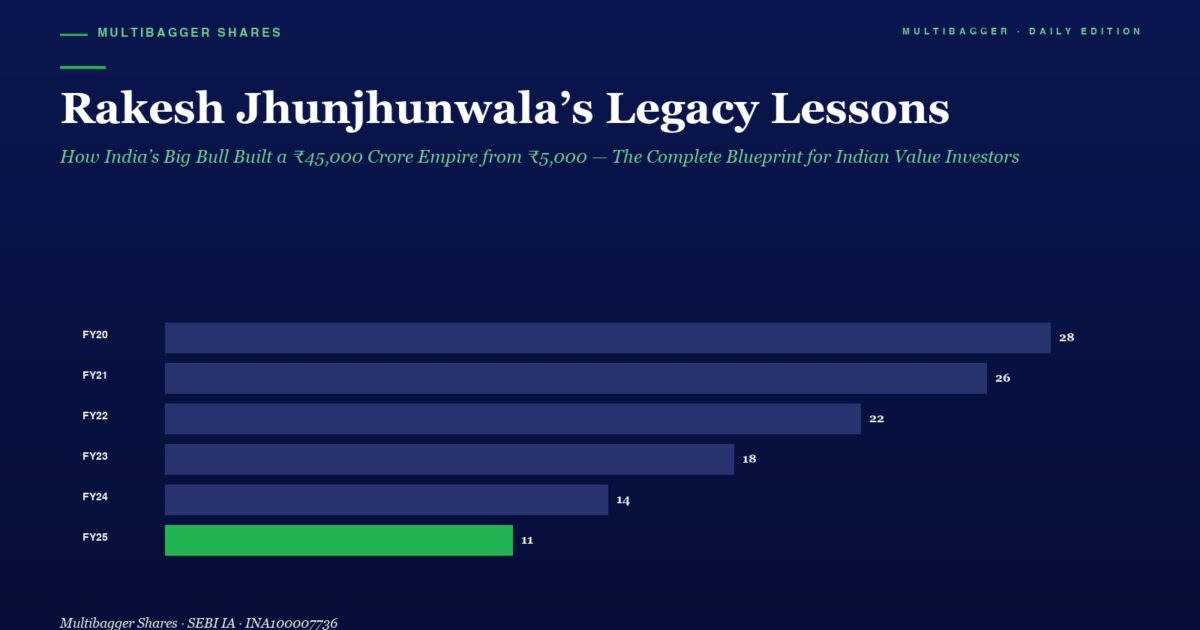
April 05, 2026
(Sunday)
The Man Who Turned ₹5,000 into ₹45,000 Crore — And What Every Indian Investor Can Learn from His Journey
In August 2022, India lost its most celebrated stock market investor — Rakesh Jhunjhunwala, fondly known as “The Big Bull” of Dalal Street. But what Jhunjhunwala left behind is far more valuable than his ₹45,000 crore portfolio: he left behind a framework for conviction-driven value investing that every Indian retail investor can study, internalize, and apply to build generational wealth.
Today, with the Sensex at 73,320 and the Nifty 50 at 22,713 (as of April 2, 2026), Indian markets continue to reward the principles Jhunjhunwala lived by. In this deep-dive, we’ll distill his most powerful investment lessons — not as abstract theory, but as actionable strategies you can deploy in your own portfolio starting today.
Lesson 1: “Buy Right, Sit Tight” — The Power of Patience and Conviction
Jhunjhunwala’s most famous philosophy was deceptively simple: Buy Right, Sit Tight. He believed that once you identify a fundamentally strong business with capable management, the right strategy is to hold — not for months, but for decades.
His legendary bet on Titan Company illustrates this perfectly. Jhunjhunwala began accumulating Titan shares in 2002-2003 at roughly ₹3-5 per share (adjusted for splits). By 2022, Titan was trading at over ₹2,500. His roughly 5% stake in Titan alone was worth over ₹14,300 crore — a return of nearly 50,000% over two decades.
The lesson? Most retail investors sell too early. They get nervous during corrections, panic during crashes, and exit great businesses just before the next leg of growth. Jhunjhunwala’s Titan investment survived the 2008 Global Financial Crisis, the 2011 correction, the 2016 demonetization shock, and the 2020 COVID crash. Through all of these, he held firm.
Action Step: Before you invest in any stock, ask yourself: “Am I confident enough in this business to hold it for 10 years?” If the answer is no, reconsider the investment entirely. As Jhunjhunwala said, “The biggest risk is not investing in stocks.”
Lesson 2: Bet Big on High-Conviction Ideas — Concentration Over Diversification
While many financial advisors preach diversification, Jhunjhunwala practiced concentrated conviction betting. His portfolio, managed through Rare Enterprises, typically held only 20-30 stocks — with the top 5 positions accounting for over 60% of portfolio value.
This wasn’t recklessness — it was informed conviction. Jhunjhunwala would spend months studying a company before investing. He would analyze the business model, meet the management, study the industry dynamics, and only then make a large, concentrated bet.
Consider his bet on Star Health Insurance. When insurance was still underappreciated in Indian markets, Jhunjhunwala recognized the secular growth opportunity in health insurance penetration. He invested early and heavily. Today, his Star Health stake is worth over ₹6,300 crore.
Action Step: Don’t over-diversify into 50-60 stocks you can’t track. Pick 10-15 of your best ideas, allocate meaningfully to each, and know them deeply. As Jhunjhunwala believed, concentrated knowledge creates concentrated wealth.
Lesson 3: Be a Contrarian — Buy When Blood Is on the Streets
Jhunjhunwala’s greatest returns came from buying when everyone else was selling. During the 2003 market bottom, when Indian markets were deeply depressed and investor sentiment was at rock bottom, Jhunjhunwala was aggressively buying. The stocks he accumulated during this period became the foundation of his multi-billion-dollar fortune.
He also bought aggressively during the 2008-2009 crash, adding to positions in banks, real estate, and consumer companies when prices were 50-70% below their peaks.
“The stock market is the only market where goods go on sale and everyone runs out of the store,” Jhunjhunwala once remarked. His contrarian approach wasn’t about blindly buying during crashes — it was about having the homework already done so that when fear creates opportunity, you can act decisively.
Action Step: Maintain a watchlist of 20-25 high-quality companies with pre-determined buy prices. When market corrections strike, you’ll have the conviction to act while others panic.
Lesson 4: India’s Growth Story Is Unstoppable — Stay Invested in India
Perhaps Jhunjhunwala’s most enduring belief was his unwavering bullishness on India. He was India’s most vocal champion, consistently arguing that India’s demographics, digital infrastructure, entrepreneurial culture, and growing middle class would drive decades of economic growth.
“India is on the threshold of becoming a great economic power,” he said in multiple interviews. “The best is yet to come.”
This conviction wasn’t just talk — he backed it with action. He co-founded Akasa Air, an ultra-low-cost airline, just months before his passing. The move signaled his belief in India’s aviation growth story and the expanding spending power of India’s 1.4 billion citizens.
Today, India is the world’s fifth-largest economy and is on track to become the third-largest by 2028. Indian equities continue to attract global institutional capital. The structural growth drivers that Jhunjhunwala identified — urbanization, formalization of the economy, digital payments, and rising aspirational spending — are all playing out exactly as he predicted.
Action Step: Stay invested in India’s structural growth themes. Companies benefiting from rising incomes, healthcare access, financial inclusion, and digital transformation are the modern equivalents of the Titan-like opportunities Jhunjhunwala captured two decades ago.
Lesson 5: Management Quality Is Non-Negotiable
Jhunjhunwala placed enormous emphasis on management integrity and capability. He famously said, “I always look for a management with integrity, which treats minority shareholders fairly, and which has the competence to grow the business.”
His investment in Titan Company was as much a bet on the Tata Group’s governance and Titan’s management team as it was on the jewelry and watch market. Similarly, his bets on companies like Crisil and Lupin were driven by his respect for the leadership running these businesses.
In the Indian market — where promoter-driven companies dominate — assessing management quality is even more critical than in Western markets. Look for promoters who have a track record of honest capital allocation, transparent communication with shareholders, and a long-term vision for the business.
For example, consider companies like Titan Biotech (BSE: 524717), currently trading at ₹504 with a market cap of ₹2,082 crore, ROCE of 16.9%, and ROE of 15.0%. This is precisely the kind of capital-efficient, growth-oriented company that Jhunjhunwala’s framework would identify — strong returns on capital, a debt-free balance sheet, and secular demand tailwinds in the biotech/life sciences space.
Action Step: Before investing, research the promoter’s track record. Study their capital allocation decisions over the past 10 years. Have they grown the business profitably? Have they treated minority shareholders fairly? Do they have skin in the game? These questions matter more than any financial ratio.
Lesson 6: Understand the Business, Not Just the Numbers
Jhunjhunwala was not a “screener investor” who filtered stocks by P/E ratios and bought the cheapest ones. He was a business analyst who happened to express his analysis through stock investments.
When he invested in Titan, he understood that India’s jewelry market was massively unorganized and that a branded, trusted player could capture enormous market share as incomes rose. When he invested in Lupin, he understood the global generics opportunity for Indian pharmaceutical companies.
This is a critical distinction. Many retail investors focus obsessively on financial metrics without understanding what drives those metrics. Revenue growth, margins, and return ratios are outputs — they are the result of competitive positioning, industry dynamics, management decisions, and secular trends.
Action Step: For every stock you own, write a one-paragraph thesis explaining why this business will be bigger and more profitable in 10 years. If you can’t write that paragraph convincingly, you don’t understand the business well enough to own it.
Lesson 7: Embrace Risk — But Only Calculated Risk
Jhunjhunwala started his investing journey in 1985 with just ₹5,000. He was willing to take risks that others wouldn’t — but they were always calculated risks backed by research.
His early trades in the 1980s and 1990s involved leveraged positions in futures and options. But even then, his leverage was applied to positions where he had deep fundamental conviction. He wasn’t gambling — he was amplifying bets where his research gave him an edge.
However, Jhunjhunwala himself evolved over time. As his portfolio grew, he moved away from trading and toward long-term investing. His later years were dominated by “buy and hold” positions in quality businesses. This evolution is itself a lesson: the strategies that help you build wealth from ₹5,000 to ₹5 crore are different from those that take you from ₹5 crore to ₹5,000 crore.
Action Step: Be honest about your stage in the wealth-building journey. If you’re early, it’s okay to take slightly higher risks in small-cap and mid-cap quality stocks. As your portfolio grows, gradually shift toward larger, more stable compounders.
Lesson 8: Never Stop Learning — The Market Is the Greatest Teacher
Despite being a billionaire, Jhunjhunwala never stopped learning. He was a voracious reader, a keen observer of global markets, and a constant student of business. He attended annual general meetings, read annual reports cover to cover, and had conversations with entrepreneurs, economists, and fellow investors regularly.
“The day you stop learning, the market will teach you a very expensive lesson,” he once said. This humility — this recognition that the market is always evolving and that yesterday’s edge can become tomorrow’s trap — is what separated Jhunjhunwala from thousands of other wealthy traders who eventually blew up.
In today’s market, this means staying updated on India’s evolving regulatory landscape, understanding new sectors like digital infrastructure and green energy, and recognizing that the companies that will create the next generation of multibaggers may look very different from those that did so in the past two decades.
Action Step: Commit to reading at least one annual report per week and studying one new industry per month. Build your knowledge base consistently — it is the only sustainable edge in investing.
The Jhunjhunwala Framework — A Summary for Action
Let’s consolidate Rakesh Jhunjhunwala’s legacy into a practical framework you can apply immediately:
Step 1: Research Deeply — Spend 80% of your time studying businesses and 20% making decisions. Understand the industry, management, competitive advantages, and growth drivers before investing a single rupee.
Step 2: Bet with Conviction — When you find a great business at a fair price, invest meaningfully. Don’t spread your capital so thin across 50 stocks that no single position can make a difference to your wealth.
Step 3: Hold with Patience — Great businesses need time to compound. Resist the urge to trade in and out. The tax and transaction costs of frequent trading alone can destroy 2-3% of returns annually.
Step 4: Be Contrarian — The best buying opportunities come during fear. Maintain a watchlist and cash reserves so you can act when markets overreact to short-term events.
Step 5: Believe in India — India’s structural growth story remains intact. Stay invested in businesses that benefit from rising incomes, urbanization, and formalization.
A Word on F&O Gambling — What Jhunjhunwala Would Say Today
If Rakesh Jhunjhunwala were alive today, he would be appalled by the explosion of Futures & Options gambling among young Indian retail investors. SEBI’s own study confirms that 9 out of 10 individual traders in the F&O segment incur net losses. This isn’t investing — it’s destruction of wealth disguised as sophistication.
Jhunjhunwala built his fortune through equity ownership in great businesses, not through speculative derivatives trading. His legacy teaches us that the path to wealth is through patient, conviction-driven investing in quality companies — not through gambling on weekly expiry options.
If you’re currently trading F&O, consider redirecting that capital into a portfolio of 10-15 high-quality businesses and holding them for the next decade. The results will speak for themselves.
Continue Your Value Investing Education
Want to learn more about building a Jhunjhunwala-style quality portfolio? Watch our complete value investing education course on YouTube: Multibagger Shares Value Investing Course
SEBI Disclaimer: 9 out of 10 individual traders in the equity Futures & Options segment incurred net losses according to a SEBI study. F&O trading is essentially gambling. Focus on quality stock picking and long-term value investing instead.
Disclaimer: This article is for educational purposes only and does not constitute financial advice. The author may hold positions in stocks mentioned. Always conduct your own research and consult a SEBI-registered financial advisor before making investment decisions. Stock market investments are subject to market risks. Past performance does not guarantee future returns.
📢 Join Our Telegram Channel
Get daily value investing lessons, stock analysis — delivered straight to your phone!
✈️ Join @longtermequityy on Telegram
🔔 Free • No spam • Value investing insights daily