The Customer Who Makes the Rules: What Changes When a Company’s Main Buyer Is the Government

The Shopkeeper’s Cut: What a Company Pays to Sit on the Shelf, and What That Tells You
August 25, 2026
More Packets, or a Bigger Price Tag? How to Read a Company’s Sales Growth
August 27, 2026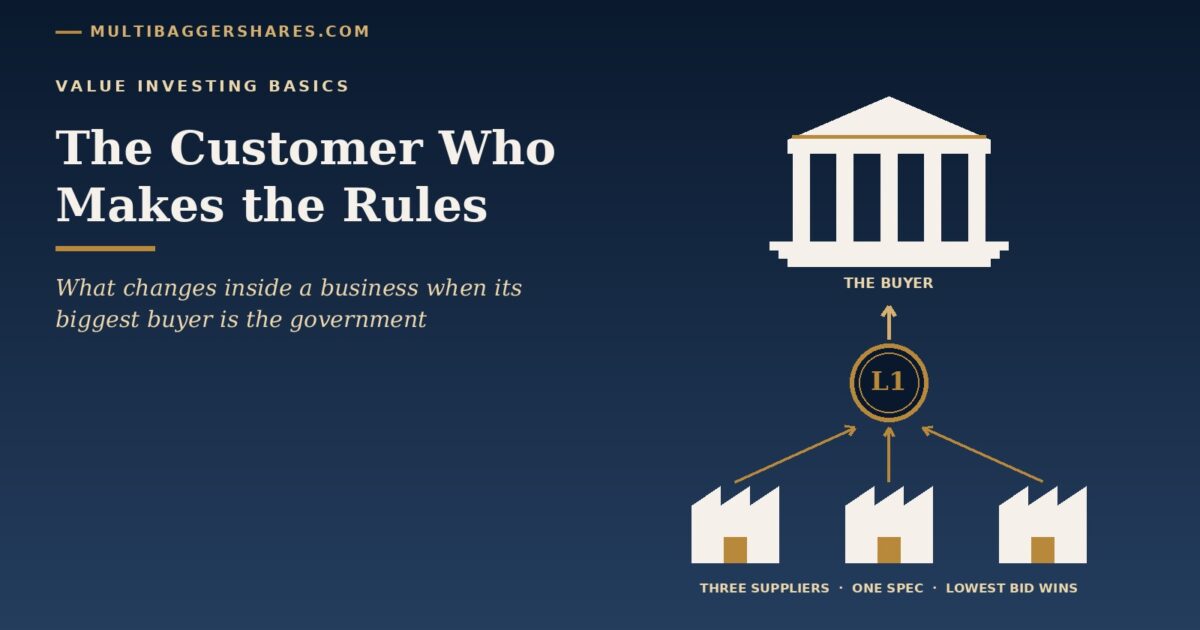
Value Investing Basics
Picture two small factories on the same road, in the same town. Both stitch school bags. Same machines, same cloth, same workers, same owner’s son doing the accounts in the evening.
The first one sells to shops. A trader arrives with a van, takes two hundred bags, pays within the month, comes back when he needs more. The second one makes school bags too — but almost every bag it makes goes to the state education department, in one large order each year, for children in government schools.
From the road, these two businesses look identical. Look at their bank passbooks and they are two entirely different animals. The first one has money moving in and out all year, in small steady waves. The second one has a huge order, a long silence, and then — eventually — one very large payment. In between, it borrows to pay wages.
Nothing about the stitching explains that difference. It comes entirely from who is standing on the other side of the counter.
When you buy a share, you are not only buying a factory and a brand name. You are also inheriting that company’s customers, exactly as they are. And of all the customers a business can have, one changes the arithmetic more than any other: the government.
What “the government as a customer” actually means
The government is not one buyer. It is thousands of them. Central ministries and departments. State governments. Municipal bodies that run your city’s water and streetlights. The railways. Defence. Public sector undertakings, or PSUs (companies that the government owns, wholly or in part, and that buy on their own account). And state electricity distribution companies, usually called discoms (the utilities that buy power in bulk and sell it to your home).
They differ enormously in how promptly they pay and how carefully they buy. But almost all of them share three habits, and those three habits are what you are really inheriting.
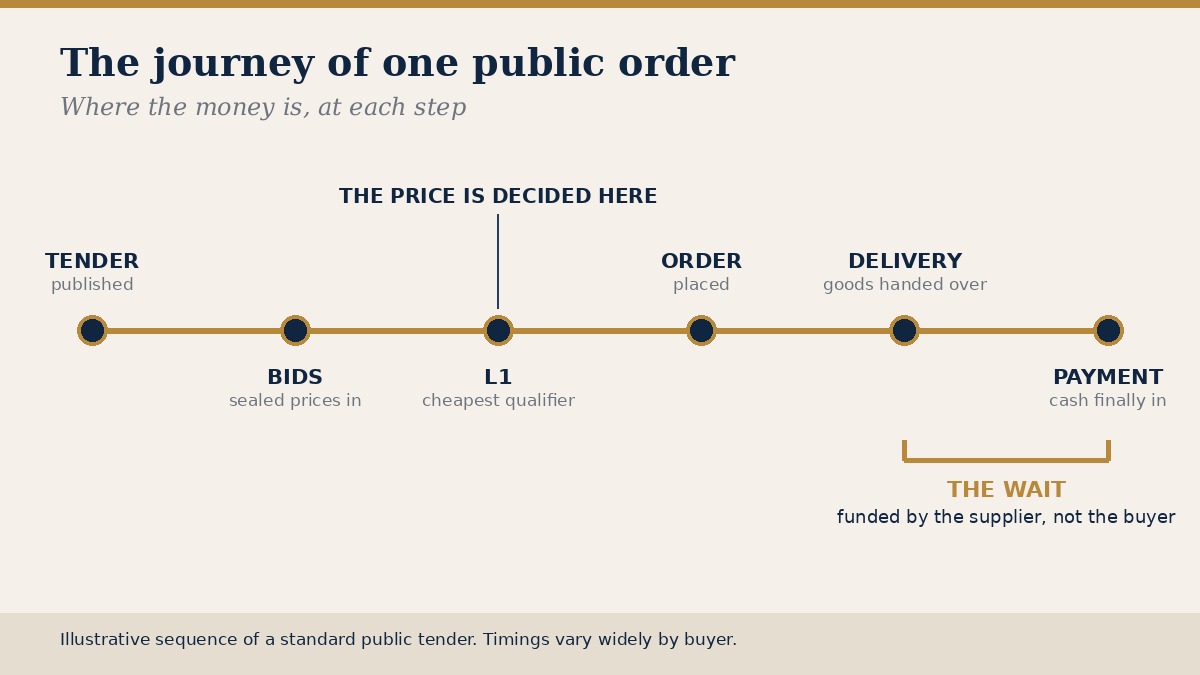
First, they buy by tender. A tender is a public invitation to quote. The buyer writes down exactly what it wants — the size, the strength, the delivery date — and invites anyone who qualifies to submit a sealed price, called a bid. The bids are opened together, in front of witnesses, and the cheapest qualifying bid wins. In Indian procurement shorthand that winning bid is called L1, simply meaning “lowest one”.
Second, the rules are written down and public. Central government buying runs on the General Financial Rules, 2017. For years, the lowest price was the standard way to choose. That has been softened: in general instructions issued by the Department of Expenditure on 29 October 2021, the government allowed departments to use Quality-cum-Cost Based Selection for works and non-consultancy services as well — a method that scores technical quality alongside price, though the non-financial part may not carry more than 30 per cent of the weight, and at the time the route was opened for procurements valued up to about ₹10 crore. The reason for the change was stated plainly. A Central Vigilance Commission note quoted in the Economic Survey 2020–21 put it this way: lowest-price selection “may still hold good for procurement of routine works, goods and non-consulting services, but not for high impact and technologically complex procurements”.
Third, it happens at enormous scale, in the open. The Government e Marketplace, or GeM, is the government’s own online purchasing platform. On 6 April 2026 the Ministry of Commerce and Industry said GeM had crossed a cumulative order value of ₹18.4 lakh crore since it began, having passed ₹5 lakh crore in the financial year 2025–26 alone. That is one platform, one year, and a sum larger than the annual sales of most industries you could name.
Why the identity of the buyer changes the business
Three things change: how the price gets set, when the cash arrives, and who is allowed to move the goalposts.
The price stops being yours. This is the part beginners miss. In an ordinary market, a company that has built something people ask for by name gets to name its own number. In a tender, the buyer has already written a specification that several suppliers can meet — and the moment several suppliers can meet it, the product has been turned into a commodity (a thing where one seller’s version is as good as another’s, so only price decides). The buyer does this deliberately, and for a good reason: it is spending public money and must be able to defend the choice. But the effect on the seller is severe.
Warren Buffett described the consequence in his 1990 letter to Berkshire Hathaway shareholders, writing about an airline the company had put money into just before the industry fell apart. Fares were collapsing, and he drew out the general lesson: “The trouble this pricing has produced for all carriers illustrates an important truth: In a business selling a commodity-type product, it’s impossible to be a lot smarter than your dumbest competitor.”
That sentence was written about aeroplane seats, but it describes a tender room perfectly. You may be the best manufacturer in the room. If the specification treats you as interchangeable with the weakest bidder present, his opening price becomes your ceiling. Being better earns you nothing unless the rules give quality a score.
The cash arrives late, even when it arrives. A government buyer is usually good for the money in the end. That is genuinely valuable — you rarely have to write the debt off. But “in the end” can be a long time. The gap between delivering goods and being paid for them shows up in the accounts as receivables (money that customers owe the company but have not yet handed over). Receivables are not free. Somebody has to fund the wages, the electricity and the raw material during the wait, and that somebody is either the company’s own cash or its bank.
The customer can change the rules. An ordinary customer can walk away. A government customer can walk away and rewrite the terms: change the specification, cap the price, alter who is eligible to bid, or simply not release the budget this year. This cuts both ways, and it is worth saying so honestly. Buffett, reviewing the same airline mistake in his 1994 letter, pointed out that regulation had once been the industry’s shelter: “Airlines were then protected from competition by regulation, and carriers could absorb high costs because they could pass them along by way of fares that were also high.” Rules can protect a supplier for years. The point is not that rules are bad. The point is that the profit belongs to somebody else’s decision.
Two places in India where you can see this plainly
The electricity chain. A power generating company sells its output to discoms, and the discoms sell it to households. The generator has done its work, the electricity has been consumed, the bill has been raised — and then it waits. The Ministry of Power runs a public portal, PRAAPTI, which publishes what discoms owe generators. Reporting that portal’s figures, the trade publication Mercom India said discoms owed generators about ₹717.5 billion in total dues for the monthly billing cycle in April 2025 — roughly ₹71,750 crore — having stood at about ₹615.95 billion for the January 2025 cycle. Uttar Pradesh discoms alone accounted for about ₹98.41 billion of the April figure.
Read that as a beginner should read it. The generators are not badly run. The power was delivered. The customer is solvent and will pay. The money is simply somewhere else for a while, and while it is somewhere else the generator is carrying the cost.
The small supplier on GeM. The same government release of 6 April 2026 gives a second, quieter lesson. During 2025–26, micro and small enterprises executed 68 per cent of all orders placed on the platform — but those orders were only 47.1 per cent of the total value. More than 11 lakh such enterprises are registered, and they received over 51 lakh orders worth ₹2.36 lakh crore during the year.
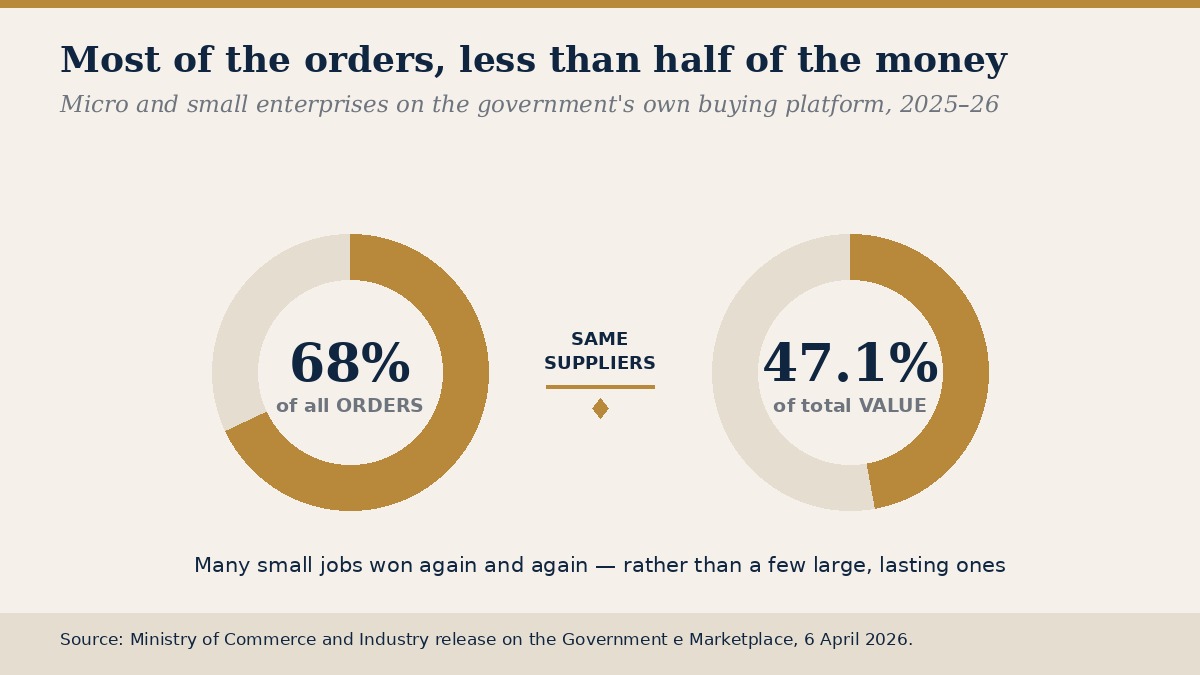
Look at the two numbers together: most of the orders, less than half of the money. Small suppliers to the government win a great many small jobs. That is a real livelihood and, for the buyer, a deliberate and worthwhile policy. But for someone judging a business, it describes a particular shape — lots of transactions, modest tickets, constant re-bidding, and a position that has to be won again every time.
What a government customer does give you
It would be lazy to leave it there, because plenty of fine businesses sell mostly to the state, and some of the advantages are real.
The customer does not go bankrupt and vanish. Household demand can fall away in a bad year; a defence programme or a rural water scheme usually does not. The orders can be large enough, and long enough, to fill a factory for years, which is why companies serving the state often publish an order book (the value of work won but not yet delivered) that stretches far into the future.
There is also a genuine barrier around some of this work. Getting on to an approved-supplier list can take years of registration, factory inspections, product testing and a record of past performance. That paperwork is dull, and dullness is a moat (a lasting advantage that keeps competitors out). A new rival with a cheaper price and no track record may simply not be allowed to bid.
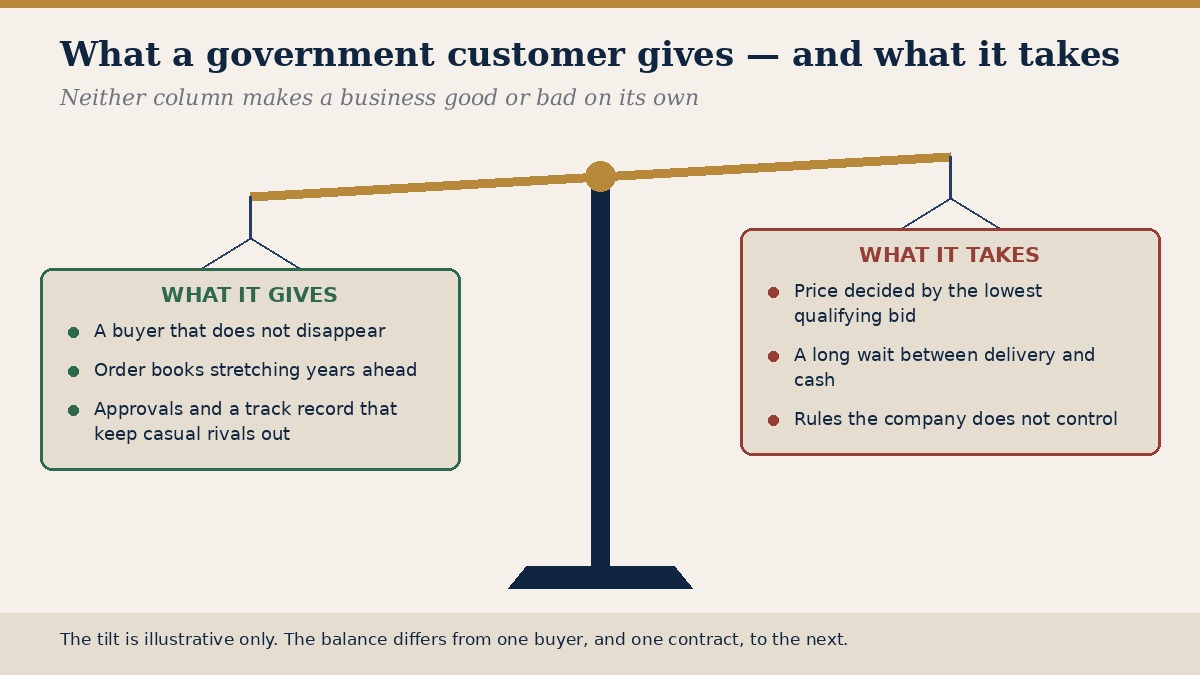
So the honest summary is not “government customer, bad”. It is: the buyer’s identity tells you where this company’s profit is decided. In a business selling to millions of households by name, the profit is decided inside the company. In a business selling into tenders, a large part of it is decided in a room the company does not sit in.
Four things this test cannot tell you
It cannot tell you the company is weak. Some of the most durable engineering businesses in India were built on public orders. The test tells you what kind of business it is, not how good it is.
It cannot be read off a single percentage. Two annual reports may both say “government customers” and mean completely different things — one a fully funded central ministry paying on time, the other a stretched municipal body. The label is the same; the experience is not. You have to read which arm of the state, and for what.
It cannot predict the next policy. Nobody can. The most you can do is notice that the company’s fortunes depend on decisions it does not control, and be honest with yourself about how comfortable that makes you.
And it says nothing about the share price. This is a question about the shape of a business, not about what its shares are worth or when anything should be done about them. Keep the two apart.
Five questions to ask
1. Who actually signs the cheque? Not “the government” — which ministry, which state, which utility. The annual report and the management’s own commentary usually say, if you read past the pictures.
2. How was the price set? Did the company quote in a tender against others, or did it name its price and the buyer agreed? If it is the former, ask whether quality carried any weight in the scoring at all.
3. How long is the wait, and is it getting longer? Compare receivables across three or four years against sales in the same years. Sales rising while the wait for payment rises faster is worth pausing over.
4. What happens if the rule changes? If a price cap arrived, or the eligibility rules widened, or the budget slipped a year — what would be left? A business with an answer is in a different position from one without.
5. Is this a rented order or an earned position? Anyone can win a tender once by quoting low. Approvals, testing clearances, a decade of delivery without a failure — those are earned, and they last.
None of this requires arithmetic you did not learn in school. It requires only that you stop looking at the product for a moment and look at the person paying for it. The bag tells you nothing. The buyer tells you almost everything.
Key takeaways
- When you buy a share you inherit the company’s customers — and who they are shapes the business as much as what it makes.
- A government buyer usually chooses by tender, and a tender is designed to make suppliers interchangeable, which removes the seller’s say over price.
- The money is generally safe but slow; the wait shows up as receivables, and somebody has to fund the gap.
- In return you may get scale, long order books and a paperwork barrier that keeps casual rivals out — real advantages, honestly earned.
- Ask which arm of the state signs the cheque, how the price was set, and whether the position was rented for one order or earned over years.
— Manish Goel · multibaggershares.com
Disclaimer: This article is for educational purposes only and does not constitute financial advice. The author may hold positions in stocks mentioned. Always conduct your own research and consult a SEBI-registered financial advisor before making investment decisions. Stock market investments are subject to market risks. Past performance does not guarantee future returns.