The Shop That Sells to Every Miner: Why Some Businesses Win Whoever Wins the Race

The Tree and the Size of the Field: How to Tell How Much Bigger a Business Can Still Grow
September 8, 2026
The Shop That Painted Only Two Walls: What a Company’s Spending on Itself Tells You
September 10, 2026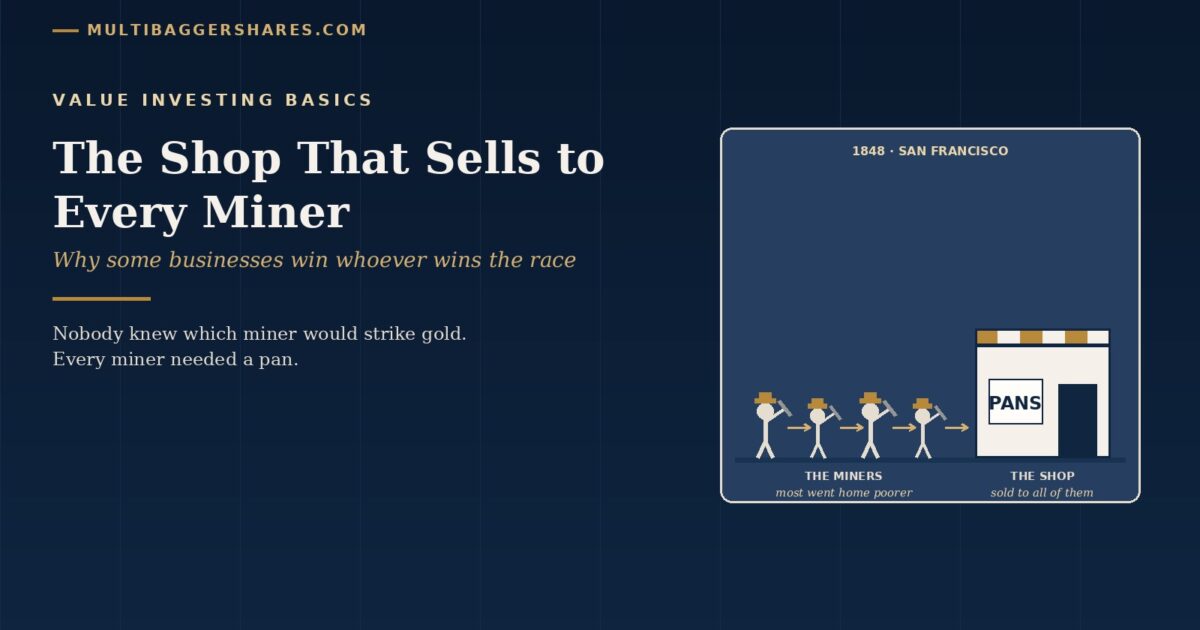
The man who never dug
In the spring of 1848, a shopkeeper named Samuel Brannan ran through the streets of San Francisco waving a small glass bottle of gold dust and shouting that gold had been found on the American River. He was not a miner. He owned the only store between the town and the gold fields. Before he started shouting, he had quietly bought up every pick, shovel and tin pan he could find.
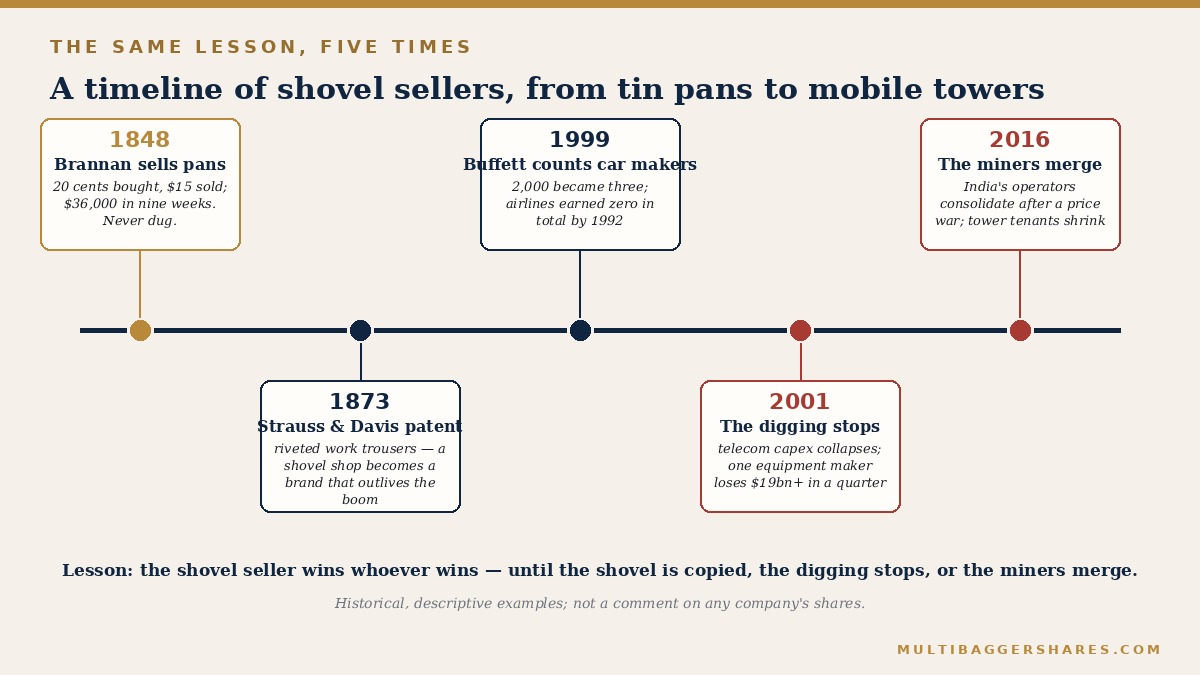
The men who heard him dropped their jobs and rushed to the hills. Almost all of them would go home poorer than they came. Brannan, on the other hand, sold tin pans he had bought for twenty cents at fifteen dollars each. In nine weeks he made thirty-six thousand dollars, a fortune at the time. By the next year his store at Sutter’s Fort was taking in around one hundred and fifty thousand dollars a month. He became California’s first millionaire, and he never dug for a single day.
Nobody knew which miner would strike it rich. Brannan did not need to know. Every miner, the lucky ones and the unlucky ones alike, needed a pan.
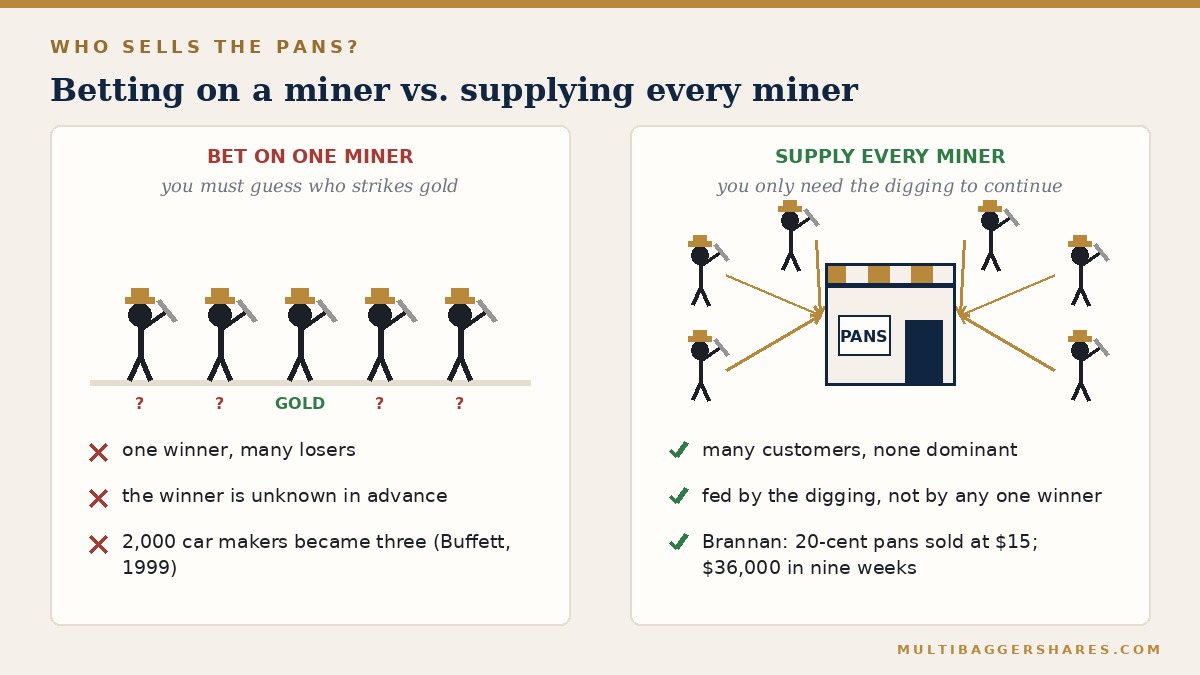
That is the whole idea of this letter. When a new industry booms, the newspapers, the television channels and your cousin at the wedding all argue about which company will come out on top. There is a quieter question that long-term investors have learned to ask instead. Who is selling the pans?
What it really means
Investors have an old name for this kind of business: picks and shovels (a company that supplies something every competitor in an industry must buy, rather than competing in that industry itself). The miners are the ones fighting for the gold. The picks-and-shovels business stands at the edge of the field and sells to all of them.
Think of the tea stall outside a big examination hall. Thousands of students walk in. Only a few will top the exam, and nobody can say in advance who they will be. But every one of them, the toppers and the ones who fail, buys a cup of tea on the way in. The stall does not care who wins. It cares that the exam is held, and that the hall is full.
Or think of the wedding season in a small town. Five caterers compete fiercely for every function. Each year one or two of them shut down and new ones open. The shop that sells them cooking gas, paper plates and disposable cups sells to all five. When a caterer fails, its replacement comes to the same shop the following week.
Warren Buffett explained why this matters in a talk that Fortune magazine printed in November 1999. He had looked up the history of two industries that changed the world: cars and aeroplanes. He counted at least two thousand car makers that had operated in America over the years. By the 1990s three were left, and even those had been poor rewards for their shareholders. He found about three hundred aircraft makers between 1919 and 1939, and a list of one hundred and twenty-nine airlines that had gone bankrupt in twenty years. As of 1992, he said, the total money made by all of America’s airlines since the beginning of flight was zero.
His conclusion was gentle and important. Being right about how big an industry will become is not the same as being right about which company will make money from it. In his words: “The key to investing is not assessing how much an industry is going to affect society, or how much it will grow, but rather determining the competitive advantage of any given company and, above all, the durability of that advantage.”
The picks-and-shovels business is one answer to that problem. It lets you be right about the industry without having to be right about the winner. Petrol stations, tyre makers and road builders did not need to know which of the two thousand car makers would survive. They only needed cars, of any brand, to keep multiplying.
Why it works
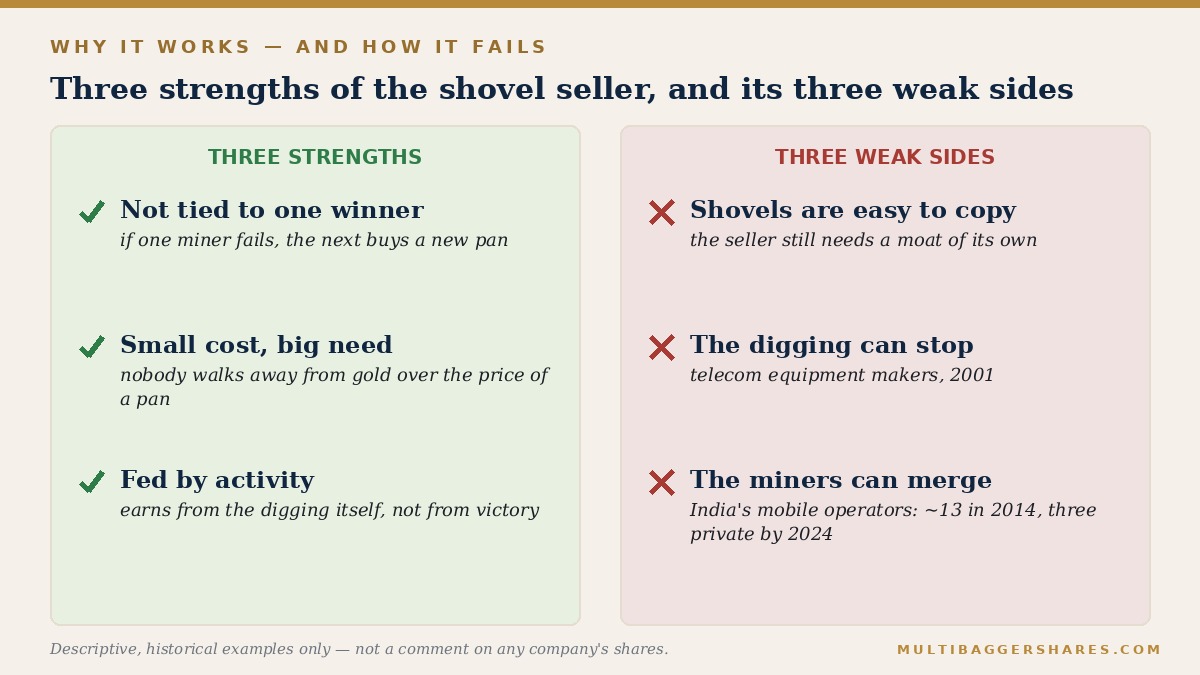
Three things make this kind of business attractive, and each one can be checked with a simple question.
First, it does not depend on one winner. A company that sells to only one big customer lives or dies with that customer. A company that sells to every player in an industry is protected by the industry as a whole. If one miner goes broke, another takes his claim and buys a new pan. The demand moves from one customer to the next without leaving the shop.
Second, the pan is a small cost to the miner and a big cost to be without. A miner who has travelled two thousand miles for gold does not walk away over the price of a tin pan. This gives the seller pricing power (the ability to raise prices without losing customers), especially in the early years of a boom when the miners are many and the pans are few.
Third, the business is fed by activity, not by victory. Every day the miners dig, they wear out picks, need new boots and eat food they did not grow. The shop earns from the digging itself. Whether any particular miner finds gold is not its concern.
Now the honest part, because every strong idea has a weak side, and this one has three.
The first weakness is that a shovel is easy to make. Brannan’s fortune came from being the only shop for a few months. Within a year San Francisco was full of shops selling shovels, and the price came down. A picks-and-shovels business still needs a moat (a durable advantage that keeps competitors out) of its own. If anyone can open a shovel shop next door, the miners’ gold will flow past the shovel sellers too, and land with the customer. Ask not only “does this company sell to everyone?” but also “why does everyone buy from this company rather than the one next door?”
The second weakness is that the digging can stop. The shop lives on the activity of the whole industry, so when the industry stops spending, the shop’s sales fall all at once, and it has no customer left to turn to. The gold rush faded within a few years, and the towns that lived on it emptied. We will see a modern version of this below.
The third weakness is that the miners can merge. A shop that sells to ten small miners has ten customers who cannot bargain much. A shop that sells to two giant mining companies has two customers who can. When an industry consolidates (shrinks to a few large players), the picks-and-shovels seller often loses the very thing that made it safe.
A real example or two
Five years after Brannan’s run through the streets, a young Bavarian immigrant named Levi Strauss arrived in San Francisco to sell dry goods (cloth, blankets and everyday supplies) to the miners. He did not dig either. In 1873 he and a tailor named Jacob Davis received a patent for work trousers held together with copper rivets. The gold rush had long since cooled by then, but working men everywhere still needed trousers that did not tear. The picks-and-shovels shop had become a brand, and the brand outlived the boom by a century and a half. That is the first lesson: the shovel sellers who last are the ones who turn a temporary position into a durable one.
Now the modern version of the digging stopping. In the late 1990s, telephone companies across the world raced to lay fibre-optic cable (glass threads that carry internet traffic as light) for the new internet. Nobody knew which telephone company would win, so many investors did the sensible thing and bought the companies that sold the equipment to all of them. These were the picks and shovels of the internet, and for a while they looked unbeatable. Then, in 2001, the telephone companies discovered they had laid far more cable than anyone would use for years, and they stopped spending almost overnight. The equipment makers lost their customers all at once. One of the largest, Nortel Networks of Canada, reported a loss of more than nineteen billion dollars in a single quarter of 2001. Another, Lucent Technologies, had lent its own customers money to buy its equipment, and then had to write off more than two billion dollars of those loans in one year when the customers could not pay. The shovels were fine. The digging had stopped.
And the Indian version of the miners merging. In 2007, three of India’s mobile phone companies created a shared company, Indus Towers, to build and own the steel towers that carry everyone’s signals. A tower company is a textbook picks-and-shovels business: every operator, whichever one wins the customer, must rent space on a tower. In 2014 India had around thirteen mobile operators. Then a new entrant arrived in 2016 with very cheap data, a price war followed, and by 2024 the market had consolidated to three private operators. The towers were still standing and the phones were still ringing. But the number of tenants who could rent space on each tower had shrunk, and so had their power to bargain with the tower companies. Nothing here is a comment on anyone’s shares. It is a picture of the third weakness: when the miners merge, the shop’s safety shrinks with them.
One coda on Brannan himself, because it carries a lesson of its own. He put his fortune into land, lost much of it in a divorce settlement, and died poor in 1889. Standing in the right place is not the same as staying disciplined once you are there. That is true of businesses too.
How you can use it
The next time an industry is in the news and everyone is arguing about the winner, step back and ask who sells the pans. Then put that company through five plain questions. You will not need a calculator for any of them.
One. Does it sell to all the players, or mostly to one? Open the annual report (the yearly document a listed company must publish for its shareholders) and look for the share of sales that comes from its biggest customer. A picks-and-shovels business should have many customers, none of them dominant.
Two. Is the product a must-have for the digging? Would a customer stop work without it, and is it a small part of the customer’s total cost? A yes to both usually means the customer will not bargain hard.
Three. Why this shop and not the one next door? This is the moat question. Look for something the rivals cannot easily copy: a brand people trust, a network of service engineers, a product built into the customer’s own process so that switching is painful, or simply a scale that makes it the cheapest maker.
Four. What happens when the digging pauses? Look at the company’s sales in the last bad year for its customers. A shovel seller whose sales fell by half when the miners paused is a fine business only if it carried little debt (borrowed money that must be repaid with interest whether or not sales arrive) through the pause. A boom-fed business with heavy debt is the most dangerous kind.
Five. Are the miners merging? Count the customers today and compare with five years ago. If the industry is consolidating into a few giants, expect the shovel seller’s margins (the share of each sale that is left as profit) to come under pressure, however good its product.
A business that passes all five is rare and worth understanding deeply. A business that passes the first three but not the last two is not a bad business. It is simply a business whose good years come in waves, and you should expect the waves rather than be surprised by them.
Nothing in this letter is about whether any share is cheap or expensive. The tea stall, the wedding caterers, the tower company and the tin pan are pictures, not suggestions. The lesson is a habit of mind. When everyone is guessing the winner, look for the shop that wins whoever wins.
Key takeaways
- Look for the shop that sells the pans. A picks-and-shovels business supplies something every competitor in an industry must buy, so it does not need to guess the winner.
- Buffett’s 1999 warning. Two thousand car makers became three; airlines in total had earned nothing by 1992. Being right about an industry is not the same as being right about a company.
- Three reasons it works. Many customers instead of one, a small cost the customer will not fight over, and income from the industry’s activity rather than from any single winner.
- Three ways it fails. Shovels are easy to copy, so the seller needs a moat of its own; the digging can stop, as in telecom in 2001; and the miners can merge, as India’s mobile operators did after 2016.
- Five questions, no calculator. Sells to all? Must-have and small cost? Why this shop? What happened in the last pause? Are the customers merging?
— Manish Goel · multibaggershares.com
Disclaimer: This article is published by multibaggershares.com for education and general information only. It is not investment advice, investment research, or a recommendation to buy, sell or hold any security. Any companies named are discussed only as illustrative examples. Markets carry risk; please do your own research or consult a qualified professional before making any investment decision.