The Loan That Does Not Come Back: Why How Carefully a Lender Lends Matters More Than How Much It Lends

The EMI Test: Why a Business Whose Customers Buy on Loan Rises and Falls With the Cost of Borrowing
October 24, 2026
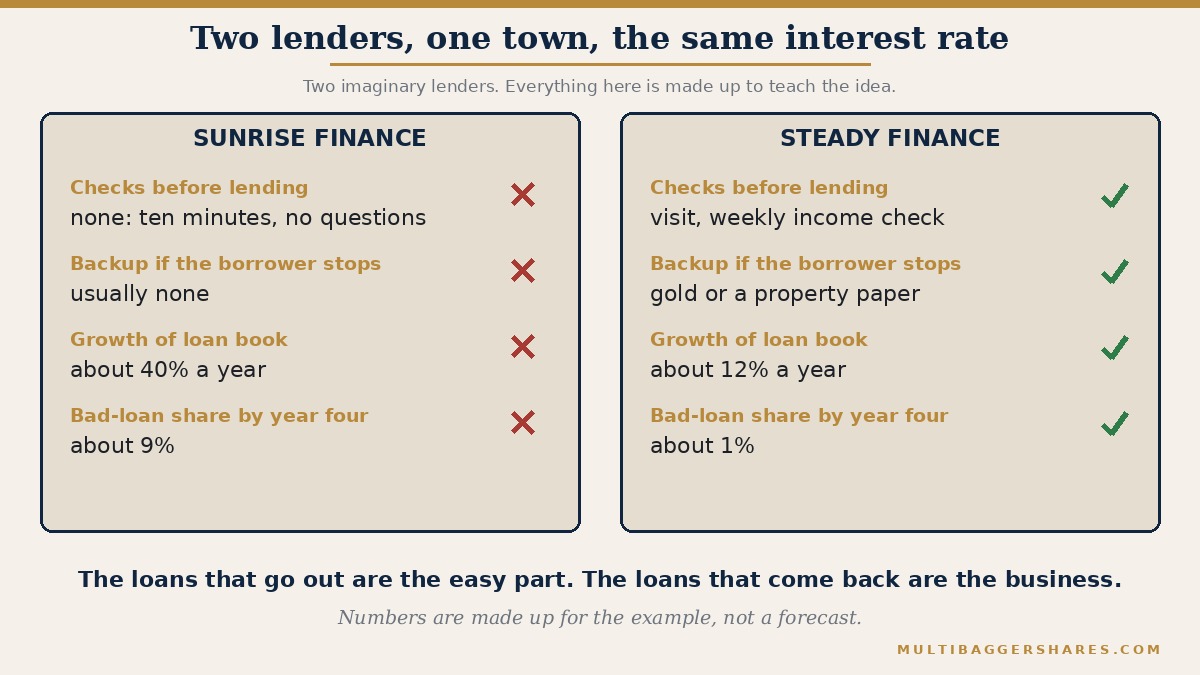
Two lenders open their doors in the same small town in the same month. Everything in this story is made up to teach an idea. The first is Sunrise Finance. The board outside says, “Loans in ten minutes, no questions asked.” The second is Steady Finance, run by a quiet woman who once worked as a bank clerk. Her board says only, “Loans after a visit.”
In the first year, Sunrise lends to almost everyone who walks in. Its loan book (the list of every rupee a lender has lent out and not yet got back) grows fast. Steady turns away about half the people who ask. She visits their shops, checks how much money comes in each week, and keeps something safe as a backup. Sunrise looks like the clear winner. Its office is crowded, its staff are smiling, and its numbers race upward.
Three years later the picture has changed. Steady is still open, growing slowly and calmly. Sunrise has a locked door and a notice from the people who lent it money. Today’s lesson is about that gap. For a lender, handing out loans is the easy part. Getting them back is the business.
What it really means
A lender is a business that lends money and earns interest (the fee a borrower pays for using someone else’s money). A sweet shop is different. When it sells a box of kaju katli, the sale is over the moment the customer pays. When a lender makes a loan, the sale is not over for months or years. It is complete only on the day the last instalment comes back. What the lender really sells is a promise to be repaid, and a promise is only as good as the person making it.
Sometimes a borrower stops paying. In Indian banking language, a loan on which the interest or an instalment has stayed unpaid for more than 90 days is called a non-performing asset, or NPA. Add up all such loans and divide by the whole loan book, and you get the gross NPA ratio (the share of the loan book that has stopped paying). A lower number means more of the money lent is coming back. When a lender finally gives up on a loan, it writes it off (accepts that the money is lost and removes it from its books as a cost).
Now see how a lender earns. Most lenders do not lend only their own money. They borrow too, from depositors or from other lenders, and lend it on at a higher rate. The gap between what the lender charges and what it pays for its own money is called the spread. It works like the small margin a kirana owner earns between the price at which he buys rice and the price at which he sells it. But there is one big difference. The kirana owner sees his mistakes quickly, because rice that does not sell is sitting on his shelf. A lender’s mistakes stay hidden for a long time.
Why it works
Let us use made-up numbers to see why bad loans matter so much. Take a lender with a loan book of Rs 100 crore (a crore is ten million, so this is Rs 1,000 million). It charges 14% interest, so over a year it earns Rs 14 crore. Of the Rs 100 crore it has lent, Rs 25 crore is its own money, which is called equity (the money the owners themselves have put in). The other Rs 75 crore is borrowed at 8%, which costs it Rs 6 crore a year. Staff, rent and other running costs take another Rs 3 crore.
Do the sum: Rs 14 crore earned, less Rs 6 crore of interest paid, less Rs 3 crore of costs, leaves Rs 5 crore. That Rs 5 crore is the lender’s room to make mistakes. Every loan that fails eats into it. If 1% of the loan book goes bad, that is Rs 1 crore lost, and the year’s profit is Rs 4 crore. If 4% go bad, Rs 4 crore is lost and the profit shrinks to Rs 1 crore. If 7% go bad, Rs 7 crore is lost, and the lender ends the year with a loss of Rs 2 crore.
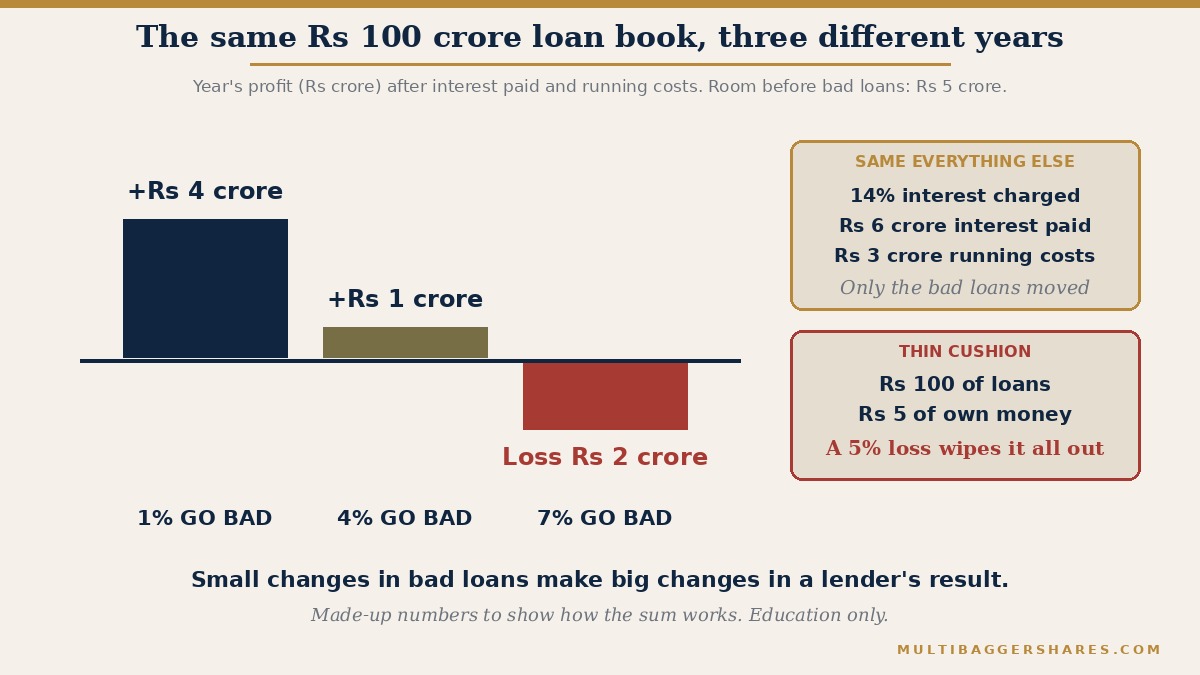
Look at what did not change. The interest rate was the same. The staff and the rent were the same. Only the share of loans that failed moved, from 1% to 7%, and the result swung from a healthy profit to a loss. That is why a careful lender and a careless one can look almost the same on a busy day and completely different at the end of the year.
There is a second reason, and it makes the first worse. Lenders use a lot of borrowed money, which means the cushion of their own money is thin. Leverage (using borrowed money to do more than your own money alone would allow) is like driving fast on a narrow road. In his 1990 letter to the shareholders of Berkshire Hathaway, the same letter in which he described buying about a tenth of Wells Fargo, a large American bank, for about $290 million, Warren Buffett wrote that the banking business was no favourite of his. His reason was this: when assets are twenty times equity, mistakes on only a small portion of assets can destroy a major portion of equity.
Do the arithmetic yourself. Suppose a lender has Rs 100 of loans and only Rs 5 of its own money. That is twenty times. If just 5 rupees out of the 100 lent are lost, the whole of the owners’ money is gone. This is told only as history, to show how the sum works. It is not a view on any company or share.
The slow-moving trap
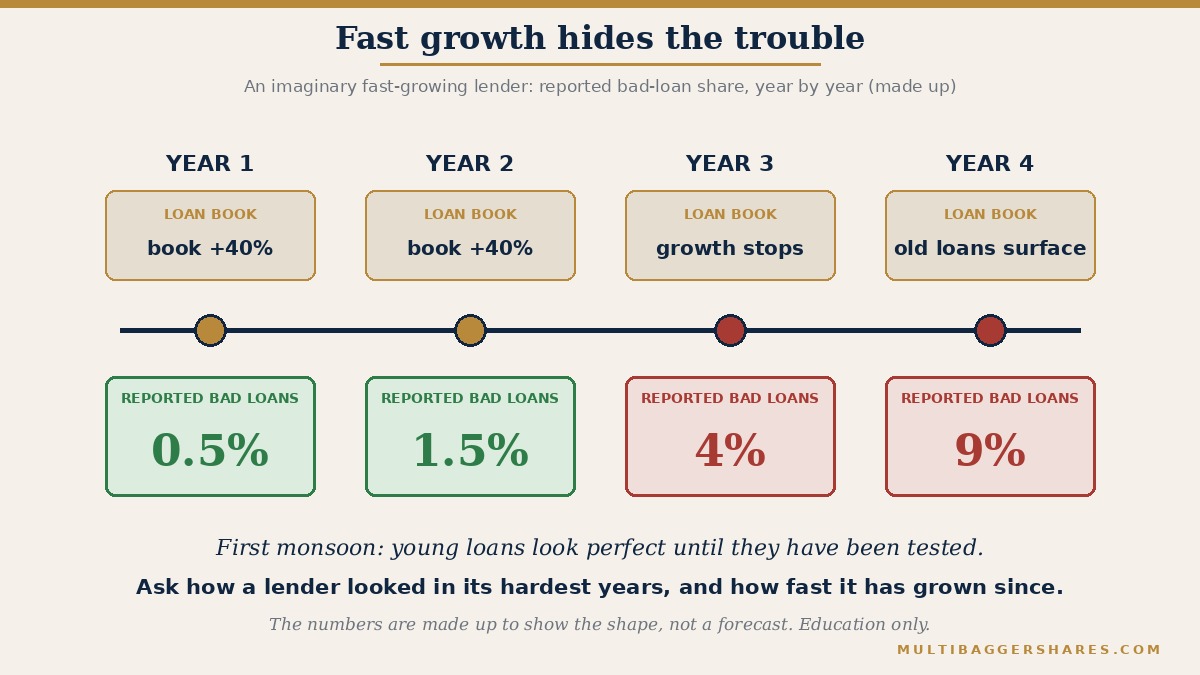
Here is the part that fools even careful people. A bad loan does not show up on the day it is made. A borrower usually pays the first few instalments. Trouble comes months or even years later. So when a lender is growing very fast, most of its loans are young, and young loans have not yet had time to go wrong. Its bad-loan percentage looks lovely.
Think of a new road that has just been laid. It is smooth and black and it looks perfect. But nobody can say how good it is until it has been through its first monsoon. In lending, this time for a loan to prove itself is called seasoning. A loan book that is mostly unseasoned has not yet been tested.
Go back to Sunrise. In its first two years the book grows 40% a year. Almost every loan is new. In the first year only 0.5% of its loans look bad, and in the second year 1.5%. Visitors say, “What a clean lender.” Then in the third year it slows down, because it has run out of easy borrowers and because the people who lent Sunrise its money become nervous. With no new loans to flatter the percentage, the older loans stand out. The bad-loan share jumps to 4%, and then to 9%. Nothing suddenly changed about the borrowers. The road simply met its first monsoon.
This is also why a very high interest rate is not always good news. In our example both lenders charge the same 14%, so Sunrise wins customers only by saying yes. In real life, lenders who say yes to risky borrowers often charge more to cover the risk. A high rate can then be a sign that the lender is lending where others will not. The extra interest is only earned on loans that are actually repaid.
A real example or two
Our first example is a piece of Indian history, told only as a record. The Reserve Bank of India, the country’s central bank, publishes a Financial Stability Report twice a year. Business Standard reported that the June 2018 report put the gross NPA ratio of scheduled commercial banks (the main banks of the country) at 11.6% at the end of March 2018. That means that more than Rs 11 out of every Rs 100 lent by the system was stuck. Years of fast lending, much of it in good times, had been tested by a hard patch.
Now fast-forward. The Reserve Bank’s June 2026 report, as widely reported, showed the same ratio at 1.8% at the end of March 2026, described as a multi-decade low. Its own baseline view was that the ratio could edge up to about 1.9% by March 2028. The same banks, in the same country, moved from one of the worst patches to one of the best. Part of this was a clean-up of old loans, and part was more careful lending afterwards.
What should a thoughtful reader take from this? Not that a low number is a certificate. A figure of 1.8% is a photograph of a good period. The lesson from Sunrise is that a photograph taken in good times can hide the seasoning problem. A wise reader asks how the same lender looked in its hardest years, and how fast it has grown since.
Our second example is the one from Buffett’s letter. The lesson was not that lending is wrong. Banks and lenders do a useful job for society. The lesson was that because the cushion is so thin, the quality of lending matters more than the quantity of lending. The most important line in a lender’s story is not how much it lent. It is how little of what it lent was lost.
How you can use it
You do not need to be a banker to use these ideas. When you read about any lender, whether a bank or a finance company, here are five plain questions. Everything below is for learning how to judge quality. It says nothing about any particular company or its share price.
Question one: how fast has the loan book grown? A lender that has grown 30% or 40% a year for several years has mostly young loans. That is not wrong in itself, but it means the book has not yet been tested. Compare its growth with the growth of the country’s economy and with the growth of its careful peers.
Question two: what did the bad-loan percentage look like across many years, including the last hard patch? Look back five or ten years. A lender that kept its bad loans low even in a bad year has shown something real. A lender with a lovely number only in the most recent good year has shown much less.
Question three: how many loans were written off, and not only how many are still counted as bad? A lender can keep its bad-loan percentage low by writing loans off quickly. That is not wrong, because it is honest to remove a lost loan. But you must look at both numbers together, or you will think the lender is cleaner than it is.
Question four: how thick is the cushion? Check how much of the loan book is covered by the owners’ own money. A thick cushion lets a lender survive a few bad years. A thin one means a small mistake can become a very large problem, just as in Buffett’s twenty times example.
Question five: who are the borrowers, and what stands behind the loans? Lending to salaried people with steady pay is different from lending to people with irregular income. A loan backed by something the lender can take and sell, such as gold or a property (this backup is called collateral), is safer than a loan backed only by a promise. A lender that visits, checks and keeps a backup is behaving like Steady Finance. A lender that hands out money in ten minutes with no questions is behaving like Sunrise.
A few cautions will keep you balanced. First, no lender can avoid all bad loans, and a lender with zero bad loans is probably not lending enough to earn its keep. Second, one good year proves little, and one bad year proves little too. Third, the numbers in this article are made up to teach the shape of the idea, so please do not use them as a yardstick for any real lender.
There is something calming in all this. We cannot know when the next hard patch will come. But we can learn to tell the difference between a lender that is growing and a lender that is growing carefully. The first kind often makes the louder noise. The second kind is usually the one still standing when the rain arrives. That is the whole lesson of the loan that does not come back.
This article is for education only. It does not tell you what to do with any particular investment.
Key takeaways
- A lender sells a promise of repayment, so a loan is only a good sale on the day the last instalment comes back.
- A small rise in bad loans can erase a lender’s profit: in the made-up example, the same Rs 100 crore book earns Rs 4 crore with 1% bad loans and loses Rs 2 crore with 7%.
- Lenders use borrowed money, so their own cushion is thin; with assets twenty times equity, a 5% loss wipes out all the owners’ money.
- Fast growth hides trouble because young loans have not yet been tested; the bad-loan percentage can look tiny, then jump once growth slows.
- Ask five questions: how fast has the book grown, how did bad loans look in hard years, how many were written off, how thick is the cushion, and what stands behind the loans.
— Manish Goel · multibaggershares.com
Manish Goel is a Chartered Accountant and Principal Officer of Multibagger Securities Research & Advisory Pvt. Ltd. (MSRAPL), a SEBI-registered Investment Adviser, Registration No. INA100007736. This content is published by MSRAPL for education only and is not personalized investment advice.
Disclaimer: This article is published by multibaggershares.com for education and general information only. It is not investment advice, investment research, or a recommendation to buy, sell or hold any security. Any companies named are discussed only as illustrative examples. Markets carry risk; please do your own research or consult a qualified professional before making any investment decision. |