Economic Moats: How to Find Companies That Competitors Simply Cannot Destroy

How Titan Biotech Turned ₹1 Lakh into ₹50 Lakh — A Value Investing Case Study
March 15, 2026
Rupee at ₹93/$ — Why This Is a Golden Opportunity for Pharma & Biotech Investors
March 16, 2026
March 16, 2026
(Monday)
What Is an Economic Moat?
In the world of value investing, few concepts are as powerful — or as misunderstood — as the economic moat. Coined by Warren Buffett, the term refers to a company’s ability to maintain a sustainable competitive advantage over its rivals, much like a moat protects a castle from invaders.
Buffett once said: “In business, I look for economic castles protected by unbreachable moats.” For Indian retail investors seeking multibagger returns, understanding economic moats is not optional — it is essential. A company with a wide moat can compound wealth for decades, while a company without one will eventually see its profits eroded by competition.
Today, we’ll explore the five types of economic moats, how to identify them in Indian companies, and why Titan Biotech Ltd (BSE: 524717) serves as a compelling real-world example of a niche moat builder that has delivered extraordinary returns to patient investors.
The Five Types of Economic Moats
1. Cost Advantage Moat
A company with a cost advantage can produce goods or services at a lower cost than competitors while maintaining similar quality. This allows it to either undercut rivals on price or earn fatter margins at the same price point.
How to identify it: Look for consistently higher operating margins compared to industry peers, economies of scale, proprietary manufacturing processes, or access to cheaper raw materials. Companies like Titan Biotech, which have built vertically integrated manufacturing facilities over decades, often develop cost advantages that new entrants simply cannot replicate overnight.
2. Switching Cost Moat
When customers find it expensive, time-consuming, or risky to switch to a competitor’s product, the company enjoys a switching cost moat. This is especially powerful in B2B businesses where products are deeply embedded in the customer’s operations.
How to identify it: High customer retention rates, long-term contracts, products that require training or certification, and integration into customer workflows. In the life sciences industry, switching from one supplier of biological peptones and culture media to another involves revalidation, regulatory paperwork, and quality risk — creating natural switching costs.
3. Network Effect Moat
A network effect exists when the value of a product or service increases as more people use it. This is most common in technology and platform businesses. While less common in traditional manufacturing, understanding this moat type rounds out your analytical toolkit.
How to identify it: User growth accelerates without proportional marketing spend, two-sided marketplaces, and winner-take-most dynamics in the industry.
4. Intangible Assets Moat
Brands, patents, regulatory licenses, and proprietary know-how create barriers that competitors cannot easily overcome. A pharmaceutical company with 20 patents, a consumer brand with fierce loyalty, or a manufacturer with specialized certifications all enjoy intangible asset moats.
How to identify it: Brand premium pricing power, patent portfolios, ISO/GMP/regulatory certifications, and proprietary formulations. Titan Biotech holds multiple quality certifications and has built specialized expertise in manufacturing biological peptones and dehydrated culture media — a niche domain where expertise takes years to develop.
5. Efficient Scale Moat
When a market is only large enough to support one or a few profitable players, the incumbents enjoy an efficient scale moat. New entrants would drive industry profitability below acceptable levels, so rational competitors stay away.
How to identify it: Limited number of competitors in the niche, stable market shares over long periods, and modest market size that doesn’t attract large players. The biological peptones and culture media market in India is exactly this kind of niche — too small for MNC giants to prioritize, but profitable enough for a focused player like Titan Biotech to dominate.
Case Study: Titan Biotech Ltd — A Niche Moat Builder
Let’s apply the economic moat framework to a real company that has rewarded long-term investors handsomely.
Company Snapshot (As of March 2026)
- CMP: ₹368.55 (post stock split — ₹10 face value split to ₹2)
- Market Cap: ~₹305 Crores
- Debt-to-Equity: 0.04x (virtually debt-free)
- Net Profit Growth (Q3 FY26): 94-107% YoY
- 52-Week High: ₹400
- Revenue (Q3 FY26): Highest-ever quarterly net sales of ₹56.51 Crores
- Exports to: 75+ countries worldwide
- Multibagger Returns: ₹1 Lakh invested early could have grown to ₹42+ Lakhs (4,200%+ returns)
Identifying Titan Biotech’s Moat
Titan Biotech doesn’t have just one moat — it has a combination of moats working together, which is the hallmark of truly exceptional businesses:
🔬 Intangible Assets: Decades of specialized expertise in biological peptones and dehydrated culture media. This isn’t a business you can start by simply setting up a factory. The formulation knowledge, quality consistency, and regulatory approvals take years to build. Titan Biotech holds ISO certifications and has established credibility across 75+ countries.
💰 Cost Advantage: Having operated in this niche for decades, Titan Biotech has optimized its manufacturing processes, supplier relationships, and distribution networks. Their operating margins reflect this advantage. With a debt-to-equity of just 0.04x, the company doesn’t burn cash on interest payments — every rupee of operating profit flows more directly to the bottom line.
🔄 Switching Costs: In the life sciences and pharmaceutical industry, changing your raw material supplier (especially for culture media and peptones) requires extensive revalidation. Customers in 75+ countries rely on the consistency and quality of Titan Biotech’s products. Switching involves regulatory risk, time delays, and potential quality issues — costs most customers would rather avoid.
📏 Efficient Scale: The niche market for biological peptones in India is not large enough to attract Reliance, Tata, or multinational pharma giants. But for a focused company like Titan Biotech, this ₹300+ crore revenue opportunity is highly profitable. This efficient scale acts as a natural barrier.
How to Use the Moat Framework in Your Stock Analysis
Here is a practical step-by-step process you can follow before investing in any stock:
Step 1: Identify the Moat Type
Ask yourself: Why can’t a well-funded competitor replicate this business in 3-5 years? If you can’t answer this question convincingly, the company may not have a moat. Write down which of the five moat types applies.
Step 2: Check the Financial Evidence
A true moat shows up in the financial statements. Look for:
- Consistent or improving Return on Capital Employed (ROCE) above 15% over 5+ years
- Stable or expanding profit margins even during industry downturns
- Low debt-to-equity ratio (like Titan Biotech’s 0.04x) — companies with moats don’t need to borrow heavily
- Strong free cash flow generation — moats translate into cash, not just accounting profits
- Revenue growth without proportional increase in capital expenditure
Step 3: Assess Moat Durability
A moat today doesn’t guarantee a moat tomorrow. Consider:
- Is the industry facing technological disruption?
- Are regulatory changes threatening the company’s position?
- Is a well-funded competitor entering the niche?
- Is the company investing in R&D to strengthen its moat?
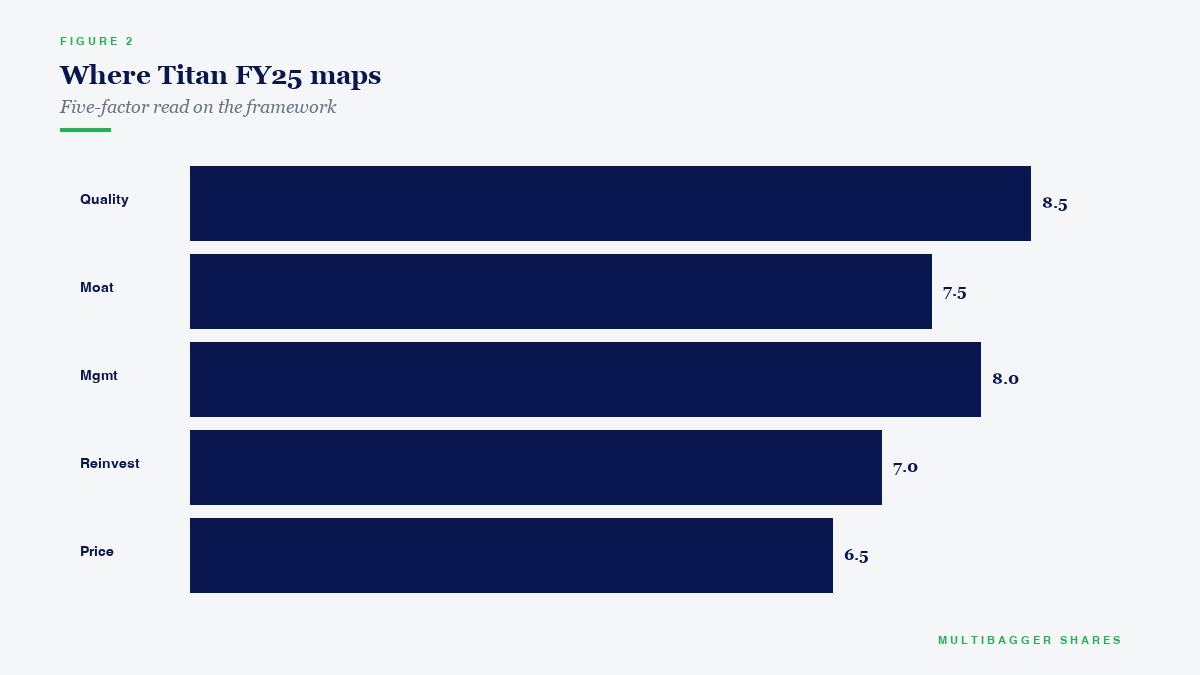
Titan Biotech’s moat appears durable because biological peptones and culture media are essential inputs for the growing pharmaceutical, biotechnology, and food testing industries. As India’s biotech sector expands, demand for these products should grow structurally.
Step 4: Determine the Price You’re Willing to Pay
Even the widest moat is worthless if you overpay. Benjamin Graham’s principle of margin of safety still applies. Calculate intrinsic value using discounted cash flow (DCF) or earnings-based models, and buy only when the stock trades at a meaningful discount.
Common Mistakes Investors Make When Evaluating Moats
Mistake #1: Confusing temporary advantages with durable moats. A company might have a hot product today, but if competitors can replicate it in 12 months, there’s no moat. True moats take years to build and are nearly impossible to replicate quickly.
Mistake #2: Ignoring moat erosion. Companies like Nokia and Kodak once had powerful moats that eroded due to technological disruption. Always monitor whether the moat is widening or narrowing over time.
Mistake #3: Overvaluing brand without pricing power. A well-known brand without the ability to raise prices is not a moat. True brand moats come with pricing power — customers willingly pay a premium.
Mistake #4: Neglecting management quality. Even the widest moat can be destroyed by poor capital allocation. Look for management teams with skin in the game (promoter holding), conservative financial policies (low debt), and a track record of reinvesting profits wisely. Titan Biotech’s near-zero debt policy is a signal of disciplined management.
The Moat Checklist for Indian Retail Investors
Before you invest in any stock, run through this checklist:
- ☐ Can I identify at least one clear moat type?
- ☐ Has the company maintained above-average ROCE for 5+ years?
- ☐ Is the debt-to-equity below 0.5x?
- ☐ Are profit margins stable or improving over the last 5 years?
- ☐ Does the company have pricing power (can it raise prices without losing customers)?
- ☐ Is the moat widening or at least stable?
- ☐ Is management aligned with minority shareholders?
- ☐ Am I buying at a reasonable valuation with a margin of safety?
If you can check 6 or more of these boxes, you’ve likely found a high-quality business worth owning for the long term.
Conclusion: Build Your Portfolio Around Moats
The greatest value investors — Warren Buffett, Charlie Munger, and in India, investors like Manish Goel who identified Titan Biotech early — all share one common trait: they invest in businesses with durable competitive advantages. They don’t chase tips, momentum, or quarterly results. They study moats.
Titan Biotech’s journey from a small-cap niche player to delivering 4,200%+ returns is a testament to what happens when you combine a strong economic moat with conservative financial management (0.04x debt-to-equity), consistent execution (exports to 75+ countries), and patient capital.
The lesson is clear: Find the moat, buy at a fair price, and let compounding do the rest.
— Manish Goel
SEBI Registered Research Analyst
Multibagger Securities Research & Advisory Pvt. Ltd.
Investment Adviser INA100007736
Disclaimer: This article is for educational purposes only and does not constitute financial advice. The author may hold positions in stocks mentioned. Always conduct your own research and consult a SEBI-registered financial advisor before making investment decisions. Stock market investments are subject to market risks. Past performance does not guarantee future returns.