The Date on the Money: Why Money You Will Need Soon Does Not Belong in Shares

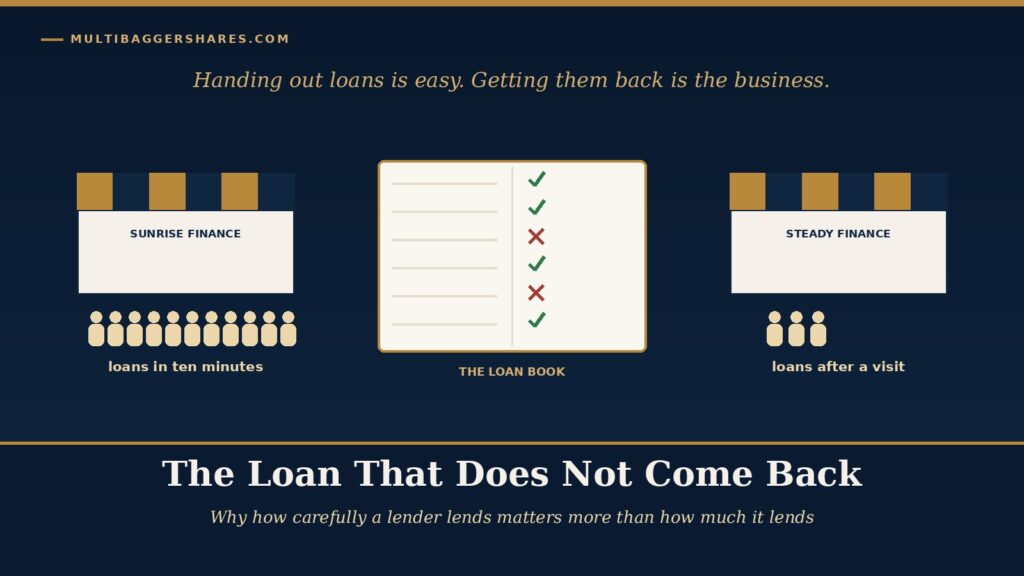
The Loan That Does Not Come Back: Why How Carefully a Lender Lends Matters More Than How Much It Lends
October 25, 2026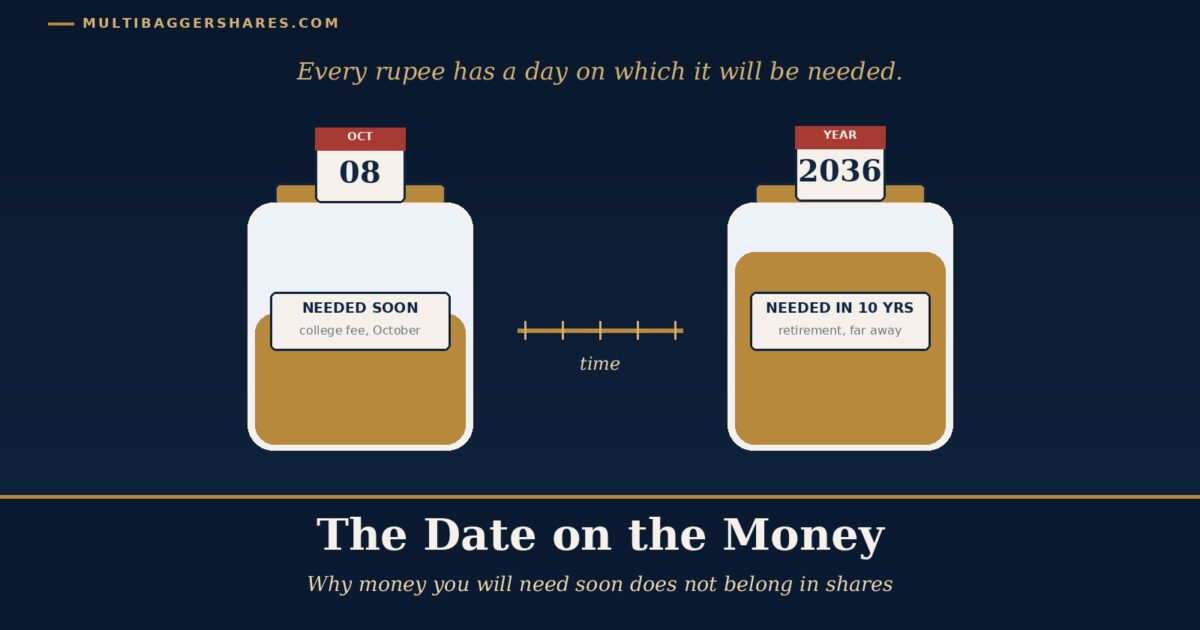
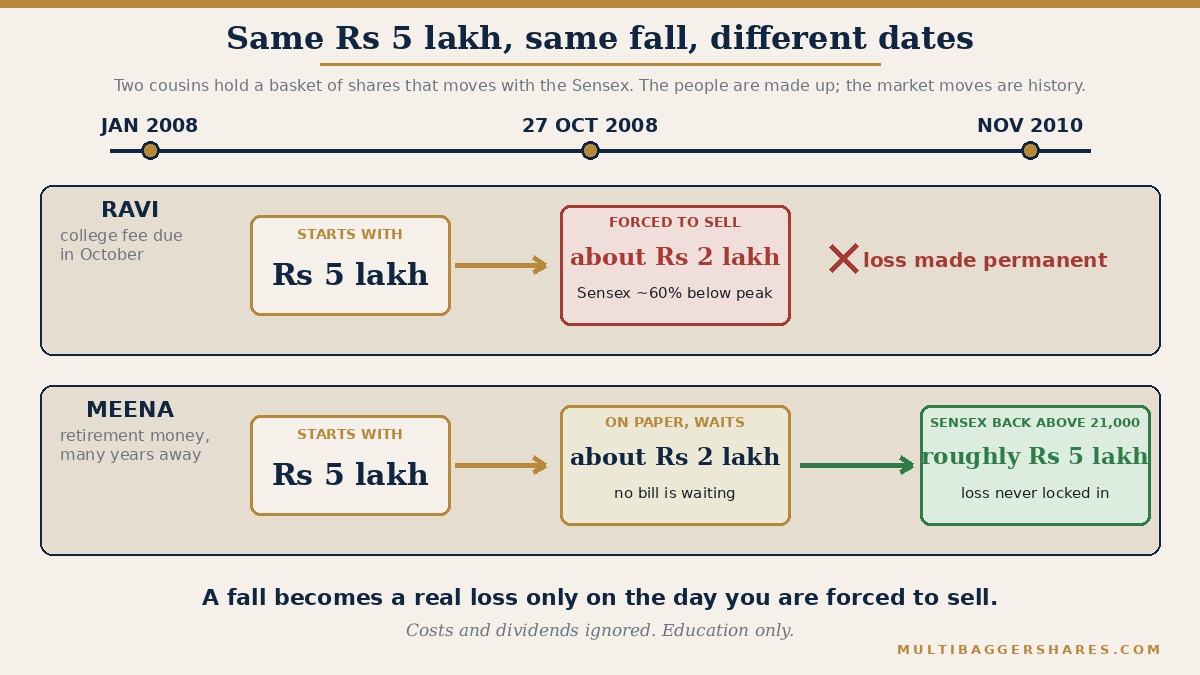
Two cousins, Ravi and Meena, each have Rs 5 lakh in the first week of January 2008. Everything about them in this story is made up to teach an idea, but the market numbers are real history. Both put their money into a basket of shares that simply moves with the Sensex (the index, or scoreboard, that follows thirty large companies on the Bombay Stock Exchange). To keep the sums simple, we ignore costs and dividends.
Ravi’s daughter will start college in October 2008, and the first year’s fees are due that month. Meena’s money is for a day many years away, when she plans to stop working. In January neither cousin thinks about this difference. They have done the same thing and they feel equally clever.
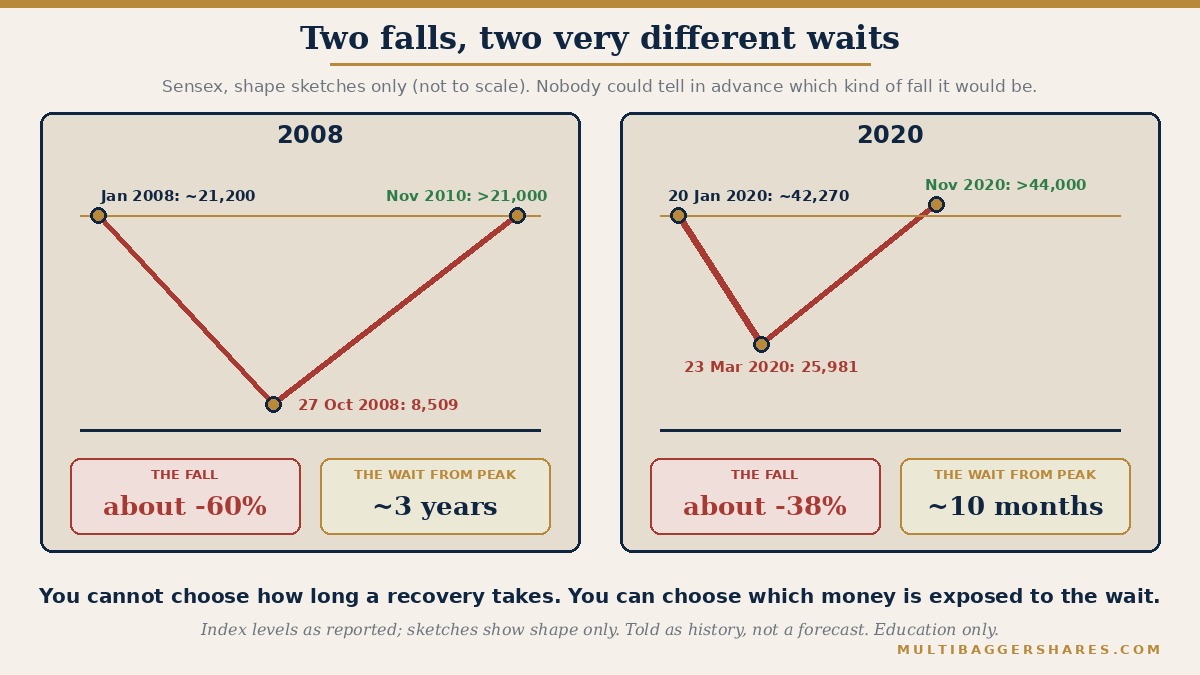
Then the market falls. On 27 October 2008, the Sensex closed at 8,509. In January that year it had touched about 21,207. So the scoreboard was roughly 60% lower. Ravi’s Rs 5 lakh had become about Rs 2 lakh, and the college fee was due that week. He had no choice. He sold, paid the fee with the money that was left, and carried a loss he could never undo.
Meena also saw her Rs 5 lakh turn into about Rs 2 lakh on paper. It hurt. But no bill was waiting for her. She waited. By November 2010 the Sensex was back above 21,000, and her basket was roughly back where she had started. The same market, the same shares, the same fall. One cousin lost about Rs 3 lakh for good and the other lost nothing but sleep. Today’s lesson is about why.
What it really means
The difference between the cousins was not skill, and it was not luck in picking shares. It was the date on the money. Every rupee you save is meant for something: a school fee next year, a wedding in four years, a home in ten, a calm retirement in thirty. Each of those purposes has a day when the money must be in your hand. That day is the date on the money.
Shares have a feature that matters a great deal here. Their prices swing. Finance people call this volatility (how much and how quickly a price moves up and down). A swing in price is not the same thing as a lasting loss of value, but it can become one if you are forced to sell in the middle of the swing. A fall only turns into a real loss on the day you are made to sell.
A fixed deposit, or FD (a bank account where you lock money for a set period and the bank pays you a fixed interest), behaves very differently. Its value on any given day is steady, and you know roughly what you will get on the due date. The price of that steadiness is a lower long-run return. So the question is never “which is better, shares or an FD?” The better question is “when do I need this particular money?”
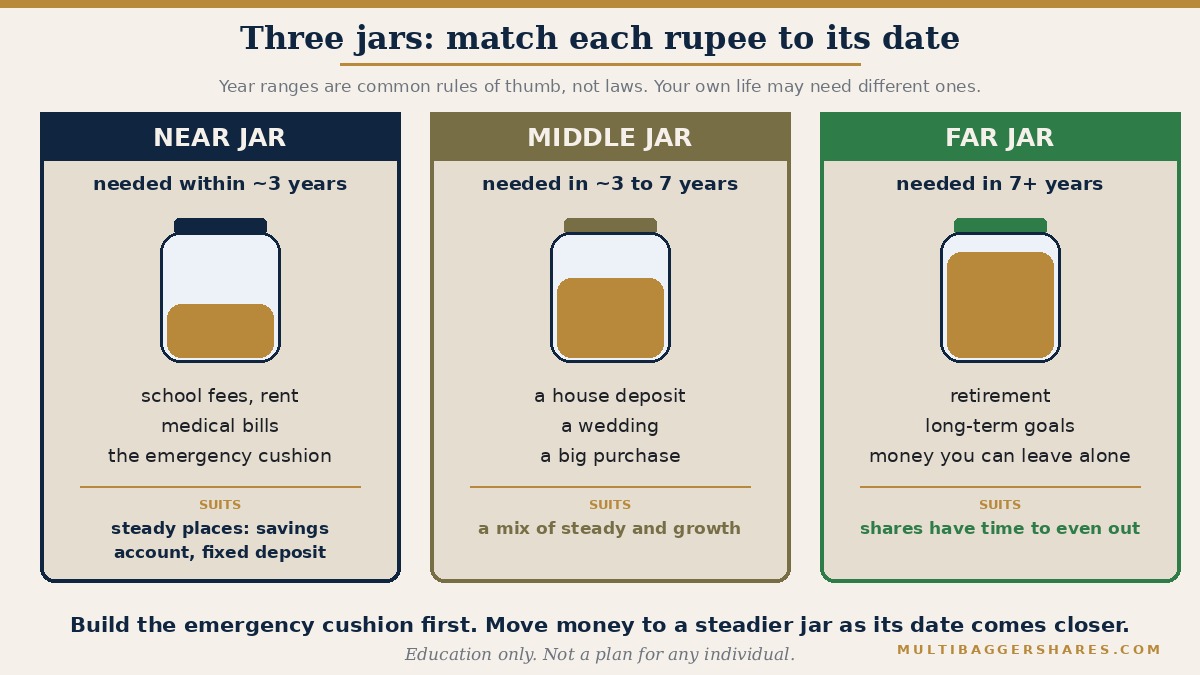
Here is a simple way to think about it. Imagine three jars on your kitchen shelf. The near jar holds money you will need within about three years: fees, rent, medical bills, and an emergency fund (a cushion of money kept aside for a sudden need, such as a job loss or a hospital stay). The middle jar holds money you will need in roughly three to seven years. The far jar holds money you will not touch for seven years or more. These year ranges are only common rules of thumb. Your own life may need different ones.
Why it works
Think of a farmer deciding what to plant. Spinach grows in a few weeks. Sugarcane takes the better part of a year or more. A farmer who needs cash in two months does not plant sugarcane. It is not because sugarcane is a bad crop. It is because the farmer’s date does not match the crop’s calendar. If he is forced to cut the cane early, he gets a little and wastes a great deal.
Shares are like sugarcane. Over long stretches, ownership of good businesses has rewarded patient owners, because the businesses keep selling, keep earning, and keep growing while the price board outside the exchange keeps changing its mood. But the mood can turn dark for a year, or for three. The owner who can wait lets the business do its work. The owner who cannot wait is forced to accept whatever mood the market is in on the one day he must sell.
Warren Buffett, the chairman of Berkshire Hathaway, made the point in his shareholder letter for 2014: “Stock prices will always be far more volatile than cash-equivalent holdings.” In the same letter he said that anyone who might have meaningful needs for money in the near term should keep appropriate sums in very safe places, such as government bonds or insured bank deposits. He was describing the same two jars we are talking about.
There is a second reason the date matters, and it is the arithmetic of recovery. After a 60% fall, getting back to where you began is not a 60% climb. If Rs 5 lakh has become Rs 2 lakh, you need to gain Rs 3 lakh on a base of Rs 2 lakh, which is a 150% rise. Such a climb takes time. Time is exactly what Ravi did not have and Meena did.
Notice what time does and does not do. Time does not guarantee that any single share will recover. Businesses can fail, and that is a different lesson about quality. Time simply gives a broad basket of sound businesses room to ride out the mood swings, which is the thing a short date takes away.
A real example or two
Our first example is the one you just read, told only as history. The Sensex reached about 21,207 in January 2008. On 27 October 2008 it closed at 8,509, and it had dipped even lower that day, to 7,697. It took until November 2010, nearly three years after the peak, for the index to climb back above 21,000. A person with a date in 2009 was hurt badly. A person with a date in 2020 was barely affected.
Our second example is more recent. The Sensex touched about 42,274 on 20 January 2020. Then came the first weeks of the Covid lockdown, and on 23 March 2020 it closed at 25,981, about 38% below that peak. If the 2008 story had made you expect a three-year wait, the next chapter surprised everyone. By November 2020 the Sensex was trading above 44,000, higher than its January peak, less than a year after the high.
What should a thoughtful reader take from the two stories side by side? Not that falls are always short, and not that they are always long. One took nearly three years to heal and the other about ten months. Nobody on the day of the fall could have told you which kind it was. That is the whole point. You cannot choose how long a recovery will take, but you can choose which money is exposed to the wait.
There is also a mistake in the other direction, and fairness requires us to mention it. Money with a date far away, kept entirely in a drawer or entirely in a bank deposit, faces its own quiet problem. Inflation (the slow rise in prices, which means that Rs 100 buys a little less each year) eats into it. In the same 2014 letter, Buffett argued that over very long periods, holding only money-like instruments can be a riskier path than owning a wide mix of good businesses. The jars are not a rule that shares are bad. They are a way of putting each rupee where its date can be respected.
How you can use it
You do not need any financial training to use this idea. It is a habit of mind, and it takes an evening. Everything below is for learning how to think. It says nothing about any particular company, fund or share price, and it is not a plan for any individual.
Step one: write down what your money is for, and put a rough date next to each purpose. A child’s school fee in two years. A trip in one. A house deposit in six. Retirement in twenty-five. Do not worry about being exact. A rough date is far better than none.
Step two: sort each purpose into a jar. Near dates go in the near jar, middle dates in the middle jar, far dates in the far jar. Ask one question of each rupee: “If the market fell by half next month, would I be forced to sell this money to pay a bill?” If the honest answer is yes, that rupee belongs in a steadier place.
Step three: build the emergency cushion first. Many planners suggest keeping several months of household expenses aside, but the right amount depends on how steady your income is and how many people depend on you. The cushion is what stops a surprise from forcing you to sell shares at a bad moment. It is the reason Meena could wait and Ravi could not.
Step four: let money move between jars as its date comes closer. Meena’s retirement money sits in the far jar today. As the date approaches, say within five years or so, it becomes middle-jar money, and later near-jar money. A date does not stay still. It walks toward you, and the jar it belongs in changes along the way.
A few cautions will keep you balanced. First, the jars are a way of thinking, not a formula. Your income, your family and your health shape the right answer for you, and a qualified professional can help you with that. Second, a long date does not make every share safe, so the quality of what you own still matters most. Third, the years in this article are rules of thumb and the market numbers are history. None of it is a forecast.
There is something calming in this habit. You cannot know whether the next fall will last ten months or three years. But you can make sure that the money you will need soon is not standing in its way. When the market mood turns dark, the person whose bills are already safe can look at the price board and feel no urgency to do anything at all. That patience is not a personality trait. It is simply what a date written on the money buys you.
This article is for education only. It does not tell you what to do with any particular investment.
Key takeaways
- Every rupee has a date on which you will need it, and that date matters more than which share or deposit it sits in.
- A fall in prices becomes a lasting loss only if you are forced to sell: in 2008 a cousin who needed money in October lost about 60%, while one who could wait was back to even by November 2010.
- Recovery takes time and the wait is unpredictable: the Sensex took nearly three years to recover after 2008 but under a year after March 2020.
- Use three jars: near money (about three years or less) in steady places, far money (seven years or more) where shares have time to even out, and a mix in between.
- Build the emergency cushion first, and move money to a steadier jar as its date comes closer.
— Manish Goel · multibaggershares.com
Manish Goel is a Chartered Accountant and Principal Officer of Multibagger Securities Research & Advisory Pvt. Ltd. (MSRAPL), a SEBI-registered Investment Adviser, Registration No. INA100007736. This content is published by MSRAPL for education only and is not personalized investment advice.
Disclaimer: This article is published by multibaggershares.com for education and general information only. It is not investment advice, investment research, or a recommendation to buy, sell or hold any security. Any companies named are discussed only as illustrative examples. Markets carry risk; please do your own research or consult a qualified professional before making any investment decision. |