The Owner With Other Goals: How to Judge a Business the Government Controls

The Other Half of the Return: Why the Dividends You Reinvest Quietly Do a Big Part of the Work
October 28, 2026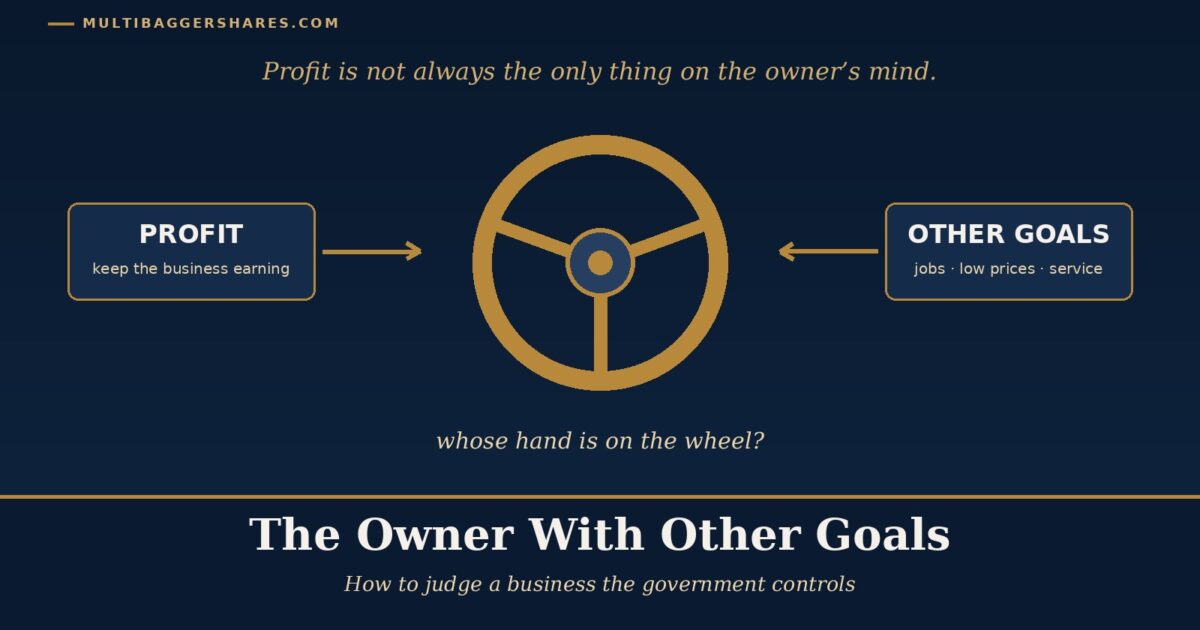
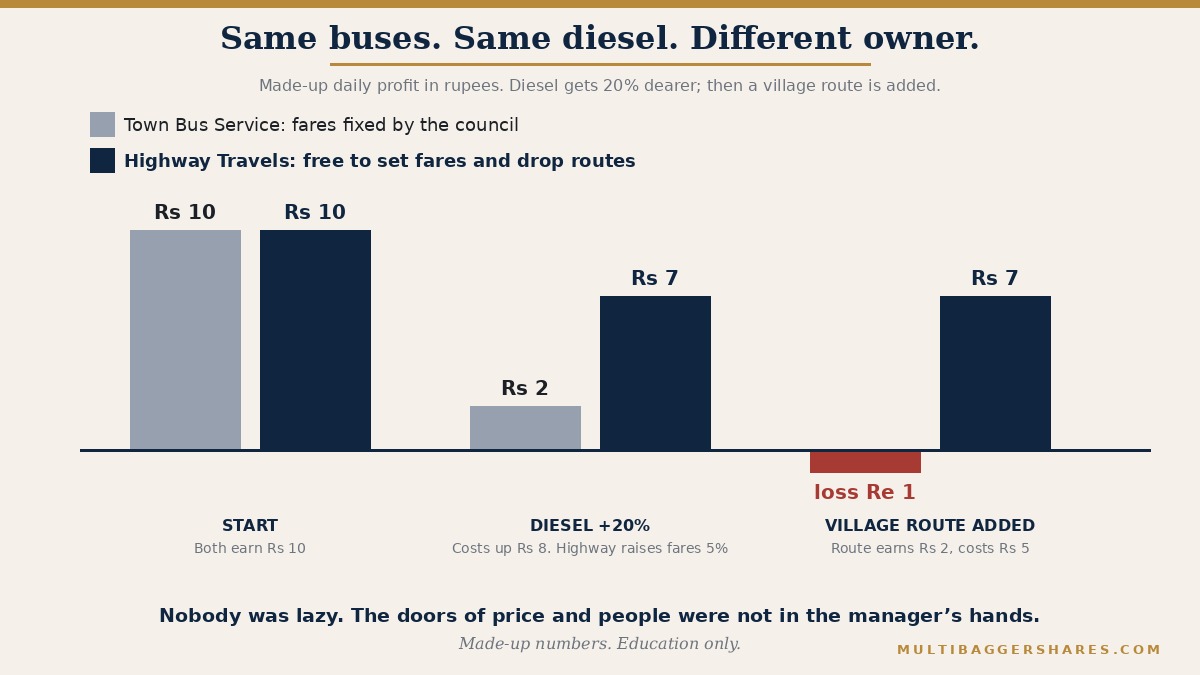
There is a town with two bus companies. Both are made up for this story. Town Bus Service is owned by the town council. Highway Travels is owned by a private family. They use the same kind of bus, the same roads and the same diesel pump. Each earns Rs 100 a day from fares and spends Rs 90 on running costs, so each makes a profit of Rs 10 a day. On paper they look like twins.
Then diesel gets 20% dearer. Diesel is Rs 40 of the Rs 90 daily cost, so the bill goes up by Rs 8. Highway Travels raises its fares by 5%, which brings in Rs 5 more, and its profit falls from Rs 10 to Rs 7. Town Bus Service cannot do that. The council has fixed the fares, and a fare rise needs a decision in a meeting. Its profit falls from Rs 10 to Rs 2.
A month later the council asks Town Bus Service to keep running a village route that earns Rs 2 a day and costs Rs 5. The villagers need it, and the council is happy to ask. Town Bus Service now makes a loss of Re 1 a day. Highway Travels is free to drop such a route and stays at Rs 7. Same buses. Same roads. Same diesel. A very different result, and no one in the story was lazy or foolish. The difference is who the owner is and what the owner wants.
What it really means
Every business has a boss, and the boss wants things. In most companies the biggest owner is a family or a founder, and the main wish is plain: grow the business and make it earn more. In some companies the biggest owner is the government. The words you will see are PSU (public sector undertaking, a company owned mainly by the government) and CPSE (central public sector enterprise, a company in which the central government, or other such companies, hold at least 51% of the shares). Many PSUs are listed on the stock exchange, so ordinary people can own a small slice of them.
A government owner can have a wider list of wishes. It may want jobs for many people. It may want a basic service to reach far-off places, even where it loses money. It may want prices kept low for ordinary families. It may want the company to support a national plan. These are not bad wishes. Many of them are good for the country. The point for you, as someone who studies businesses, is only this: profit is not the sole wish of such an owner, and a business that is asked to do many things at once will not look like a business that is asked to do one.
This is also not a story of good and bad. A government owner can give a company real strengths. It can bring steady orders, a strong name, easy access to loans and the kind of backing that helps a company stay alive in a hard year. Some state-owned companies run very well and pay regular dividends (a share of the profit paid out to the owners in cash). The aim of this lesson is not to rank owners. The aim is to help you see whose hand is on the wheel, and what that hand is trying to do.
Why it works
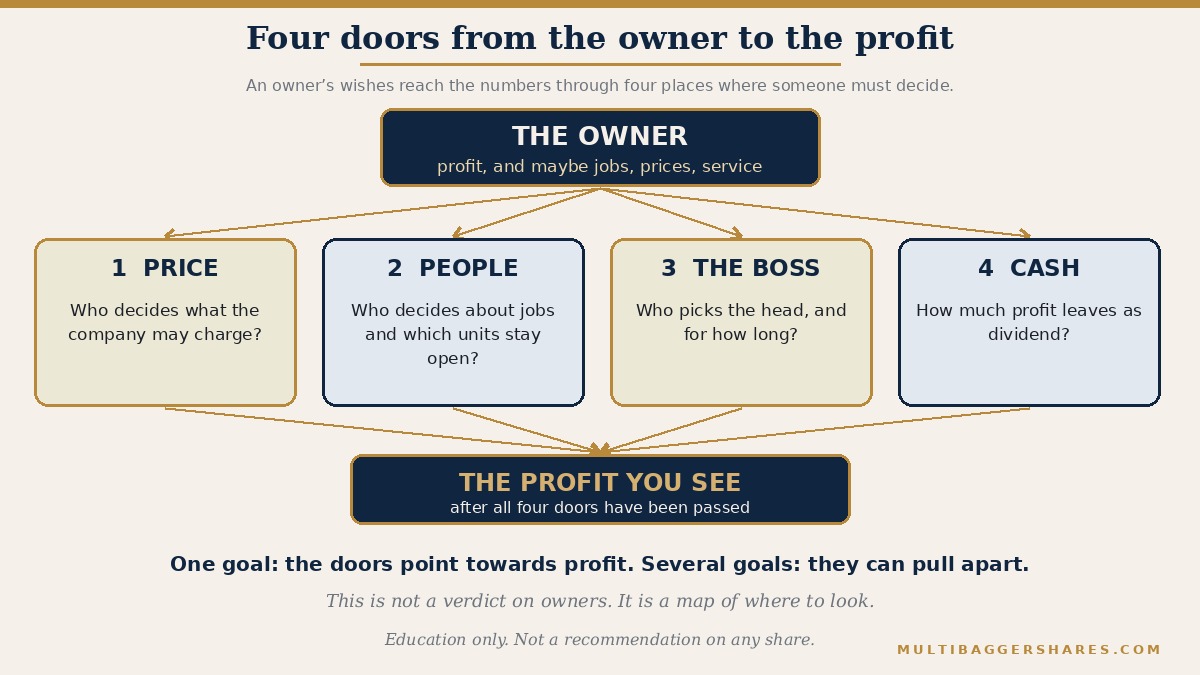
An owner’s wishes reach the numbers through four doors. Think of them as four places where someone has to decide, and where an owner with more than one goal may decide differently.
The first door is price. Who decides what the company may charge? In our made-up story, the council fixed the bus fares. In real life, some prices in India (cooking gas and fuel at various times, for example) have been kept in check by government decisions, which are called administered prices (prices set or guided by the government instead of the market). When costs rise and the company cannot raise its price, the gap comes out of its profit, exactly as in the diesel story.
The second door is people. Who decides how many people work in the company and which units stay open? A private owner may close a unit that keeps losing money. An owner who also cares about jobs in that town may not. Again, that is a fair wish. It simply has a cost, and the cost shows up in the profit.
The third door is the boss. Who picks the head of the company, and for how long? For the big central government companies, a government body called the Public Enterprises Selection Board is responsible for the top management posts. The system is meant to be orderly. For a reader, the useful thing is a question: does the head of the company have time to finish a long plan, and who do they answer to first? A founder-owner with decades ahead thinks in decades. A boss who knows the term is limited may think in years.
The fourth door is cash. Who decides how much of the profit goes out as dividend, and how the rest is used? In November 2024, the Department of Investment and Public Asset Management (DIPAM, part of the Finance Ministry) issued revised rules for the central government’s companies. Under them, a company is generally expected to pay a dividend of at least 30% of its profit after tax (the profit left once all costs, interest and tax are paid) or 4% of its net worth (the money that belongs to the owners: what the company would have left if it paid off everything it owes), whichever is higher. Public sector banks and insurers are outside this rule. The old rule, from 2016, said 5% of net worth. For a minority shareholder (a small owner who does not control the company), a regular dividend is welcome cash. The other side is that cash paid out is cash that the company cannot use to grow. Both things are true at once.
Now look back at the bus story. The first door (price) and the second door (people) were enough to turn a profit of Rs 10 into a loss of Re 1. Nothing was wrong with the buses. The doors were just not in the manager’s hands.
There is one more point worth knowing. When the government is the controlling owner, its vote usually carries the day. Small shareholders own a real slice, and the law gives them real rights. But the final say sits with the main owner. That is true of any company with a strong promoter (the person or group that started and controls the company). With a government owner, the promoter is simply a very large and very patient one, with a longer list of wishes.
A real example or two
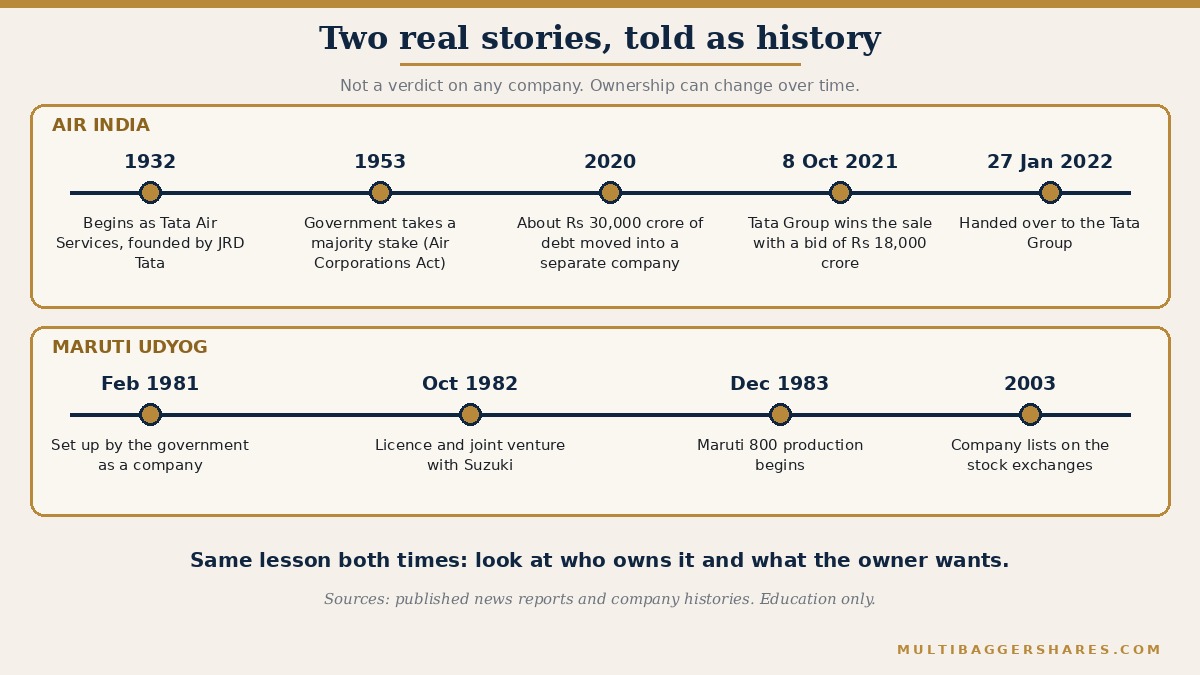
Air India is an old story that most Indians know. The airline began in 1932 as Tata Air Services, founded by JRD Tata. In 1953, under the Air Corporations Act, the government bought a majority stake and the airline became a state-owned company. JRD Tata stayed on as chairman for many years after that, until 1977. The airline stayed in government hands for about sixty-nine years.
By 2020, the airline carried a very heavy load of debt. In that year the government moved nearly Rs 30,000 crore of its debt and other liabilities into a separate company set up for the purpose. On 8 October 2021 the government accepted a bid from the Tata Group of Rs 18,000 crore for Air India. About Rs 15,300 crore of that was debt the buyer took over, and Rs 2,700 crore was cash paid to the government. The airline was handed over on 27 January 2022. When the bid was accepted, Ratan Tata posted a short message on Twitter: “Welcome back, Air India.”
What should a careful reader take from this? Not that government ownership is bad and private ownership is good. Airlines are one of the hardest businesses in the world for every owner, and many things were going on at once. The sensible lesson is smaller. A famous name and a loyal public are not enough if the people running a business are being pulled in different directions for a long time. The four doors matter. This is history only. It is not a comment on any listed company today.
A second story shows a gentler side. In February 1981, the government set up a company called Maruti Udyog to make a small car for ordinary families. In October 1982 it signed a licence and joint venture agreement with Suzuki of Japan, which took an initial 26% stake. Production of the Maruti 800 began in December 1983. Over the following years Suzuki’s stake grew, and in 2003 the company was listed on the stock exchanges. Here a government gave birth to a business, then invited a partner with one clear goal, building small cars well. The ownership mix moved over time. Again, this is told as history. Nobody can say from a story what any one ownership structure will do next.
How you can use it
When you study any company, ask who the biggest owner is. In India, the shareholding pattern (the table in which a company reports who owns how much) shows this in a few lines. The government appears under the word promoter. If the government holds the majority, you now know that the owner may have wishes beyond profit. That is not a warning. It is a prompt to ask five questions.
First: what does the biggest owner want besides profit? Look for words like service, affordability, employment, national priority or strategic in the annual report. These words are the owner’s other goals written down in plain sight.
Second: who sets the price? Can the company raise its price when its costs go up, or does someone else decide? Look at what happened to the company’s margin (profit as a share of sales) in the last year when its costs rose. If the margin swings wildly with input costs while competitors hold steady, you are probably looking at the first door.
Third: can the company say no? Can it close a loss-making unit, shrink a staff cost or drop a route? A business that cannot say no to unprofitable work will find that the unprofitable work eventually becomes most of the work.
Fourth: who chooses the boss, and how long do they stay? How many heads has the company had in the last ten years? A plan that needs ten years does not fit easily with a boss who has three.
Fifth: what happens to the cash? How much goes out as dividend, how much is kept, and what is the kept money used for? The company’s own annual report tells you. A company that pays out a lot and also keeps asking for fresh money is telling you something about its freedom. A company that keeps its cash and puts it to good use is telling you something else.
None of these questions is special to the government. Ask the same five of a family-run company and you will learn a lot. The difference is only how loud the owner’s other goals are. The more clearly you can say what the owner wants, the less the numbers will surprise you.
This article is for education only. It does not say that any government-controlled company is a good business or a bad one, and it does not tell anyone what to do with any share, fund or sum of money.
Key takeaways
- Every business has a boss with wishes. When the biggest owner is the government, those wishes can include jobs, low prices and service in far-off places, not only profit.
- A CPSE is a company in which the central government, or other such companies, hold at least 51%. Many are listed, so ordinary people can own a small slice.
- An owner’s goals reach the numbers through four doors: price, people, the boss and cash. In the made-up bus story, the first two turned a Rs 10 profit into a loss of Re 1.
- Air India and Maruti Udyog are told as history: a famous name is not enough when the people running a business are pulled in different directions, and ownership can change over time.
- Ask five questions of any company: what does the owner want besides profit, who sets the price, can it say no, who chooses the boss and for how long, and what happens to the cash.
— Manish Goel · multibaggershares.com
Manish Goel is a Chartered Accountant and Principal Officer of Multibagger Securities Research & Advisory Pvt. Ltd. (MSRAPL), a SEBI-registered Investment Adviser, Registration No. INA100007736. This content is published by MSRAPL for education only and is not personalized investment advice.
Disclaimer: This article is published by multibaggershares.com for education and general information only. It is not investment advice, investment research, or a recommendation to buy, sell or hold any security. Any companies named are discussed only as illustrative examples. Markets carry risk; please do your own research or consult a qualified professional before making any investment decision. |