The Hottest Stall on the Street: Peter Lynch’s Warning About the Hottest Stock in the Hottest Industry

The Owner With Other Goals: How to Judge a Business the Government Controls
October 29, 2026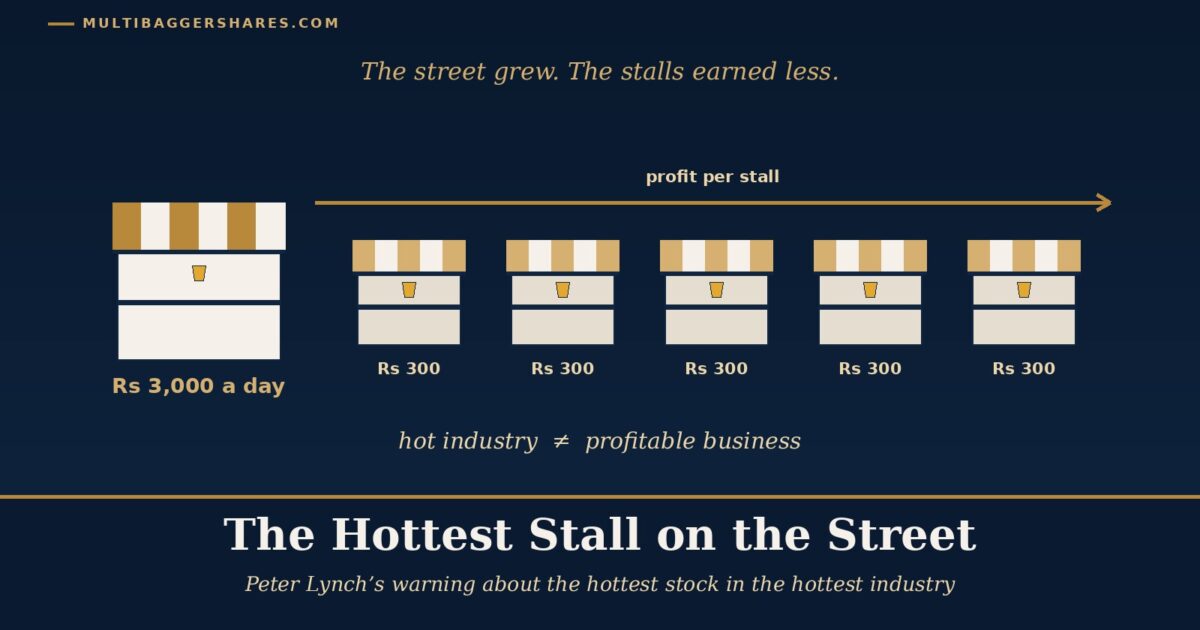
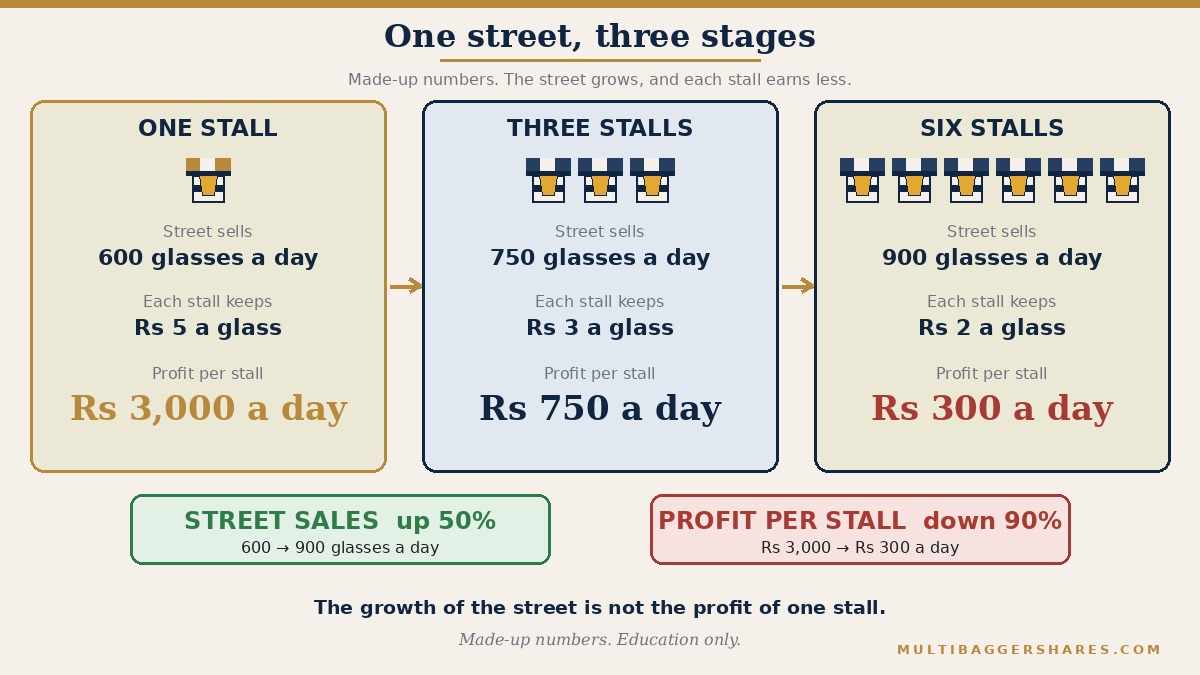
There is a busy street outside a railway station. It is made up for this story, but you have seen a hundred like it. One juice seller sits at the corner. Every day he sells 600 glasses of sugarcane juice, and after paying for cane, ice, rent and a helper he keeps Rs 5 on each glass. That is Rs 3,000 a day.
Soon the whole town is talking about him. A newspaper writes about the “juice boom”. Within a few months, two more stalls open beside him. People still come, and a few more come out of curiosity, so the street now sells 750 glasses a day. But three stalls share them, so each sells about 250. To win customers, the stalls cut their prices a little, and the profit on each glass falls to Rs 3. Each stall now earns about Rs 750 a day.
The boom goes on. A year later, six stalls stand in a row. The street now sells 900 glasses a day, which is 50% more than at the start. But each stall sells only 150 glasses, and the fight for customers has pushed the profit on each glass down to Rs 2. Each stall earns Rs 300 a day. The street grew by half. The profit of each stall fell by nine-tenths.
Nobody in this story did anything foolish. The juice really was popular. The street really did grow. And yet the people who joined late, because the business looked so hot, earned a tenth of what the first seller earned. That small picture holds a big idea from one of the most famous investors of all time.
What it really means
Peter Lynch ran the Fidelity Magellan Fund (a large American fund that pooled the money of many investors) from 1977 to 1990. In 1989 he wrote a book called One Up on Wall Street, and in it he left readers with a short list of things to remember. One line on that list is this: “Avoid hot stocks in hot industries.”
In plain words, a hot industry is a field that everyone is talking about, where sales are rising fast and new companies keep appearing. A hot stock is the most popular share (a small slice of ownership in a company) in that field. Lynch’s warning is that being popular and being profitable are two different things.
Look closely at the word industry. An industry is the whole group of companies that do the same kind of work, such as all the airlines in a country or all the juice stalls on a street. An industry can grow while the average business inside it earns less and less. In our story the street grew by half, but profit per stall fell by 90%. The growth of the street is not the same as the profit of one stall.
This is not a rule against growth, and it does not say that the internet, flying or any other new field does not matter. These things matter a great deal to the world. The point is narrower. The question for a patient owner of a business is not “Is this field exciting?” It is “Will this particular business keep the money it makes?”
It also helps to notice who gains while the crowd gathers. The juice drinker gains. He now has six stalls to choose from, cheaper juice and shorter queues. A busy, competitive field is often good for customers and good for the country. It is the owners who feel the squeeze. A patient investor is a part-owner of a business, so the investor needs to ask what is left for the owner after the customers have won.
Why it works
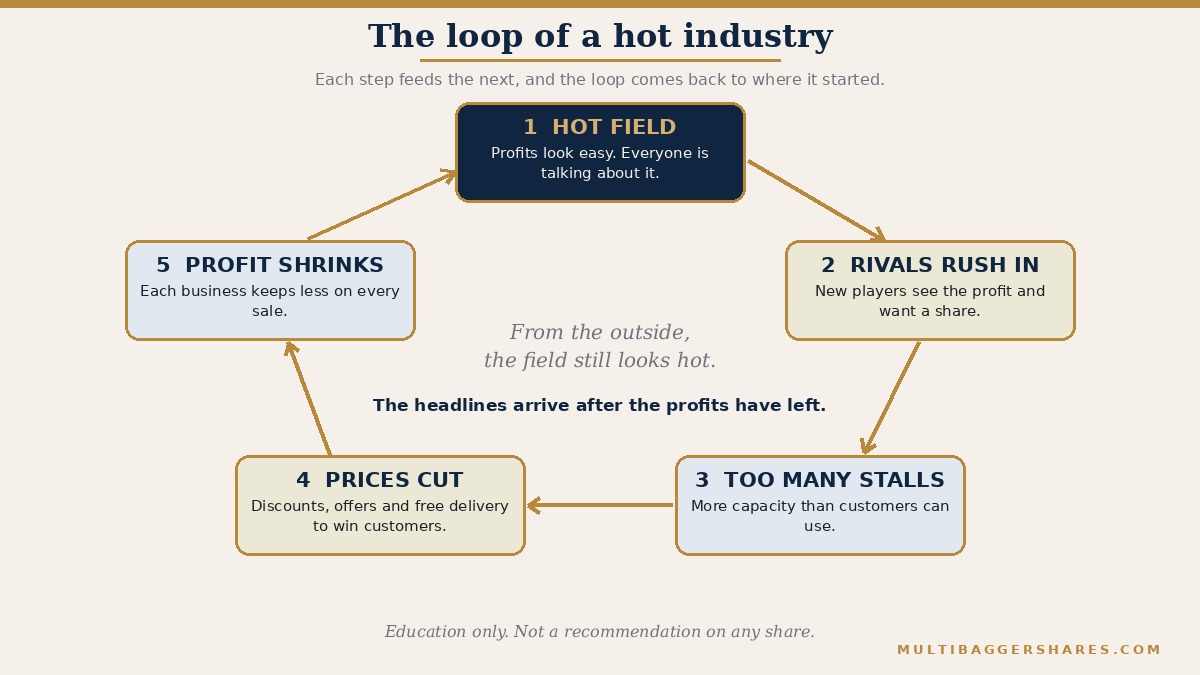
Three forces work together, and you can see all three on the juice street.
The first force is that easy money calls in rivals. When a field shows fat profits, other business people see it too. Joining in is the most natural thing in the world. Each new rival splits the customers and often cuts prices to win a share. The profit that made the field look hot is the very thing that invites the crowd that eats it.
The second force is extra capacity. Capacity means how much a field can produce or serve, such as the number of stalls, shops, factories or planes. When everyone knows a field is growing, the new rivals are often well funded. Lenders lend to them and investors hand them fresh money, and they build faster than the customers can grow. Soon the field can serve more people than there are people to serve. Spare capacity is paid for in lower prices.
The third force is that it is hard to know who will win. In a new and fast-moving field, nobody can say in year one which business model will work, which company will run well, or which will run out of cash. Many will fail even while the field as a whole thrives. Picking the one winner in advance is far harder than saying that the field will grow.
There is a fourth, quieter cost. In a hot field, every rival must keep spending just to hold its place, on bigger shops, louder advertising, free delivery or special offers. The stall owner who gives a free glass to every tenth customer is not being generous. He is paying to stop the stall next door from taking his customers. That money comes out of profit, and it never shows up in the headline about how fast the field is growing.
Put the three together and you have the juice street. Easy profit called in rivals. The rivals filled the street with more stalls than the customers needed. And nobody could tell, in the first year, which stalls would still be there in the tenth.
A real example or two
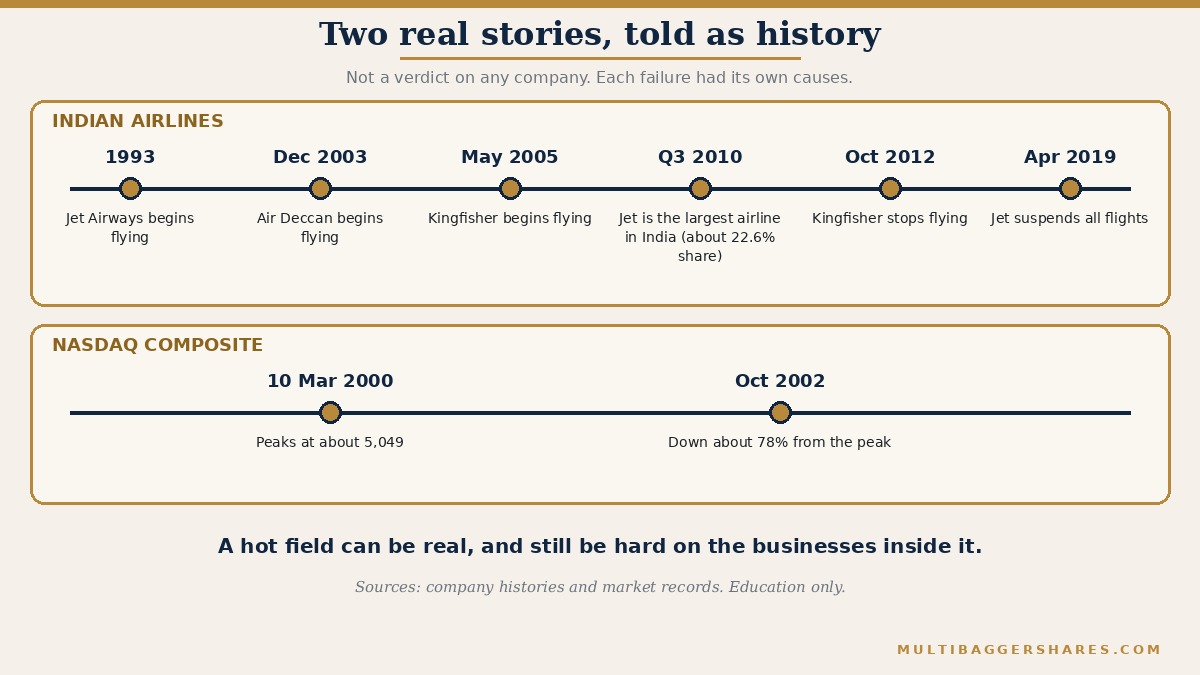
In the late 1990s the internet was the hottest field in the world. The excitement was about something real, because the internet did change how people shop, talk and work. Yet on Friday, 10 March 2000, the Nasdaq Composite (an index that tracks many technology-heavy American shares) touched about 5,049. By October 2002 it had fallen by about 78%. The field was real. The profits of many of the companies in it, and the savings of many who owned their shares, did not follow.
Some of the companies from that time did grow into giants, and that is exactly why the lesson is easy to miss. Looking back, we remember the few that lasted and forget the many that did not. But in the year 2000 nobody could say in advance which few would last. The honest summary is that the field was a great idea, the crowd was huge, and picking the survivors was very hard.
India’s skies offer a closer example, told here only as history. Jet Airways started flying in 1993. Air Deccan, a low-fare airline, began flying on 23 December 2003. Kingfisher Airlines began on 9 May 2005 and later took over Air Deccan. More Indians started to fly, and new names kept arriving. But an airline carries heavy costs, such as planes, fuel, staff and airport charges, and most of them must be paid whether the seats are full or not. When many airlines chase the same passengers, fares come under pressure.
Kingfisher’s licence was suspended and its flights stopped on 20 October 2012, a little over seven years after it began. Jet Airways became the largest airline in India in the third quarter of 2010, with a passenger share of about 22.6%. On 17 April 2019 it suspended all flights, after its lenders rejected a request for emergency funding of Rs 400 crore (Rs 4 billion). Being the biggest name in a hot field did not protect it.
Please read this fairly. Airlines are among the hardest businesses in the world, and each of these stories has its own causes, such as debt and the way the companies were run. The lesson here is smaller and simpler. When a field is hot, being big, famous and in the news is not the same as having something that keeps profits safe.
There is a second half to Lynch’s idea. In the same book, he praised a company that grows at a good pace in an industry that is not growing at all. In a dull field few rivals rush in, few reporters write about it, and the company can quietly serve the same customers year after year. Think of the things ordinary families buy again and again, such as soap, salt, spices or paint. We are not saying that any company in such a field is good. We are saying that boring fields are often less crowded.
How you can use it
When a field is in the headlines, slow down and ask five plain questions about any business in it. None of them needs a finance degree.
First: how many new players have arrived in the last five years? If the count is rising quickly, a crowd is gathering. You can usually find this out from the company’s annual report, which often names its main rivals, or from a quick look at the industry’s own association.
Second: are the profits of the companies rising, or only the sales of the field? Look at the operating margin (the profit from running the business, as a share of sales) of several companies, not just one. If sales soar while margins shrink, the street is filling up.
Third: what does this business have that a rival cannot copy next year? A strong brand, loyal customers, or a cost that is lower than everyone else’s would count. “It is growing fast” does not count. That is what every rival in a hot field is also saying.
Fourth: how is the growth paid for? Does the company pay for it from its own cash, or does it borrow or raise fresh money from shareholders every year? A business that must keep asking for money to keep growing is telling you something about how easy its profits really are.
Fifth: would this still be a good business if nobody wrote about it? Take away the headlines, the television debates and the stories your neighbour tells at dinner. Is it still a good business on an ordinary Tuesday?
None of this means you must stay away from every popular field. Some hot fields do produce excellent businesses. Those businesses usually have something real that the crowd cannot copy, such as customers who stay for years, a name that people trust, or a cost of doing the work that is lower than everyone else’s. The five questions are a way of checking for that something. If the answers are weak, there is no hurry. A hot field stays hot for years, and the thinning-out that follows will show you, in the numbers, which businesses had a real edge.
A small habit helps. When you hear that a field is hot, write down the names of five companies in it, then check how each one’s margin has moved over the last five years. It takes an hour, and it will often tell you more than the headlines do.
This article is for education only. It does not say that any field or any company named here is good or bad, and it does not tell anyone what to do with any share, fund or sum of money.
Key takeaways
- A hot industry and a profitable business are not the same thing. In the made-up juice street, sales grew by half while profit per stall fell by 90%.
- Peter Lynch’s list of things to remember includes one short line: avoid hot stocks in hot industries.
- Three forces crowd a hot field: easy profit calls in rivals, rivals build more than customers need, and nobody can pick the winner in year one.
- History shows the pattern: the Nasdaq Composite fell about 78% from March 2000 to October 2002, and India’s Kingfisher and Jet Airways both stopped flying.
- Ask five questions of any business in a popular field: how many new rivals, are margins rising, what can rivals not copy, how is growth paid for, and would it be good without headlines.
— Manish Goel · multibaggershares.com
Manish Goel is a Chartered Accountant and Principal Officer of Multibagger Securities Research & Advisory Pvt. Ltd. (MSRAPL), a SEBI-registered Investment Adviser, Registration No. INA100007736. This content is published by MSRAPL for education only and is not personalized investment advice.
Disclaimer: This article is published by multibaggershares.com for education and general information only. It is not investment advice, investment research, or a recommendation to buy, sell or hold any security. Any companies named are discussed only as illustrative examples. Markets carry risk; please do your own research or consult a qualified professional before making any investment decision. |