The Staircase of Wants: Why a Business That Owns the Upper Steps Gains as Customers Grow Richer

The Bigger Engine: Why, in the Early Years, How Much You Save Matters More Than How Well You Invest
November 1, 2026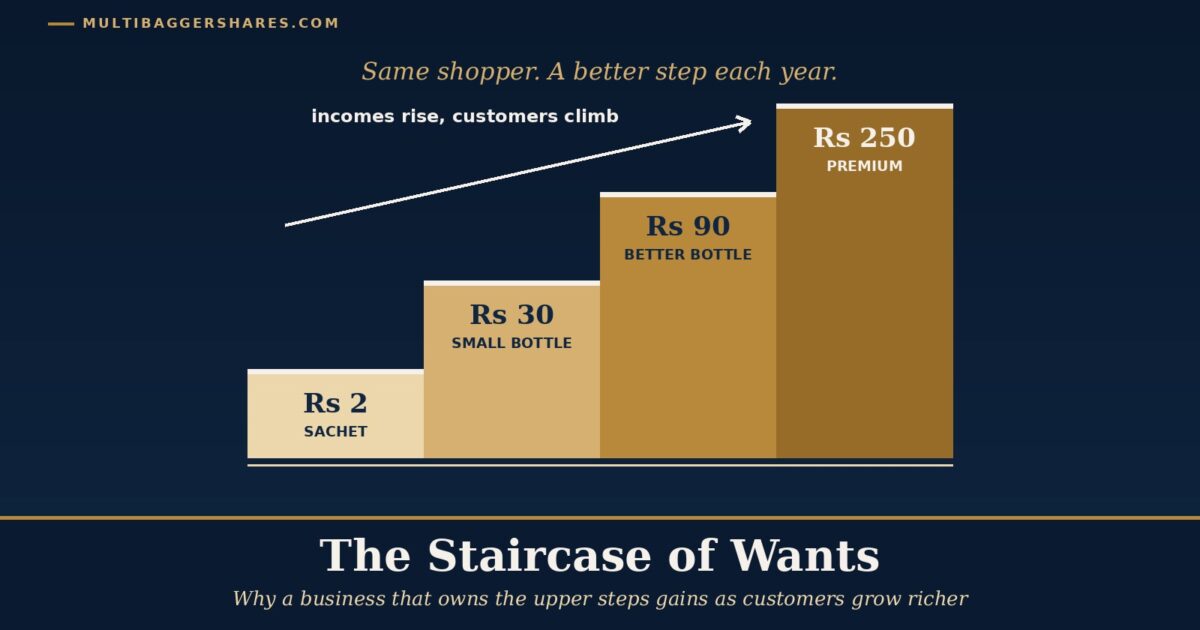
Suman’s mother bought tea in a small paper twist from the shop at the corner, a hundred grams at a time, weighed out loose on a scale. Suman is thirty now, with a steady job in the city. Her tea comes in a printed box, it carries a name she trusts, and it costs her about four times as much per cup. She does not drink four times as much tea. She drinks about the same amount. What changed is the step she stands on.
The same thing happened with biscuits. Her mother bought the plain kind. Suman buys the cream-filled pack, and on festival days she buys the gift box. Suman is made up for this story, but you probably know someone exactly like her, and you may be someone like her yourself.
Now multiply Suman by millions of households. A business that sells her the better box earns more money from the same customer, without having to find a single new one. This lesson is about that quiet effect. It is called premiumisation (customers moving up, over the years, to better and costlier versions of the things they already buy).
What it really means
Picture a staircase. On the bottom step stands the cheapest version of a product, the one that only does the basic job. Loose tea is on the bottom step. So is a one-rupee sachet (a small single-use packet) of shampoo. Each step above it is a little better in some way the customer can feel: taste, comfort, convenience, safety, or the pride of owning it. Each step also costs more.
A family with a small income stands on the lower steps. As its income grows, it climbs. It does not climb everywhere at once. Suman may buy the best tea and still buy the cheapest salt, because there is very little to gain by upgrading salt. Each household has its own staircase for each thing it buys, and each one climbs at its own pace.
A German statistician named Ernst Engel noticed a related pattern back in 1857, after studying how families spent their money. Poorer families spent most of their budget on food. Richer families still spent more rupees on food in total, but food took a smaller slice of the whole. He put it plainly: the poorer a family is, the greater is the share of its spending that must go on food. This idea is now called Engel’s law.
What does a richer family do with the rest? Part of it buys better food, and part of it buys other things such as phones, travel, schooling and comfort. That is the staircase in action. Extra income does not only buy more of the same. It buys a better version, and it buys things that were not on the shopping list before.
India’s own numbers show the pattern. The government’s Household Consumption Expenditure Survey for 2023-24 found that rural households spent about 47% of their budget on food, while urban households spent about 40%. In the same survey, the average person in a rural household spent about Rs 4,122 a month, and the average person in an urban household spent about Rs 6,996 (this figure is called monthly per capita consumption expenditure, which simply means what an average person spends in a month). The group with more money to spend gave a smaller slice of it to food, just as Engel would expect. One caution: the survey compares two groups of people at one moment. It does not follow the same family over many years.
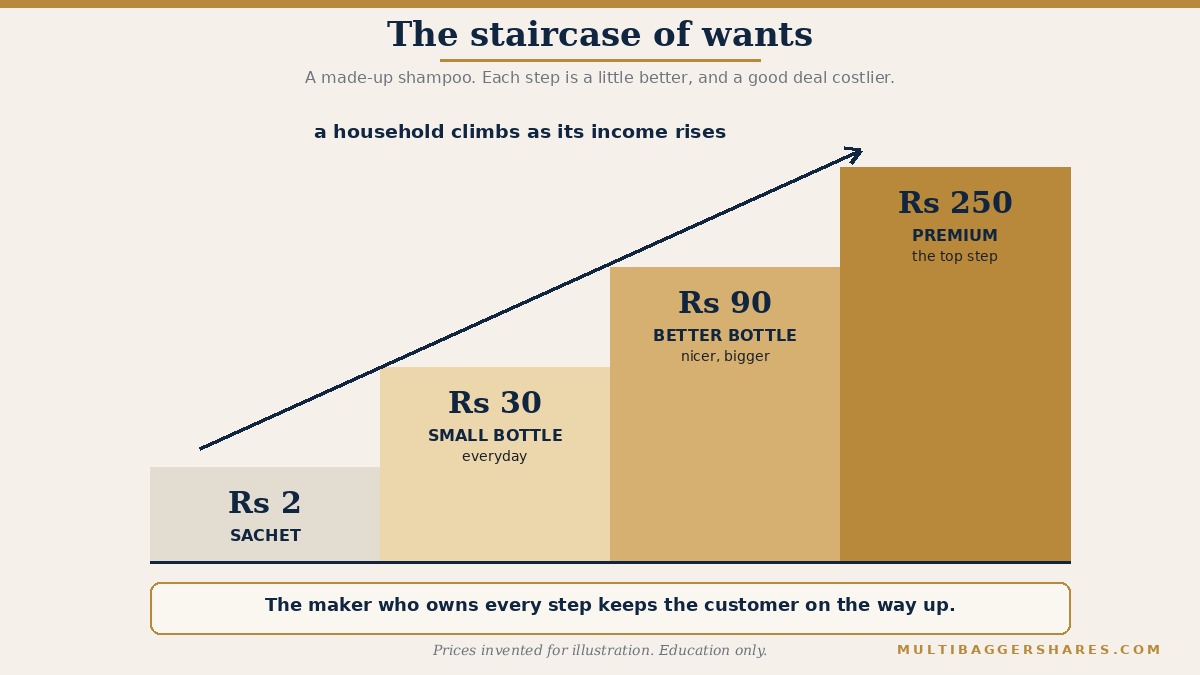
The picture above shows the idea with a made-up shampoo. A household that cannot spare much starts with the sachet. A few years and a few raises later it buys a small bottle, then a better bottle, and one day perhaps the premium bottle. The prices in the picture are invented to show the shape of the staircase. What matters is the shape: each step is a bit better and a good deal costlier.
Why it works
There are three reasons why a business that owns the upper steps can do well when customers climb. Each one can be checked with simple arithmetic.
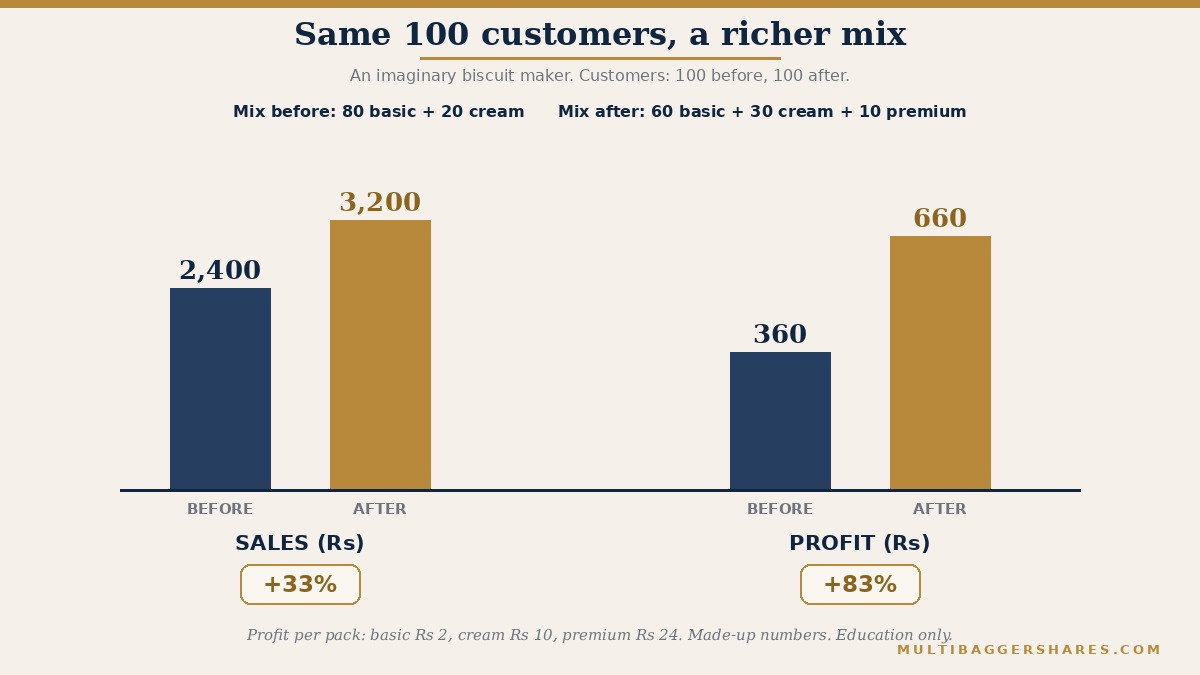
The first reason is profit per pack. A better product usually costs somewhat more to make, but it can be sold for a lot more. The extra price pays for much more than the extra cost. Take an imaginary biscuit maker with 100 customers. Today 80 of them buy the basic pack at Rs 20, and the maker earns Rs 2 of profit on each. The other 20 buy the cream pack at Rs 40, and the maker earns Rs 10 on each. Sales are 80 times Rs 20 plus 20 times Rs 40, which is Rs 2,400. Profit (what is left after the costs of making and selling) is Rs 160 plus Rs 200, which is Rs 360.
Now incomes rise, and the same 100 customers move up. Sixty buy the basic pack, thirty buy the cream pack, and ten buy a new premium pack at Rs 80, on which the maker earns Rs 24. Sales become Rs 1,200 plus Rs 1,200 plus Rs 800, which is Rs 3,200. Profit becomes Rs 120 plus Rs 300 plus Rs 240, which is Rs 660. Sales grew by about one third. Profit grew by about 83%. The number of customers did not change at all.
The second reason is cost of winning. Finding a new customer is expensive. It takes advertising, shelf space, samples and time. Selling a better box to someone who already buys from you is far cheaper, because that person already knows the name and has already tasted the product. When a business grows by climbing its own customers up the staircase, a larger part of each extra rupee of sales can stay as profit.
The third reason is trust. A customer who trusts a name on the bottom step tends to look for that same name when she climbs. This only works if the business has built the upper steps inside the same house. If it sells only the bottom step, the customer climbs right out of the house and into a rival’s shop. In this lesson we call that the question of who owns the staircase.
It is worth being fair about the limits, because this idea is easy to over-sell. Incomes do not always rise, and they certainly do not rise for everyone. In a hard year, families step down, buying smaller packs and cheaper brands, and a business that leaned heavily on its premium range feels it quickly. Rivals can also build their own upper steps. And a premium label means little if the customer cannot feel a real difference. A bigger price tag and a louder advertisement do not make a better product.
The staircase also takes years to climb, not months. Nothing in this lesson is a forecast about incomes, about any industry, or about any company. It is a way of understanding what to look for in a business you are studying.
A real example or two
Start at the very bottom step. A profile in Madras Musings, a Chennai magazine, calls an entrepreneur named C.K. Ranganathan the man behind the sachet revolution in India. His shampoo was sold at Re 1 a sachet. Think about what that means. Many families could not spare the money for a whole bottle, but almost anyone could spare a rupee. The sachet let a first-time user in, and the first step of the staircase was built low enough for her to step on. We are telling this as history only. We are not saying what happened to any company’s later sales.
Now look at the upper steps of a different staircase. Counterpoint Research, which tracks the phone market, reported in early 2026 that about 22% of the smartphones shipped in India in 2025 cost more than Rs 30,000, the highest share it had recorded. It also reported that the total value of phones sold in India grew about 8% in 2025, its highest-ever annual value growth. (Value here means the total rupees spent, not the number of phones.) Phones are one place where many Indian households have been stepping up. Again, this is a description of what happened, and it says nothing about what will happen next.
These two stories sit at opposite ends of the staircase. One shows how a business can start by welcoming people on the lowest step. The other shows what a crowded upper step can look like years later. Both are reminders that the staircase is built one step at a time, and that the people who climb it were once standing at the bottom.
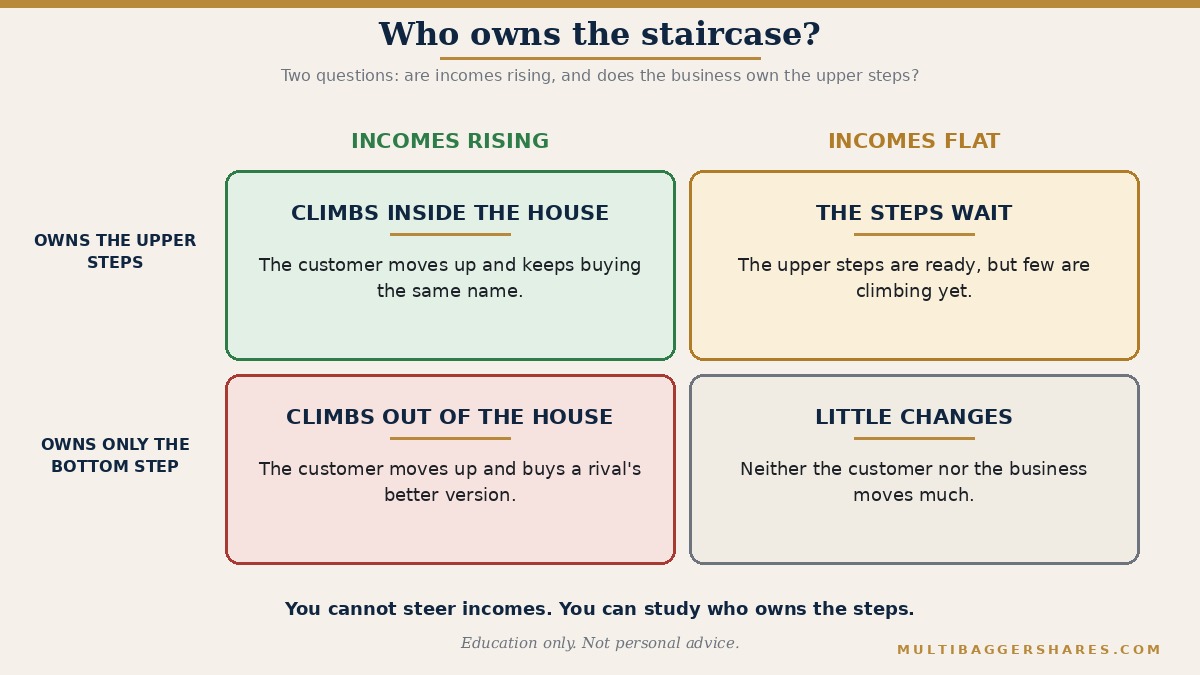
The picture above puts two questions side by side. Are the customers’ incomes rising? And does the business own the upper steps? When both answers are yes, customers climb inside the same house, which is the good case for the business. When incomes rise but the business owns only the bottom step, customers climb out of the house. When incomes are flat, the upper steps simply wait. You cannot control the first question, but you can learn a great deal by studying the second.
How you can use it
You can use this idea in two ways: when you study a business, and when you look at your own spending. Here are five questions to ask about a business.
First, is there a staircase at all? Some products can be upgraded in ways customers care about, such as tea, clothing, phones and cooking oil. Others have little to upgrade. A business without a staircase must grow by selling more units or by raising prices, and those are different lessons.
Second, who owns the upper steps? Check whether the business sells a range from basic to premium, or only one kind of product. The annual report and the company’s own presentations often say how much of its sales come from its higher-priced range.
Third, does the customer stay when she climbs? Ask whether the same name appears on several steps, so that a customer moving up keeps buying from the same maker. This is trust working across the staircase.
Fourth, what happened in a bad year? Look at how the business behaved when incomes were squeezed. Did customers step down? Did they return to the upper steps once times improved? A business that has been through a hard year and kept its customers has shown you something no brochure can.
Fifth, is the upper step real? Ask whether the customer gets something she can feel, such as better taste, better comfort or better safety, or whether the premium is mostly in the advertising. Real differences last. Imagined ones fade.
The second use is personal. The staircase works on you too. Each time your income rises, it is natural to step up on a few things, and each new step soon feels like the normal floor. There is nothing wrong with living a little better as you earn more. The point is to climb on purpose. If every raise is spent on a higher step, your savings never grow. If you keep part of each raise for saving, you climb and you build your pot as well.
This article is for education only. The family, the prices and the biscuit maker are made up, and the numbers in the examples are illustrations. Nothing here is a forecast about incomes or about any business, and nothing here suggests that anyone should buy or sell anything.
Key takeaways
- Premiumisation means customers moving up to better and costlier versions of what they already buy as their incomes rise, like climbing a staircase.
- Engel’s law (1857): richer families spend more rupees but a smaller share of their budget on food. India’s 2023-24 survey shows about 47% in rural and about 40% in urban households.
- In the made-up example, the same 100 customers moved up and sales rose about one third while profit rose about 83%, because upper steps carry fatter profit per pack.
- The business that owns the upper steps keeps the customer on the way up. A business with only the bottom step watches the customer climb out of the house.
- Climbing is not guaranteed. Incomes can stall, families step down in hard years, and a premium label means little without a difference the customer can feel.
— Manish Goel · multibaggershares.com
Manish Goel is a Chartered Accountant and Principal Officer of Multibagger Securities Research & Advisory Pvt. Ltd. (MSRAPL), a SEBI-registered Investment Adviser, Registration No. INA100007736. This content is published by MSRAPL for education only and is not personalized investment advice.
Disclaimer: This article is published by multibaggershares.com for education and general information only. It is not investment advice, investment research, or a recommendation to buy, sell or hold any security. Any companies named are discussed only as illustrative examples. Markets carry risk; please do your own research or consult a qualified professional before making any investment decision. |