Operating Leverage: The Hidden Force That Turns Good Companies Into Great Multibaggers in India

Episode 3: The Power of Compounding — How ₹1 Lakh Becomes ₹50 Lakh | Value Investing Course
March 25, 2026
Circle of Competence: Why Staying Within Your Knowledge Zone Is the #1 Rule for Finding Multibagger Stocks in India
March 25, 2026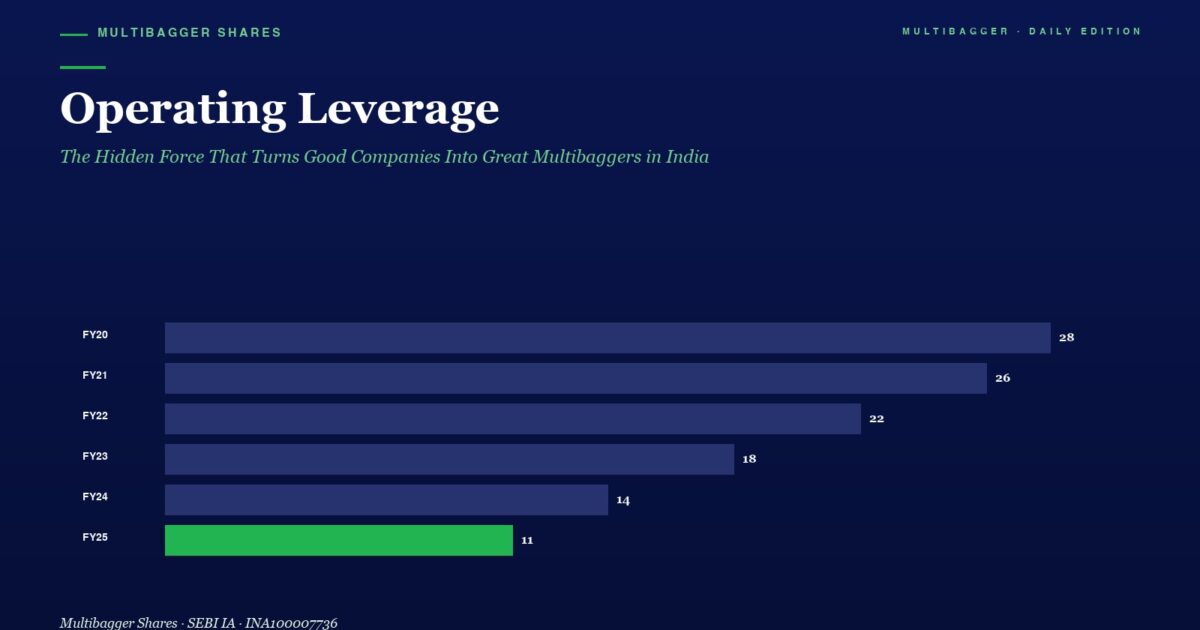
March 25, 2026
(Wednesday)
Why Some Companies Explode in Profits While Others Barely Grow
As of March 25, 2026, the Sensex stands at approximately 74,068 and Nifty at 22,912 — recovering sharply from Monday’s US-Iran tension-driven crash. In times like these, most investors panic. But smart value investors know that market volatility is the perfect time to study which companies have the hidden superpower of operating leverage — the force that turns modest revenue growth into explosive profit growth.
Today, I want to teach you one of the most powerful — yet most overlooked — concepts in investing: Operating Leverage. Understanding this single concept can completely change how you evaluate stocks and identify future multibaggers in the Indian market.
What Is Operating Leverage? A Simple Explanation
Operating leverage measures how sensitive a company’s operating profit (EBIT) is to changes in revenue. In simple terms: when a company with high operating leverage grows its revenue by 10%, its profits might grow by 30-50% or even more.
Think of it like this: Imagine you run a pharmaceutical manufacturing plant. Your factory costs ₹10 crore per year in rent, equipment maintenance, salaries, and depreciation — whether you produce 1,000 units or 100,000 units. These are your fixed costs. Your raw materials cost ₹100 per unit — these are your variable costs.
Now here’s where the magic happens:
If you sell 50,000 units at ₹500 each, your revenue is ₹25 crore, your variable costs are ₹5 crore, your fixed costs are ₹10 crore, and your profit is ₹10 crore.
But if you increase sales by just 20% to 60,000 units, your revenue becomes ₹30 crore, variable costs become ₹6 crore, fixed costs remain ₹10 crore, and profit jumps to ₹14 crore — a 40% profit increase from just 20% revenue growth!
That’s operating leverage in action. The fixed cost base stays the same while revenue grows — and every additional rupee of revenue flows almost directly to the bottom line.
The Operating Leverage Formula
The Degree of Operating Leverage (DOL) is calculated as:
DOL = % Change in EBIT ÷ % Change in Revenue
A DOL of 2.0 means that for every 1% increase in revenue, operating profit increases by 2%. A DOL of 3.0 means profits grow 3x faster than revenue. The higher the DOL, the more explosive the profit growth potential.
Why Operating Leverage Creates Multibaggers
This is where it gets exciting for Indian investors. Companies with high operating leverage and growing revenues are essentially profit compounding machines. Here’s why:
1. Profit margins expand automatically. As revenue grows, fixed costs get spread over a larger base. A company with 10% operating margins today could have 20% margins in 3-5 years — without changing anything about its business model. The stock market LOVES margin expansion.
2. Earnings growth outpaces revenue growth. If a company grows revenue at 15% annually but has a DOL of 2.5, its earnings are growing at 37.5% annually. Over 5 years, that’s the difference between a 2x return and a 5x return.
3. Re-rating happens naturally. When the market sees accelerating profit growth and expanding margins, the PE multiple expands. You get a “double whammy” — earnings growth PLUS PE expansion — which is exactly how multibagger returns are generated.
Real-World Example: The Titan Biotech Story
Let’s look at how operating leverage played out in a real Indian company. Titan Biotech Ltd (BSE: 524717), currently trading around ₹369 with a spectacular 52-week range of ₹74.73 to ₹400, is a textbook case of operating leverage at work.
Titan Biotech had already built its manufacturing infrastructure — the agar, gelatin, and collagen processing plants, the quality certifications, the distribution network. These were largely fixed costs. As global demand for biotech ingredients surged (driven by the semaglutide revolution and the weak rupee making Indian exports competitive), Titan Biotech’s revenue grew significantly.
But here’s the key: because the fixed cost infrastructure was already in place, every additional crore of revenue translated into disproportionately higher profits. The operating margins expanded, earnings per share surged, and the stock responded — rising from ₹8 to ₹400 over time, delivering 50x returns to patient investors.
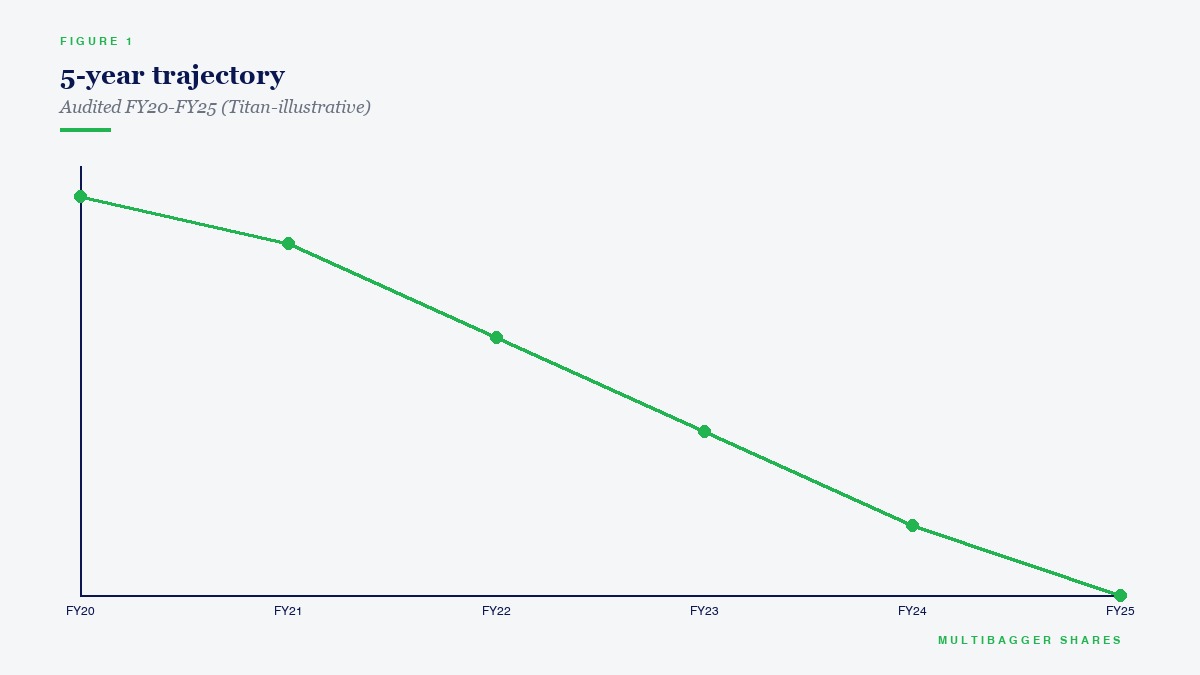
With the stock up over 326% in the last year alone, Titan Biotech demonstrates exactly what happens when operating leverage meets revenue growth in a quality company with honest management.
How to Identify Companies with High Operating Leverage
Here are the key signals to look for when screening Indian stocks:
1. High Fixed Cost Base Relative to Variable Costs: Look for companies with significant capital investments — manufacturing plants, technology platforms, distribution networks — that don’t need to scale proportionally with revenue. Pharma companies, IT services firms, and capital goods manufacturers often have this characteristic.
2. Growing Revenue with Stable Operating Expenses: Check if the company’s revenue is growing faster than its operating expenses. If revenue grows 20% but opex only grows 8%, operating leverage is doing its magic.
3. Expanding Operating Margins Over Time: Look at the trend of operating profit margins over 3-5 years. If margins are steadily expanding from, say, 12% to 18%, operating leverage is likely at play.
4. High ROCE with Room for Capacity Utilization: Companies with existing capacity that isn’t fully utilized have the most operating leverage potential. As utilization increases, fixed costs are spread over more units, and margins expand dramatically.
5. Low Incremental Capital Needs: The best operating leverage stories come from companies that can grow revenue significantly without proportional new capital expenditure. Their existing assets simply work harder.
The Dangerous Flip Side: Operating Leverage in Reverse
Operating leverage is a double-edged sword. Just as it amplifies profit growth when revenue rises, it amplifies profit declines when revenue falls. A company with a DOL of 3.0 that experiences a 10% revenue decline will see operating profits drop by 30%.
This is exactly why quality matters so much. You want high operating leverage in companies with:
• Durable competitive moats that protect revenue stability
• Diversified customer bases so no single client departure causes a revenue crash
• Strong secular tailwinds that make sustained revenue growth likely
• Zero or low debt — because high operating leverage combined with high financial leverage is extremely dangerous
This is why F&O trading and penny stock speculation are so destructive. SEBI data shows that 90% of F&O traders lose money — and many of them are unknowingly betting on highly leveraged positions in companies with poor operating leverage characteristics. They’re gambling, not investing.
Operating Leverage vs. Financial Leverage: Know the Difference
Many investors confuse operating leverage with financial leverage (debt). Here’s the critical difference:
Operating leverage comes from the business structure — fixed costs in operations. It’s an inherent characteristic of the business model and is generally healthy when paired with revenue growth.
Financial leverage comes from borrowing money. It amplifies returns but also amplifies risk through interest obligations. High financial leverage with high operating leverage is a recipe for disaster if revenue drops.
The ideal multibagger combination is: High operating leverage + Low financial leverage + Growing revenue + Quality management. This is exactly the profile of companies like Titan Biotech — high fixed-cost manufacturing infrastructure (operating leverage), minimal debt (low financial leverage), growing revenue (secular tailwinds), and honest, capable promoters.
Sectors in India with Highest Operating Leverage
Understanding which sectors naturally have high operating leverage helps you fish in the right pond:
Pharmaceuticals & Biotech: Manufacturing plants represent massive fixed investments. Once built, producing more units costs relatively little. Indian pharma companies exporting globally are prime operating leverage beneficiaries as the weak rupee (₹94/$) boosts revenue without adding costs.
IT Services: Office infrastructure and employee salaries are partially fixed. As billing rates increase or utilization improves, margins expand significantly.
Capital Goods & Infrastructure: Companies with large manufacturing setups (Larsen & Toubro, for example, which rallied 5.25% on March 24 alone) see dramatic margin expansion during infrastructure upcycles.
Consumer Brands: Brand-building costs are largely fixed. As distribution expands and sales volume grows, operating margins expand naturally.
How to Use Operating Leverage in Your Investment Strategy
Here’s your actionable framework:
Step 1: Screen for companies with expanding operating margins over the last 3-5 years on Screener.in or Trendlyne.
Step 2: Calculate the historical DOL — check if profit growth has consistently outpaced revenue growth.
Step 3: Verify the quality checklist — high ROCE (above 15%), low debt, honest management, and growing revenue.
Step 4: Check for underutilized capacity — this is the “spring loaded” signal that margins could expand further.
Step 5: Hold for the long term. Operating leverage plays out over years, not weeks. The stock market eventually recognizes and rewards sustained margin expansion with PE re-rating.
Current Market Context: Why This Matters NOW
With Nifty at 22,912 and markets recovering from the US-Iran tension selloff, FIIs have sold ₹1.07 lakh crore of Indian equities in 2026 so far. This has created significant fear in the market — but for informed value investors, fear creates opportunity.
Many high-quality companies with strong operating leverage characteristics are trading below their fair potential because of indiscriminate FII selling. These are exactly the companies where operating leverage will work its magic over the next 3-5 years as India’s economy continues to grow.
The smart strategy? Identify quality companies with high operating leverage, use this period of fear to accumulate them patiently, and let time and compounding do the rest. This is the exact approach that created returns of 50x in stocks like Titan Biotech.
The Bottom Line
Operating leverage is the hidden force that separates good companies from great multibaggers. It’s the reason why some companies turn modest revenue growth into explosive profit growth — and why their stocks deliver life-changing returns to patient investors.
The next time you analyze a stock, don’t just look at revenue growth. Ask yourself: “Does this company have operating leverage? Will profits grow FASTER than revenue?” If the answer is yes, and the company also has a competitive moat, honest management, and low debt — you may have found your next multibagger.
Remember: investing in quality companies with operating leverage and holding for the long term is the proven path to wealth creation. Avoid the wealth-destroying trap of F&O trading, intraday speculation, and tip-based investing. Be patient. Be disciplined. Be a value investor.
Want to learn more about finding multibaggers? Watch our complete Value Investing Course on YouTube.
Published by Manish Goel | MultibaggerShares.com — Educating 200 Million Indian Stock Market Investors
Disclaimer: This article is for educational purposes only and does not constitute financial advice. The author may hold positions in stocks mentioned. Always conduct your own research and consult a SEBI-registered financial advisor before making investment decisions. Stock market investments are subject to market risks. Past performance does not guarantee future returns.
📢 Join Our Telegram Channel
Get daily value investing lessons, stock analysis — delivered straight to your phone!
✈️ Join @longtermequityy on Telegram
🔔 Free • No spam • Value investing insights daily