Circle of Competence: Why Staying Within Your Knowledge Zone Is the #1 Rule for Finding Multibagger Stocks in India

Operating Leverage: The Hidden Force That Turns Good Companies Into Great Multibaggers in India
March 25, 2026
Market Surges 1,500+ Points on Iran Peace Hopes — Why Smart Investors Stay Calm in Both Rallies and Crashes
March 25, 2026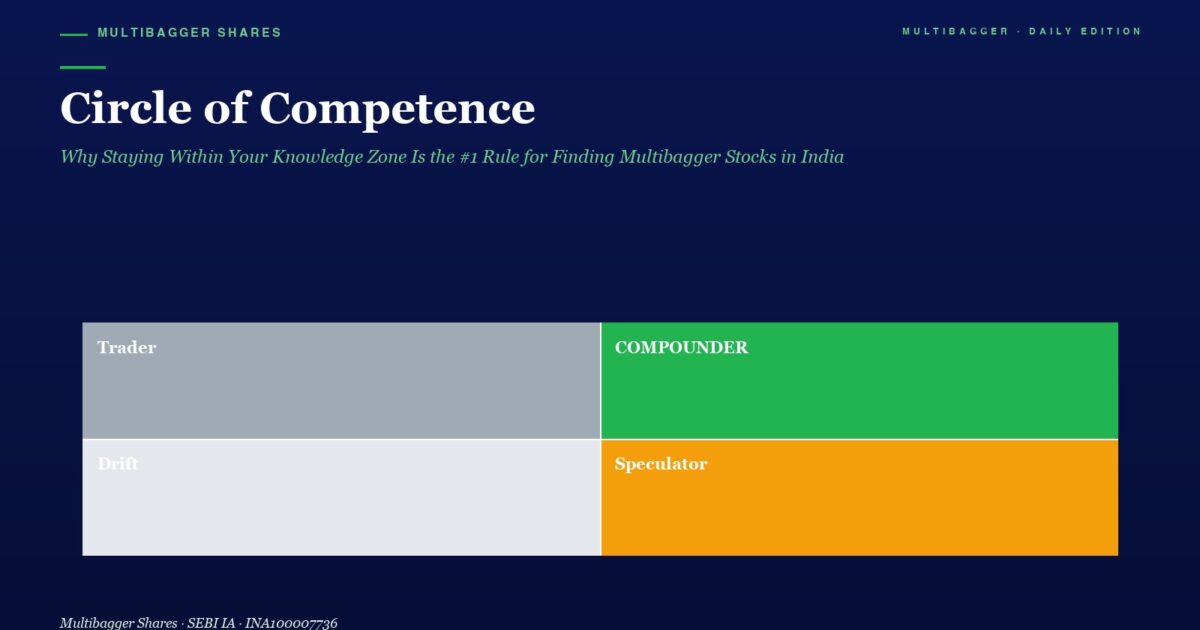
March 25, 2026
(Wednesday)
Introduction: The Most Ignored Rule in Investing
In March 2026, with the Sensex rallying past 75,200 and the Nifty touching 23,279, investors across India are once again chasing the next hot stock. Social media is flooded with tips about AI stocks, defence plays, and crypto tokens. But here’s a question that separates the wealthy long-term investor from the average trader: Do you actually understand what you’re buying?
Warren Buffett and Charlie Munger have consistently credited one concept above all others for their extraordinary success at Berkshire Hathaway — the Circle of Competence. As Buffett famously said: “What an investor needs is the ability to correctly evaluate selected businesses. Note that word ‘selected’: You don’t have to be an expert on every company, or even many. You only have to be able to evaluate companies within your circle of competence. The size of that circle is not very important; knowing its boundaries, however, is vital.”
Today, let’s explore why this principle is arguably the single most important concept for Indian investors seeking multibagger returns — and how ignoring it leads to the devastating losses that SEBI data confirms: over 90% of F&O traders lose money.
What Exactly Is the Circle of Competence?
The Circle of Competence is elegantly simple: it represents the area where you have genuine, deep knowledge — not surface-level familiarity, but true understanding of how a business works, what drives its economics, who its competitors are, and what could go wrong.
Think of it as three concentric zones. The innermost zone is your core competence — industries you work in, businesses you interact with daily, sectors where you have years of experience. The middle zone represents areas where you have some knowledge but significant gaps. The outer zone is where you’re essentially guessing — relying on tips, herd mentality, or borrowed conviction.
The tragedy of Indian retail investors is that most of their money sits in that outermost zone. They buy pharma stocks without understanding API pricing, IT stocks without grasping delivery models, or defence stocks because someone on YouTube said “defence is the next big thing.” This isn’t investing — it’s speculation dressed up in a suit.
Real-World Proof: How the Circle of Competence Creates Multibaggers
Case Study 1: The Doctor Who Found a Multibagger in His Own Clinic
Consider a practicing doctor who understands the pharmaceutical supply chain intimately. He knows which companies manufacture quality biological peptones and culture media, which products are essential for clinical diagnosis and vaccine production, and which firms have genuine R&D capabilities versus those merely repackaging imported materials. When such a doctor discovers a company like Titan Biotech (BSE: 524717) — currently trading around ₹368 with a remarkable journey from ₹8 to nearly ₹400 — he can evaluate the business with a depth that no stock screener can replicate.
Titan Biotech’s story is a perfect illustration. The company manufactures biological peptones, culture media, and extracts used in clinical diagnosis and vaccine/antibiotic production. An investor who understood the biotech supply chain could have identified Titan Biotech’s competitive advantages years ago — its niche positioning, growing export markets, and the secular tailwinds of India’s pharmaceutical and healthcare expansion. That understanding — that circle of competence — is what allows an investor to hold through volatility and capture the full multibagger journey.
Case Study 2: The IT Professional Who Avoided a Value Trap
Meanwhile, consider an IT professional in Bengaluru who knows SaaS businesses inside out. When a mid-cap IT company reported spectacular revenue growth but the professional noticed the growth was entirely from one client and the company was capitalizing implementation costs aggressively, he avoided what turned out to be a 70% wealth destroyer. His circle of competence — enterprise software — gave him an edge that pure financial analysis couldn’t.
Why Indian Investors Constantly Step Outside Their Circle
There are four primary reasons why Indian retail investors routinely violate this principle, and understanding them is essential to building lasting wealth.
1. The FOMO Epidemic: When your colleague’s portfolio is up 40% from defence stocks, it’s psychologically painful to sit with your 15% returns from businesses you understand. But here’s what the data shows — those who chased momentum in sectors they didn’t understand during 2007 (infrastructure), 2017 (small-cap mania), and 2021 (new-age tech IPOs) suffered catastrophic losses when reality caught up.
2. The Illusion of Knowledge: Reading three articles about AI doesn’t make you an AI expert. Watching a YouTube video about green hydrogen doesn’t give you the competence to evaluate hydrogen companies. True competence means you can explain the business model, name the top 5 competitors, identify the key risks, and estimate reasonable earnings — without looking anything up.
3. The F&O Shortcut Trap: Many investors believe that if they can’t find opportunities within their circle, they should turn to F&O trading for returns. This is perhaps the most destructive financial decision an Indian retail investor can make. SEBI’s own study confirmed that 9 out of 10 individual F&O traders incurred net losses, with the average loss being ₹1.1 lakh per person in FY22. F&O doesn’t expand your circle — it puts you in a casino.
4. Social Media Influence: Today’s market influencers present complex businesses as simple “buy” decisions. They strip away the nuance, the risks, and the need for deep understanding. Following their tips is the exact opposite of staying within your circle of competence.
How to Map and Expand Your Circle of Competence
Step 1: Honestly Assess What You Know
Sit down with a blank sheet of paper and list every industry where you have genuine expertise. If you’re a banker, you understand lending, credit quality, and interest rate dynamics. If you’re a chemical engineer, you understand process economics and capacity utilization. If you’re a pharmacist, you understand drug formulations and regulatory approvals. This is your starting point — and it’s enough. You don’t need twenty sectors; you need two or three that you know deeply.
Step 2: Go Deep, Not Wide
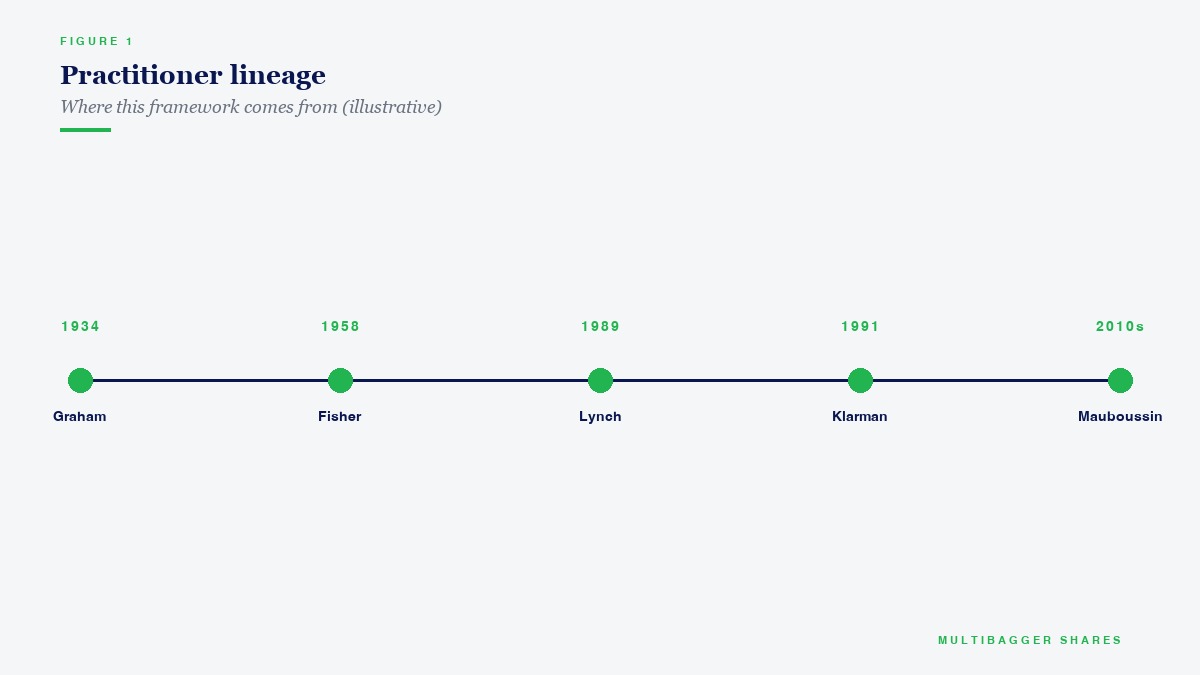
Within your circle, aim to understand every listed company. Read annual reports, visit factories if possible, talk to suppliers and customers. This is what Philip Fisher called the “Scuttlebutt Method” — and it’s exponentially more powerful within your circle. An accountant analyzing NBFC balance sheets will spot red flags that the smartest AI-driven screener would miss.
Step 3: Build a Watchlist, Not a Portfolio
Your circle of competence should generate a watchlist of 15-20 companies you deeply understand. From this watchlist, you buy only when valuations offer a margin of safety. This is how legendary investors like Rakesh Jhunjhunwala operated — deep knowledge of a few sectors, patience to wait for the right price, and conviction to go big when opportunity met competence.
Step 4: Expand Slowly and Deliberately
You can grow your circle over time, but it requires genuine effort — reading industry reports, attending AGMs, studying competitors, and tracking regulatory changes for 12-18 months before making your first investment in a new sector. Charlie Munger spent decades expanding his circle from law to investing to technology, but he did it methodically, never rushing.
Circle of Competence in Today’s Market: A Practical Framework
With the Nifty at 23,279 and markets recovering from geopolitical uncertainties (the recent US-Iran tensions saw the Sensex drop over 1,800 points before recovering sharply), here’s how to apply this principle right now.
If you’re a healthcare professional: Focus on pharma, biotech, diagnostics, and hospital chains. Evaluate companies like Titan Biotech where your professional knowledge gives you a genuine edge. You can assess product quality, regulatory compliance, and growth potential in ways that generalist fund managers simply cannot.
If you’re in manufacturing: Study auto ancillaries, capital goods, and specialty chemicals. Your understanding of capacity utilization, order books, and supply chain dynamics is your superpower.
If you’re in banking/finance: NBFCs, banks, insurance companies, and fintech platforms are your territory. You understand credit cycles, NPA recognition, and interest rate sensitivity better than anyone.
If you’re in IT: SaaS companies, IT services, and digital platforms are your domain. Evaluate deal pipelines, attrition rates, and margin trajectories with insider-level understanding.
The common thread? Stay where your knowledge gives you an unfair advantage.
The Role of Domestic Institutional Investors: A Lesson in Competence
It’s worth noting that while Foreign Institutional Investors (FIIs) have been net sellers for over 6 consecutive weeks, Domestic Institutional Investors (DIIs) have been steadily buying — over ₹12,000 crore in recent purchases. Why? Because DIIs — India’s mutual funds and insurance companies — have deep, institutional knowledge of Indian businesses. They’re operating within their circle of competence, using market dips created by FII selling to accumulate quality businesses at reasonable prices. This is circle of competence in action at an institutional level.
The Anti-F&O Message: Circle of Competence Proves Why Trading Destroys Wealth
Here’s the final, crucial connection: the circle of competence framework is the most powerful argument against F&O trading. When you trade derivatives, you’re not just outside your circle of competence regarding the underlying business — you’re adding layers of complexity (options Greeks, time decay, volatility surface, margin calls) that require an entirely different circle of competence that 99% of retail traders simply don’t have.
SEBI’s data is unambiguous: over 90% of individual F&O traders lose money. The intelligent alternative is to invest within your circle of competence in quality businesses, let compounding do its work, and build wealth the way every great investor in history has — patiently and knowledgeably.
If you want to learn more about this approach, I encourage you to explore our free Value Investing Course, where we break down these concepts with real Indian stock market examples.
Conclusion: Know What You Own, Own What You Know
Peter Lynch’s famous advice — “Buy what you know” — is essentially the circle of competence in five words. But the deeper wisdom is in its corollary: don’t buy what you don’t know.
In a market where information is abundant but wisdom is scarce, your circle of competence is your greatest edge. It’s what allowed early investors in Titan Biotech to hold from ₹8 to ₹368 while others sold at ₹20, ₹50, or ₹100. It’s what will separate the wealth creators of the next decade from the wealth destroyers.
Stay within your circle. Go deep. Be patient. The multibaggers will come to you.
Follow Manish Goel on multibaggershares.com for more value investing education.
Disclaimer: This article is for educational purposes only and does not constitute financial advice. The author may hold positions in stocks mentioned. Always conduct your own research and consult a SEBI-registered financial advisor before making investment decisions. Stock market investments are subject to market risks. Past performance does not guarantee future returns.
📢 Join Our Telegram Channel
Get daily value investing lessons, stock analysis — delivered straight to your phone!
✈️ Join @longtermequityy on Telegram
🔔 Free • No spam • Value investing insights daily