The PEG Ratio Explained: Peter Lynch’s Secret Weapon for Finding Undervalued Growth Stocks in India

VIDEO Hindi: Jab Market Girta Hai Pharma Badhta Hai
March 25, 2026
Ram Navami Special: Markets Closed Today — What Yesterday’s 1,200-Point Sensex Rally Means for Your Portfolio
March 26, 2026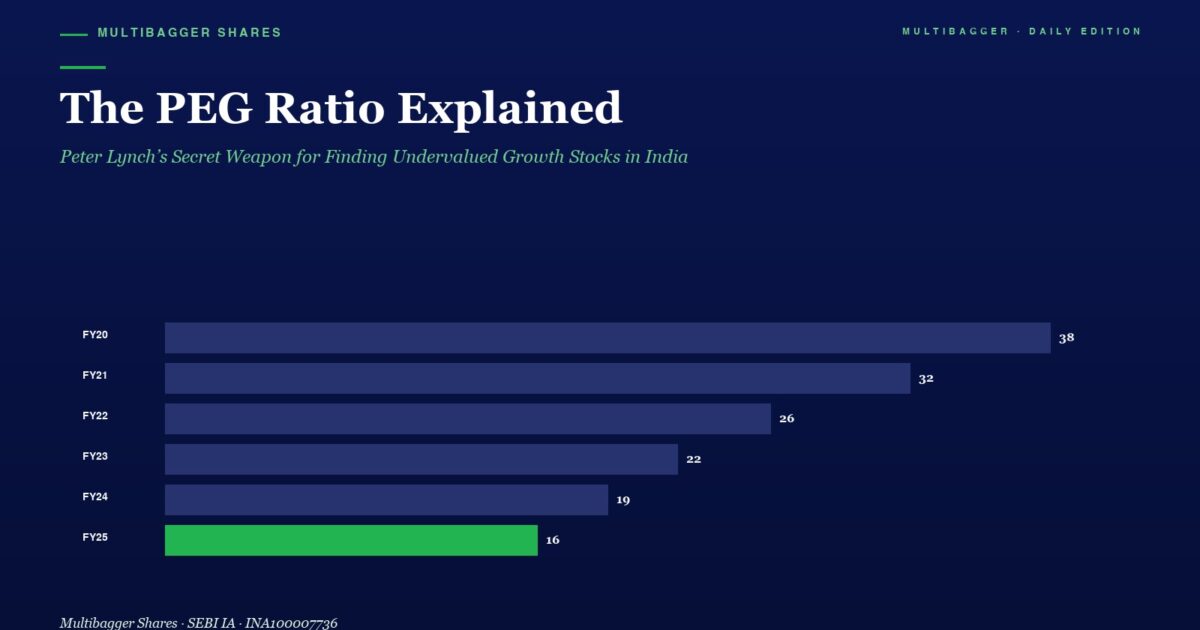
March 26, 2026
(Thursday)
Why the P/E Ratio Alone Can Mislead You
Every investor in India knows the Price-to-Earnings (P/E) ratio. It’s the first metric most people look at when evaluating a stock. But here’s what most investors don’t realize: the P/E ratio, used in isolation, can be dangerously misleading.
A stock trading at a P/E of 40 might look expensive, but if it’s growing earnings at 50% per year, it’s actually cheap. Conversely, a stock with a P/E of 10 might seem like a bargain, but if earnings are declining, you could be walking into a value trap. This is precisely why legendary investor Peter Lynch — who delivered 29.2% annualized returns at the Magellan Fund — relied on a more powerful metric: the PEG Ratio.
What Is the PEG Ratio?
The PEG Ratio (Price/Earnings to Growth) is calculated as:
PEG Ratio = P/E Ratio ÷ Earnings Growth Rate (%)
For example, if a company has a P/E ratio of 30 and its earnings are growing at 30% per year, its PEG ratio is 1.0. Peter Lynch’s rule of thumb was simple yet powerful:
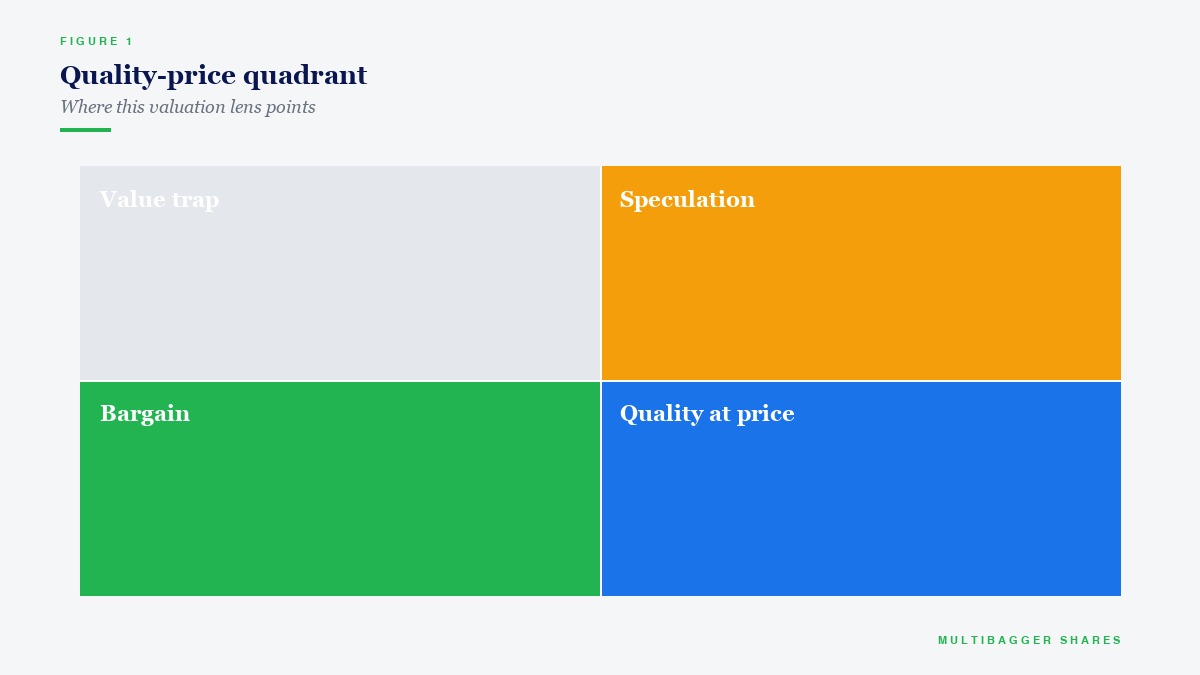
- PEG < 1.0 → The stock is potentially undervalued relative to its growth
- PEG = 1.0 → The stock is fairly valued
- PEG > 1.0 → The stock may be overvalued relative to its growth
As Lynch wrote in One Up on Wall Street: “The P/E ratio of any company that’s fairly priced will equal its growth rate.”
Why the PEG Ratio Works So Well in the Indian Market
India is one of the fastest-growing major economies in the world, with GDP growth consistently above 6%. This means many Indian companies — especially in sectors like biotechnology, pharmaceuticals, specialty chemicals, and technology — are growing earnings at rates of 20-40% per year. In such a high-growth environment, using only the P/E ratio would cause you to miss some of the best opportunities.
Consider the current market context: On March 25, 2026, the Sensex surged 1,205 points to close at 75,273 and the Nifty 50 climbed 1.72% to 23,306, driven by easing crude oil prices and renewed FII buying. In such volatile, momentum-driven markets, the PEG ratio helps you cut through the noise and focus on what truly matters — growth at a reasonable price.
Real-World Example: Titan Biotech Ltd (BSE: 524717)
Let’s apply the PEG ratio to a real company that many of our readers have been following — Titan Biotech Ltd, currently trading around ₹368 with a market capitalization of approximately ₹1,230 crore.
Titan Biotech has delivered extraordinary returns — the stock has surged over 326% in the last one year and 136% in just the last six months. But here’s what makes this story truly compelling from a PEG ratio perspective:
When we first identified Titan Biotech at around ₹55, the company was growing its earnings at a robust rate while trading at a modest P/E ratio. The PEG ratio at that time was significantly below 1.0, signaling that the market was grossly undervaluing the company’s growth potential. This is exactly the kind of opportunity Peter Lynch spent his career searching for — a quality growth company hiding in plain sight at a bargain price.
The subsequent 200%+ appreciation validated what the PEG ratio was telling us. The market eventually recognized the growth and re-rated the stock accordingly.
How to Calculate PEG Ratio: A Step-by-Step Guide for Indian Investors
Step 1: Find the P/E Ratio
You can find this on any Indian financial portal — Screener.in, Moneycontrol, Trendlyne, or your broker’s terminal. Use the trailing twelve months (TTM) P/E for current valuations.
Step 2: Determine the Earnings Growth Rate
This is where the art comes in. You can use:
- Historical growth: 3-year or 5-year earnings CAGR (compound annual growth rate)
- Forward growth: Analyst consensus estimates for next 1-2 years
- Your own estimate: Based on your analysis of the company’s business drivers
Pro tip: For Indian small-caps and mid-caps, historical growth rates can be highly variable. Use the 3-year profit CAGR from Screener.in as a reliable starting point, then adjust based on your understanding of the business.
Step 3: Divide P/E by Growth Rate
Simply divide the P/E ratio by the earnings growth rate (expressed as a whole number, not a decimal). If P/E = 25 and growth = 30%, PEG = 25/30 = 0.83 — this would be considered undervalued by Lynch’s framework.
Five Critical Rules for Using the PEG Ratio Effectively
Rule 1: Never Use PEG in Isolation
The PEG ratio is a powerful screening tool, but it should be combined with other quality metrics — Return on Capital Employed (ROCE), debt-to-equity ratio, free cash flow generation, and promoter holding patterns. A low PEG means nothing if the company has deteriorating fundamentals.
Rule 2: Be Skeptical of Very Low PEG Ratios
A PEG ratio of 0.2 or 0.3 might seem like an incredible bargain, but it could also mean the market is pricing in a slowdown that hasn’t shown up in historical numbers yet. Always ask: Is this growth sustainable?
Rule 3: PEG Works Best for Growth Companies
The PEG ratio is most useful for companies growing earnings at 15-50% per year. For very slow-growing companies (below 10% growth), dividend yield and asset-based valuations may be more appropriate. For hyper-growth companies (above 50%), the PEG ratio may understate the risk of growth deceleration.
Rule 4: Adjust for Quality of Earnings
Not all earnings growth is created equal. Growth driven by revenue expansion and improving margins is far more sustainable than growth from one-time gains, tax benefits, or accounting changes. Always look at the operating profit (EBIT) growth, not just net profit growth.
Rule 5: Consider the Industry Context
Different industries have different normal PEG ranges. FMCG companies in India typically trade at higher PEG ratios because of their earnings stability. Cyclical industries like metals may have very low PEGs during peak earnings — which is actually a sell signal, not a buy signal.
Screening for Low-PEG Stocks in India: A Practical Framework
Here’s a screening framework you can apply today using free tools like Screener.in or Trendlyne:
- Filter for profitability: ROCE > 15%, consistent profits for 5+ years
- Filter for growth: 3-year profit CAGR > 15%
- Calculate PEG: Current P/E ÷ 3-year profit CAGR
- Select PEG < 1.0: These are your initial candidates
- Deep dive: Check debt levels, cash flows, promoter holding, and competitive moats
This systematic approach — combining quantitative screening with qualitative analysis — is how professional value investors identify multibaggers before the crowd.
Common Mistakes Indian Investors Make with Valuation
One of the biggest mistakes retail investors in India make is chasing stocks based on tips, social media hype, or recent price momentum. SEBI data shows that approximately 90% of individual traders in Futures & Options (F&O) lose money. This is not a coincidence — it’s the inevitable result of speculation without a proper valuation framework.
Instead of gambling in F&O or intraday trading, use tools like the PEG ratio to build a portfolio of quality growth companies at reasonable valuations. This is how real wealth is created — not overnight, but over years and decades through the power of compounding.
Learn More: Free Value Investing Course
If you want to master these concepts and many more, check out our comprehensive free value investing course on YouTube: Value Investing Education Playlist. We cover everything from basic concepts to advanced strategies used by legends like Warren Buffett, Charlie Munger, and Peter Lynch.
The Bottom Line
The PEG ratio is one of the most elegant tools in a value investor’s toolkit. It bridges the gap between value and growth investing by asking a simple but profound question: Am I paying a fair price for this company’s growth?
In a market like India — where growth opportunities are abundant but valuations can be stretched — the PEG ratio is your compass. Use it wisely, combine it with thorough fundamental analysis, and you’ll dramatically improve your odds of finding the next multibagger.
As Peter Lynch himself said: “Know what you own, and know why you own it.” The PEG ratio is a powerful tool to help you do exactly that.
Happy Ram Navami to all our readers! Markets are closed today, making it the perfect day to study and prepare for the opportunities ahead. 🙏
Disclaimer: This article is for educational purposes only and does not constitute financial advice. The author may hold positions in stocks mentioned. Always conduct your own research and consult a SEBI-registered financial advisor before making investment decisions. Stock market investments are subject to market risks. Past performance does not guarantee future returns.
📢 Join Our Telegram Channel
Get daily value investing lessons, stock analysis — delivered straight to your phone!
✈️ Join @longtermequityy on Telegram
🔔 Free • No spam • Value investing insights daily