Cyclical vs Secular Growth: How Smart Indian Investors Tell Apart Temporary Booms from Permanent Wealth Creators

Rights Issues Demystified: The Complete Indian Investor’s Guide — Should You Subscribe, Sell Your Rights, or Let Them Lapse?
April 4, 2026
Video: Rights Issues Demystified — Subscribe, Sell RE or Lapse? Complete Indian Investor Guide (English) | Multibagger Shares
April 4, 2026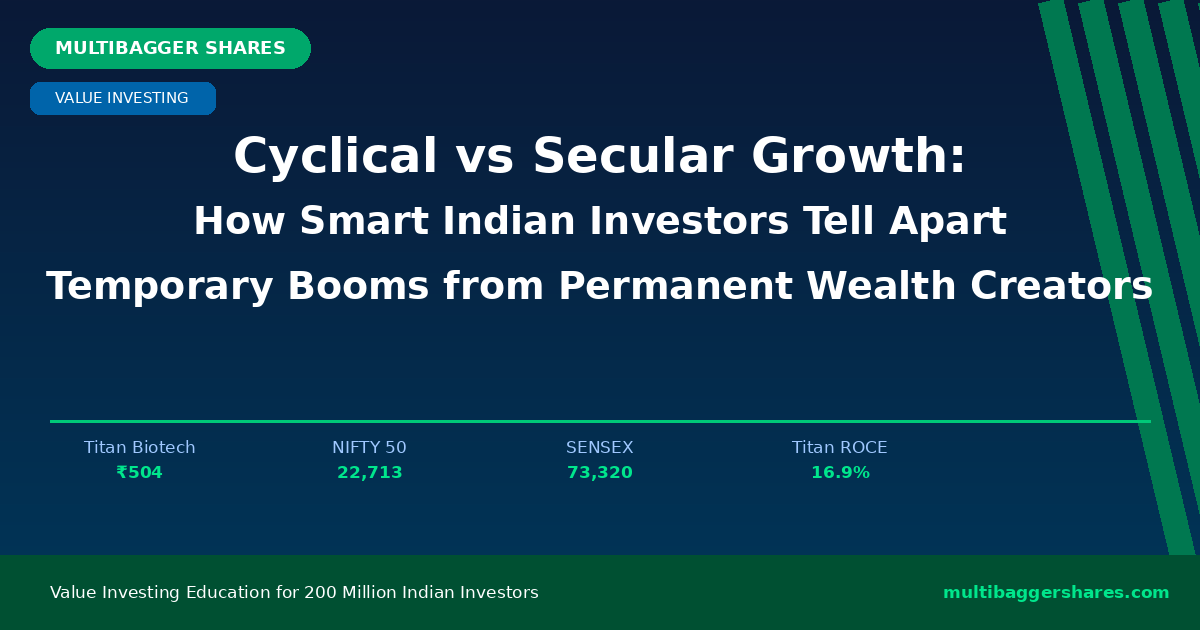
April 4, 2026
(Saturday)
Why This Distinction Can Make or Break Your Portfolio
Every Indian investor has made this mistake at least once: you spot a company growing at 40% year-over-year, you get excited, you invest — and then three years later, the growth vanishes as quickly as it appeared. The stock crashes. Your investment is down 60%. And you are left wondering: what went wrong?
The answer, almost always, is that you confused cyclical growth with secular growth. These two types of business expansion look identical on the surface — both produce strong revenue numbers, both attract analyst attention, both create temporary excitement in stock markets. But their long-term outcomes for investors are completely different. Understanding this distinction is arguably one of the most important skills a value investor can develop.
As of April 4, 2026, the NIFTY 50 is at 22,713 and the SENSEX is at 73,320 — both trading in positive territory. But amid this apparent calm, dozens of Indian stocks are riding what their promoters claim is a structural secular boom. How do you separate the real secular growers from the cyclical pretenders? Let us explore this in detail.
What Is Cyclical Growth?
Cyclical growth is growth that is driven by temporary external forces — typically economic cycles, commodity price swings, government spending bursts, or short-term demand shocks. Cyclical businesses move with the economy: they boom when conditions are favourable and shrink when conditions tighten.
The key characteristic of cyclical growth is that it is mean-reverting — it eventually returns to its long-term average. The growth is real while it lasts, but it is not sustainable without a fundamental structural driver.
Classic examples of cyclical sectors in India:
- Steel and Metals: JSW Steel, Tata Steel, Hindalco — their revenues and profits swing dramatically with global commodity prices. When steel prices spike (as they did in 2021), profits soar. When they fall (as in 2023), profits collapse.
- Real Estate: Companies like DLF and Godrej Properties boom during low interest rate cycles and dry up during tight monetary cycles.
- Automobiles: Maruti Suzuki’s volumes track consumer sentiment and interest rates. During rate cuts, sales surge. During rate hikes, demand cools.
- Capital Goods: L&T and engineers like Thermax get a massive surge in order books during government infrastructure spending cycles — but orders thin out when budgets tighten.
- Chemicals: Many specialty chemical companies that boomed in 2020–2022 due to China+1 tailwinds saw normalisation in 2023–2024 as Chinese supply recovered.
This does not mean these businesses are bad investments. Skilled cyclical investors — like Howard Marks — make fortunes by buying cyclicals at the bottom of the cycle and selling at the top. But it requires timing, which is notoriously difficult. For most long-term investors, the danger lies in paying a high multiple for a cyclical business at the peak of its cycle, mistaking the peak for a new permanent plateau.
What Is Secular Growth?
Secular growth is growth driven by deep, structural, multi-decade trends that are largely independent of short-term economic cycles. Secular businesses do not depend on whether interest rates are high or low, or whether commodity prices are favourable. They grow because something fundamental in the world is permanently changing — demographics, technology, regulation, or human behaviour.
Characteristics of secular growth businesses:
- Revenue and profits grow consistently even during economic downturns
- Growth is driven by an expanding addressable market, not just better capture of an existing market
- The fundamental driver (the structural trend) is visible and likely to persist for 10–20 years
- Management has a clear capital allocation roadmap aligned with the secular tailwind
Classic examples of secular growth in India:
- Private Banking: HDFC Bank grew consistently for 25+ years because India’s penetration of formal banking credit was fundamentally low and expanding. This is a secular story.
- Insurance: HDFC Life and SBI Life benefit from chronically low insurance penetration in India — a structural gap that will take decades to close.
- Healthcare and Diagnostics: As India’s middle class grows and ages, spending on healthcare will structurally increase for the next 20–30 years.
- API and Specialty Pharma: Indian pharmaceutical manufacturers benefit from the global secular trend of biosimilars, aging populations in developed markets, and cost-efficient drug manufacturing — all structural multi-decade trends.
The Titan Biotech Case Study: A Secular Growth Story
Titan Biotech Ltd (BSE: 524717) — our flagship value investing case study — is a compelling example of a secular growth business. As of the close on April 2, 2026, Titan Biotech trades at ₹504 per share, with a market capitalisation of approximately ₹2,082 crore and a 52-week range of ₹74.7 to ₹504 (post the 5:1 stock split in February 2026).
What makes Titan Biotech a secular grower and not a cyclical one?
- Structural demand for culture media: Titan Biotech manufactures microbiological culture media — the ingredients used by pharmaceutical labs, hospitals, research institutes, and diagnostic centres for testing and research. This demand is driven by India’s growing healthcare infrastructure, the rise of diagnostics, and global demand for India-made culture media. These are not cyclical trends — they are demographic and industrial trends that will grow for decades.
- Growing export opportunity: As global pharma companies seek quality culture media from cost-efficient manufacturers, Indian companies like Titan Biotech benefit. This is a China+1 structural tailwind that is multi-year in nature.
- Consistent financial performance: Unlike cyclical businesses, Titan Biotech has demonstrated consistent improvement in its financial ratios — ROCE stands at 16.9% and ROE at 15.0% — without relying on commodity price tailwinds.
- Debt-free balance sheet: Titan Biotech operates without meaningful debt, meaning it does not depend on interest rate cycles to sustain its business model.
The stock has delivered extraordinary long-term returns (from ₹8 to its current levels represents a 50x+ journey on a pre-split adjusted basis) precisely because the underlying business benefits from secular structural trends — not temporary cyclical booms.
The Four Tests: Cyclical or Secular?
Here is a practical four-test framework for Indian investors to distinguish between cyclical and secular growth when analysing any stock:
Test 1: What is the PRIMARY driver of growth?
Ask: Is the company growing because of a structural change in the world, or because of a temporary external condition? If a steel company is growing 50% because steel prices tripled globally, that is cyclical. If a diagnostics company is growing 25% because India’s disease burden is rising and more people can afford tests, that is secular.
Test 2: What happens during a recession?
Look at the company’s historical performance during economic downturns — 2008, 2012, 2016, 2020. Secular businesses typically show resilience or mild slowdowns. Cyclical businesses show dramatic revenue and profit drops. HDFC Bank barely blinked in 2008. JSW Steel’s profits collapsed.
Test 3: Does management talk about markets or tailwinds?
Listen to what management emphasises in their annual reports and earnings calls. Secular business managers talk about expanding addressable markets, structural demand drivers, and long-term capacity investments. Cyclical business managers talk about commodity prices, order books, and near-term economic conditions. The language reveals the nature of the business.
Test 4: Is the P/E ratio optically high or structurally justified?
A cyclical stock with a P/E of 40 at the peak of its cycle is dangerously expensive — because “E” will fall and the P/E will expand frighteningly. A secular grower with a P/E of 40 may actually be reasonable if the earnings will compound at 20% for the next decade. Titan Biotech’s current P/E of 76.6 is a reflection of the market’s recognition of its secular growth trajectory — a premium that quality secular compounders consistently command in Indian markets. Companies with durable structural tailwinds, debt-free balance sheets, and consistent ROCE improvement (16.9% for Titan Biotech) deserve premium valuations because their earnings power compounds year after year, making today’s P/E look modest in hindsight.
The Trap: False Secular Stories
Not every company that claims to be a secular grower actually is one. Indian markets have seen several “false secular” narratives:
- Telecom (2000–2010): Telecom was initially a genuine secular growth story. But as penetration reached saturation and competition intensified (especially after Jio’s entry in 2016), it became intensely cyclical. Investors who treated telecom as a permanent secular grower suffered massive losses.
- NBFCs (2015–2019): Several NBFCs were positioned as secular beneficiaries of India’s credit gap. But their aggressive lending and dependence on market liquidity made them deeply cyclical — as the IL&FS crisis of 2018 and subsequent NBFC crisis demonstrated.
- EPC / Infrastructure (2007–2008): Infrastructure was a “10-year secular story” before the 2008 crisis. Companies like IVRCL and Lanco Infratech were valued as secular compounders — only to collapse spectacularly when government spending slowed and leverage bit back.
The lesson: A secular label is only as good as the structural evidence behind it. Always challenge the narrative with hard data.
How to Build a Portfolio of Secular Growers
For Indian long-term investors seeking multibagger returns, building a portfolio anchored in secular growth businesses offers significant advantages:
- Reduce timing risk: You do not need to time economic cycles perfectly. Secular businesses can be bought and held through multiple cycles.
- Compounding advantage: When a business grows earnings consistently for 15–20 years, the compounding effect is extraordinary. A 20% CAGR over 15 years turns ₹1 lakh into ₹15.4 lakh.
- Mental peace: Owning businesses with strong structural tailwinds gives you the conviction to hold during temporary market downturns — which is the single most important behavioural advantage a long-term investor can have.
Look for secular growers in healthcare, insurance, domestic consumption, financial services (carefully selected), specialty manufacturing with export orientation, and technology-enabled services. These sectors benefit from India’s demographic dividend, rising incomes, and increasing integration with global supply chains.
The SEBI Warning Every Indian Investor Needs to Hear
While building long-term wealth through secular compounders, remember this critical fact: 9 out of 10 individual traders in the equity Futures & Options (F&O) segment incur net losses, according to SEBI’s own research. F&O trading is not investing — it is speculation, with the odds overwhelmingly against you. The path to wealth creation in Indian markets runs through patient ownership of quality secular growth businesses — not short-term F&O bets.
If you want to learn more about value investing, systematic stock analysis, and building a portfolio of quality compounders, explore our full Value Investing Course Playlist on YouTube.
SEBI Disclaimer: 9 out of 10 individual traders in the equity Futures & Options segment incurred net losses according to a SEBI study. F&O trading is essentially gambling. Focus on quality stock picking and long-term value investing instead.
Disclaimer: The author (Manish Goel) is a SEBI Registered Research Analyst (Registration No. INH100004775) and Multibagger Shares (Multibagger Securities Research & Advisory Pvt. Ltd.) is a SEBI Registered Investment Advisor (Registration No. INA100007736). This post is for educational purposes only and should not be construed as a buy/sell recommendation. Please do your own research and consult a qualified financial advisor before making investment decisions. Stock market investments are subject to market risks. Past performance is not indicative of future results.
📢 Join Our Telegram Channel
Get daily value investing lessons, stock analysis & Titan Biotech updates — delivered straight to your phone!
✈️ Join @longtermequityy on Telegram
🔔 Free • No spam • Value investing insights daily