
DuPont Analysis: The X-Ray Machine That Reveals the TRUE Quality of ROE — Why High Return on Equity Can Be Dangerous and How Smart Indian Investors Decode It to Find Genuine Multibaggers

Revenue Growth Trajectory: How to Read 10-Year Revenue CAGR Like a Pro — Why Consistent Top-Line Growth Is the #1 Signal of a Future Multibagger (Titan Biotech Case Study)
April 1, 2026Video: DuPont Analysis — The X-Ray Machine That Reveals the TRUE Quality of ROE for Indian Investors (English)
April 1, 2026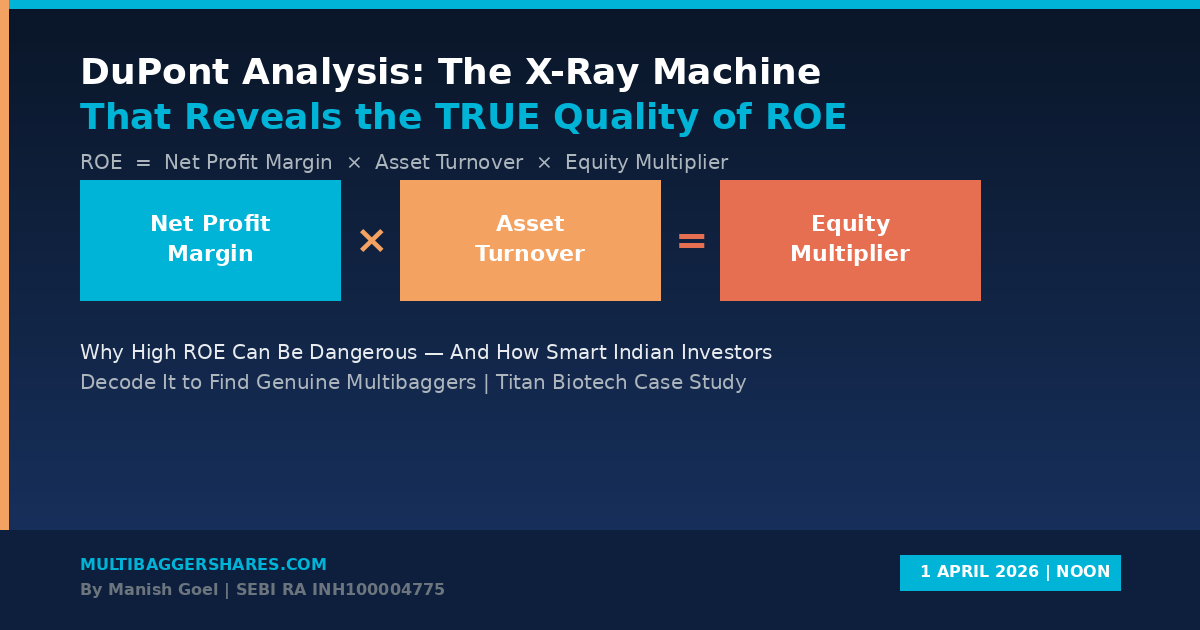
Published: 1 April 2026 | Noon Edition
Every investor in India knows about Return on Equity (ROE). It is the single most popular profitability metric on Screener.in, Trendlyne, and every stock analysis platform. If a company shows 20%+ ROE, investors rush to buy. But here is the uncomfortable truth that separates amateur investors from professionals: not all ROE is created equal.
A company can show 25% ROE and still be a ticking time bomb. Another company can show 15% ROE and be an absolute wealth-creating machine. The difference? Where the ROE comes from. And the tool that reveals this hidden truth is called DuPont Analysis — named after the DuPont Corporation that developed it in the 1920s.
What Is DuPont Analysis? The Three-Component Breakdown
DuPont Analysis breaks ROE into three distinct components using a beautifully simple formula:
ROE = Net Profit Margin × Asset Turnover × Equity Multiplier
Let me explain each component in plain language so that any Indian investor — whether you are a beginner or an experienced market participant — can use this framework immediately.
Component 1: Net Profit Margin (Net Income ÷ Revenue) — This tells you how much profit the company keeps from every rupee of revenue. A company with 15% net margin keeps ₹15 from every ₹100 of sales after all expenses, taxes, and interest. High margins indicate pricing power, operational efficiency, and a strong competitive position. When you see consistently high net margins, you are looking at a business that has genuine pricing power — it can charge more because customers value its products or services.
Component 2: Asset Turnover (Revenue ÷ Total Assets) — This measures how efficiently the company uses its assets to generate revenue. An asset turnover of 1.5x means the company generates ₹1.50 in revenue for every ₹1 of assets it owns. High asset turnover signals operational excellence — the company does not need massive capital investments to keep growing. It is an asset-light business that can scale without proportional capital increases.
Component 3: Equity Multiplier (Total Assets ÷ Shareholders’ Equity) — This is the leverage component. An equity multiplier of 2.0x means the company has ₹2 in assets for every ₹1 of equity — meaning half its assets are funded by debt. A HIGH equity multiplier means the company is using debt to boost ROE. This is where the danger lies. A company can show impressive 25% ROE simply because it has loaded itself with debt, not because it is a genuinely profitable, efficient business.
Why This Matters: The Three Paths to High ROE
Understanding DuPont Analysis reveals that there are fundamentally three different ways a company can achieve high ROE, and they are NOT equally desirable:
Path 1: High Margins (THE BEST) — Companies like Titan Biotech that achieve high ROE primarily through strong net profit margins are the most desirable investments. High margins indicate genuine competitive advantages — proprietary products, brand strength, or specialized expertise that allows the company to charge premium prices. This is the sustainable path to wealth creation.
Path 2: High Asset Turnover (GOOD) — Companies that achieve high ROE through efficient asset utilization — like well-run retail or FMCG businesses — are generating more revenue per rupee of assets. Think of Avenue Supermarts (DMart). Its margins are thin, but it turns its assets so efficiently that ROE remains strong. This is a legitimate business model, but it requires constant operational excellence.
Path 3: High Leverage (DANGEROUS) — This is the trap that catches most Indian investors. A company loads up on debt, which inflates the equity multiplier and artificially boosts ROE. On a screener, this company looks identical to a genuinely profitable business. But when interest rates rise, when a downturn hits, when revenues dip even slightly — this house of cards collapses. The high ROE was never real. It was financial engineering, not business quality.
A Real-World Indian Example: Spotting the Difference
Consider two hypothetical Indian companies, both showing 20% ROE:
Company A: Net Profit Margin = 12%, Asset Turnover = 1.1x, Equity Multiplier = 1.5x → ROE = 12% × 1.1 × 1.5 = 19.8%
Company B: Net Profit Margin = 4%, Asset Turnover = 0.8x, Equity Multiplier = 6.25x → ROE = 4% × 0.8 × 6.25 = 20%
Both companies show ~20% ROE. But Company A achieves it through genuine profitability (12% margins) and moderate efficiency (1.1x turnover) with minimal debt (1.5x multiplier). Company B has razor-thin margins (4%), poor asset efficiency (0.8x), and is drowning in debt (6.25x multiplier — meaning over 84% of its assets are funded by debt!).
Without DuPont Analysis, these two companies look identical on your screener. With DuPont Analysis, you instantly see that Company A is a potential multibagger while Company B is a potential bankruptcy candidate.
How to Perform DuPont Analysis on Screener.in
Here is a step-by-step practical guide that you can use right now:
Step 1: Go to Screener.in and pull up any company’s financials. Note down: (a) Net Profit from the Profit & Loss statement, (b) Total Revenue, (c) Total Assets from the Balance Sheet, and (d) Total Shareholders’ Equity.
Step 2: Calculate each component — Net Profit Margin = Net Profit ÷ Revenue; Asset Turnover = Revenue ÷ Total Assets; Equity Multiplier = Total Assets ÷ Shareholders’ Equity.
Step 3: Multiply all three to verify they equal the company’s reported ROE.
Step 4: Compare these three components across years (at least 5 years) to see the trend. Is the company improving margins? Is asset efficiency stable? Is leverage increasing dangerously?
Step 5: Compare with industry peers. A pharma company’s DuPont profile will look very different from a bank’s. Always compare apples to apples.
The Titan Biotech Lens: Quality ROE in Action
When we look at a company like Titan Biotech Ltd (BSE: 524717) through the DuPont lens, we see something remarkable. This is a company where ROE is primarily driven by improving net profit margins and efficient asset utilization — not by excessive leverage. The equity multiplier remains conservative, meaning the company is not artificially inflating its ROE through debt.
This is exactly the kind of DuPont profile that long-term value investors should seek. When ROE is driven by genuine profitability and efficiency rather than financial leverage, the returns are sustainable, predictable, and compounding in nature. The business creates real economic value rather than paper profits propped up by borrowed money.
Five Red Flags DuPont Analysis Reveals
Red Flag 1: Rising Equity Multiplier with Stable or Falling Margins. If the company’s leverage is increasing while profitability is not improving, management is using debt to mask deteriorating business quality. This is the single most dangerous pattern in Indian markets, especially in mid-cap and small-cap companies.
Red Flag 2: Falling Asset Turnover Over Time. This means the company is becoming less efficient — it needs more and more assets to generate the same revenue. This often signals capital misallocation, overexpansion, or declining demand for the company’s products.
Red Flag 3: ROE Increasing While Net Margins Are Declining. If ROE goes up but margins go down, the increase is coming from leverage or unsustainable asset turnover improvements. This is a classic value trap setup.
Red Flag 4: Equity Multiplier Above 3x in a Non-Financial Company. For banks and NBFCs, high leverage is normal — it is their business model. But for a manufacturing or services company, an equity multiplier above 3x is a warning sign that the company is over-leveraged.
Red Flag 5: Volatile DuPont Components. If the three components swing wildly year to year, the business lacks predictability. Consistent, slowly improving DuPont components are the hallmark of a genuine quality compounder.
DuPont Analysis for Different Sectors
Different industries have characteristic DuPont profiles that investors must understand. IT Services companies like TCS and Infosys typically show very high net margins (20%+), moderate asset turnover, and low equity multipliers — they are margin-driven ROE generators. FMCG companies like Hindustan Unilever show moderate margins with very high asset turnover — they are efficiency-driven. Infrastructure companies often show low margins, low turnover, and high equity multipliers — they are leverage-driven, which is why they are cyclical and risky.
Understanding these sector-level DuPont profiles helps you set proper expectations. A pharma company with 8% margins might be underperforming, while a cement company with 8% margins might be doing well. Context matters, and DuPont Analysis provides that context.
The Advanced DuPont: Five-Component Model
For advanced investors, there is a five-component extended DuPont model that provides even deeper insight. It breaks down net profit margin into: Tax Burden (Net Income ÷ Pre-Tax Income), Interest Burden (Pre-Tax Income ÷ EBIT), and Operating Margin (EBIT ÷ Revenue). This additional granularity helps you understand whether margin changes are driven by operational improvements, tax efficiency, or changes in interest costs. This is particularly useful when analyzing companies undergoing capital structure changes or operating in sectors with evolving tax regimes.
Your Action Plan: Implement DuPont Analysis Today
Here is what I want you to do right now: Pick the top 5 stocks in your portfolio. For each one, calculate the three DuPont components using the latest annual results on Screener.in. Then calculate them for the last 5 years. Ask yourself: Is the ROE driven by margins, efficiency, or leverage? Is the trend improving or deteriorating? Is the equity multiplier dangerously high?
This single exercise will give you more insight into your portfolio quality than a hundred YouTube videos about “multibagger stocks.” DuPont Analysis is not glamorous. It is not exciting. But it is the X-ray machine that reveals the true skeleton of a company’s profitability — and once you learn to read it, you will never look at ROE the same way again.
Manish Goel is a SEBI Registered Research Analyst (INH100004775) and founder of Multibagger Securities (SEBI RIA INA100007736). Learn the complete value investing framework in our free course playlist: Complete Value Investing Course.
👉 Join our Telegram channel for instant updates: @longtermequityy