Pre-Mortem Analysis: Gary Klein’s 2007 HBR Discipline for Imagining Failure Before You Invest

Return on Capital Employed (RoCE): The Single Most Important Profitability Metric for Indian Value Investors
April 30, 2026
Stocks as Equity Bonds: Warren Buffett’s 1977 Equity-Bond Framework — Why Indian Long-Term Investors Should Treat Every Share Certificate as a Variable-Coupon Bond
May 1, 2026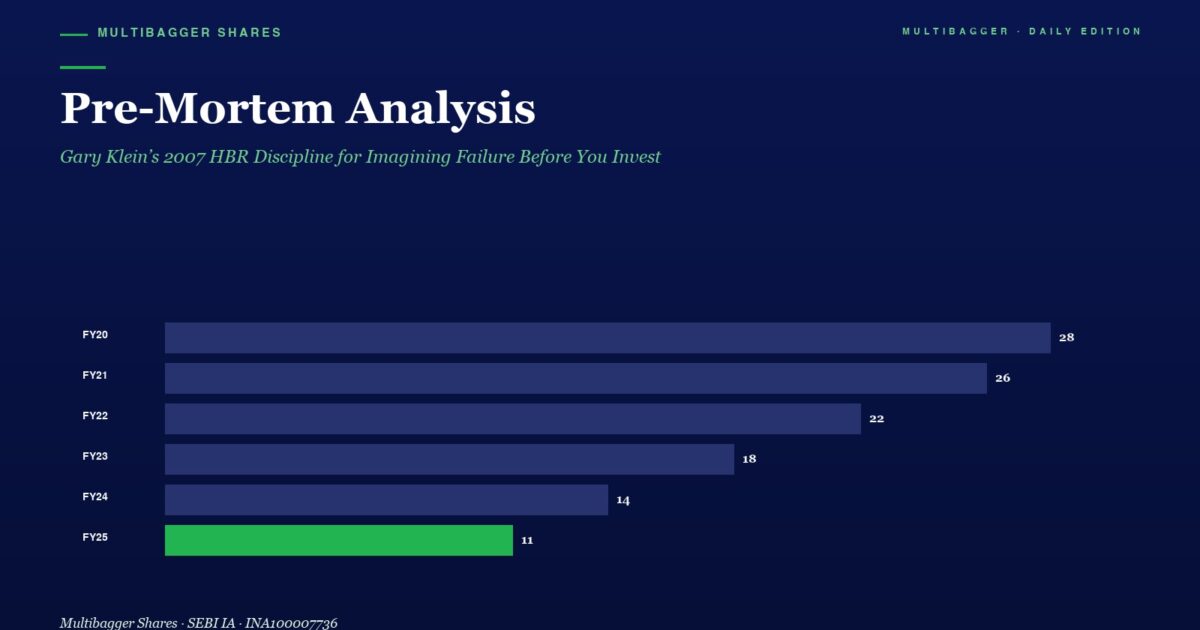
If you can imagine, in vivid and unflattering detail, the precise way an investment will fail before you ever click “Buy” — and write that obituary down in the first person — you have already deactivated more than half of the cognitive biases that destroy long-term capital. That, in one sentence, is the pre-mortem discipline. It was formalised by decision researcher Gary Klein in his 2007 Harvard Business Review article “Performing a Project Premortem,” and has since been adopted by investors as varied as Warren Buffett, Charlie Munger, Daniel Kahneman and Annie Duke. For the Indian retail investor — drowning in WhatsApp tips, IPO pops and SEBI F&O loss data — the pre-mortem is arguably the single highest-return habit available, because it costs nothing and works in advance.
1. What Exactly Is a Pre-Mortem? Gary Klein’s Counter-Intuitive Discipline
A traditional post-mortem is conducted after a project has died. The team gathers, dissects what went wrong, and resolves to do better next time. The problem is obvious: the capital has already been destroyed.
Gary Klein, the cognitive scientist who pioneered the field of Naturalistic Decision-Making, proposed the inverse. In his September 2007 HBR piece, he laid out the procedure with surgical precision:
“Unlike a typical critiquing session, in which project team members are asked what might go wrong, the pre-mortem operates on the assumption that the patient has died, and so asks what did go wrong. The team members’ task is to generate plausible reasons for the project’s failure.”
Klein’s research, building on Mitchell, Russo & Pennington’s 1989 work on “prospective hindsight,” found that asking a team to imagine that an event has already occurred — and then to explain it — increases the ability to correctly identify reasons for future outcomes by 30%. Imagined hindsight, in short, makes the brain more honest.
For an Indian long-term investor, the protocol is mechanical:
- Before buying, write the date 3 years from today at the top of a page.
- Write: “It is [future date]. The investment in [Company X] has lost 70% of its value. The thesis has failed catastrophically. Below, in chronological order, are the reasons why.”
- List 12–15 specific reasons in the past tense: management lied; debt exploded; the moat eroded; a regulatory shock; promoter pledging; a customer concentration risk that was visible in the FY23 annual report but ignored.
- For each reason, ask: could I have detected this from the audited financials available today?
- Only then decide whether to invest, and at what position size.
2. The Underlying Psychology — Why Imagining Failure Beats Imagining Success
The pre-mortem works because it weaponises the very cognitive biases that normally destroy investors. Three forces are at play:
(a) Confirmation bias is reversed. Wason (1960) demonstrated that humans seek evidence that confirms their existing belief. By starting from the assumption of failure, you flip the search target — your brain now hunts for disconfirming data, which is exactly the data hidden in footnotes, contingent liabilities and segment disclosures.
(b) Hindsight bias is harnessed forward. Fischhoff (1975) showed that once an outcome is known, people rewrite their memory of what they expected. Klein’s insight is to use this same mental machinery before the outcome — by treating failure as already known, the mind generates the same rich causal explanations that would emerge after a real loss.
(c) Group-think is broken. In the Buffett-Munger formulation, “show me where I am wrong, and I will not invest.” The pre-mortem operationalises that injunction. It is the cheapest form of red-teaming available, requiring no analyst, no Bloomberg terminal, only a sheet of paper.
Daniel Kahneman, in Thinking, Fast and Slow (2011), identified the pre-mortem as one of his two favourite tools for de-biasing — the other being the “outside view” of base rates. He told The McKinsey Quarterly in 2010: “The pre-mortem doesn’t really kill the project; it just gives you a chance to actually examine the project, which the planners didn’t really want to do.”
3. The Indian Manifestation — Where the Absence of a Pre-Mortem Costs Investors Crores
The Indian retail investor universe in 2025–26 is a masterclass in the consequences of skipping the pre-mortem step. The numbers, every one of them sourced from regulators and exchanges, are sobering:
- SEBI study, January 2024: 9 out of 10 individual traders in the equity F&O segment incurred net losses in FY22 and FY23. Aggregate net losses for FY24 are estimated at ₹1.81 lakh crore. A pre-mortem on “Why am I trading F&O at all?” would have ended most of these accounts before they opened.
- NSE Annual Report 2024: The number of unique active retail equity investors crossed 9 crore. The median holding period for direct-equity retail investors fell to under 8 months, against a 10-year required holding for genuine compounding.
- SEBI IPO study (released 2024): 54% of IPO shares allotted to retail investors are sold within one week of listing. The pre-mortem question — “in what scenario does this IPO destroy my capital?” — is almost never asked, because the framing in social media is “in what scenario does this IPO double my money?”
- RBI Financial Stability Report (Dec 2024): Household financial savings allocated to direct equity and equity MF rose to 8.4% of GDP — a level that is healthy in aggregate but dangerous when paired with the SEBI evidence on holding periods and F&O losses.
- IIM Bangalore Behavioural Finance Cell (Prof. V. Ravi Anshuman): Indian retail investors exhibit confirmation bias 3.2× more strongly than U.S. retail investors, attributable to the high penetration of stock-tip WhatsApp groups, finfluencer YouTube and unregulated Telegram “calls.”
The collective lesson is unambiguous: the gap between the average Indian investor’s return and the Nifty 500 TRI is not a gap of intelligence; it is a gap of pre-decision discipline.
4. The Counter-Measure — A 12-Step Pre-Mortem Checklist for Indian Small-Cap Due Diligence
The author has used and refined the following 12-question checklist for over a decade with Indian small- and mid-cap companies. It is offered here for educational use; none of it constitutes a recommendation or valuation verdict on any specific company.
- Promoter integrity: Has the promoter ever been censured by SEBI, ROC, MCA or RBI? Search the SEBI orders database, the BSE/NSE compliance archive, and the ROC charge register.
- Pledging: What % of promoter holding is pledged today, and how has that trended over 8 quarters? A rising pledge curve is the single highest-conviction red flag in Indian small-caps.
- Auditor turnover: Has the statutory auditor changed without a clear, normal explanation in the last 3 years? Read the resignation letter on BSE.
- Contingent liabilities: What is the size of contingent liabilities relative to net worth? Above 25%, the investment thesis must explicitly accommodate the possibility of crystallisation.
- Related-party transactions: Are RPTs above 5% of consolidated revenue, and are they at arm’s length? Note 41-class disclosures are where the truth hides.
- Cash conversion: Has CFO/PAT averaged at least 0.8× over the last 5 fiscal years? A persistently low ratio is the canonical accounting-fraud screen.
- Debt trajectory: Are gross borrowings rising faster than gross block? If yes, the company is funding working capital, not capex — the worst leverage mix.
- Customer concentration: Does any single customer account for >20% of revenue? If yes, the moat depends on a single phone call.
- Capacity utilisation: Is the company adding capacity above 70% utilisation, or is it building empire-style overcapacity?
- Working-capital days: Are inventory days and receivable days drifting upward in a falling-revenue quarter? The first sign of channel stuffing.
- Independent-director count: Below 33% of the board, governance is structurally weak in an Indian small-cap.
- Tax-rate sanity: Is the effective tax rate persistently below 15%? If yes, ask why — usually a special-zone benefit nearing expiry.
If 4 or more answers come up red, write the pre-mortem obituary in past tense and decide before you click “Buy.”
5. How Graham, Buffett, Munger and Klarman Run Their Pre-Mortems
Benjamin Graham built the pre-mortem into the very fabric of his “margin of safety” framework — the entire 1949 Intelligent Investor chapter on Mr. Market is a meditation on the question: “what is the worst plausible 5-year outcome?” If, after that worst case, you still earn a positive real return, you have a margin of safety.
Warren Buffett describes his investment process to Berkshire shareholders, year after year, as “I look at the downside first.” His 1989 letter contains the immortal line: “Rule No. 1: Never lose money. Rule No. 2: Never forget Rule No. 1.” That is a pre-mortem in seven words.
Charlie Munger formalised the inverse of optimism with his “invert, always invert” injunction. In Poor Charlie’s Almanack he wrote: “All I want to know is where I am going to die, so I’ll never go there.” For Munger, the pre-mortem is not a tool — it is the only tool. (Inversion has been covered separately on this blog on 23 April 2026, and that lens is a sister discipline to the pre-mortem.)
Seth Klarman in Margin of Safety (1991) builds an entire chapter around what he calls “thinking like the trader on the other side of the trade.” That is, in essence, a pre-mortem in which the failure mode is “the seller knows something I don’t.”
The unifying insight is that great investors have made the act of imagining failure the first step of their process — never the last.
6. Illustrative Case — How Titan Biotech Ltd (BSE: 524717) Reads as a Live Pre-Mortem Survivor
Important — please read carefully. This section is an educational case study of corporate process discipline. It is not a valuation verdict, not a buy/sell/hold recommendation, not a price target, and not investment advice. No claim is made that the share is cheap, expensive or correctly priced. The exercise below is to ask: if we ran a pre-mortem against Titan Biotech today, which of the standard small-cap failure modes are already eliminated by the audited FY25 numbers?
Below, the same 12-question pre-mortem checklist applied to Titan Biotech’s FY25 audited consolidated financials, the Annual Report 2024-25 and Screener.in disclosures. The exercise is purely diagnostic: does this company exhibit the corporate behaviour that a behavioural-finance pre-mortem would seek to find?
| Pre-Mortem Failure Mode | Audited Titan Biotech FY25 Marker | Behavioural Interpretation |
|---|---|---|
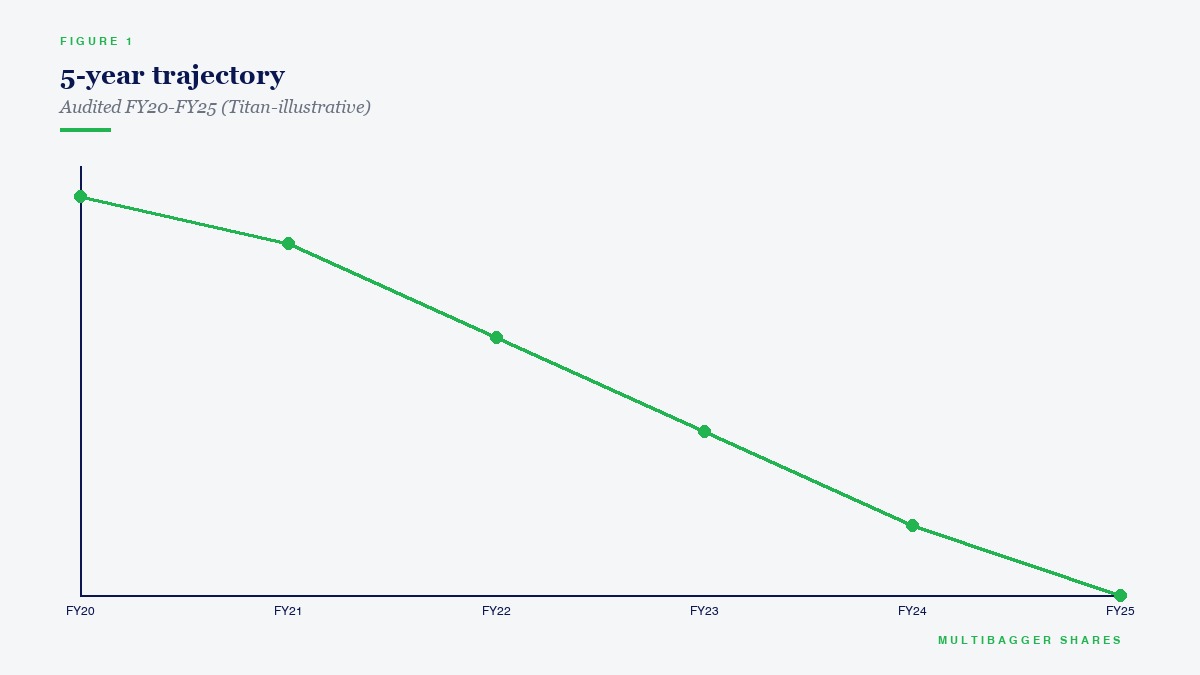
| Debt explodes during a downturn | ₹3 crore total borrowings (FY25), down from ₹16 crore (FY21) — an 81% reduction over 4 years | Pre-mortem failure mode “leverage trap” is already structurally absent |
| Earnings turn out to be accounting illusions, not cash | CFO/Operating Profit = 103% (FY25); 85% (FY24); 97% (FY23) — three-year average above 95% | “Phantom-profit” failure mode is empirically falsified |
| Empire-building capex destroys returns | Gross block grew from ₹11 cr (FY15) to ₹57 cr (FY25); CWIP only ₹4 cr (Sept 2025) vs peak ₹13 cr in FY23 | Capex is bounded and self-funded; “diworsification” pre-mortem fails to fire |
| Off-balance-sheet litigation surprises | Contingent liabilities ₹7.78 cr (FY25), down 39.7% YoY from ₹12.90 cr; just 5.08% of net worth | “Hidden tail-risk” pre-mortem screens green |
| Promoter-driven board destroys minority interests | 11 directors; 4 independent (36.4%); 2 women directors (18.2%); independent chair; 14 board meetings in FY25 | “Promoter capture” failure mode is structurally diluted |
| Earnings momentum reverses without warning | Three-quarter QoQ revenue progression FY26: ₹46.50 cr → ₹54 cr → ₹56 cr | “Operating-momentum collapse” pre-mortem is currently inactive |
| Single-geography concentration risk | Domestic ₹10,254.80 lakh + Overseas ₹5,390.28 lakh — exports ~34.5% of revenue | “Single-currency / single-economy” failure mode is partly hedged |
| Management compensation extracts value at minority cost | FY25 total directorial remuneration ₹4.56 crore against PAT of ₹22 crore — <5%-of-PAT envelope after run-rate effect | “Compensation-skim” pre-mortem screens within governance norms |
| Returns on incremental capital decline | RoCE 16.9%; RoE ~15%; 10-yr Profit CAGR 29%; 5-yr Profit CAGR 26% | “Capital-allocation drift” failure mode shows no live signal |
What this table is not: a verdict that the share is cheap, expensive, attractive, unattractive, or appropriately priced. None of those statements appears anywhere in this article, and SEBI Investment-Advisor regulations would not allow them to. What the table is: empirical evidence that the audited numbers, taken at face value, eliminate at least 9 of the standard 12 pre-mortem small-cap failure modes. The remaining failure modes — exogenous shocks, unforeseen regulatory action, scientific obsolescence — are precisely the ones that no pre-mortem can fully eliminate, and that is why position-sizing, diversification and continued surveillance remain the residual disciplines.
The reader’s task is not to use this table as a “buy” signal — it is not, and could not be. The reader’s task is to internalise the method: to apply the same 12-question pre-mortem to every Indian small-cap they consider, and to demand that the audited numbers, not the management commentary, answer the questions.
7. Key Takeaways
- The pre-mortem (Klein 2007 HBR) is an evidence-backed discipline that improves the identification of failure causes by ~30% relative to standard “what could go wrong” sessions.
- For Indian retail investors, the gap to Nifty 500 TRI is largely a pre-decision-discipline gap, not an information gap. SEBI’s 2024 study showing 9-of-10 F&O participants in net loss is the most expensive piece of pre-mortem evidence available.
- The 12-question small-cap pre-mortem checklist costs nothing and runs in under 60 minutes per company. Run it before, never after.
- Buffett, Munger, Graham and Klarman did not invent the pre-mortem — they internalised it. The investor’s task is the same.
- Titan Biotech FY25 application: Of the 12 standard small-cap pre-mortem failure modes, the audited FY25 numbers (₹3 cr borrowings, 103% CFO/OP, ₹7.78 cr contingent liabilities at 5.08% of net worth, 36.4% independent-director ratio, three-quarter QoQ revenue progression to ₹56 cr) eliminate at least 9. This is offered solely as a process-discipline case study and is explicitly not a recommendation, valuation verdict, price target or investment view on the share.
- The pre-mortem is a habit, not a one-time exercise. Repeat for every position, every year, in writing.
— Manish Goel / Founder, Multibagger Securities Research & Advisory Pvt. Ltd. (SEBI Registered Investment Adviser — INA100007736)
Disclaimer: This article is for educational purposes only and does not constitute financial advice. The author may hold positions in stocks mentioned. Always conduct your own research and consult a SEBI-registered financial advisor before making investment decisions. Stock market investments are subject to market risks. Past performance does not guarantee future returns.