The Shop That Painted Only Two Walls: What a Company’s Spending on Itself Tells You

The Shop That Sells to Every Miner: Why Some Businesses Win Whoever Wins the Race
September 9, 2026
The Helmet Shop Outside the RTO: When the Law Sends the Customers, Who Keeps the Profit?
September 11, 2026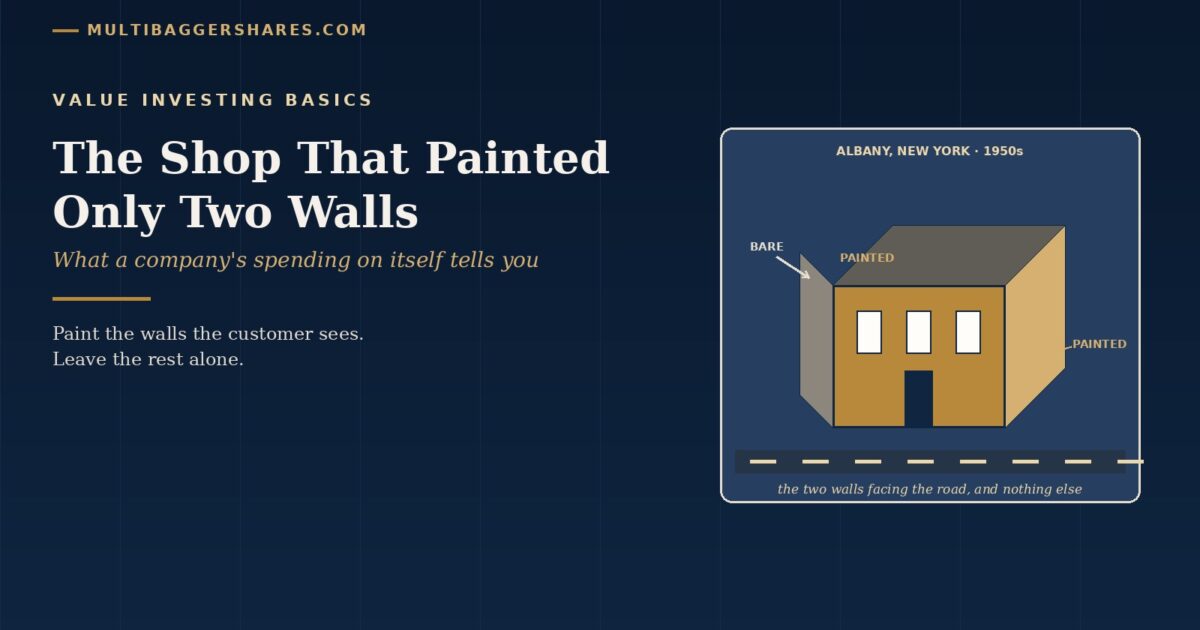
The building with two painted walls
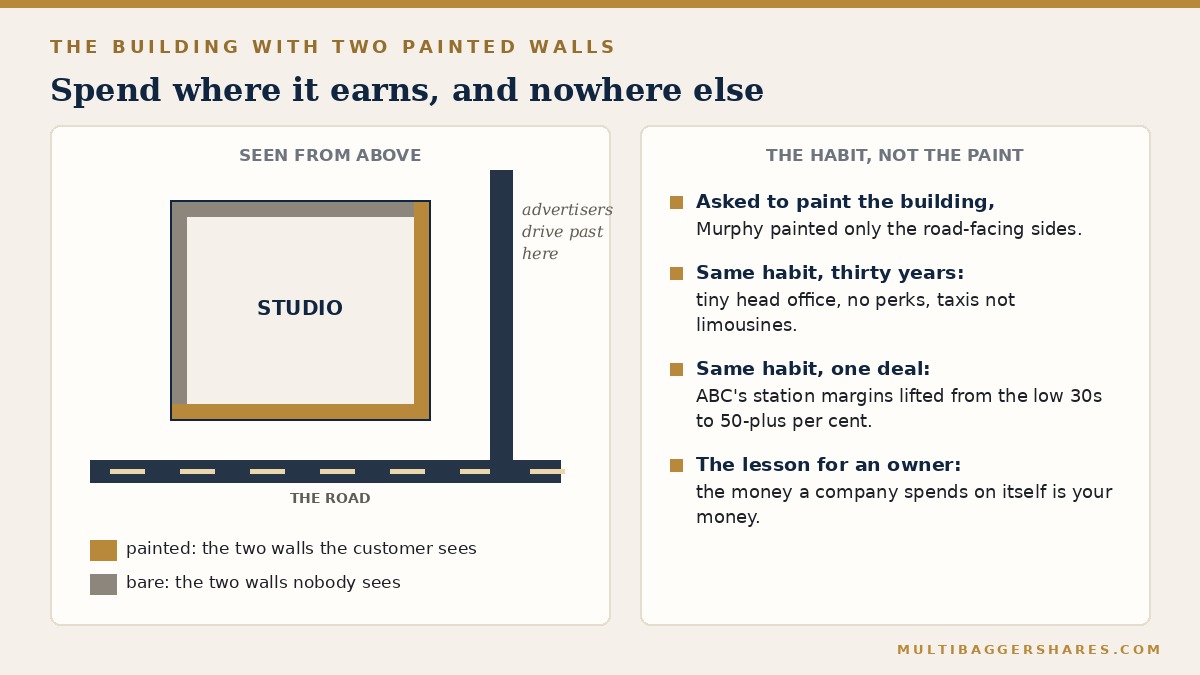
In the 1950s a young manager named Tom Murphy was sent to run a small, loss-making television station in Albany, in the state of New York. The station worked out of a run-down building that had once been a convent (a home for nuns). The owner asked Murphy to have it painted, so that visiting advertisers would see a smart, professional business.
Murphy had it painted. But only the two sides that faced the road. The other two walls, which no advertiser would ever see, stayed exactly as they were.
It is a small story, and it has been told for seventy years, because of what happened next. Murphy went on to build that little station into Capital Cities, one of the most admired media companies in America. In 1986 his company bought the ABC television network, a business far bigger than its own, in a deal the Wall Street Journal called a minnow swallowing a whale. Warren Buffett, who helped pay for that deal, called Murphy the finest executive in the country.
The two painted walls were not a stunt. They were a habit. And that habit, repeated a thousand times over thirty years, is a large part of why the company did so well for the people who owned its shares.
This letter is about that habit. It is about the money a company spends on itself, rather than on its customers, and what that spending quietly tells you about the people running it.
What it really means
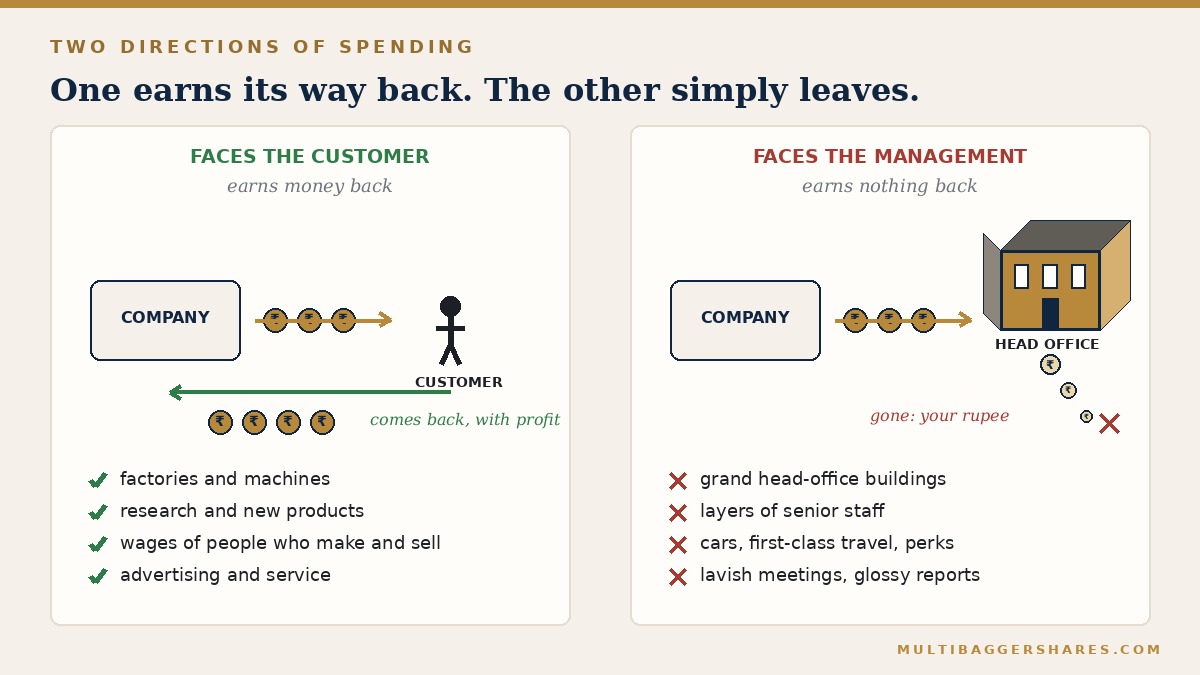
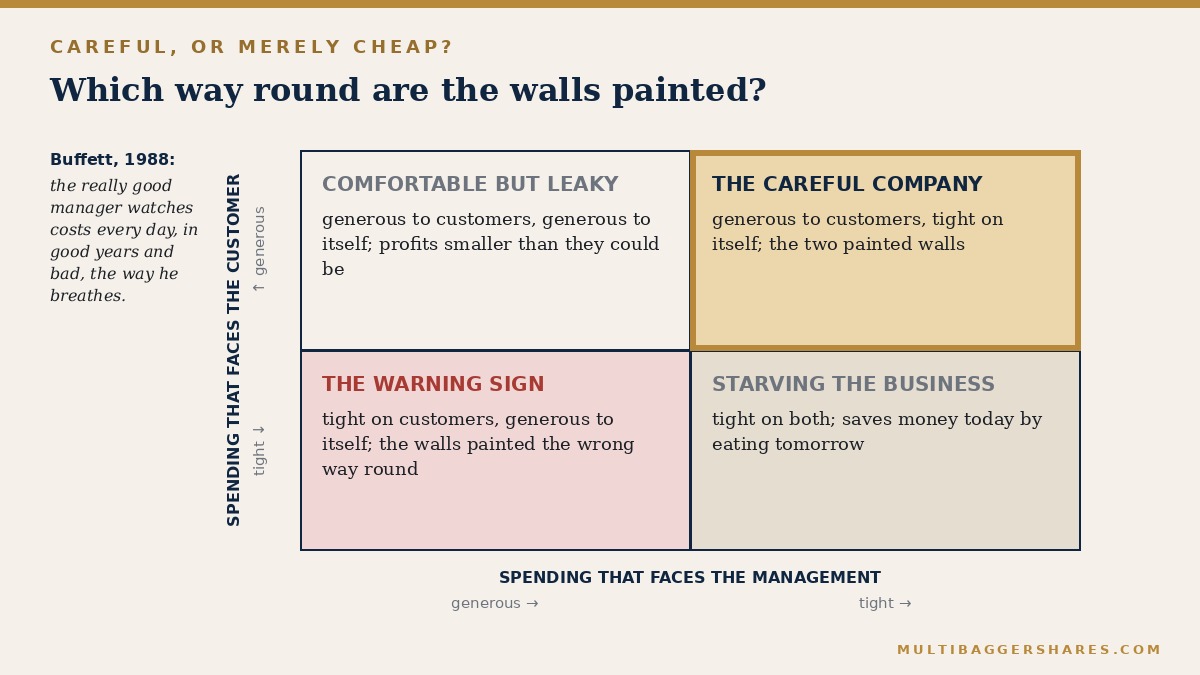
Think of a kirana shop (a small neighbourhood grocery store). The owner spends money in two directions. One direction faces the customer: good stock, a clean counter, a fridge that works, a boy to deliver orders. That spending earns money back. The other direction faces the owner: a bigger signboard than the shop needs, a new scooter bought in the shop’s name, a cousin on the payroll who never turns up, a first-class train ticket to the wholesale market. That spending earns nothing back. It simply leaves.
Every listed company has the same two directions. The money that faces the customer shows up as factories, research, advertising and the wages of people who make and sell the product. The money that faces the management shows up as head-office buildings, layers of senior staff, company cars, first-class travel, lavish annual meetings and glossy reports. Accountants file most of it under a dull heading called overheads (the running costs of a business that are not tied to making any particular unit of product).
Here is the important point. You are a part-owner of the company. Every rupee spent on the second direction is your rupee. If a company earns one hundred rupees and spends five of them on comforts that produce nothing, your share of the profit is five per cent smaller than it could have been. Do that every year for twenty years, and compounding (earning returns on your past returns, like a snowball rolling downhill) works against you instead of for you.
But the money itself is only half the lesson. The other half is what the spending reveals. A management that paints only the two walls that matter is telling you, without saying a word, that it treats the company’s money as if it were its own. A management that paints all four walls, gilds the gate and buys a helicopter is telling you something too.
Buffett has thought about this for a very long time. In 1988, when Fortune magazine profiled him, he remembered coming down hard on one of his own businesses. It had bought new labour-saving computer equipment for its accounts department, and yet the number of people in that department had risen from sixteen and a half to twenty-two and a half. He said there is a right-size staff for any operation, whether business is good or bad. Then he gave the line that this whole letter turns on: the really good manager does not wake up in the morning and decide to cut costs, any more than he wakes up and decides to practise breathing.
Why it works
Why should a small habit like this predict anything about a large company? Three reasons.
First, small spending is where character shows. When a company decides to build a new factory, dozens of people study the numbers and a board of directors votes. When it decides whether the chairman flies first class, nobody studies anything. That decision comes straight from the person’s nature. Small, unwatched choices tell you more about a person than big, watched ones. The same is true of companies.
Second, costs are the one thing a business can always control. Murphy and his partner Dan Burke understood this early: you cannot control your revenues at a television station, but you can control your costs. Sales depend on customers, competitors, the weather and the economy. Costs depend on the people inside. A management that keeps costs low in good years does not need a panic when the bad year arrives. Buffett made exactly this point in his 1990 letter to shareholders, praising two management teams he admired because they attacked costs as vigorously when profits were at record levels as when they were under pressure.
Third, careful spending compounds in the same direction as everything else you want. A company that wastes little has more cash left to reinvest, more room to cut prices when a rival attacks, and more patience to wait out a bad season. Its lower costs become a small moat (a durable advantage that protects a business from competitors, like the water around a castle). The habit that saved a few tins of paint in Albany is the same habit that, thirty years later, let Capital Cities run its television stations at profit margins (profit as a share of every rupee of sales) far higher than its rivals.
There is one caution, and it is important. Careful is not the same as cheap. A company that starves its customers to save money is not being careful. It is eating its own future. Buffett’s Buffalo News, the same Fortune article noted, made its money without ever stinting on the pages readers actually bought it for. One of Murphy’s early employees said it best: the company was careful, not just cheap. The test is direction. Spending that faces the customer should be generous. Spending that faces the management should be tight. The warning sign is a company that has those two the wrong way round.
A real example or two
Start with Capital Cities itself, because the details are instructive. The company’s head office was tiny. There were no vice-presidents for marketing, strategy or human resources, no in-house lawyer and no public relations department; Murphy’s secretary took calls from the press. The manager who ran the whole publishing division, with six daily newspapers and several magazine groups, did it with three people at headquarters, one of them an assistant. Every annual report carried the same sentence on its inside cover: managers were expected to be forever cost conscious.
Then came the ABC deal of 1986. ABC was a network of limousines, an executive dining room and a private lift for senior staff. Murphy arrived at his first meetings by taxi. The executive lift and the dining room went. The team that oversaw ABC’s television stations shrank from sixty people to eight. The profit margins of those stations, which had sat in the low thirties, were lifted to Capital Cities’ levels above fifty per cent within two years. When someone asked Murphy whether taking a taxi was a case of leading by example, he replied: is there any other way?
Buffett’s own office is the second example. In 1988, Fortune counted eleven people at Berkshire Hathaway’s headquarters in Omaha, including Buffett himself, and reported that he thought this was a shade too many. Berkshire then owned businesses employing many thousands of people. The article noted that Buffett and his partner Charlie Munger did not even consider spending on things like flashy offices that would do them no economic good. Buffett’s own salary that year was one hundred thousand dollars.
India has its own version of this story. Azim Premji took over his family’s cooking-oil business in 1966, at the age of twenty-one, after his father’s sudden death. He turned it into Wipro, one of the three companies that put India on the world map for information technology, and the first Indian IT company to list on the New York Stock Exchange. The stories about him are all of a kind. He insisted that both sides of every sheet of paper be used for photocopying. He walked around the office after hours switching off lights and fans. He paid for his personal telephone calls from his own pocket. For years he drove a modest Fiat, and he does not fly first class. None of these habits made Wipro’s software any better. All of them told its shareholders what kind of hands their money was in.
To be clear, nothing in this letter is a comment on any of these companies’ shares today. They are historical stories about a habit, and the habit is the point.
How you can use it
You do not need a calculator to check this, but you do need to look in a few places that most people skip. Here are five plain questions.
One. Are overheads growing faster than sales? Open the profit and loss statement (the page in the annual report that lists a year’s income and expenses) and find the line called other expenses, and the line called employee costs. Compare each with sales over five years. If sales have grown by half and other expenses have doubled, ask where the extra money went. A business that is getting bigger should, if anything, spend a smaller share of each rupee on running itself.
Two. How big is the head office? Some annual reports tell you how many people work at headquarters. Many do not, but you can often see it in the corporate address, the size of the building and the length of the list of senior management. A company with two thousand employees and forty vice-presidents is painting all four walls.
Three. What does the company spend on its own comfort? The annual report’s notes list things like rent, travel, vehicles and, in India, the remuneration (pay and benefits) of directors, which the law requires to be disclosed. You are not looking for a number. You are looking for a direction. Are these items rising quietly while profit stands still?
Four. What does the annual report itself look like? This is a small tell, but a real one. A report that is thick with colour photographs of the chairman, and thin on plain explanation of what went wrong, has told you where the management’s attention lies. The plainest annual reports in the world are Berkshire Hathaway’s, which have no pictures at all.
Five. What happened in the last bad year? Go back to the most recent year when sales fell. Did costs fall with them, or did they carry on rising as if nothing had happened? Buffett’s test was that good managers attack costs in record years and hard years alike. A company that only discovers costs when profits collapse, and announces a grand cost-cutting programme, has just told you it never really watched them before.
One last thought. This lens works best alongside the others we have written about: whether the company earns a high return on the money it uses, whether it carries little debt, whether its profits turn into cash, whether its customers stay. Frugality on its own does not make a business wonderful. But a wonderful business run by people who waste your money will be less wonderful every year, and a good business run by people who paint only two walls will surprise you, slowly, for a very long time.
Key takeaways
- Two directions of spending. Money that faces the customer earns its way back. Money that faces the management simply leaves, and every rupee of it belongs to the shareholders.
- Small spending shows character. Nobody votes on whether the chairman flies first class. Unwatched choices reveal more than watched ones, which is why the two painted walls predicted so much.
- Costs are the one thing a business controls. Sales depend on the world; costs depend on the people inside. Buffett praised managers who attack costs in record years as hard as in bad ones.
- Careful is not cheap. A company that starves its customers to save money is eating its future. Customer-facing spending should be generous; management-facing spending should be tight.
- Five plain checks. Overheads versus sales over five years, the size of the head office, the comfort lines in the notes, the look of the annual report, and what costs did in the last bad year.
— Manish Goel · multibaggershares.com
Disclaimer: This article is published by multibaggershares.com for education and general information only. It is not investment advice, investment research, or a recommendation to buy, sell or hold any security. Any companies named are discussed only as illustrative examples. Markets carry risk; please do your own research or consult a qualified professional before making any investment decision.