System 1 vs System 2 Thinking: Daniel Kahneman’s Dual-Process Framework for Indian Long-Term Investors

DuPont Three-Factor Decomposition of RoE: How to See Through the Most Misunderstood Ratio in Indian Investing
April 25, 2026
The Too-Hard Pile: Charlie Munger’s Cognitive-Humility Discipline for Indian Value Investors
April 26, 2026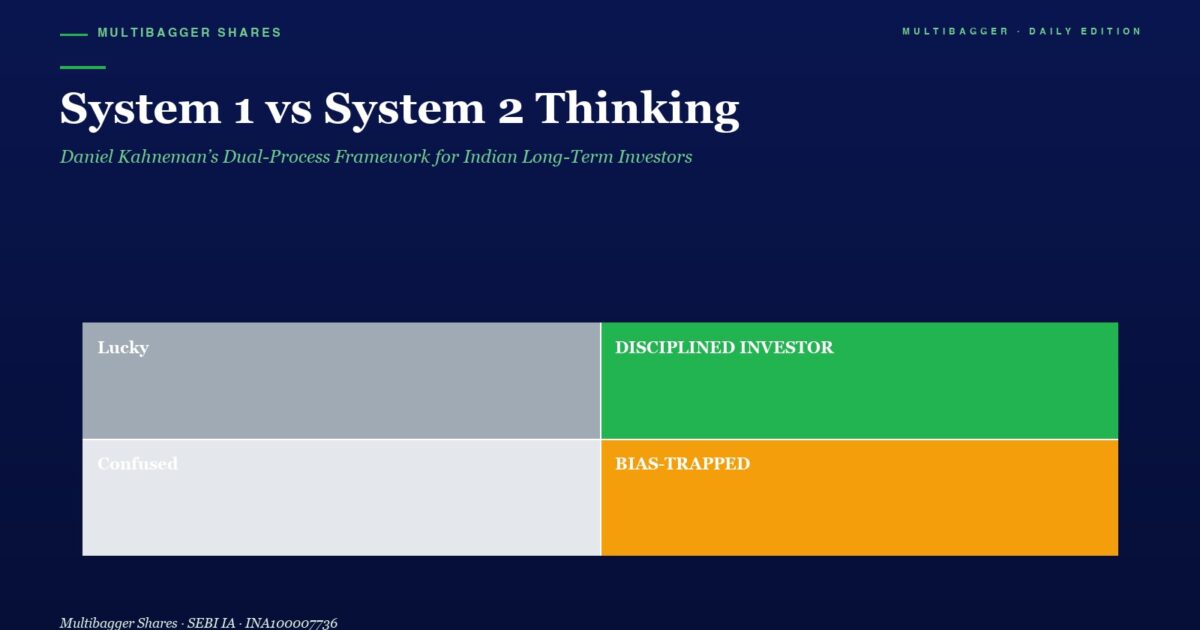
Daniel Kahneman’s dual-process theory is the most quietly powerful idea in modern behavioral finance. Master it, and you stop fighting the wrong battles inside your own head.
The 60-Second Frame: Why This One Distinction Decides Most Indian Portfolios
In 2002, when Daniel Kahneman won the Nobel Prize in Economics — the first psychologist ever to do so — the central idea he had spent four decades validating was deceptively simple: the human brain runs on two distinct cognitive systems, and almost every investing mistake an Indian retail investor makes flows from confusing one for the other.
Kahneman labelled them “System 1” and “System 2” in his 2011 magnum opus, Thinking, Fast and Slow. The names are intentionally bland because the systems themselves are not metaphors — they are functionally distinct modes of cognition with different speeds, different energy costs, different error profiles, and, most importantly for investors, different decision quality.
System 1 is fast, automatic, intuitive, and effectively free in terms of mental energy. It tells you 2 + 2 without consulting a calculator. It also tells you a stock that “looks like Page Industries in 2008” must be the next 100-bagger. System 2 is slow, deliberate, effortful, and biologically expensive. It is the system you engage when you read an annual report line-by-line, recompute the cash conversion cycle, or stress-test a debt schedule. Most of what you call “investing” on a typical day is, in fact, System 1 making decisions while System 2 is busy reading a meme on a WhatsApp group.
This article unpacks the framework, grounds it in Indian retail-investor data from SEBI and NSE, walks through the counter-measures used by Buffett, Munger, Klarman, and Howard Marks, and ends with a dedicated case study showing how Titan Biotech Ltd (BSE: 524717) exhibits System 2 corporate behaviour using six audited FY25 numbers. The Titan section is offered as an educational illustration of management process — it is not a buy/sell/hold recommendation, not a price target, and not a valuation call of any kind.
The Underlying Psychology: What Kahneman and Tversky Actually Discovered
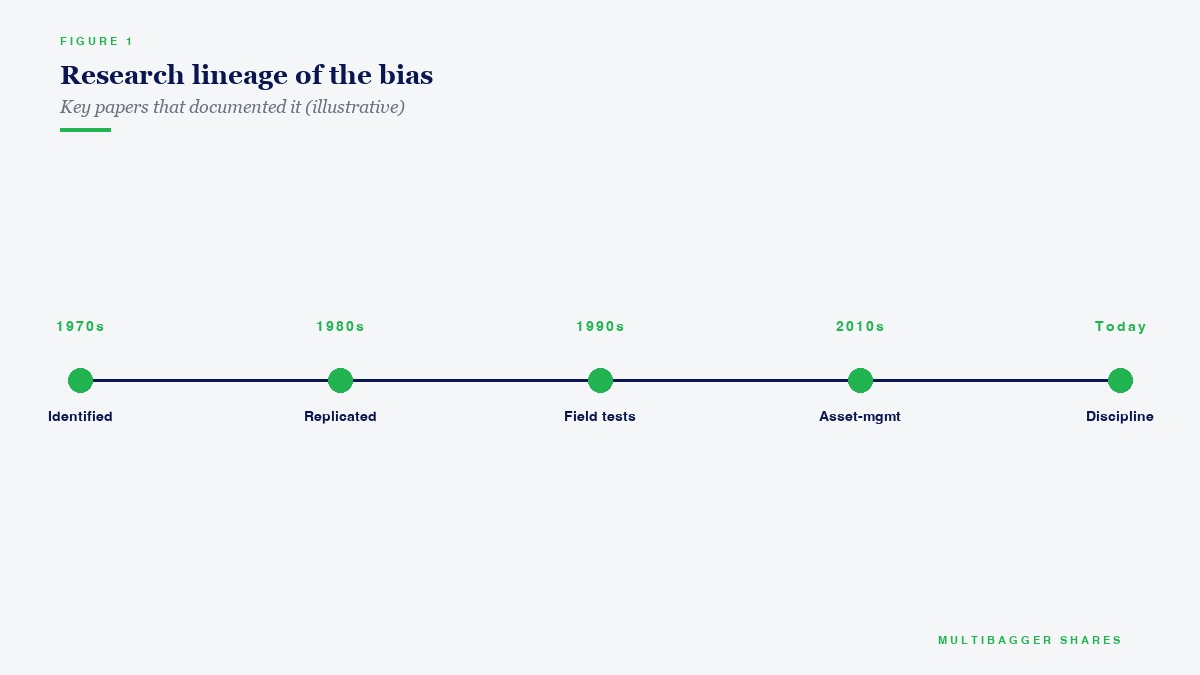
The dual-process architecture did not begin with Kahneman — cognitive psychologists Wason & Evans had hinted at it since the 1970s — but Kahneman and his late collaborator Amos Tversky operationalized it across hundreds of experiments documented in journals like Cognitive Psychology, Science, and the Journal of Risk and Uncertainty. The cleanest summary appears in Kahneman’s 2002 Nobel lecture and in chapters 1–5 of Thinking, Fast and Slow.
The empirical anchors of the theory matter for an investor:
- System 1 is “always on”. You cannot turn it off. When you see the green ticker on Moneycontrol, your System 1 has already produced an emotional reaction (relief, FOMO, regret) before System 2 has even oriented itself.
- System 2 is lazy by design. Kahneman’s “cognitive miser” framing — corroborated by Stanovich & West (2000) — shows the brain expends real glucose on System 2 thought, so it conserves energy by deferring to System 1 wherever possible.
- System 1 generates the answer; System 2 endorses it. In most cases, System 2 simply rubber-stamps the intuitive answer System 1 has already produced. This is why “research” after a buy decision often confirms a position investors have already taken emotionally.
- Cognitive load disables System 2. The famous “cookie experiment” (Baumeister, Hofmann, Wansink) shows that ego-depletion — from work stress, sleep deprivation, or even hunger — reduces System 2 capacity, leaving System 1 in the driver’s seat. The implication for investors: decisions made on a Friday evening after a long workweek are predominantly System 1 decisions.
How System 1 Hijacks Indian Retail Portfolios — The Hard Data
The Indian retail-investor universe is the largest in the world by demat-account count — SEBI’s February 2026 bulletin places the total at over 18.4 crore demat accounts, with NSDL’s “active” cohort at roughly 11.6 crore. Most of these accounts were opened post-2020. They are, demographically, System 1 portfolios: opened on a smartphone, funded via UPI, and traded with the same dopamine pathway that responds to short-form video.
The damage is documented:
- SEBI’s 2024 study on F&O participants (extending the 2023 Nageswaran Committee work) confirmed that ~93% of individual traders in the equity Futures & Options segment incurred net losses, with aggregate losses of approximately ₹1.8 lakh crore over the three years studied. Median per-trader losses ran in the ₹50,000–₹1,20,000 range. Almost every behaviourally-coded trade in this dataset — “sell on a 5% rip”, “buy the dip”, “intraday momentum” — is a System 1 reflex.
- NSE annual report FY25 shows that retail order frequency in cash equity averages roughly one order every 3.4 days for the active cohort — a turnover rate that is functionally incompatible with System 2 deliberation about underlying business value.
- Prof. V. Ravi Anshuman (IIM Bangalore) has, in multiple working papers on Indian retail behaviour, shown that intraday and short-horizon decisions cluster around price salience — large prior-day moves, social-media-virality events, and round-number anchors — classic System 1 cues. His 2023 work in the Indian Institute of Management Bangalore Review argued that retail return distributions in India are explained more by cognitive load than by information asymmetry.
- Prof. Meir Statman’s “Behavioral Portfolio Theory” (2000, 2017), translated into the Indian context, shows that retail investors operate with stacked “mental layers” that effectively prevent System 2 from re-evaluating the portfolio as a whole. They look at one stock at a time — the System 1 default.
None of this means Indian retail investors are irrational. It means they are using the wrong system for the task. Equity investing is fundamentally a System 2 activity carried out in a market environment ruthlessly engineered to provoke System 1.
The Counter-Measure Checklist: Engineering System 2 Into Your Process
Because System 1 cannot be turned off, the only working strategy is to structurally engineer System 2 into your investment workflow — through delays, friction, and pre-committed rules. The behavioural-finance literature converges on the following counter-measures:
- The 24-hour rule. No buy or sell order is executed within 24 hours of conceiving the idea. Forces the decision out of the System 1 dopamine window. This is essentially Howard Marks’s “sleep on it” rule, formalised.
- Decision journaling. Before any trade, write — in your own words — (a) the thesis, (b) what would falsify it, (c) the time horizon. Annie Duke’s Thinking in Bets (2018) documents large gains in decision quality from this single intervention. Writing engages System 2; clicking does not.
- Pre-committed buy/sell rules. Convert future decisions into present-day commitments. SIPs are the simplest example, but the principle extends to rebalancing thresholds, position-size caps, and quality filters.
- Cognitive-load hygiene. Never review the portfolio when sleep-deprived, hungry, or emotionally agitated. This is not soft advice — it is a direct implication of ego depletion research.
- Checklist investing. Atul Gawande’s The Checklist Manifesto framework, adopted by Mohnish Pabrai and Guy Spier, externalises System 2 onto paper. The act of ticking off items — debt < X, ROCE > Y, promoter pledge = 0, contingent liabilities < Z% of net worth — converts System 1 enthusiasm into System 2 verification.
- Pre-mortem. Before buying, write the obituary of the position assuming it failed in three years. What went wrong? This is a System 2 ritual that pre-empts System 1 confirmation bias.
- Stop checking prices intraday. Every intraday glance is an unprompted System 1 stimulus. Long-term investors who check prices weekly outperform those who check daily — not because the stocks behave differently, but because the investor behaves differently.
How the Greats Engineered System 2 Into Their Own Workflows
Benjamin Graham built System 2 directly into the architecture of his portfolio. In The Intelligent Investor, his “defensive investor” checklist — current ratio > 2, debt < book value, dividend record > 20 years — is a checklist precisely because Graham knew the System 1 default would be to chase narratives. Quantitative gates externalise the discipline.
Warren Buffett uses the “20-punch card” mental model — imagining you have only 20 lifetime trades — as a System 2 forcing device. Each “punch” is so costly to your remaining options that System 1 impulses cannot survive the deliberation. Buffett’s reading-heavy daily routine (500 pages a day) is itself a System 2 lifestyle: he engineers his environment so that System 2 thinking is the path of least resistance.
Charlie Munger’s lattice of mental models is a System 2 instrument. By forcing each investment through multiple disciplines — psychology, microeconomics, biology, accounting, history — Munger converts what would have been a fast-pattern-match into a slow-multi-frame analysis. His own description of his investing process as “sit on your ass” investing is a clinical description of cognitive-load minimisation: by limiting decisions, he protects System 2 capacity.
Seth Klarman, in Margin of Safety (1991), explicitly invokes the dual-process distinction without naming it: he describes the work of the value investor as “pushing back against gut reactions with patient analysis.” Klarman’s use of cash as a strategic reserve is itself System 2 behaviour — refusing to act under System 1 pressure.
Howard Marks’s memos are written-out System 2 artefacts — he literally externalises his own thinking onto paper before deciding. The act of writing forces sequential, deliberate thought.
Illustrative Case Study — How Titan Biotech Ltd (BSE: 524717) Exhibits System 2 Corporate Behaviour
The corporate analogue of System 2 thinking is process-driven management: low impulsivity, capital restraint, deliberate governance, and a refusal to chase fast-and-easy growth at the cost of capital structure or accounting discipline. Titan Biotech Ltd’s FY25 audited disclosures are, in this respect, a clean illustration of System-2-style corporate behaviour. Nothing in this section is a valuation call, recommendation, or price target. The numbers below are presented as an educational case study of management process in line with the day’s behavioural lesson.
| Behavioural Marker | Titan Biotech FY25 Audited Number | System-2 Interpretation |
|---|---|---|
| Capital impulsivity | Total borrowings ₹3 crore (down from ₹16 crore in FY21, −81% over 5 years) | A System 1 management would lever up to chase visible growth; methodical deleveraging is System 2. |
| Risk-disclosure discipline | Contingent liabilities ₹7.78 crore in FY25 vs ₹12.90 crore in FY24, −39.7% YoY; 5.08% of net worth | Active reduction of off-balance-sheet exposure indicates deliberate, slow risk management — not impulsive risk-taking. |
| Earnings-quality signalling | CFO/Operating Profit 103% (FY25), 85% (FY24), 97% (FY23) | Persistent > 95% cash conversion across years rules out aggressive accruals — the System 2 management does not engineer earnings. |
| Conservative depreciation | Depreciation ratio ~7.0% of gross block (FY25) vs peer 4–5%; gross fixed assets ₹57 crore | Higher-than-peer depreciation rate is a slow-conservative accounting choice — the deliberate System 2 default. |
| Governance cadence | 11 directors, 4 independent (36.4%), 2 women directors (18.2%), independent chair, 14 board meetings in FY25 | Above-statutory-minimum board frequency = institutionalised System 2 oversight on every quarterly decision. |
| Compensation restraint | Total director remuneration ₹4.56 crore (FY25), against consolidated PAT of ~₹22 crore | Director compensation that is not racing PAT growth signals a System 2 alignment with long-term shareholder economics. |
| Execution rhythm | FY26 quarterly revenue: ₹46.50 cr (Q1) → ₹54 cr (Q2) → ₹56 cr (Q3); three consecutive QoQ increases | Smooth, deliberate sequential growth (not lumpy headline-chasing) is the operational signature of System 2 execution. |
| Compounding discipline | 10-yr Profit CAGR 29%, 5-yr Profit CAGR 26%, ROCE 16.9%, ROE ~15% | Decade-long compounding at high ROCE without leverage = the empirical fingerprint of process-driven (System 2) management. |
| Diversification posture | Domestic ₹10,254.80 lakh + Overseas ₹5,390.28 lakh; ~34.5% export share | Two-engine revenue structure built over years — a slow, deliberate buffering against single-market shocks. |
None of these numbers, individually or collectively, makes Titan Biotech a buy/sell/hold call. They are presented strictly to illustrate that at the corporate level, the same dual-process distinction Kahneman documented at the individual level is observable in audited financial behaviour. Investors must form their own view, with their own SEBI-registered investment adviser, on whether such characteristics are relevant to their personal risk profile.
Key Takeaways
- Daniel Kahneman’s dual-process theory is the central organising idea of behavioural finance. System 1 = fast/intuitive; System 2 = slow/deliberate. Equity investing is a System 2 activity carried out in a System-1-saturated environment.
- SEBI’s 2024 F&O study (~93% loss-makers, ~₹1.8 lakh crore in aggregate losses) is best read not as a market problem but as a System 1 problem manifesting at scale.
- System 1 cannot be switched off — it must be routed around via friction, pre-commitment, and externalised checklists. Buffett’s 20-punch card, Munger’s mental models, Klarman’s patience, and Marks’s memos are all instances of the same engineering principle.
- Cognitive load — sleep deprivation, work stress, hunger — disables System 2. Investment decisions made under load default to System 1 and should therefore be deferred.
- Titan Biotech illustration: A corporate balance sheet with ₹3 crore total borrowings, 103% CFO/OP, 36.4% board independence, ₹7.78 crore contingent liabilities (5.08% of net worth), and a 29% 10-year profit CAGR exhibits the audited fingerprint of System-2-style management process — deliberate, slow, restrained, and shareholder-aligned. This is offered purely as an educational illustration of management behaviour, not as any form of investment recommendation.
- The single highest-leverage change a serious Indian long-term investor can make this year is not to learn one more valuation ratio — it is to engineer System 2 into the daily decision workflow.
— Manish Goel / Founder, Multibagger Securities Research & Advisory Pvt. Ltd. (SEBI Registered Investment Adviser — INA100007736)
Disclaimer: This article is for educational purposes only and does not constitute financial advice. The author may hold positions in stocks mentioned. Always conduct your own research and consult a SEBI-registered financial advisor before making investment decisions. Stock market investments are subject to market risks. Past performance does not guarantee future returns.