The Debt-Free Balance Sheet Superpower: Why Titan Biotech’s D/E Ratio of 0.02x Makes It a Fortress Stock — How Zero-Debt Companies Outperform in Every Market Cycle and Why Indian Investors Must Prioritize Financial Strength Over Leverage

Risk-Adjusted Returns: Why Sharpe Ratio and Sortino Ratio Are the Secret Weapons Smart Indian Investors Use to Measure True Portfolio Performance — Stop Chasing Raw Returns and Start Measuring What Really Matters
April 4, 2026Video: Sharpe Ratio & Sortino Ratio — The Secret Weapons for Smart Indian Investors (English) | Multibagger Shares
April 4, 2026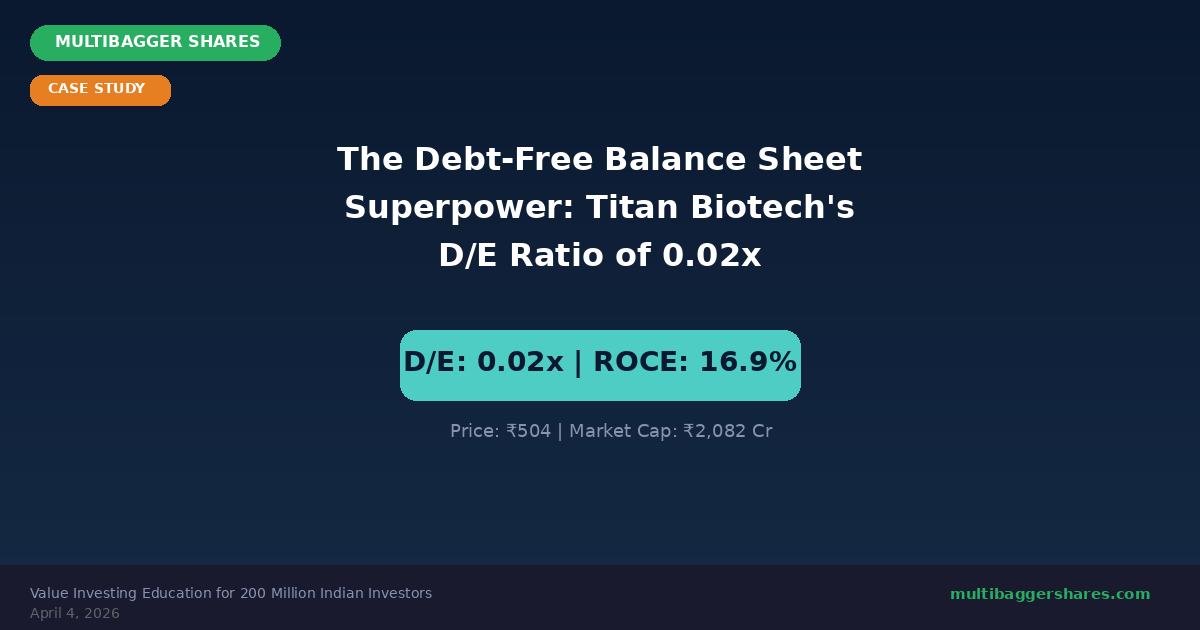
April 4, 2026
(Saturday)
🏰 Today’s Fundamental Analysis Lesson: The Debt-Free Balance Sheet Superpower
SEBI’s landmark study revealed that 9 out of 10 individual traders in the equity Futures & Options segment incurred net losses. While millions of Indians gamble their savings on F&O contracts — essentially playing a casino rigged against them — a small group of disciplined investors quietly build wealth by owning shares of fundamentally superior companies. Today, we explore one of the most powerful yet underappreciated fundamental indicators: the debt-free balance sheet.
📚 What Is a Debt-Free Balance Sheet and Why Does It Matter?
A debt-free balance sheet means a company operates with zero or negligible borrowings — it funds its entire operations, expansion, and growth from internal accruals (retained earnings and operating cash flows) rather than relying on bank loans, bonds, or other forms of external debt. The Debt-to-Equity (D/E) ratio quantifies this: it divides total borrowings by shareholders’ equity. A D/E of 0 means zero debt; anything below 0.1 is considered virtually debt-free.
Why is this so powerful? Consider what happens during economic downturns, interest rate hikes, or credit crunches. Companies with heavy debt face a triple threat: first, their interest expenses eat into profits, reducing EPS. Second, banks may tighten credit lines, restricting working capital. Third, debt covenants may force them to sell assets at distressed prices or dilute equity. A debt-free company faces none of these threats. It is a fortress — it can weather any storm, continue investing in growth, and even acquire distressed competitors.
Warren Buffett has consistently emphasized that his favourite companies are those that can generate high returns on capital without needing to lever up their balance sheets. As he wrote in his 2007 letter to Berkshire shareholders: “A truly great business must have an enduring ‘moat’ that protects excellent returns on invested capital… The dynamics of capitalism guarantee that competitors will repeatedly assault any business castle that is earning high returns.” A debt-free balance sheet is one of the strongest moats a company can have — it ensures the castle’s walls remain unbreachable.
🔍 The Hidden Dangers of Leverage — Real-World Casualties
Indian market history is littered with examples of companies that looked like winners on the surface but were destroyed by excessive leverage. Let us examine some cautionary tales:
Bhushan Steel (D/E > 10x): Once one of India’s largest steel producers, Bhushan Steel accumulated over ₹44,000 Cr in debt to fund aggressive expansion. When the steel cycle turned, the company couldn’t service its interest payments, was dragged into NCLT proceedings under IBI, and was eventually acquired by Tata Steel at a fraction of its peak valuation. Shareholders were nearly wiped out — equity value fell over 95% from peak. The fundamental lesson? Leverage amplifies returns in good times but becomes a death sentence when cycles turn.
Jet Airways (D/E > 8x): India’s once-premier full-service airline accumulated ₹8,500 Cr+ in debt, couldn’t service its obligations when fuel prices spiked and competition intensified, and ultimately ceased operations in April 2019. Every rupee invested in Jet Airways equity was destroyed. Contrast this with IndiGo (InterGlobe Aviation), which maintained a much leaner balance sheet and is now the dominant airline in India.
Reliance Communications (D/E > 5x): Anil Ambani’s telecom venture took on massive debt of over ₹46,000 Cr. When Jio disrupted the market with free data, RCom couldn’t compete while also servicing its debt mountain. The company went through bankruptcy proceedings, and equity investors lost virtually everything. Meanwhile, debt-free and cash-rich companies in other sectors sailed through the disruption unscathed.
The pattern is unmistakable: debt kills companies during downturns, disruptions, and cyclical reversals. Every decade produces new casualties. The only guaranteed protection is to own companies that don’t carry the debt burden in the first place.
🏢 Case Study: Titan Biotech Ltd — A Debt-Free Fortress
₹504
₹2,082 Cr
16.9%
15.0%
Titan Biotech Ltd (BSE: 524717) is a textbook example of what a debt-free balance sheet looks like in practice. With a Debt-to-Equity ratio of just 0.02x — meaning total borrowings of just ₹3 Cr against shareholders’ equity of ₹153 Cr — this company is essentially debt-free. To put this in perspective, for every ₹100 of shareholders’ money in the business, only ₹2 comes from borrowings. The remaining ₹98 is pure owner equity.
What makes this even more remarkable is that Titan Biotech has achieved all of its growth — a 15% revenue CAGR and 29% profit CAGR over 10 years — using internal accruals alone. The company has never diluted equity, never raised significant debt, and never relied on external financing. Every rupee of growth was funded by the business itself. This is the hallmark of a truly self-sustaining compounder.
The company’s reserves and surplus have grown to approximately ₹145 Cr — entirely from retained earnings over 30+ years of operation. When a company can build ₹145 Cr in reserves without any external help, it tells you something profound about the quality of its business model, the efficiency of its capital allocation, and the discipline of its management.
In the latest quarter (December 2025), Titan Biotech posted revenue of ₹56.51 Cr with an operating profit margin of 19.16% and net profit of ₹8.53 Cr. These are strong numbers achieved with virtually zero leverage — proof that the business generates healthy cash flows without needing to borrow.
⚖️ Comparison: Debt-Free vs Leveraged Companies — A Tale of Two Balance Sheets
To truly understand the power of a debt-free balance sheet, let us compare Titan Biotech’s financial structure with three other well-known Indian companies across different leverage levels:
| Company | D/E Ratio | Interest Cost as % of Revenue | Balance Sheet Health |
|---|---|---|---|
| Titan Biotech | 0.02x | ~0.2% | 🟢 Fortress |
| Page Industries | 0.05x | ~0.3% | 🟢 Very Strong |
| Tata Motors | 0.8x | ~3.5% | 🟡 Moderate |
| Vodafone Idea | >5x | ~25%+ | 🔴 Distressed |
The contrast is stark. Titan Biotech spends virtually nothing on interest payments — less than 0.2% of revenue goes toward servicing debt. This means almost every rupee of operating profit flows straight to shareholders’ equity. Compare this with Vodafone Idea, where a quarter or more of revenue is consumed by interest payments alone — the company is essentially working to pay its bankers, not its shareholders.
Page Industries, a well-known quality compounder (Jockey innerwear brand), maintains a similarly clean balance sheet with a D/E of just 0.05x. This is not a coincidence — the best compounders in Indian market history tend to operate with minimal or zero leverage. They grow from the strength of their business, not from the crutch of borrowed money.
On the other end, Vodafone Idea’s debt mountain has prevented it from investing in network upgrades, leading to subscriber losses, further revenue decline, and a vicious cycle of value destruction. This is what excessive leverage does — it creates a downward spiral from which recovery becomes nearly impossible.
🧮 Five Reasons Why Debt-Free Companies Are Superior Long-Term Investments
1. Interest Rate Immunity: When the RBI raises interest rates (as it did during 2022-2023, pushing the repo rate from 4% to 6.5%), debt-laden companies see their interest costs spike immediately. A company with ₹1,000 Cr in floating-rate debt would see an additional ₹25 Cr in annual interest expense for every 100 basis point hike. A debt-free company? Zero impact. Titan Biotech sailed through the entire rate-hiking cycle without any impact on its profitability because it has virtually no borrowings to service.
2. Maximum Financial Flexibility: When competitors are struggling to refinance their debt during a downturn, a debt-free company has the cash and creditworthiness to make opportunistic investments — acquiring distressed assets, poaching top talent, increasing marketing spend, or accelerating R&D. This counter-cyclical advantage is how great companies widen their moats during downturns.
3. Higher Effective Returns: A company that generates 16.9% ROCE (like Titan Biotech) without using leverage is generating truly organic returns. Compare this with a company that shows 20% ROE but achieves it with a D/E of 2x — remove the leverage effect, and the underlying business returns are much lower. In investing, unlevered returns are the truest measure of business quality.
4. Survival During Black Swan Events: COVID-19, demonetization, global financial crises, geopolitical shocks — black swan events hit every decade. Companies with clean balance sheets survive and often thrive during such events because they have no debt covenants to breach, no lenders to negotiate with, and no forced selling of assets. Titan Biotech navigated the COVID-19 disruption and emerged stronger, posting record revenues in subsequent years.
5. Management Discipline Signal: A management team that chooses to grow without debt is demonstrating extraordinary discipline. It’s easy to take cheap debt and show flashy growth numbers. It’s much harder to grow organically, reinvest profits wisely, and compound wealth slowly but surely. When you see a D/E of 0.02x maintained over decades, you’re looking at a management team that prioritizes sustainable, quality growth over aggressive, leveraged expansion. This management quality is itself a competitive advantage.
📊 How to Screen for Debt-Free Companies: A Step-by-Step Framework
For investors who want to build a portfolio of debt-free quality compounders, here is a practical screening framework:
Step 1 — Check D/E Ratio: Filter for companies with D/E below 0.1x. This eliminates companies with meaningful leverage. You can use free tools like Screener.in to run this filter instantly.
Step 2 — Verify Consistency: A company might have low debt today but may have been highly leveraged in the past. Check the 5-year and 10-year trend of the D/E ratio. The best companies (like Titan Biotech) maintain consistently low leverage across market cycles.
Step 3 — Check Interest Coverage Ratio: Even for companies with some debt, the interest coverage ratio (EBIT / Interest Expense) tells you how comfortable they are servicing it. A ratio above 10x is excellent. Titan Biotech’s is effectively infinite because it has negligible interest expense.
Step 4 — Combine with Quality Filters: Debt-free alone isn’t enough. Add filters for ROCE above 15%, consistent revenue growth, and positive free cash flow. This ensures you’re finding quality businesses, not just asset-light companies with no growth. Titan Biotech passes all these filters: 16.9% ROCE, 15% revenue CAGR, and positive free cash flow of ₹12 Cr in FY2025.
Step 5 — Verify Promoter Behaviour: A debt-free company with high promoter holding (like Titan Biotech at 55.78% with zero pledge) is the gold standard. It means the promoters have skin in the game and aren’t using company shares as collateral for personal loans — another sign of financial discipline at the top.
🎯 Key Takeaways from Today’s Lesson
- A debt-free balance sheet is a superpower — it provides immunity to interest rate cycles, maximum financial flexibility, and survival during black swan events
- Titan Biotech’s D/E of 0.02x is a textbook example of how a quality company can achieve 15% revenue CAGR and 29% profit CAGR over 10 years purely from internal accruals — no debt, no equity dilution
- Indian market history is full of leveraged casualties — Bhushan Steel, Jet Airways, Reliance Communications — all destroyed by excessive debt when cycles turned against them
- Screen for D/E below 0.1x combined with ROCE above 15% to find the sweet spot of debt-free quality compounders
- One debt-free compounder beats 10 speculative F&O bets — 93% of F&O traders lose money (SEBI data), while patient investors in quality debt-free companies build lasting wealth
📈 Market Context
Indian stock markets are closed today (Saturday, April 4, 2026) following the Good Friday holiday on April 3. In the last trading session on April 2, markets experienced volatility driven by geopolitical developments. The SENSEX closed around the 73,300 level and NIFTY 50 around the 22,700 level. Markets will resume regular trading on Monday, April 7, 2026.
Amid this short-term volatility, it is worth remembering that market fluctuations are noise — fundamental quality is signal. Companies with fortress balance sheets like Titan Biotech are built to navigate any storm. While F&O traders lose sleep (and money) over daily price swings, long-term investors in quality debt-free companies can afford to be patient and let compounding do its work.
For the latest value investing insights and daily case studies, join our growing community of disciplined investors on Telegram — learn to think like a fundamental analyst, not a speculator.
SEBI Disclaimer: 9 out of 10 individual traders in the equity Futures & Options segment incurred net losses according to a SEBI study. F&O trading is essentially gambling. Focus on quality stock picking and long-term value investing instead.
Disclaimer: The author (Manish Goel) is a SEBI Registered Research Analyst (Registration No. INH100004775) and Multibagger Shares (Multibagger Securities Research & Advisory Pvt. Ltd.) is a SEBI Registered Investment Advisor (Registration No. INA100007736). This post is for educational purposes only and should not be construed as a buy/sell recommendation. Please do your own research and consult a qualified financial advisor before making investment decisions. Stock market investments are subject to market risks. Past performance is not indicative of future results.
📢 Join Our Telegram Channel
Get daily value investing lessons, stock analysis & Titan Biotech updates — delivered straight to your phone!
✈️ Join @longtermequityy on Telegram
🔔 Free • No spam • Value investing insights daily