The Line Without Wobbles: Why a Promise of Steady, High Returns Should Make You Ask Where the Money Comes From

The Staircase of Wants: Why a Business That Owns the Upper Steps Gains as Customers Grow Richer
November 2, 2026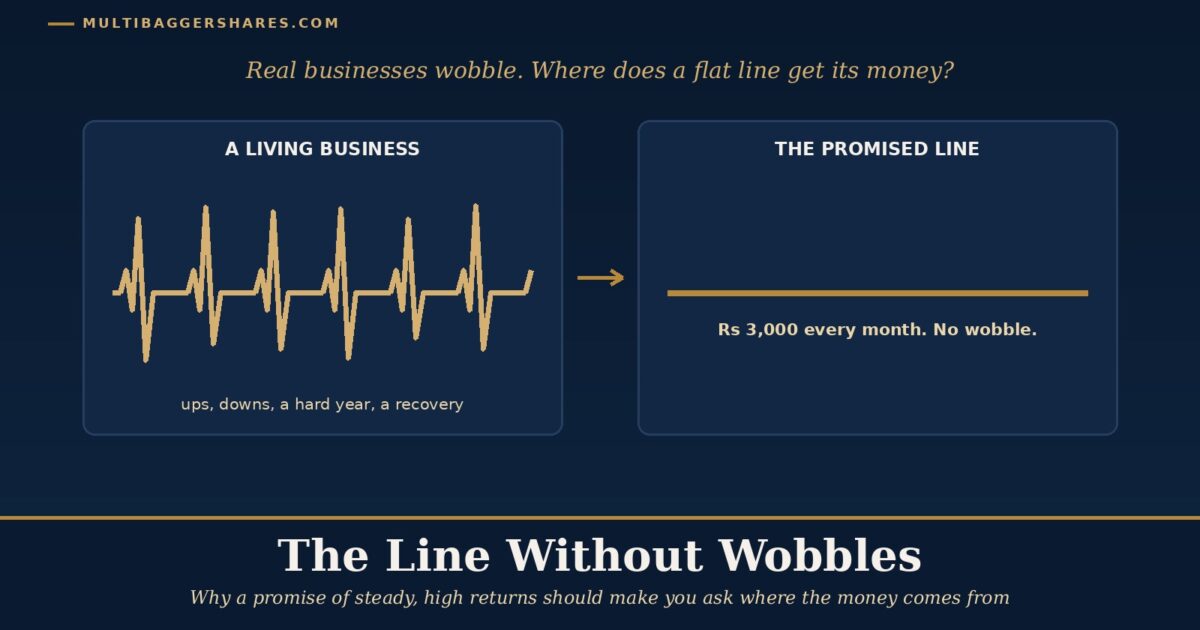
Imagine a neighbour in your housing society, a pleasant man known to everyone as Anand uncle. He tells a few families about a scheme he has joined. You put in Rs 1 lakh. Every month, on the first, Rs 3,000 arrives in your account. Not Rs 2,800 in a slow month and Rs 3,400 in a good one. Exactly Rs 3,000, month after month, rain or shine. Anand uncle, the scheme and the numbers are all made up for this lesson, but you may have heard a story very much like it.
The first six months go well. Every payment arrives on time. The families who joined first are delighted, and they tell their relatives. The line on the bank statement is perfectly flat, and that flatness feels like proof of safety. This lesson is about why it should feel like the opposite. It is about one question that helps sort real businesses from everything else: where does the money come from?
What it really means
Start with how a real business earns. Think of a kirana shop (a small neighbourhood grocery) on your corner. In the week before Diwali the till fills up. In a heavy monsoon week few customers walk in. A new supermarket opens nearby and sales dip for a year. Then the owner learns something, fixes something, and profits recover. If you drew the shop’s yearly profit on a graph, you would see hills and valleys.
Doctors read a heart the same way. A line on a hospital monitor that goes up and down shows a living heart. A line that is perfectly flat means something has gone badly wrong. A living business shows wobbles too. So an investment that pays a high amount, month after month and year after year, without a single wobble, is telling you something. It is telling you that the money is probably not coming from a living business.
That brings us to the key idea. A return (the money you receive for letting someone else use your money) can come from only a few honest places. The first is the profit of a business. Owners receive it as dividends (a share of profit paid out in cash) or see it kept inside the business to help it grow. That kind of return wobbles, because profits wobble.
The second honest place is interest paid by a borrower under a written contract, the way a bank pays interest on a fixed deposit (FD, money kept with a bank for a fixed time at a fixed rate). That kind can be steady. But it is steady because a contract and a regulator (an official body that sets the rules and watches over them) stand behind it, and the rate is modest. Nobody promises 3% a month on an FD.
The third place is the money of new investors. This is the dangerous one. When old investors are paid with the money of new investors, and not with real profit, the arrangement is called a Ponzi scheme (named after a man called Charles Ponzi, whose story comes later in this lesson). From outside it looks like a business. In reality it behaves like a relay race in which each runner can be paid only by the next runner joining. It works only as long as new runners keep arriving.
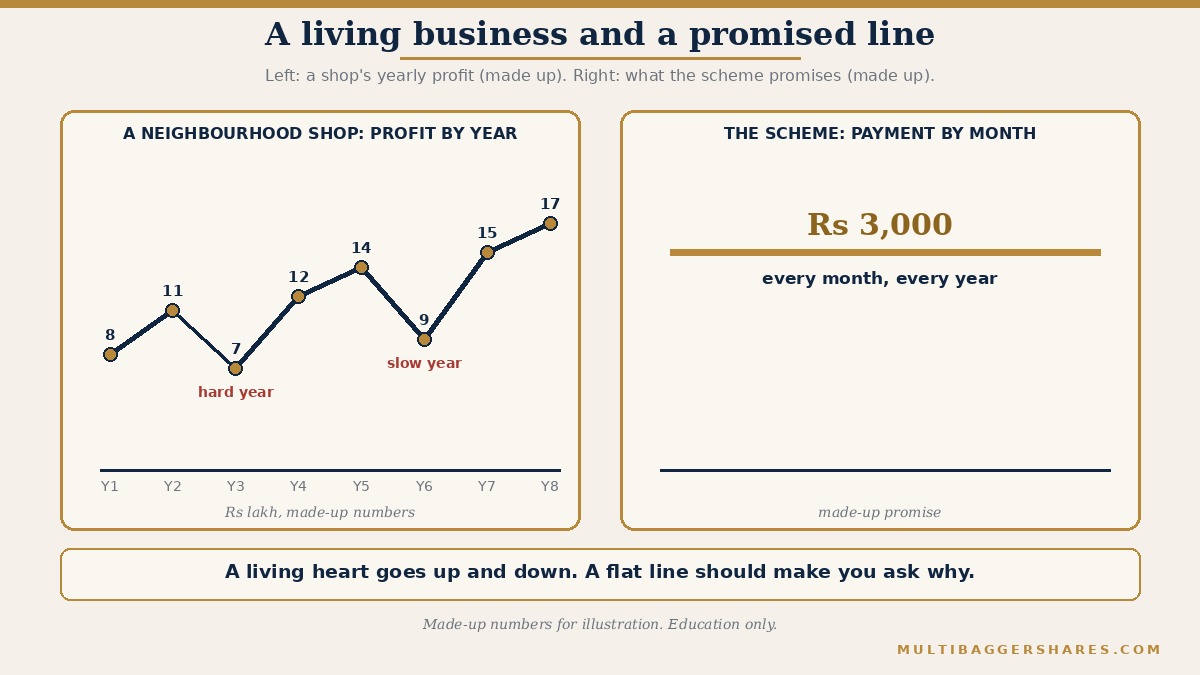
The picture above shows the two lines side by side. On the left is the made-up yearly profit of a real shop: a dip, a recovery, a hard year, a good year. On the right is the line the scheme promises. One of them is far more comfortable to look at, and that is exactly the problem.
Why it works
Why is “where does the money come from?” such a strong question? Because it can be answered with simple arithmetic, and arithmetic does not care how friendly the person making the promise is.
Take Anand uncle’s scheme. Suppose 100 families each put in Rs 1 lakh, so the pot is Rs 100 lakh (Rs 1 crore). A payment of Rs 3,000 a month on each Rs 1 lakh is 3% a month. Across all 100 families that is Rs 3 lakh every month, or Rs 36 lakh a year. Put another way, the scheme promises 36% a year. If those payments were reinvested, they would grow even faster through compounding (earning returns on your past returns, like interest on interest, the way a snowball grows as it rolls downhill). Compounded, 3% a month becomes about 43% a year. That is a figure far above what most long-term investors would hope to earn from a business, year after year.
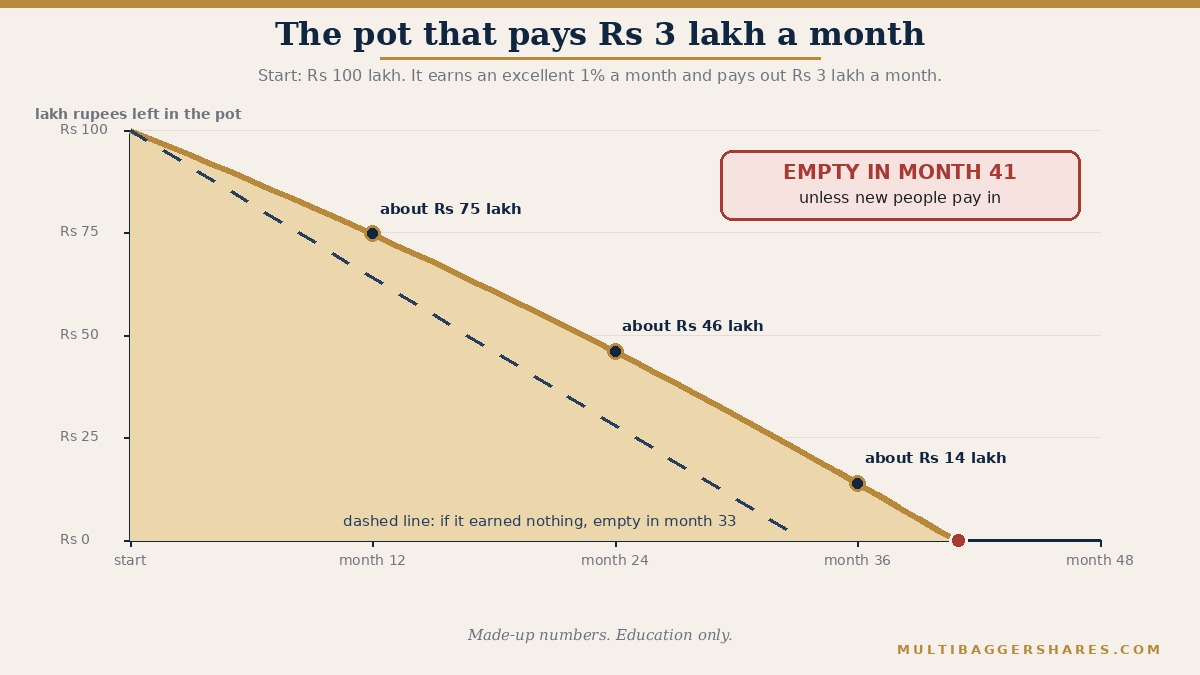
Now suppose the pot is placed somewhere very good, and earns an excellent 1% every month, which is about 12% a year. Each month the pot earns Rs 1 lakh and pays out Rs 3 lakh. So the pot shrinks by Rs 2 lakh a month, and the shrinking speeds up, because a smaller pot earns less. After one year about Rs 75 lakh is left. After two years about Rs 46 lakh. After three years about Rs 14 lakh. In the forty-first month the pot is empty. And this assumes the money is earning an excellent return. If it earned nothing at all, the pot would run dry in about 33 months.
Only one thing can fill the gap, and that is new money. The gap also grows with time. The promise to the early families keeps running, so the scheme needs more and more new people just to stand still. At some point the people willing to join run out, or a few existing investors ask for their original Rs 1 lakh back all at once. Then the relay stops, and the families who joined last are left holding nothing.
Notice what the arithmetic did not need. It did not need to know what Anand uncle says he does with the money. It did not need to question his honesty. Even a completely honest man cannot turn a living business into a flat 36% a year. That is why this question is so useful. You can ask it of any offer, without being an expert in the business behind it.
Notice, too, why these schemes spread. The early payments are real, and they arrive on time. Real payments are the best advertisement a scheme can have. People do not feel they are taking a risk. They feel they are collecting rent from a flat. And the more they tell their friends, the longer the scheme lasts. The flat line is not only a warning from the numbers. It is also the thing that makes the scheme spread.
A real example or two
The scheme gets its name from a real man. In December 1919 an Italian immigrant named Charles Ponzi opened a business in Boston. He promised investors a 50% return in 45 days. His explanation sounded clever. International reply coupons (prepaid postal vouchers that could be exchanged for stamps in another country) were cheaper in some countries than in America, he said, so he would buy them cheaply abroad and redeem them at a higher value at home.
The money poured in. According to the Massachusetts history site MassMoments, about 30,000 people put in more than $10 million in roughly seven months, and early investors were paid out of the money of later ones. In July 1920 the Boston Post began a series of articles that showed the scheme could not work at the scale involved. State officials audited the company. By August it was insolvent (it owed more than it owned) by about $3 million, and Ponzi was arrested. Notice that a flat, generous promise brought in 30,000 people in seven months, and that the whole story is a hundred years old. The pattern has not changed.
India has written this danger into law. The Banning of Unregulated Deposit Schemes Act, 2019, defines a deposit as money taken with a promise to return it, with or without interest, and it bans such schemes when they are taken for a business purpose and are not registered with the regulators the law lists. As the legislative-tracking group PRS summarised the bill when it was introduced, taking an unregulated deposit was to carry a prison term of two to seven years. Lawmakers do not write rules like this for rare problems.
Now look at what a real return looks like. NSE’s own record of the Nifty 50 (an index, which is a list that tracks fifty of India’s largest listed companies) shows that in calendar year 2008 the index, with dividends included, fell by roughly half. In 2009 it rose by roughly three-quarters. Those are the results of real businesses, and they are anything but flat. A smooth ride was never on offer. What an owner of real businesses receives is an uneven path with an honest source behind it. This is history, not a forecast, and it says nothing about what any index will do next.
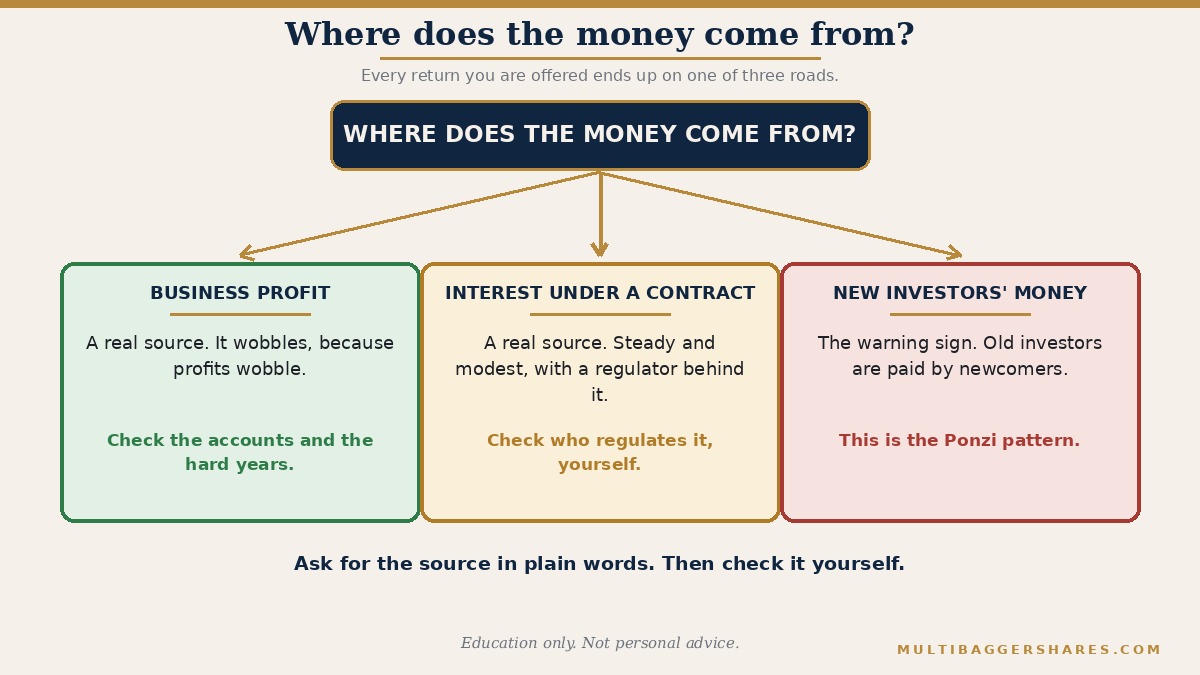
The picture above turns the lesson into a flow chart. Every return you will ever be offered ends up on one of those three roads. Two of them are real sources. The third is the one to be afraid of.
How you can use it
You can use this idea in two ways: when someone offers you a return, and when you think about your own expectations. Here are five questions to ask of any offer.
First, where does the money come from? Ask for the source in plain words, and ask until you get an answer you can repeat to a friend. “Trading” or “a special arrangement” is not an answer. A shop’s profit, a borrower’s interest and new investors’ money are answers.
Second, is it a promise or a result? A result is what already happened, shown in audited accounts (books checked by an independent professional). A promise is what someone says will happen. A guaranteed high return, with nothing behind it but a person’s word, is a promise only.
Third, who regulates it, and can you check? Real deposit-takers, lenders and investment managers are registered with a regulator, and that registration can usually be looked up on the regulator’s own public website. Do the look-up yourself, instead of trusting a certificate shown to you by the person selling.
Fourth, does the line ever wobble? Ask what happened in the hardest year. A real business can tell you about its bad years, and you can read about them in its past reports. If the answer is that nothing ever goes wrong, treat that as the answer.
Fifth, are you paid for bringing in friends? And could you take out all your money, on any day, without pressure to stay? When the people who join later are being used to pay the people who joined earlier, bringing in friends is the engine of the scheme. A request to bring in others, or a nudge to roll over your payout, is a loud signal.
The second use is personal. It is natural to want a flat line for your own money, because wobbles are uncomfortable. But real returns from real businesses come with wobbles. That discomfort is not a sign that something is wrong. It is a sign that the source is real. Buffett warned in his 2008 shareholder letter to beware of any investment activity that produces applause, because the great moves are usually greeted by yawns. A quiet, uneven, boring path with an honest source is worth more than a smooth, exciting one with none.
This article is for education only. Anand uncle, his scheme and the numbers in the examples are made up. Charles Ponzi, the 2019 Act and the Nifty 50 figures are described as history. Nothing here is a forecast about any index, scheme or business, and nothing here suggests that anyone should buy or sell anything.
Key takeaways
- A real business earns uneven profits, so a real return wobbles. A perfectly flat line of high payments is a reason to ask questions, like a flat line on a hospital monitor.
- Money can come from only a few places: a business’s profit, interest under a contract and a regulator, or the money of new investors. The last one is the Ponzi pattern.
- In the made-up example, paying 3% a month on a Rs 100 lakh pot empties it in about 41 months even if it earns 1% a month. Only fresh money can keep such a promise going.
- Charles Ponzi promised 50% in 45 days in 1919-20 and about 30,000 people put in more than $10 million before it collapsed in August 1920. India’s 2019 law bans unregistered deposit schemes.
- Ask five questions of any offer: where does the money come from, is it a promise or a result, who regulates it, does the line ever wobble, and can I take all my money out?
— Manish Goel · multibaggershares.com
Manish Goel is a Chartered Accountant and Principal Officer of Multibagger Securities Research & Advisory Pvt. Ltd. (MSRAPL), a SEBI-registered Investment Adviser, Registration No. INA100007736. This content is published by MSRAPL for education only and is not personalized investment advice.
Disclaimer: This article is published by multibaggershares.com for education and general information only. It is not investment advice, investment research, or a recommendation to buy, sell or hold any security. Any companies named are discussed only as illustrative examples. Markets carry risk; please do your own research or consult a qualified professional before making any investment decision. |