Titan Biotech Ltd: A Fundamental Analysis Case Study — What Makes a Quiet Compounder in Indian Markets?

Video: Survivorship Bias Samjhiye — Aapki Investment Research Ki Hidden Galti Jo Har Strategy Ko Guaranteed Winner Dikhati Hai (Hindi)
March 31, 2026
Promoter Buying: Why Insider Purchases Are the Most Powerful Buy Signal in Indian Markets — How to Track, Analyze, and Profit from Promoter Conviction in Small-Cap and Mid-Cap Stocks
March 31, 2026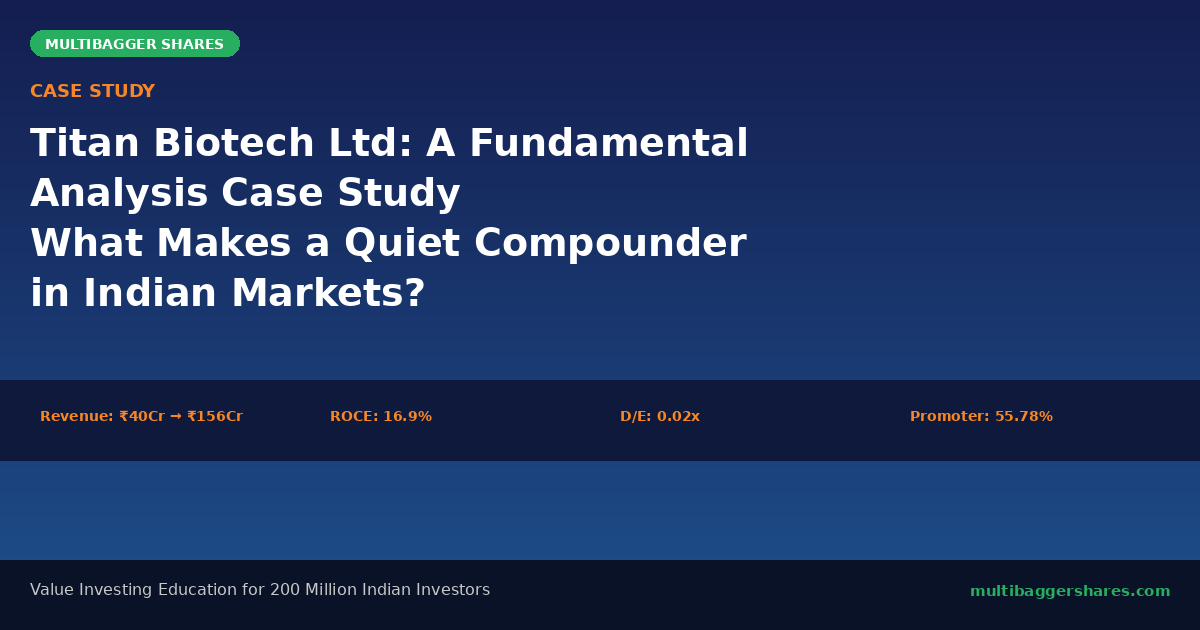
March 31, 2026
(Monday)
Case Study
Titan Biotech Ltd: A Fundamental Analysis Case Study — What Makes a Quiet Compounder in Indian Markets?
In This Case Study
- Why This Case Study? The Problem It Solves
- Company Overview: What Does Titan Biotech Actually Do?
- The 10-Year Financial Trajectory (2015–2025)
- Key Financial Ratios: Reading the Report Card
- Balance Sheet Anatomy: Where the Strength Lives
- Quarterly Momentum: The Latest Q3 FY26 Numbers
- Shareholding Structure: Who Owns the Company?
- Competitive Positioning: The Niche Moat Question
- What This Case Study Teaches Us About Stock Selection
1. Why This Case Study? The Problem It Solves
According to SEBI’s initial January 2023 study, 89% of individual traders in the Futures & Options segment lost money. The updated September 2024 study painted an even grimmer picture: 93% of over 1 crore individual F&O traders incurred losses between FY22 and FY24, with aggregate losses exceeding ₹1.8 lakh crore over three years. In FY24 alone, individual F&O traders lost approximately ₹75,000 crore, with the average loss-making trader losing around ₹2 lakh (inclusive of transaction costs).
These are staggering numbers. And yet, during the same period, several fundamentally strong small-cap and mid-cap companies quietly compounded wealth for patient shareholders who simply bought and held.
This case study examines one such company — Titan Biotech Ltd (BSE: 524717) — not as a recommendation, but as a learning exercise in fundamental analysis. The goal is to teach you how to read financials, what to look for in a quality compounder, and why certain characteristics in a company’s numbers matter more than others.
Whether you ultimately invest in this company or not is entirely your decision. What matters is that after reading this, you’ll be equipped to analyze any company with the same rigour.
“The stock market is a device for transferring money from the impatient to the patient.”
— Warren Buffett
2. Company Overview: What Does Titan Biotech Actually Do?
Titan Biotech Ltd, headquartered in New Delhi, is an ISO 9001:2008 certified and cGMP-compliant manufacturer and exporter of biological products. If that sounds technical, here’s the simple version: the company manufactures the raw materials that pharmaceutical companies, vaccine producers, diagnostic labs, and food safety laboratories need to grow and test microorganisms.
Their core product range includes:
Dehydrated Culture Media — Used in clinical diagnosis, food & water contamination testing, and biotechnology research.
Yeast Extracts & Malt Extracts — Used across pharma, nutraceutical, and fermentation industries.
Plant Tissue Culture Media — Used in agricultural biotechnology for plant propagation.
The company serves industries spanning pharmaceuticals, nutraceuticals, food & beverages, biotechnology, fermentation, cosmetics, veterinary, agriculture, and microbiology — a diversified end-user base that reduces dependence on any single sector.
Critically, Titan Biotech operates in a niche segment of the life sciences supply chain. This is not a commodity business where the largest manufacturer wins on price. Biological peptones and culture media require specific technical expertise, quality certifications, and regulatory approvals — creating natural barriers to entry that we’ll examine in the competitive positioning section.
3. The 10-Year Financial Trajectory (2015–2025)
The most revealing way to understand a company is to study its financial journey over a full decade. Short-term numbers can mislead. A 10-year track record reveals whether growth is structural or cyclical, whether management is consistent or erratic, and whether the business model genuinely compounds value.
Here is Titan Biotech’s 10-year financial progression:
| FY | Revenue (₹ Cr) | Net Profit (₹ Cr) | EPS (₹) | OPM % |
|---|---|---|---|---|
| 2015 | 40 | 2 | 0.42 | 10% |
| 2016 | 46 | 2 | 0.46 | 9% |
| 2017 | 53 | 2 | 0.56 | 10% |
| 2018 | 57 | 3 | 0.66 | 12% |
| 2019 | 65 | 4 | 0.85 | 14% |
| 2020 | 79 | 8 | 1.71 | 17% |
| 2021 | 142 | 32 | 7.35 | 32% |
| 2022 | 124 | 22 | 5.25 | 25% |
| 2023 | 144 | 25 | 6.01 | 21% |
| 2024 | 164 | 25 | 6.02 | 21% |
| 2025 | 156 | 22 | 5.21 | 16% |
What This Data Tells Us
Revenue grew from ₹40 Cr to ₹156 Cr in 10 years — a 10-year revenue CAGR of approximately 15%. This is not explosive, viral-style growth. This is the steady, structural kind of growth that characterises genuine compounders. The company didn’t grow because of one lucky contract or one viral product — it grew because demand for its niche products expanded consistently across multiple end-user industries.
Net profit grew from ₹2 Cr to ₹22 Cr — a 10-year profit CAGR of approximately 29%. Notice that profit grew nearly twice as fast as revenue. This is a powerful signal: it means the company achieved operating leverage. As revenue scaled, the company didn’t need to proportionally increase costs, so a larger share of each incremental rupee of revenue flowed to the bottom line.
Operating profit margins (OPM) expanded from 10% to 16-21%. The peak was 32% in FY2021, which was an exceptional year (COVID-driven demand for diagnostic and pharmaceutical inputs). The important observation is that even in the post-COVID normalisation, margins settled at 16-21% — significantly higher than the pre-2019 levels of 10-14%. This suggests a structural improvement in profitability, not just a temporary spike.
4. Key Financial Ratios: Reading the Report Card
Raw revenue and profit numbers tell only part of the story. Financial ratios reveal how efficiently the company generates those numbers. Here are Titan Biotech’s key ratios:
Understanding ROCE and ROE
Return on Capital Employed (ROCE) measures how much profit the company generates for every rupee of capital deployed in the business. Titan Biotech’s current ROCE stands at 16.9%, with a historical average that has been significantly higher (Screener.in reports a 10-year average ROCE of ~25%). A consistent ROCE above 15% is generally considered strong for a manufacturing company. It means the business doesn’t need to keep throwing large amounts of capital to generate growth — the existing capital base is productive.
Return on Equity (ROE) measures returns specifically for equity shareholders. The 10-year average ROE of 22% is excellent. For context, the long-term average ROE of Nifty 50 companies is approximately 13-15%. Titan Biotech has consistently exceeded this benchmark.
Cash Flow Quality: The Most Overlooked Metric
A number that most retail investors completely ignore — but professional fund managers obsess over — is the CFO/Operating Profit ratio. This metric answers a simple question: “Is the company’s reported profit backed by actual cash, or is it just accounting entries?”
Titan Biotech’s CFO/Operating Profit ratio is 103%. This means for every ₹100 of operating profit the company reports, ₹103 actually flows in as cash. A ratio above 80% is considered healthy. Above 100% is exceptional — it means the company is not just profitable on paper but is actually collecting that profit in cash. This eliminates one of the biggest risks in small-cap investing: accounting manipulation.
5. Balance Sheet Anatomy: Where the Strength Lives
If the profit & loss statement tells you how well a company performed last year, the balance sheet tells you how strong the company is. Here is a simplified breakdown of Titan Biotech’s balance sheet as of March 2025:
| Balance Sheet Item | Amount (₹ Cr) | Significance |
|---|---|---|
| Equity Capital | 8 | No dilution — same capital base for years |
| Reserves | 145 | Accumulated retained earnings — wealth built over decades |
| Total Borrowings | 3 | Almost debt-free — borrowings are negligible |
| Total Assets | 175 | Asset base built from internal accruals, not debt |
| Fixed Assets | 57 | Manufacturing infrastructure |
| Investments | 33 | Surplus cash deployed in investments |
The Debt-Free Advantage
With total borrowings of just ₹3 crore against a net worth of ₹153 crore, Titan Biotech has a debt-to-equity ratio of approximately 0.02x. For practical purposes, this company is debt-free.
Why does this matter? During market crashes and economic downturns, companies with high debt face a triple squeeze: revenues fall, interest costs remain fixed, and banks tighten credit lines. Heavily leveraged companies — think Infrastructure Leasing (IL&FS), Jet Airways, Vodafone Idea — collapse under this pressure. Debt-free companies survive downturns and often emerge stronger because they can invest when competitors are retrenching.
No Equity Dilution
The equity capital has remained at ₹8 crore for years. This means the promoters have not issued new shares to raise money. All growth has been funded from internal cash generation. This is important because when companies issue new shares, they dilute existing shareholders’ ownership. Titan Biotech’s zero-dilution history means every rupee of profit growth has accrued fully to existing shareholders.
6. Quarterly Momentum: The Latest Q3 FY26 Numbers
The most recent quarterly results (Q3 FY 2025-26, December 2025 quarter) show an acceleration in performance:
| Metric | Q3 FY26 | Q3 FY25 | Growth |
|---|---|---|---|
| Revenue | ₹56.51 Cr | ₹39.08 Cr | +44.6% |
| Operating Profit | ₹10.84 Cr | — | — |
| OPM | 19.18% | — | Quarterly High |
| Net Profit | ₹8.53 Cr | ₹4.39 Cr | +94.3% |
| EPS | ₹2.07 | ₹1.07 | +93.5% |
The Q3 FY26 results mark record quarterly revenue (₹56.51 Cr — highest ever) and record quarterly PBT (₹9.30 Cr — highest ever). Operating margins touched a quarterly high of 19.18%, signalling that the margin expansion we observed in the long-term data is continuing.
Net profit nearly doubled year-on-year. This kind of acceleration in a company that has been growing steadily for a decade is notable — it suggests the business may be reaching an inflection point where its accumulated investments in capacity, certifications, and market reach are beginning to compound more visibly.
7. Shareholding Structure: Who Owns the Company?
The shareholding pattern reveals important information about alignment of interests between promoters and public shareholders.
| Category | Holding % | Interpretation |
|---|---|---|
| Promoters | 55.78% | Majority control — skin in the game |
| DIIs | 0.03% | Under-the-radar for institutional investors |
| Public | 44.19% | Healthy free float |
| Promoter Pledge | 0.00% | Zero pledging — no financial stress |
| Total Shareholders | 16,367 | Growing retail interest |
Reading the Shareholding
Promoter holding at 55.78% with zero pledging is a strong positive signal. When promoters hold more than 50% of a company and have not pledged any shares, it typically indicates two things: (a) they are confident about the company’s future (otherwise they would be selling), and (b) they are not under financial pressure that would force them to pledge shares as collateral for personal loans.
The near-zero DII (domestic institutional investor) holding is actually an interesting characteristic common to many quality small-caps before their “discovery phase.” Institutional investors have minimum market-cap thresholds and liquidity requirements. Small-caps that eventually graduate to mid-caps often see a sharp increase in DII holding as they cross these thresholds — and this institutional entry itself can drive re-rating.
However, this must be noted as a double-edged sword. Low institutional holding also means lower liquidity, wider bid-ask spreads, and potentially higher volatility. This is a characteristic that investors need to be aware of and comfortable with before considering any small-cap investment.
8. Competitive Positioning: The Niche Moat Question
Perhaps the most important question in fundamental analysis is: can competitors easily replicate what this company does?
Titan Biotech operates in the biological peptones and culture media market — a niche within the broader life sciences supply chain. This niche has several characteristics that create natural protection:
Technical Expertise Barrier: Manufacturing biological peptones requires deep knowledge of microbiology, fermentation science, and quality control. This isn’t a product you can manufacture by simply purchasing machinery. The know-how has been accumulated by Titan Biotech over its 30+ years of operations.
Regulatory and Certification Barrier: Pharmaceutical and diagnostic customers require their suppliers to maintain stringent certifications (ISO 9001, cGMP, etc.). Obtaining and maintaining these certifications takes years and significant investment. New entrants face a long certification runway before they can begin selling to the same customer base.
Switching Cost Barrier: When a pharmaceutical company validates a raw material supplier for its manufacturing process, changing that supplier requires re-validation — a time-consuming and costly process. This creates natural stickiness in customer relationships.
Market Size Barrier: The Indian biological peptones market is large enough to sustain a company like Titan Biotech profitably, but arguably too small to attract MNC giants or large industrial conglomerates who need much bigger markets to justify entry. This “Goldilocks” market size is a genuine form of competitive protection.
9. What This Case Study Teaches Us About Stock Selection
Regardless of what you think about Titan Biotech as an investment, this case study illustrates several timeless principles of fundamental analysis that you can apply to any company:
Principle 1: Revenue Consistency Over Revenue Spikes. Look for companies that have grown revenue over at least 7-10 years across multiple economic cycles. One-time spikes are unreliable. Titan Biotech grew from ₹40 Cr to ₹156 Cr over a decade — not in a straight line, but with a clearly upward trajectory through demonetisation, GST, COVID, and global disruptions.
Principle 2: Profit Growth Should Exceed Revenue Growth. This is the mark of operating leverage and improving business economics. Titan Biotech’s 29% profit CAGR versus 15% revenue CAGR over 10 years demonstrates this principle clearly.
Principle 3: Cash Flow Validates Profit. Reported profit without cash flow backing is an illusion. Always verify that CFO/Operating Profit is above 80%. At 103%, Titan Biotech passes this test.
Principle 4: Debt-Free Is a Superpower in Downturns. Companies with zero or near-zero debt survive recessions, market crashes, and sector downturns. They can invest when others are struggling. A debt-to-equity ratio of 0.02x is as close to zero as it gets.
Principle 5: Promoter Alignment Matters. Promoters who hold 50%+ with zero pledging are financially aligned with shareholders. They benefit when the stock rises and suffer when it falls — their incentives are in the right place.
Principle 6: Niche Dominance Can Be a Powerful Moat. You don’t need a famous brand name to have a moat. Technical expertise, regulatory certifications, switching costs, and optimal market size can create formidable competitive advantages.
“In the short run, the market is a voting machine. In the long run, it is a weighing machine.”
— Benjamin Graham, The Intelligent Investor
Learn to Identify Quality Compounders Yourself
This case study is part of our ongoing series teaching retail investors how to perform fundamental analysis. Subscribe to receive educational content on value investing, stock analysis frameworks, and market insights directly in your inbox.
This article is published for educational and informational purposes only and should not be construed as investment advice, a stock recommendation, or a solicitation to buy or sell any security. The analysis presented is a case study intended to teach fundamental analysis methodology.
Disclosure of Interest: The author, Manish Goel, and/or entities associated with Multibagger Shares may hold positions in Titan Biotech Ltd (BSE: 524717) at the time of publication.
SEBI Registration: Manish Goel is a SEBI-registered Research Analyst / Investment Advisor (Registration No: INH100004775). This publication is not a part of the Investment Advisory service. Personalised investment advice is only provided to registered clients under the advisory agreement.
Risk Warning: Investing in small-cap and micro-cap stocks involves substantial risk, including the risk of complete loss of capital. Past performance does not guarantee future results. The financial data presented in this article is sourced from publicly available filings and third-party platforms (Screener.in, BSE, Trendlyne) and while efforts have been made to ensure accuracy, the author does not guarantee the completeness or accuracy of this data. Readers should independently verify all data before making investment decisions.
No Liability: The author and Multibagger Shares shall not be liable for any losses, damages, or costs arising from the use of information in this article. All investment decisions are made at the reader’s own risk.
Regulatory Note: As per SEBI regulations, readers are advised to consult a SEBI-registered Investment Advisor before making any investment decisions. Mutual fund investments are subject to market risks. Please read all scheme-related documents carefully before investing.
© 2026 Multibagger Shares | multibaggershares.com | All Rights Reserved
📢 Join Our Telegram Channel
Get daily value investing lessons, stock analysis & Titan Biotech updates — delivered straight to your phone!
✈️ Join @longtermequityy on Telegram
🔔 Free • No spam • Value investing insights daily
SEBI Disclaimer: 9 out of 10 individual traders in the equity Futures & Options segment incurred net losses according to a SEBI study. F&O trading is essentially gambling. Focus on quality stock picking and long-term value investing instead.
Disclaimer: The author (Manish Goel) is a SEBI Registered Research Analyst (Registration No. INH100004775) and Multibagger Shares (Multibagger Securities Research & Advisory Pvt. Ltd.) is a SEBI Registered Investment Advisor (Registration No. INA100007736). This post is for educational purposes only and should not be construed as a buy/sell recommendation. Please do your own research and consult a qualified financial advisor before making investment decisions. Stock market investments are subject to market risks. Past performance is not indicative of future results.