Vijay Kedia’s SMILE Framework: The Indian Investing Legend’s Proven System for Turning Small-Cap Hidden Gems Into Multibaggers — A Complete Guide for Smart Indian Investors
OPPORTUNITY ALERT: Markets Crash as Iran War Escalates — Why Value Investors Should Be Excited, Not Scared | 30 March 2026
March 30, 2026
Joel Greenblatt’s Magic Formula: The Simple Two-Factor System That Returned 23.8% Annually for 20 Years — And How Indian Investors Can Use It to Find Hidden Multibaggers
March 30, 2026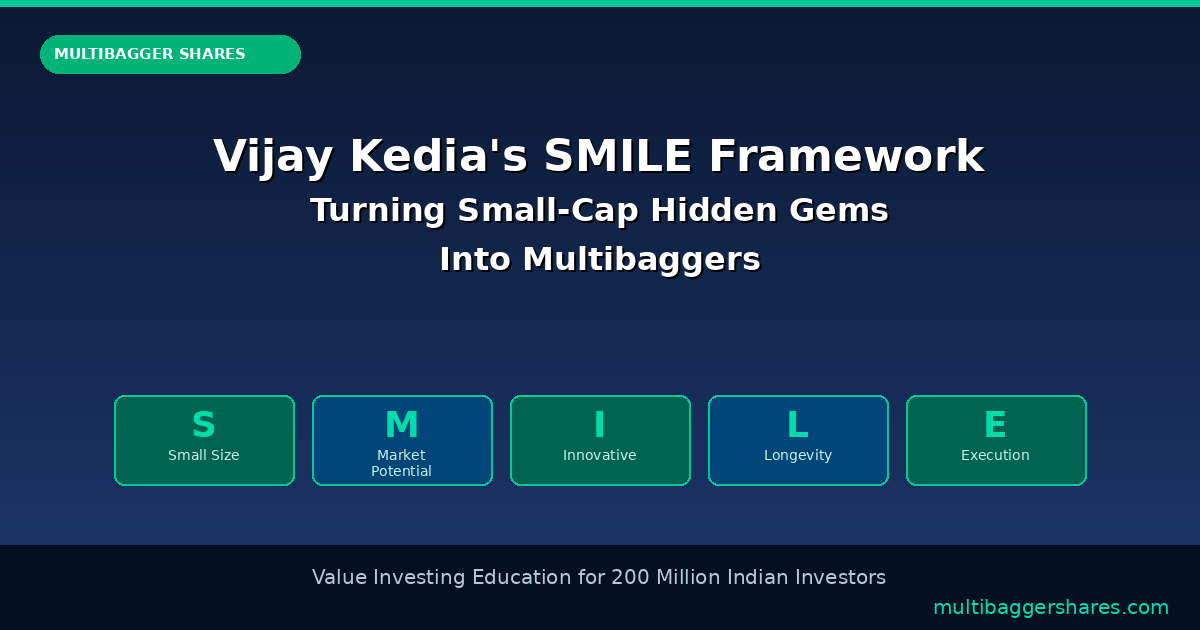
March 30, 2026
(Monday)
The Indian stock market closed sharply lower today — SENSEX down 1,636 points to 71,948 and NIFTY at 22,493. Global headwinds, Iran war tensions, and Goldman Sachs downgrading Indian equities have rattled nervous investors. But while retail traders panic, India’s legendary value investing master Vijay Kedia does exactly the opposite: he pulls out his SMILE framework, scans the carnage for small-cap gems, and positions his portfolio for the next 5-7 year multibagger journey.
Today, we decode Vijay Kedia’s SMILE framework in full — the same system that helped him turn ₹1 lakh into hundreds of crores over three decades of patient, disciplined investing in the Indian market.
🎯 SEBI Data Point
SEBI’s own studies confirm that 90% of F&O traders lose money. Yet, investors who hold quality small-cap stocks through Vijay Kedia’s SMILE framework for 5+ years have historically generated 10x–100x returns. The mathematics of patient investing vs. F&O gambling could not be more stark.
Who Is Vijay Kedia? — India’s Stock Market Oracle
Born in 1964 into a traditional Marwari business family in Kolkata, Vijay Kedia began investing in the Indian stock market in his teenage years. His early years were marked by painful losses as he tried to time short-term trades — a lesson that most retail investors learn the hard way. By the early 1990s, Kedia had made a fundamental shift: away from speculation and toward patient, fundamental investing.
The transformation was dramatic. Between 2004 and 2016, Kedia invested in Atul Auto, Aegis Logistics, and Cera Sanitaryware — three companies that multiplied more than 100 times in value. His philosophy crystallised into a repeatable, teachable framework that any Indian investor can learn and apply: the SMILE framework.
Today, Vijay Kedia manages a focused portfolio through Kedia Securities and is widely regarded as one of India’s most celebrated value investors. His public market disclosures reveal concentrated bets on small-cap companies with long runways for growth — and his track record speaks for itself.
The SMILE Framework: Five Letters That Can Transform Your Portfolio
The SMILE acronym breaks down as follows:
- S — Small in Size
- M — Large in Market Potential
- I — Innovative in Business Approach
- L — Longevity of Business Model
- E — Extra-Large Execution Ability
Let us go through each pillar in depth with real Indian examples and the investing wisdom behind each component.
S — Small in Size: Why Tiny Companies Create Giant Returns
The first letter is the foundation of the entire framework. Vijay Kedia deliberately targets companies with a relatively small market capitalisation — typically below ₹1,000–2,000 crore at the time of investment. The logic is powerful and mathematical: it is infinitely easier for a ₹500 crore company to become ₹5,000 crore (10x) than for a ₹50,000 crore Nifty 50 heavyweight to multiply ten times.
Small-cap companies are often completely ignored by large institutional investors — mutual funds, FIIs, and insurance companies simply cannot buy meaningful positions in companies with thin liquidity and tiny float. This institutional neglect creates pricing inefficiencies. A smart retail investor with patience can buy excellent businesses at prices that large funds cannot touch.
Kedia’s investment in Cera Sanitaryware is the textbook example. When he invested, Cera was a tiny, largely unknown company making sanitaryware in Gujarat. Large institutional money had no interest. The promoters were building a genuine business. The market cap was under ₹100 crore. Over the next decade, Cera grew revenues more than 20 times as India’s urbanisation and the middle-class housing boom drove demand for quality bathroom fittings. The stock returned over 100x.
How to apply this: Look for companies with market cap between ₹200 crore and ₹2,000 crore. Below ₹200 crore carries execution risk; above ₹2,000 crore already has significant analyst coverage. The sweet spot is the under-researched mid-zone where individual investors have an edge over institutions.
M — Large in Market Potential: The Total Addressable Market Principle
A small company is only exciting if the market it operates in is large — or is about to become large. Vijay Kedia calls this the “M” of SMILE: the Total Addressable Market (TAM) must be significantly bigger than the company’s current revenues. Ideally, the company should be addressing less than 5% of its potential market at the time of investment.
Think about Aegis Logistics when Kedia invested. India was just beginning to build out its LPG and liquid fuel distribution infrastructure. As a logistics and storage company serving the energy sector, Aegis sat at the intersection of two mega-trends: India’s growing energy appetite and the government’s push to expand LPG coverage. The TAM was enormous. Aegis was tiny. The result? 100x+ returns over a decade.
In the Indian context today, sectors with large and growing TAMs include: specialty chemicals (India targeting $300 billion by 2030), healthcare and diagnostics (severely underpenetrated), defence manufacturing (PLI schemes are opening a massive new market), and agri-inputs (India’s farm productivity remains well below global peers). A ₹300 crore specialty chemicals company in a sector growing at 15% per year has years of runway ahead of it — if the other SMILE parameters are met.
How to apply this: Before investing, answer this question: “Can this company grow revenues 10x from here?” If the market size does not support 10x revenue growth, the SMILE framework’s “M” test fails. Move on.
I — Innovative in Business Approach: The Moat of Adaptability
The third letter separates the durable multibaggers from the one-trick ponies. Vijay Kedia looks for companies that are doing something genuinely different — whether through proprietary technology, a unique distribution model, a differentiated product, or innovative use of capital. Innovation does not necessarily mean technology; it means the business has found a better way to serve customers than competitors.
The innovation parameter is particularly important in Indian small-caps because many operate in commoditised industries. The company that breaks out of commodity pricing through innovation — whether product, process, or distribution — earns superior margins and grows faster than the pack. Kedia has spoken extensively about how companies like Atul Auto (innovative three-wheeler designs for rural India) and PI Industries (contract research and manufacturing for global agrochemical companies) demonstrated this innovative edge.
A key indicator of innovation in Indian companies is the R&D spend relative to revenues, the number of patents filed, the gross margins relative to industry peers (higher margins = better value delivery), and management commentary on new product pipelines in AGM speeches and conference calls. If a company’s gross margins are 5-10 percentage points above its industry peers, that differential is almost always innovation-driven.
How to apply this: Read the company’s last three annual reports. Count the number of times the words “new product,” “patented,” “first-in-India,” “import substitution,” or “proprietary process” appear. Companies with high innovation DNA mention these frequently because they are genuinely building competitive advantages. Companies without it use boilerplate language about “operational efficiency.”
L — Longevity of Business Model: Building Businesses That Last Decades
Perhaps the most underappreciated letter in the SMILE framework is “L” for Longevity. Vijay Kedia invests with a minimum 5-year horizon and often holds for 10-15 years. For this to work, the business model must be structurally durable — immune to technological disruption, regulatory change, or competitor replication over the investment horizon.
Longevity in a business means the demand for its products or services will persist and grow for at least the next decade. Essential goods, quality healthcare, critical infrastructure inputs, and companies serving India’s secular demographic trends (urbanisation, rising middle class, healthcare spending) all have durable longevity.
Kedia explicitly avoids sectors where business models could be disrupted: he has been cautious about certain consumer electronics, some retail formats, and companies heavily dependent on a single government contract. The SMILE framework’s “L” test asks: “Will this company still be growing in 10 years, or could it be obsolete?”
This is where Titan Biotech (BSE: 524717, current price ~₹458) demonstrates exceptional “L” characteristics. Biological peptones and dehydrated culture media are essential for pharmaceutical manufacturing, medical diagnostics, and biotech research globally. This is not a fashionable product — it is a critical industrial input with decades of assured demand. As India’s pharmaceutical sector grows and as Biopharma SHAKTI policy drives domestic biotech capacity, the demand for Titan Biotech’s inputs only increases. That is genuine longevity — a business model built on essentials, not trends. Despite the market being down today, Titan Biotech’s fundamentals remain completely intact.
How to apply this: Ask yourself: “Would people still need this product/service in 2035?” If yes, the “L” test is passed. If the answer depends heavily on a single government scheme, one customer, or a technology that could be disrupted, apply a heavy discount to your thesis.
E — Extra-Large Execution Ability: Management That Delivers, Not Just Promises
The final and most critical letter of the SMILE framework is “E” for Extra-Large Execution. This is where the most analysis is required and where most investment theses fail in practice. A small company with a huge market, innovative approach, and durable model still needs a management team that can execute brilliantly over a 5-10 year period.
Vijay Kedia’s process for evaluating execution ability is rigorous. He studies management’s track record: have they done what they said in previous annual reports? Do revenue targets get met? Are capital allocation decisions (capex, acquisitions, dividends) wise in hindsight? Is management honest about failures or do they spin everything positively? Does the promoter hold significant shares without excessive pledging?
One of Kedia’s key signals is promoter ownership combined with skin in the game. A promoter who owns 60-70% of a small-cap company and has committed their personal wealth to the business has powerful incentives to execute. They cannot afford to fail. Their motivation is aligned with minority shareholders in a way that professional managers of large companies often are not.
An equally important signal: management accessibility. Kedia has spoken about meeting management before investing and asking sharp questions about capital expenditure plans, competition, and succession. Promoters who give clear, honest, conservative answers score far higher on the “E” parameter than those who make grandiose promises at investor presentations.
How to apply this: Compare the company’s actual financial performance against the targets the management set 3 years ago. Find the annual report from 2022 or 2023. Did revenue grow as promised? Did margins expand as guided? Did the product launches mentioned actually happen? The gap between promise and delivery is your “E” score.
Putting It All Together: A Practical Screening Process
Here is how to use the SMILE framework as a complete screening system for Indian small-cap stocks:
Step 1 — Universe: Start with BSE SmallCap or Nifty SmallCap 250 index. Filter for companies with market cap between ₹500 crore and ₹3,000 crore. This gives you approximately 400-500 companies to scan.
Step 2 — Market Potential (M test): Eliminate companies in structurally declining industries. Keep only companies in sectors where the Indian TAM is growing at 12%+ per year. This should cut your universe to 150-200 companies.
Step 3 — Innovation screen (I test): Check gross margins. If the company’s gross margin is below the industry median, it likely lacks innovation pricing power. Keep only companies in the top quartile of gross margins in their sector.
Step 4 — Longevity screen (L test): Apply qualitative judgement. Does this business serve a durable need? Will it exist in 10 years? Eliminate companies with questionable business longevity.
Step 5 — Execution check (E test): For the remaining 30-50 companies, compare 3-year projections vs. actual results. Rank by execution reliability. The top 10-15 companies with the highest execution scores are your SMILE candidates.
Step 6 — Valuation: Only now do you look at valuation. A company that passes all five SMILE tests deserves a premium multiple. If it is also reasonably priced (P/E < 30x for 20%+ growth), you have found what Kedia would call a "sleeping giant."
The Vijay Kedia Portfolio Philosophy: Concentration With Patience
One aspect of Vijay Kedia’s approach that surprises many investors is his comfort with concentration. Unlike the standard advice to “diversify across 20-30 stocks,” Kedia typically holds 5-8 positions in his public portfolio disclosures, with large weights in his highest-conviction SMILE picks. His logic: if you have genuinely done the SMILE analysis and found a company that scores high on all five parameters, why would you put only 3% of your portfolio in it?
Concentration works when it is based on deep research and conviction — not on tips or momentum. The risk of concentration is mitigated by the quality of analysis, not by spreading your portfolio thin across mediocre ideas.
The other cornerstone of Kedia’s philosophy is an investment horizon of minimum 5 years. He explicitly ignores quarterly earnings fluctuations, short-term market crashes (like today’s 1,636-point Sensex fall), and macro commentary. His question is always: “Is the 5-year story for this company intact?” If yes, short-term noise is irrelevant — it is often an opportunity to add more.
Why Days Like Today Are SMILE Investors’ Best Friends
The Sensex fell 1,636 points today on Iran war fears, Goldman Sachs downgrades, and FII outflows. Many retail investors are checking their portfolios in distress. But consider the SMILE framework investor’s perspective: none of today’s events changes the 5-year demand trajectory for a well-chosen Indian small-cap in specialty chemicals, pharma inputs, or defence manufacturing.
When markets fall, SMILE-quality small-caps often fall even more sharply than the broader market — because institutional sellers need liquidity and small-cap stocks have thinner liquidity. This creates temporary pricing dislocations. A company that scored 9/10 on the SMILE framework yesterday still scores 9/10 today — but it is available 5-10% cheaper. For patient investors, this is not a crisis. It is a sale.
SEBI’s data showing that 90% of F&O traders lose money tells the other side of the story. The people losing money today are not long-term SMILE framework investors — they are leveraged F&O traders who are getting margin calls on their Nifty puts and calls. The contrast between these two approaches to the Indian market is the entire thesis of value investing education.
Titan Biotech as a SMILE Framework Case Study
Titan Biotech (BSE: 524717) at the current price of approximately ₹458 is an excellent example of the SMILE framework applied to a real Indian company:
- S (Small): Market cap under ₹600 crore — completely off the radar of large institutional funds
- M (Market Potential): Global biologics market growing at 10-15% CAGR; India’s Biopharma SHAKTI policy targeting $130 billion by 2030; culture media and peptones are foundational inputs with enormous demand growth ahead
- I (Innovative): Import substitution play in a technically demanding product category; first-mover advantage in Indian peptone manufacturing for pharma clients
- L (Longevity): Biological culture media is an essential, recurring consumable in pharma manufacturing — not discretionary, not disruptable by software, not dependent on government subsidy
- E (Execution): Consistent revenue growth track record; promoter-driven management; zero debt — a hallmark of disciplined capital allocation
This is not a recommendation to buy or sell any specific stock. But the intellectual exercise of applying SMILE to Titan Biotech illustrates how the framework transforms abstract investing principles into a structured analytical process.
Key Takeaways: The SMILE Framework in Action
To summarise the complete SMILE framework:
- S — Small in Size: Target market cap ₹200–2,000 crore for maximum return potential and institutional neglect advantage
- M — Large Market Potential: The industry TAM must be capable of supporting 10x revenue growth over the next decade
- I — Innovative Approach: Look for gross margin leadership, patents, proprietary processes, and unique customer value delivery
- L — Longevity: The business model must be durable for 10+ years — serving essential, secular demand, not trends
- E — Extra-Large Execution: Management must have a verifiable track record of doing what they promise; promoter skin-in-the-game is critical
The SMILE framework is not magic. It is a structured way to avoid the common traps that destroy retail investors’ wealth: chasing recent winners (recency bias), following tips without analysis, over-diversifying into mediocre ideas, and selling quality businesses too early out of short-term fear.
Vijay Kedia’s track record — built over 30 years of disciplined SMILE investing in the Indian market — is proof that ordinary investors who commit to this kind of patient, fundamental approach can build extraordinary wealth over time.
For an in-depth video series covering the complete toolkit of value investing — from DCF and fundamental ratios to behavioral finance and sector analysis — visit our course playlist at YouTube: Complete Value Investing Course.
Disclaimer: This article is purely for educational and informational purposes. Nothing in this article constitutes investment advice, buy/sell recommendations, or financial guidance. All investments in the stock market carry risk. Please conduct your own due diligence and consult a SEBI-registered investment advisor before making any investment decisions. Past performance is not indicative of future results. The author and multibaggershares.com are not responsible for any investment decisions made based on this content.
📢 Join Our Telegram Channel
Get daily value investing lessons, stock analysis & Titan Biotech updates — delivered straight to your phone!
✈️ Join @longtermequityy on Telegram
🔔 Free • No spam • Value investing insights daily