The Shop That Says No: Why the Best Businesses Turn Away Customers

The Scooter That Sells Twice: What the Second-Hand Price Tells You About a Business
September 5, 2026
The Shop With Free Rent: How to Tell a Business That Earns Its Profit From One That Is Handed It
September 7, 2026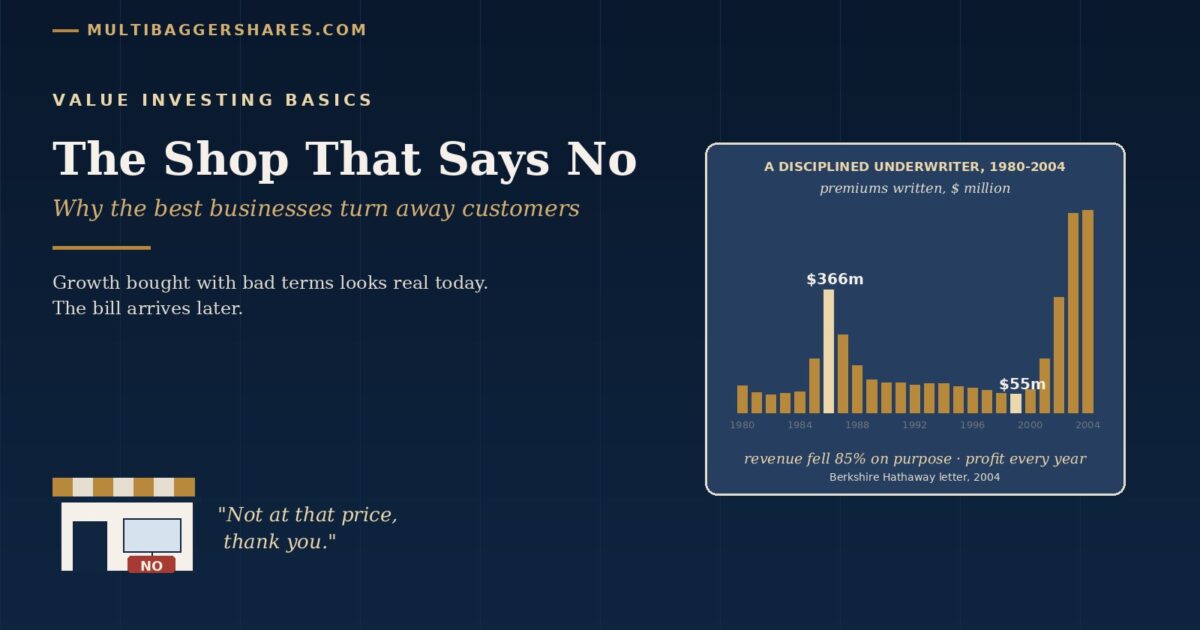
The printer who turned down the biggest order of the year
In a small market town there are two printing shops on the same street. Both print wedding cards, shop signboards and school notebooks. Both are run by men who know their trade. One October, a stranger walks into each shop with the same offer. He is organising a large exhibition. He wants forty thousand brochures, printed in a week, and he will pay in full ninety days after delivery. It is the biggest single order either shop has seen all year.
The first printer says yes on the spot. He buys paper on credit (goods taken now and paid for later), runs his machines through the night, and delivers on time. The second printer asks a few questions, thinks for a minute, and says no. He explains, politely, that he prints for people he knows or for people who pay half in advance. The stranger shrugs and walks out. The second printer’s wife tells him he has just thrown away a month’s profit.
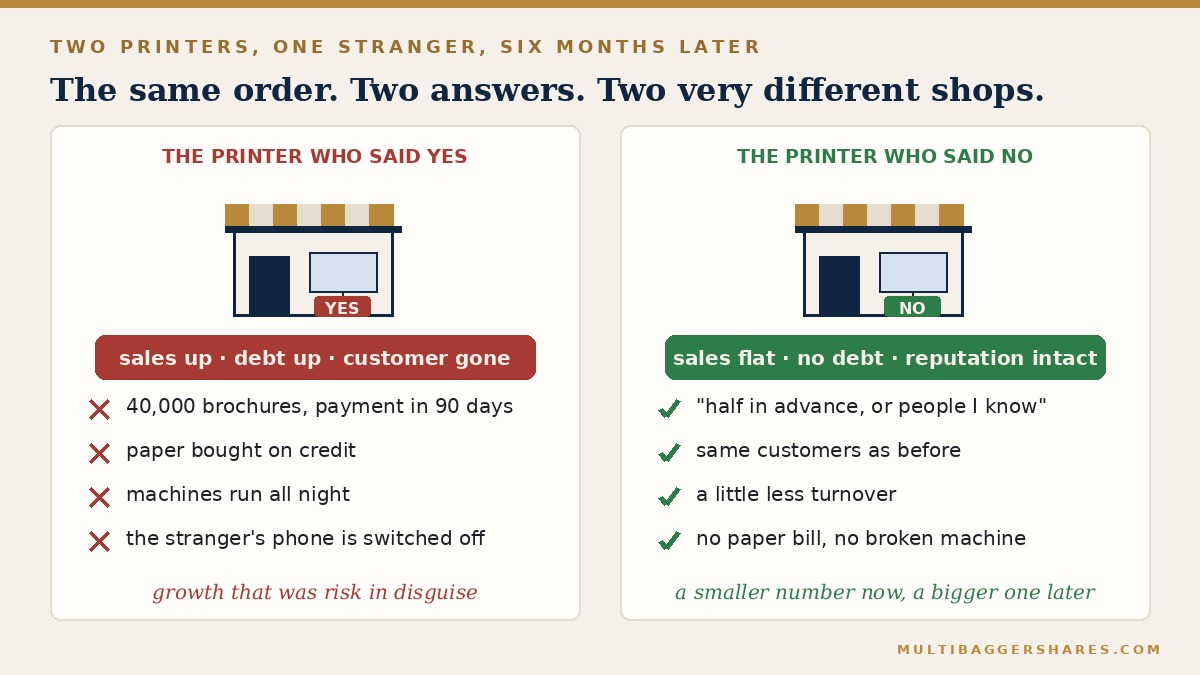
Six months later the picture has changed. The exhibition never happened. The stranger’s phone is switched off. The first printer has forty thousand brochures nobody wants, a paper bill he cannot pay, and a machine that needs repair because it was run too hard. The second printer has the same customers he always had, a little less turnover than he might have had, and no debt.
Nobody wrote about the second printer in the town newspaper. Saying no is not a story. But the second printer was doing something that the finest businesses in the world do every day, quietly and on purpose. He was turning away business that looked like growth but was really risk in disguise.
This letter is about that habit. It is one of the least visible marks of a quality business, and one of the most reliable.
What saying no really means
Let us be precise, because this idea is easy to get wrong.
We are not talking about a business that is shrinking because customers have left it. That is usually a sign of trouble. We are talking about a business that chooses to let sales fall, or grow more slowly, because the only way to keep growing would be to accept bad terms: a price that does not cover costs, a customer who may not pay, a risk the company does not understand, or a product it cannot make well.
Nor are we saying that the shares of such companies are cheap or expensive. Nothing in this letter is about the price of any share. It is about how to recognise a certain kind of behaviour inside a business, in the same way you might recognise a careful driver by watching how he takes a corner.
Here is the thing to understand. Almost every business can grow its sales tomorrow if it wants to. It only has to cut its price, loosen its credit terms (the time it gives customers to pay), or take on work it is not really equipped for. Growth bought this way looks exactly like real growth on the sales line of the profit and loss account (the statement that shows what a company earned and spent in a year). The difference shows up later, in the form of bad debts, losses on badly priced work, and broken customer relationships.
So when a company says no, it is really saying something about time. It is choosing a smaller number this year in order to protect a much larger number over ten or twenty years. A business that can hold that thought, year after year, while its rivals chase every order, is showing you something about the people who run it that no ratio can show.
Think of a kirana shop (a small neighbourhood grocery) that refuses to give udhaar (credit) to a customer with a history of not paying. The shopkeeper loses a sale today. But he keeps his working capital (the money a business needs day to day to keep running) intact, and he keeps the shop open for the next thirty years. His neighbour, who gives credit to everyone, has bigger sales and a bigger notebook of unpaid dues. One of these shops is stronger, and it is not the one with the bigger sales.
Why it works
There is a simple reason this habit is so rare, and Warren Buffett explained it better than anyone. In his 2004 letter to the shareholders of Berkshire Hathaway, he described an insurance company Berkshire owns called National Indemnity. Insurance is a business where the temptation to say yes is enormous. A customer pays you money today. Whether that money was enough will only be known years later, when the claims (the money an insurer pays out when something goes wrong) come in. So an insurer that cuts its price to win business looks wonderful for a while. The bill arrives later.
Buffett published a table he called “Portrait of a Disciplined Underwriter” (an underwriter is the person who decides which risks to insure and at what price). It showed that National Indemnity’s premiums (the money customers pay for insurance) fell from about 366 million dollars in 1986 to about 55 million dollars in 1999. That is a fall of roughly 85 per cent over thirteen years. Almost no listed company anywhere would accept that on purpose.
Yet through all of those years the company made an underwriting profit. It was paid more than it paid out, every single year. Buffett wrote that billions of dollars of business had been available, if only the company had been willing to cut its price. Instead, he wrote, the company “consistently priced to make a profit, not to match our most optimistic competitor. We never left customers – but they left us.”
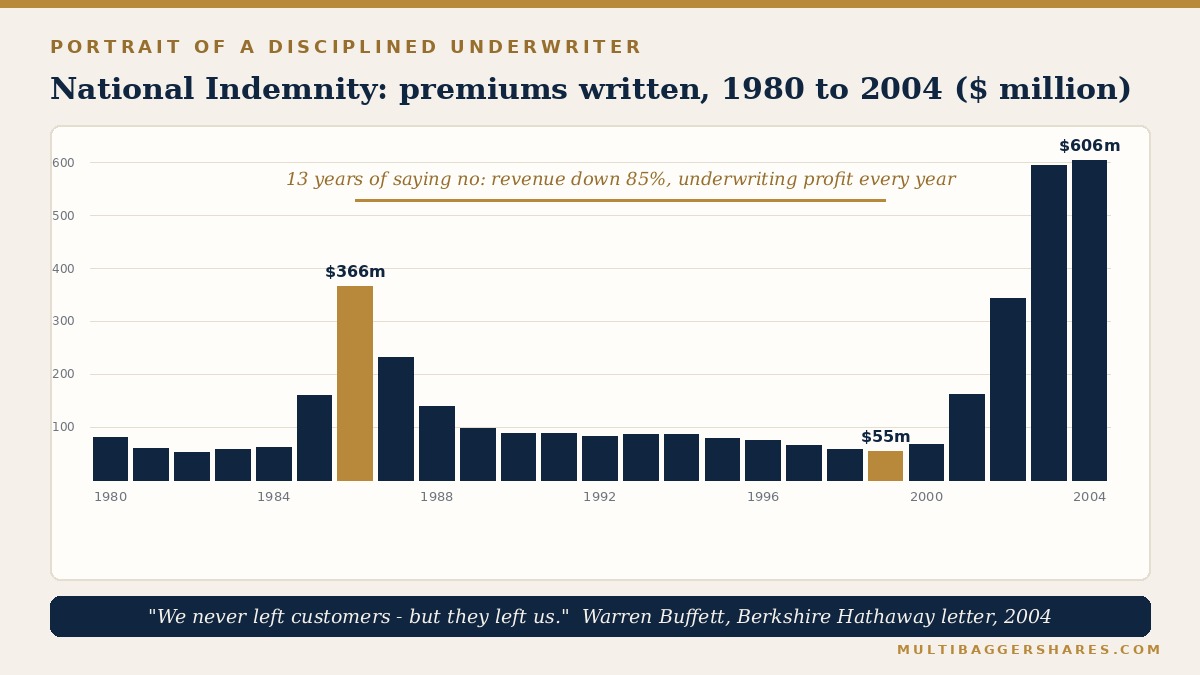
Then, from 2001, when the industry finally raised prices after years of losses, National Indemnity’s premiums rose more than tenfold in four years, to about 600 million dollars by 2003, because it still had the people, the capital and the reputation to write business when the price was right. The years of saying no were what made the years of saying yes possible.
Buffett also explained why most companies cannot do this. Managers are afraid that a shrinking business means layoffs, so they talk themselves into accepting bad prices to keep everyone busy. He called this pressure, in an earlier letter, the institutional imperative: the tendency of organisations to copy whatever their rivals are doing. To fight it, Berkshire promised National Indemnity’s staff that nobody would be fired because of falling volume. The number of employees did fall over those years, from about 400 to about 220, but through people leaving on their own, not through pink slips.
The lesson generalises far beyond insurance. Any business where the cost of a sale arrives after the sale itself faces the same temptation: banks that lend, builders that quote a fixed price for a long project, suppliers that give long credit, manufacturers that promise a warranty (a promise to repair or replace a faulty product free of charge). In all of them, saying yes feels good now and hurts later. Saying no hurts now and pays later. That is exactly why saying no is such a strong signal. It is expensive, so only businesses with real discipline can afford to keep doing it.
Charlie Munger liked to say that all he wanted to know was where he was going to die, so that he would never go there. A company that stays out of bad business is applying the same joke seriously. It is not being timid. It is being intelligent about where its losses would come from.
A few examples from India and elsewhere
The stories below are told only to show what the habit looks like in practice. Nothing here is a comment on anyone’s shares.
A bank that lent less than it could have. Between roughly 2010 and 2014, Indian banks lent enormous sums to power plants, roads, steel and other large projects. The loans looked like growth. Some years later many of them stopped being repaid. By March 2018, gross non-performing assets (loans on which the borrower has stopped paying) across the Indian banking system had climbed to about 11 per cent of all loans. HDFC Bank, which had kept a much smaller share of its loans in those sectors and had grown instead through smaller loans to individuals and businesses it could assess, reported gross non-performing assets of about 1.3 per cent at around the same time. One of its senior executives said plainly that the bank had simply had a lower concentration in infrastructure. It had said no, quietly, for years, to loans that others were happy to make.
A carmaker that walked away from a quarter of its own sales. In 2019, Maruti Suzuki announced that it would stop selling diesel cars from April 2020, when India’s stricter BS6 emission rules came into force. At the time, roughly a quarter of the cars it sold in India ran on diesel. Its reasoning was that meeting the new rules would make small diesel engines so expensive that the customer would no longer save enough on fuel to justify them. Rather than pour money into a product it believed was fading, it let those sales go. Diesel’s share of the Indian car market, which had been close to half of all cars a few years earlier, fell to under a fifth within a couple of years.
A two-wheeler maker whose no did not work out. This is the honest limit of the idea. In 2009, Bajaj Auto, whose name was once almost a synonym for the Indian scooter, announced that it would stop making scooters altogether and focus only on motorcycles. It was a deliberate no. But the scooter market did not fade. Light automatic scooters, led by Honda’s Activa, took off, and scooters grew from around a sixth of India’s two-wheeler market to close to a third within a decade. Bajaj eventually returned to the segment in 2020 with an electric scooter. Saying no is a sign of discipline, not a guarantee of being right. Even disciplined managers misjudge where a market is going. What the habit protects you from is the far more common mistake, which is saying yes to everything.
A sweet shop that closes early. Away from the stock market, many of India’s most respected small businesses show the same habit. The famous halwai (sweet-maker) who makes a fixed quantity each morning and closes when it is sold, rather than making more and selling stale sweets in the evening, is saying no to sales in order to protect a reputation built over decades. His customers queue precisely because he does.
How you can use this idea
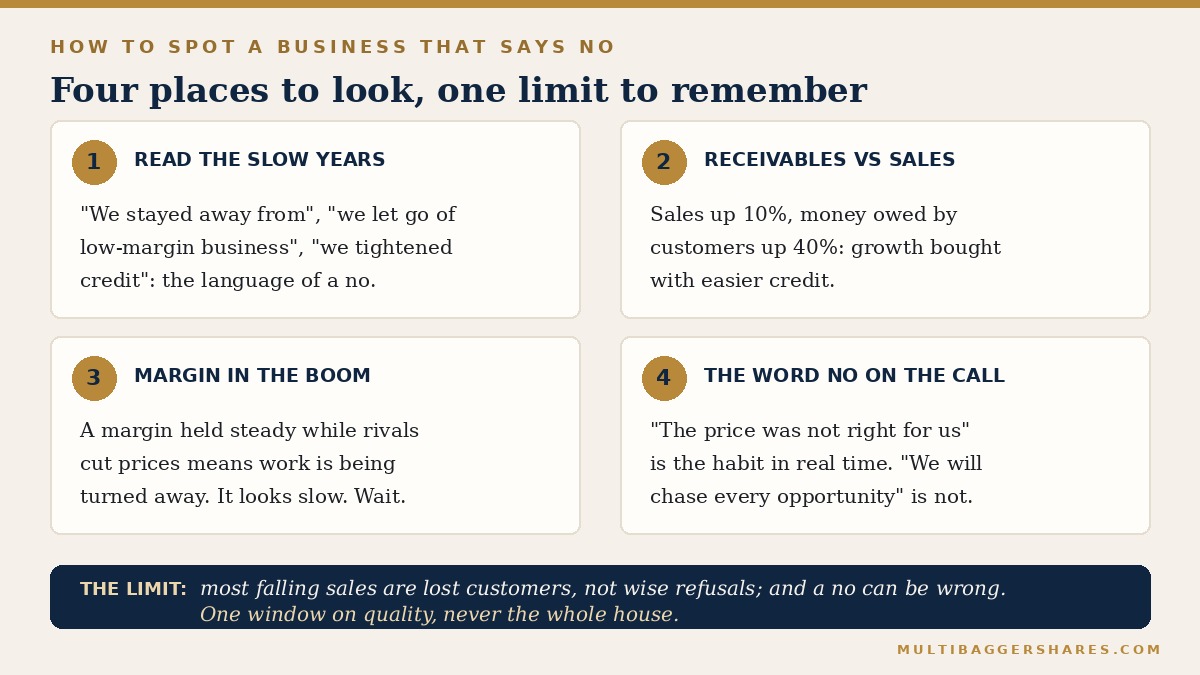
You do not need a spreadsheet to look for this habit. You need to read what the company says, and compare it with what it does, over more than one year. Here is a simple way to go about it.
Step one: look for the years the company grew slower than its rivals, and read why. Every annual report (the yearly document a listed company sends to its shareholders) has a section where management discusses the year. When a company grew more slowly than the industry, did it explain that it chose to? Phrases such as “we stayed away from”, “we did not participate in”, “we let go of low-margin business” or “we tightened our credit norms” are the language of a business that says no. A company that only ever blames the weather, the economy or the government for slower growth is telling you something different.
Step two: watch what happens to receivables when sales grow. Receivables are the money customers owe a company for goods already delivered. If sales grow ten per cent and receivables grow forty per cent, the company has been buying growth with easier credit. It has been saying yes to customers it should perhaps have refused. A company whose receivables grow in line with sales, or slower, is holding its standards.
Step three: watch the margin in the boom years. A business that keeps its profit margin (the share of each rupee of sales that is left as profit) steady while rivals are cutting prices to win volume is almost certainly turning away work. It will look slow while the boom lasts. The test comes when the boom ends and the rivals’ cheap orders turn into losses.
Step four: listen for the word no on the earnings call. Companies now publish transcripts of their conversations with analysts. Search them for the questions about why the company is not entering some hot new area, or why it lost a large order. A manager who can say, calmly, “the price was not right for us” is showing you the habit in real time. A manager who promises to chase every opportunity is showing you its absence.
Step five: know the limits. Not every fall in sales is a wise no; most are simply lost customers, and you must read carefully to tell the two apart. A no can also be wrong, as the scooter story shows. And a company that refuses bad business can still carry too much debt, pay its managers too much, or make a product nobody wants. This is one window on quality, not the whole house. Use it alongside the other tests in this series, never on its own.
One last thought. The habit of saying no is easiest to see in the years when everyone else is saying yes. In a boom, the disciplined company looks dull and the reckless one looks brilliant. That is the moment to take notes. The tide, as Buffett likes to say, goes out eventually, and then you find out who was careful.
This is a lesson about learning to see. It is not about what to do with what you see, which depends on your own situation and which no article can settle for you.
Key takeaways
- Almost any business can grow tomorrow by cutting price, loosening credit or taking work it cannot do well. Growth bought that way looks identical on the sales line; the bill arrives later.
- A company that chooses to let sales fall rather than accept bad terms is trading a smaller number this year for a much larger one over decades. That choice is a mark of management quality no ratio can show.
- Buffett’s 2004 “Portrait of a Disciplined Underwriter”: National Indemnity let premiums fall about 85 per cent from 1986 to 1999, made a profit every year, and then grew tenfold when prices turned. “We never left customers – but they left us.”
- HDFC Bank’s low share of infrastructure loans and Maruti’s diesel exit show the habit at work; Bajaj’s scooter exit shows its honest limit. Saying no is discipline, not a guarantee of being right.
- Look for it in the annual report’s explanation of slow years, in receivables growing no faster than sales, in margins held during booms, and in the word no on the earnings call. One window on quality, never the whole house.
— Manish Goel · multibaggershares.com
Disclaimer: This article is published by multibaggershares.com for education and general information only. It is not investment advice, investment research, or a recommendation to buy, sell or hold any security. Any companies named are discussed only as illustrative examples. Markets carry risk; please do your own research or consult a qualified professional before making any investment decision.