The Scooter That Sells Twice: What the Second-Hand Price Tells You About a Business

The Sweet Shop That Took the Box Back: How a Business Behaves When Something Goes Wrong
September 4, 2026
The Shop That Says No: Why the Best Businesses Turn Away Customers
September 6, 2026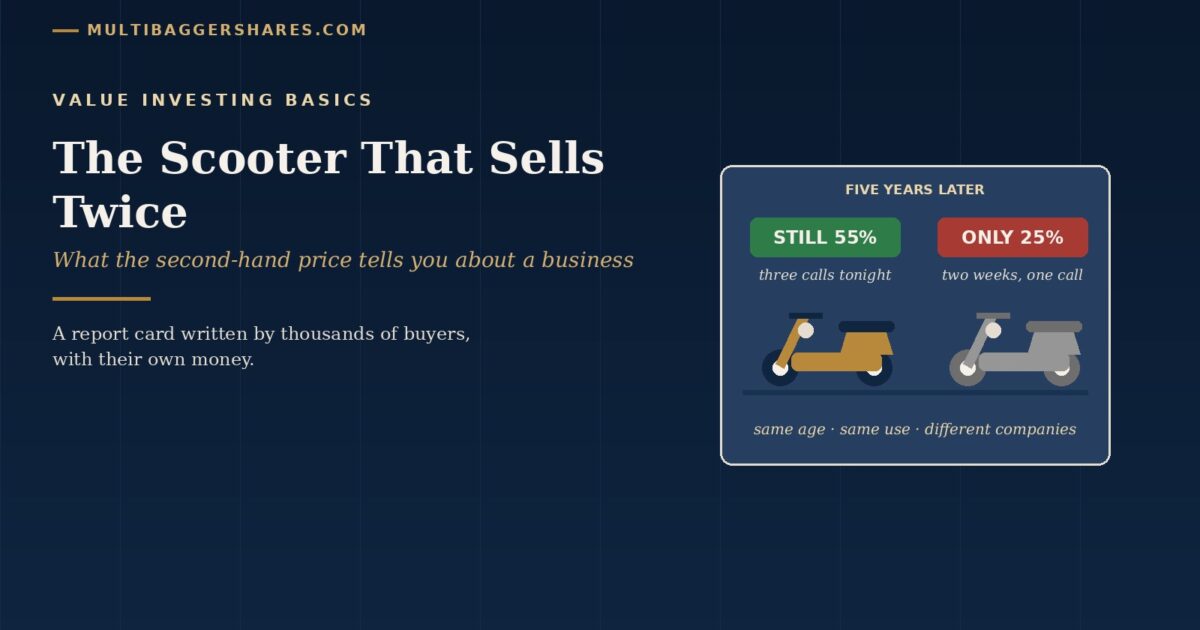
Two scooters, five years later
Picture two neighbours in the same lane. Five years ago, on the same week, each bought a new scooter from a different company. Both paid about the same money. Both rode to work every day, took the children to school, and parked in the same sun and the same monsoon.
Now both want to sell. The first neighbour puts a notice on the colony board and gets three calls the same evening. The buyers do not ask many questions. Everyone knows this scooter. Spare parts are in every second shop. The mechanic at the corner has fixed hundreds of them. He gets a little more than half of what he paid five years ago.
The second neighbour waits two weeks for a single call. The caller wants to know whether parts are still available, whether the company still exists, and whether anyone in town can service it. He finally sells it for a quarter of what he paid, to a man who mainly wants it for the metal.
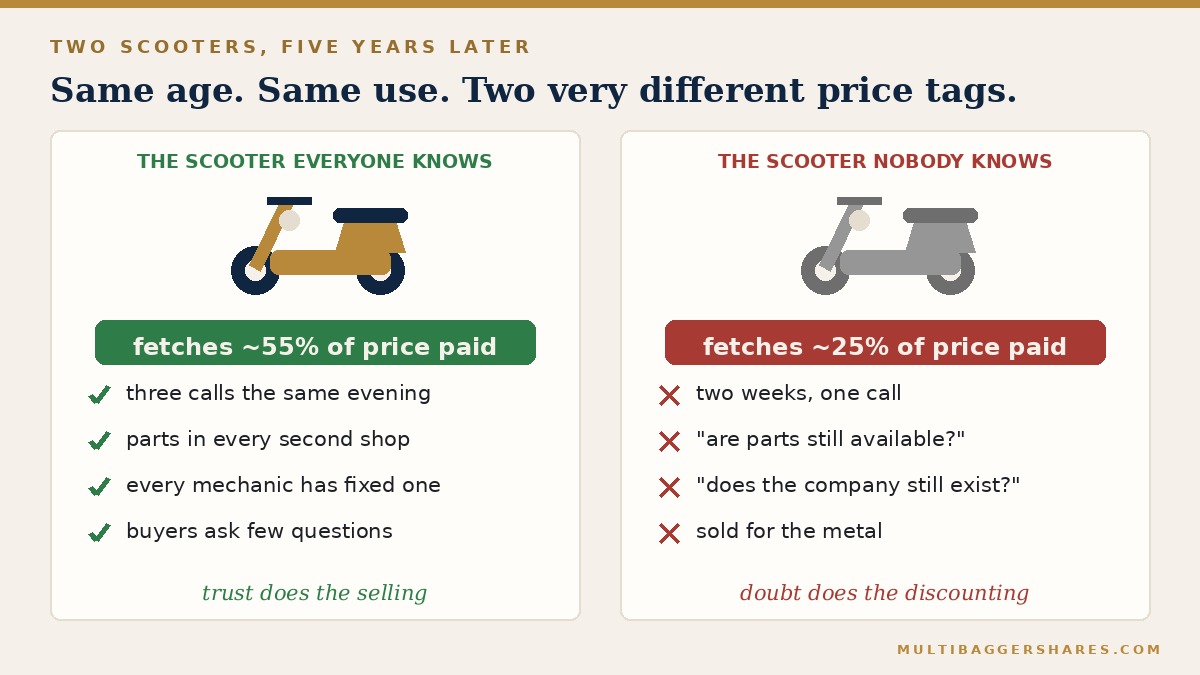
Both scooters were the same age, in the same condition, ridden the same way. The difference in price had nothing to do with the two neighbours. It came entirely from the two companies. One company made a product that strangers were happy to buy blind. The other made a product that strangers were afraid of.
That is the whole idea of this letter. The price a product fetches when it is sold a second time, years later, by someone other than the company, is one of the most honest report cards a business ever receives. The company does not write it. Its advertising agency does not write it. Thousands of ordinary buyers write it, with their own money, on the colony notice board. And anyone can read it.
What the second-hand price really means
Let us be careful about what we are and are not saying, because this is easy to misread.
We are not talking about the price of the company’s shares (the small slices of ownership that trade on a stock exchange). Nothing in this letter is about whether any share is cheap or expensive. We are talking about the price of the product — the scooter, the car, the phone, the tractor, the watch — when it changes hands the second time, in what economists call the secondary market (the market for things that have already been sold once).
Nor are we saying that a company earns the second-hand price. It does not. When your neighbour sells his five-year-old scooter, the company that made it gets nothing. The second-hand price is a signal, not a source of profit. It is like the smell from a kitchen. The smell is not the meal, but it tells you a great deal about what is being cooked.
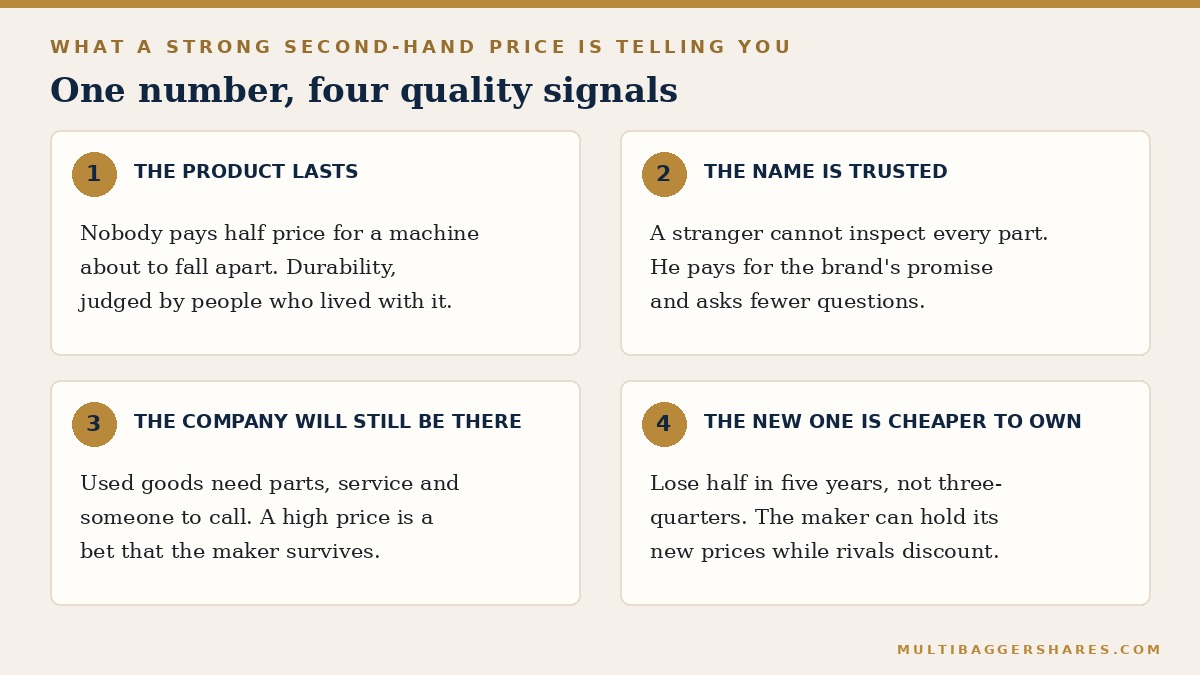
So what exactly does a strong second-hand price signal? Four things, and each one is a mark of a quality business.
First, the product lasts. Nobody pays half price for a five-year-old machine that is about to fall apart. A strong resale price (the price a used item sells for) is a verdict on durability delivered by people who have actually lived with the product.
Second, the buyer trusts the name. A stranger buying a used product cannot open it up and inspect every part. He has to trust something. If the brand carries that trust, the buyer pays more and asks fewer questions. If it does not, the buyer discounts heavily to protect himself against the unknown.
Third, the company will still be there. Used goods need spare parts, service, and someone to call. A high resale price is a bet by the buyer that the company will exist, and will support the product, for years to come. Thousands of small buyers rarely make that bet carelessly.
Fourth, and most quietly, the new product is cheaper to own than its sticker suggests. If a car loses only half its value in five years, the true cost of owning it is the other half. If a rival’s car loses three-quarters, its true cost is far higher even if the showroom price was the same. Buyers work this out, often without any spreadsheet. It is why the trusted brand can hold its new prices firm while the rival must discount. A strong second-hand market quietly protects the new business.
Why it works: the lemon problem
There is a famous piece of economics behind all this, and it is simple enough to explain over a cup of tea.
In 1970 a young American economist named George Akerlof published a short paper called “The Market for Lemons.” In American slang a “lemon” is a used car that turns out to be a dud. Akerlof asked a plain question: why does a car lose so much value the moment it leaves the showroom, even though it is the same car?
His answer was about information. The seller of a used car knows whether it is good or bad. The buyer does not. So the buyer assumes the worst and offers a low price. But at that low price, the owners of the good cars refuse to sell — why give away a good car cheaply? Only the owners of bad cars accept. The buyer’s suspicion comes true, prices fall further, and the market for good used cars can shrink to almost nothing. Economists call this problem asymmetric information (one side knowing more than the other). Three journals rejected the paper as trivial or wrong. In 2001 it helped earn Akerlof the Nobel Prize.
Now turn the idea around, because this is where it becomes a quality test. Akerlof showed that a used market fails when buyers cannot tell good from bad. So when a used market works — when strangers happily pay a strong price for a five-year-old product — something must be solving the lemon problem. That something is usually the company: a brand that has kept its promise for decades, a service network that keeps old products running, spare parts that are easy to find, and a habit of building things the same reliable way year after year.
In other words, a strong second-hand price is evidence that the company has spent years earning trust, and that the trust is real. That is exactly the kind of quality a long-term investor wants to find, and it is very hard to fake. A company can buy advertising in a month. It cannot buy a reputation on the colony notice board.
Warren Buffett described the strongest kind of business in his 1991 letter to shareholders. An economic franchise, he wrote, arises from a product or service that “(1) is needed or desired; (2) is thought by its customers to have no close substitute and; (3) is not subject to price regulation.” Look at the second condition. When a buyer of a used product pays extra for one name and not another, he is telling you, with his own money, that he sees no close substitute. The second-hand market is one of the few places where you can watch Buffett’s test being passed or failed in public.
A few real examples
The following companies are mentioned only as stories to make the idea concrete. Nothing here is a comment on their shares, and nothing here is advice.
Toyota. In the United States, Kelley Blue Book (a well-known guide to used-car prices) gives a yearly award to the car brand whose vehicles keep the most value after five years. In 2026 Toyota won it for the sixth year in a row and for the tenth time overall. Its cars were expected to keep roughly half of their original price after five years, well above the typical mass-market brand. Notice what the award is really measuring. Not marketing. Not the size of the factory. It is measuring what millions of second buyers, who never met the company, were willing to pay for a used Toyota. That is decades of reliability, dealer service and parts supply, summed up in one number.
Maruti Suzuki. In India the same story is visible in every town. Ask anyone selling a used hatchback (a small family car) and they will tell you which badge sells fastest and holds its price best. The reasons are the ones we have just listed: a service centre within reach of almost every village, spare parts that are cheap and everywhere, and mechanics who know the cars by heart. The company noticed this so long ago that in 2001 it set up its own certified used-car business, True Value, which today has well over a thousand outlets. A company that is willing to inspect, refurbish and put its own warranty (a promise to repair at its own cost) on its own five-year-old cars is a company that is confident about how those cars were built. It is worth adding that a strong second-hand market does not make a company immune to competition. Maruti’s share of new cars sold in India has slipped from about half to under forty per cent as buyers moved towards larger vehicles. The second-hand test tells you about the strength of a product; it does not promise that the product is the one people want next year. Keep both ideas in your head at once.
Smartphones. Trade-in services that buy used phones publish depreciation figures (depreciation here simply means the fall in resale value over time). For years their reports showed the same pattern: a flagship iPhone typically lost around a third of its value in its first year, while many rival flagship phones lost around half. Interestingly, the latest reports show the gap narrowing, with the largest Android maker improving year by year. That is a useful reminder that the second-hand price is a moving report card, not a permanent medal. Read it every year.
Watches and handbags. At the far end of the scale are a handful of luxury products whose used prices have, at times, gone above the new price. At the peak of the pre-owned watch boom in 2022, almost every Rolex model traded second-hand for more than the showroom asked, and the most famous Hermès handbags have sold used at one and a half to two times their retail price for years. When a stranger will pay more for your old product than the company charges for a new one, the company is not selling leather or steel. It is selling something Buffett’s second condition describes exactly: a name for which buyers see no close substitute. The same reports also show that used Rolex prices fell by about a third after the 2022 peak. Even the strongest signal moves, and a wise reader watches the direction as well as the level.
How you can use it
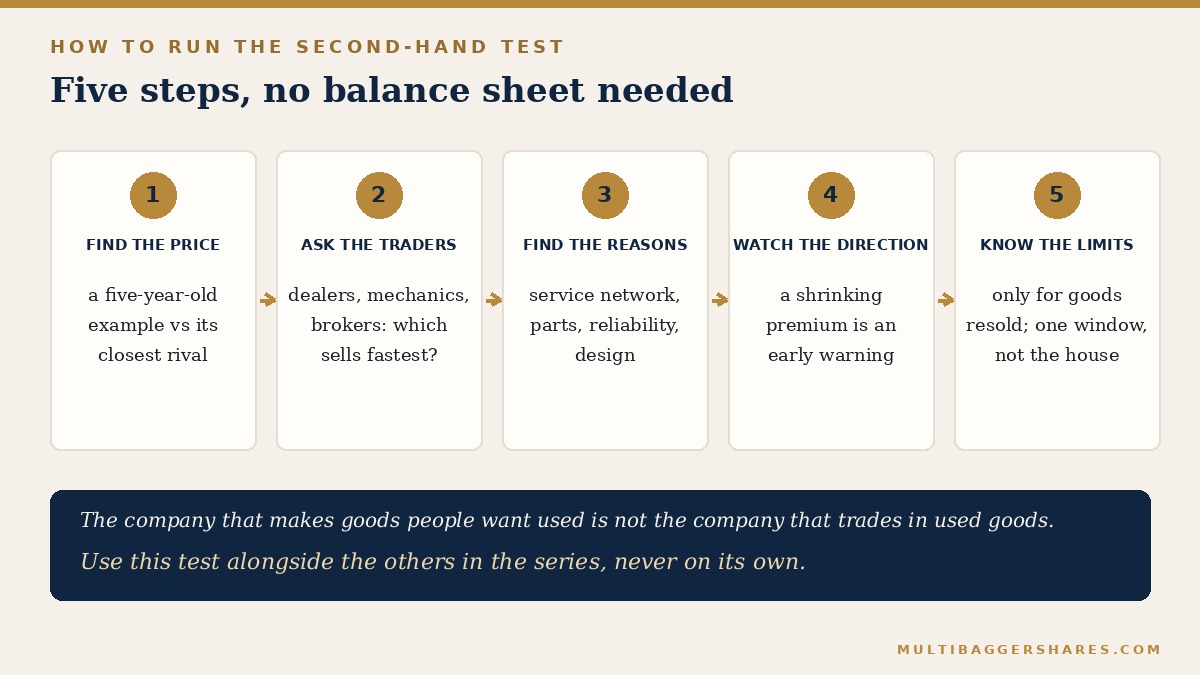
This test costs nothing and requires no accounts. Here is how to run it, step by step.
Step one: find the product on the second-hand market. For vehicles, phones, appliances, tools and machinery, this is easy. Look at classified sites, used-goods platforms and, for farm and factory equipment, the local dealers. Compare a five-year-old example from the company you are studying with a five-year-old example from its closest rival. Ask a simple question: what fraction of the original price does each still fetch?
Step two: ask the people who trade it. A used-car dealer, a mechanic, a farm equipment broker or a phone-shop owner will tell you in two minutes which brand sells fastest and which sits unsold. They have no reason to flatter the company. This is the method the investor Philip Fisher called scuttlebutt (asking people around a business rather than the business itself), applied to a market the company cannot control.
Step three: look for the reasons. If the second-hand price is strong, find out why. Is it the service network? The parts? The reputation for not breaking? A design that changes little, so old models do not look dated? Each reason is a different kind of strength, and each can be checked in the company’s own annual report (the yearly document a listed company sends to its shareholders) — the number of service touchpoints, the growth of the parts and service business, the warranty claims.
Step four: watch the direction. A resale premium that is shrinking year by year is an early warning, often earlier than the sales figures. It means that trust is leaking somewhere: a bad batch, a rival closing the gap, a service network that has stopped growing. A resale premium that is widening is the reverse. Either way, the second-hand market often notices before the annual report admits it.
Step five: know the limits. The test only works for products that are sold again. It says nothing about a company that sells biscuits, software, cement or insurance. A used product can also hold value for reasons that have little to do with the company — a shortage of new supply, a fashion, a rule change. And a strong second-hand price for the product does not tell you whether the company is well run today, whether it carries too much debt, or whether it is making money on each new unit. It is one window, not the whole house. Use it alongside the other quality tests in this series, never on its own.
One last caution. The company that trades in used goods is a different business from the company that makes goods people want used. The first is a dealer with thin margins and a lot of stock. The second is what we have been describing. Do not confuse the two.
This is a lesson about learning to see. It is not about what to do with what you see, which depends on your own situation and which no article can settle for you.
Next time you pass a used-vehicle lot or scroll through a classifieds site, slow down for a minute. Notice which names sell quickly and which sit for weeks. You will be reading a report card that thousands of people wrote with their own money, and that no company can edit.
Key takeaways
- The price a product fetches years later, sold by someone else, is a report card written by thousands of buyers with their own money. The company cannot edit it.
- A strong second-hand price signals four things: the product lasts, the name is trusted, the company will still be around, and the new product is cheaper to own than its sticker suggests.
- Akerlof’s 1970 “lemons” paper explains why: used markets fail when buyers cannot tell good from bad. When one works, the maker’s reputation is usually what makes it work.
- Toyota’s ten resale-value awards, Maruti’s certified used-car network since 2001, and Rolex watches selling used above new are all the same signal at different strengths.
- Watch the direction, not just the level, and know the limits: the test only works for goods that are resold, and it is one window on quality, never the whole house.
— Manish Goel · multibaggershares.com
Disclaimer: This article is published by multibaggershares.com for education and general information only. It is not investment advice, investment research, or a recommendation to buy, sell or hold any security. Any companies named are discussed only as illustrative examples. Markets carry risk; please do your own research or consult a qualified professional before making any investment decision.