Who Chooses, Who Uses, Who Pays: The Three People Hiding Inside Every Sale

The Shop That Sells Only One Thing: How to Judge a Business That Lives Off a Single Product
September 1, 2026
The Ten-Rupee Part That Stops a Ten-Lakh Machine: How to Judge a Business Nobody Bargains With
September 3, 2026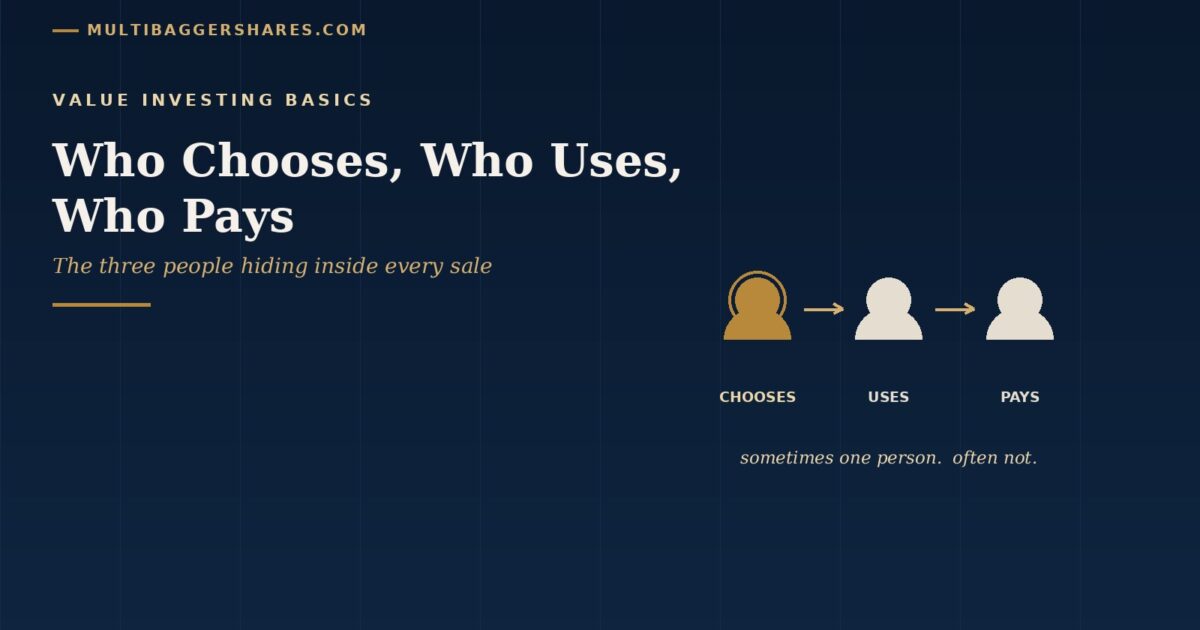
A tin of paint and three people
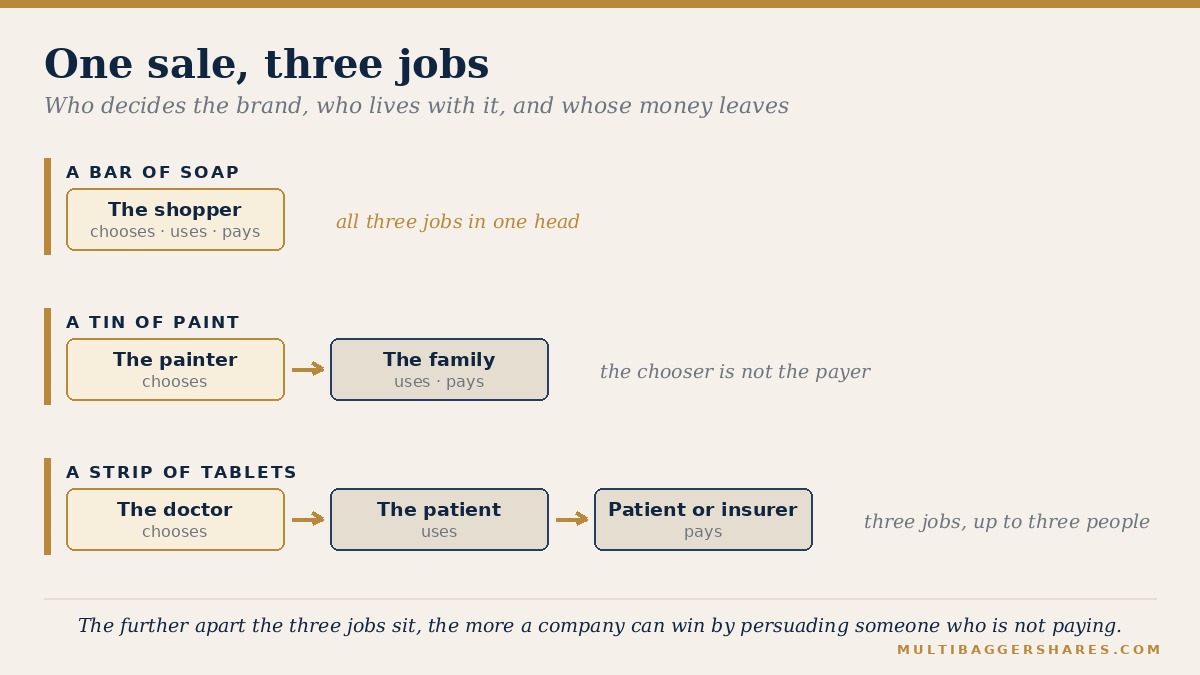
Suppose a family in Nagpur decides to repaint the flat before Diwali. They call a painter they have used twice before. He walks around the rooms, taps a wall, mentions a brand, and says he can get it at a fair rate from the shop at the corner. The family nods. Two weeks later the flat looks new, and the family pays the bill.
Now read that again slowly and count the people. The painter decided which brand of paint went on the wall. The family will live with that paint for the next six or seven years. And the money left the family’s bank account. Three separate jobs — choosing, using, paying — and they did not all sit with the same person.
Compare it with the same family buying a bar of soap. One person picks it off the shelf, the same person washes with it, and the same person hands over forty rupees at the counter. All three jobs sit inside one head.
That difference is small to look at and large in its consequences. Whether the three jobs sit in one head or are spread across two or three people quietly decides what a company has to be good at in order to sell anything at all. It is one of the least technical ways I know to judge how solid a company’s demand (the wish of buyers to have what a company sells, backed by the money to actually pay for it) really is. And once you can see it, you cannot stop seeing it.
What the three roles actually mean
The chooser is the person who decides which brand or which product is used. Not the person who feels a general need for paint, but the person who says which tin comes into the house.
The user is the person who lives with the result afterwards, day after day, long after the choosing is forgotten.
The payer is the person whose money actually leaves.
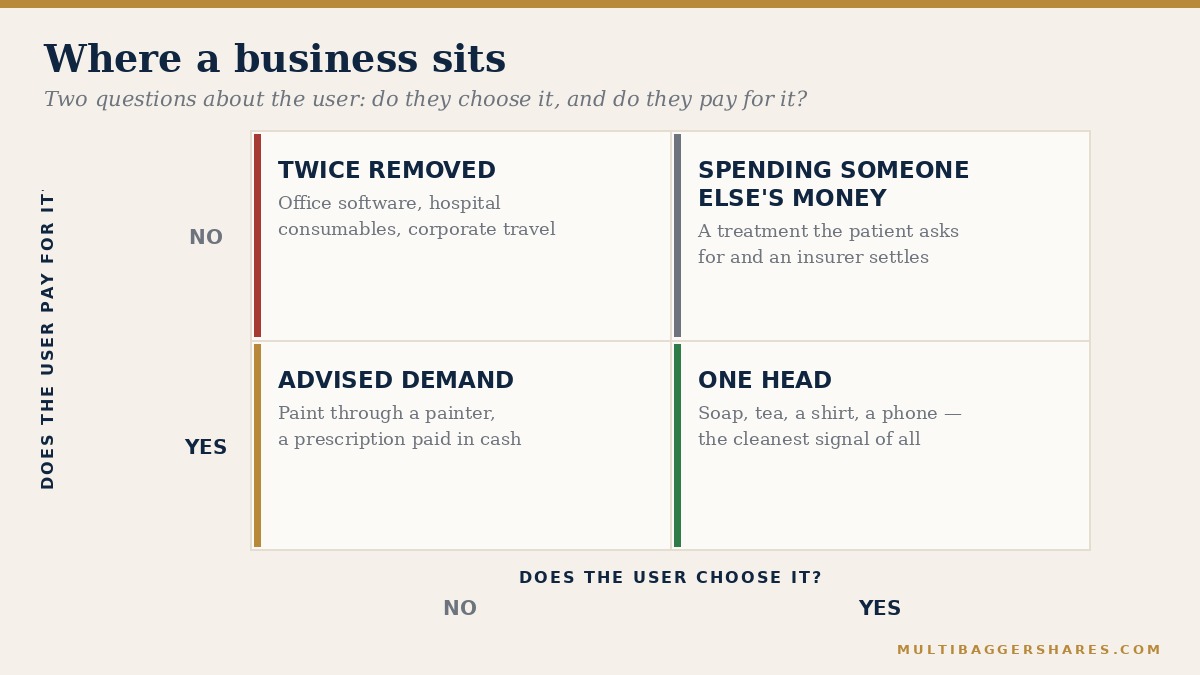
In an enormous number of everyday purchases these are one person: soap, tea, a shirt, a phone, a packet of biscuits. But in a surprising number of large and respectable industries they are not. A doctor writes the name of a medicine; the patient swallows it; the patient, or an insurance company, pays for it. A mason or an architect names the cement, the tiles and the wiring; the family lives in the house; the family pays. A school selects the textbooks and the uniform; the child uses them; the parent pays. A company’s technology head selects the software; two thousand employees use it; the company pays. A distributor recommends a savings product; the investor holds it for ten years and pays for it out of the returns.
It is worth being precise about what this is not. It is not the question of how many customers a company has, and it is not the question of how hard it is for a customer to walk away. Those are useful questions and they have their own answers. This one is different. This one asks: inside a single sale, which person is the company actually trying to persuade?
Why the split changes everything for the company
When the chooser and the payer are the same person, a company has only one road to a sale. It has to win an argument with the person holding the money. Make the product better, or cheaper, or easier to get, or nicer to live with. Every rupee the company spends to win that argument goes into something the payer can see and feel.
When the two roles separate, a second road opens, and it is usually the cheaper one: persuade the chooser. A chooser who is not paying feels the price of the product very differently from the person who is. If the painter earns a little more, or gets a set of tools, or points that add up to a scooter, for recommending one brand over another, and the family is not going to check either way, the brand has bought itself a sale without ever having to be the better paint.
Charlie Munger, Warren Buffett’s partner of nearly sixty years, put the whole idea into eight words in a 1995 talk at Harvard Law School on how people fool themselves: “Show me the incentive and I will show you the outcome.” He believed incentives (the rewards that make a person do one thing rather than another) were the most underestimated force in human affairs. In a business where the chooser is not the payer, the incentive is sitting right there in plain sight.
None of this is sinister, and it would be a mistake to read it as an accusation. The chooser is very often the one who genuinely knows more. A doctor has studied for years; a patient has not. A painter can tell from touching a wall what a homeowner cannot. Handing the decision to somebody who understands the problem is sensible behaviour, not foolish behaviour, and a great many companies in these industries are entirely honourable.
But for somebody trying to judge a business from the outside, the split has two consequences worth learning.
The first is that the company’s effort moves to a different part of the accounts (the financial statements a company publishes every year). Instead of showing up only as a better product, it shows up as selling and distribution expenses, as commissions, as rebates and discounts given, as “schemes”, as training programmes, as loyalty points. India’s large paint companies, for instance, openly run academies and reward programmes for painters and contractors, and describe them in their own annual reports. That is money spent on the chooser rather than on the payer, and it does not stop being money.
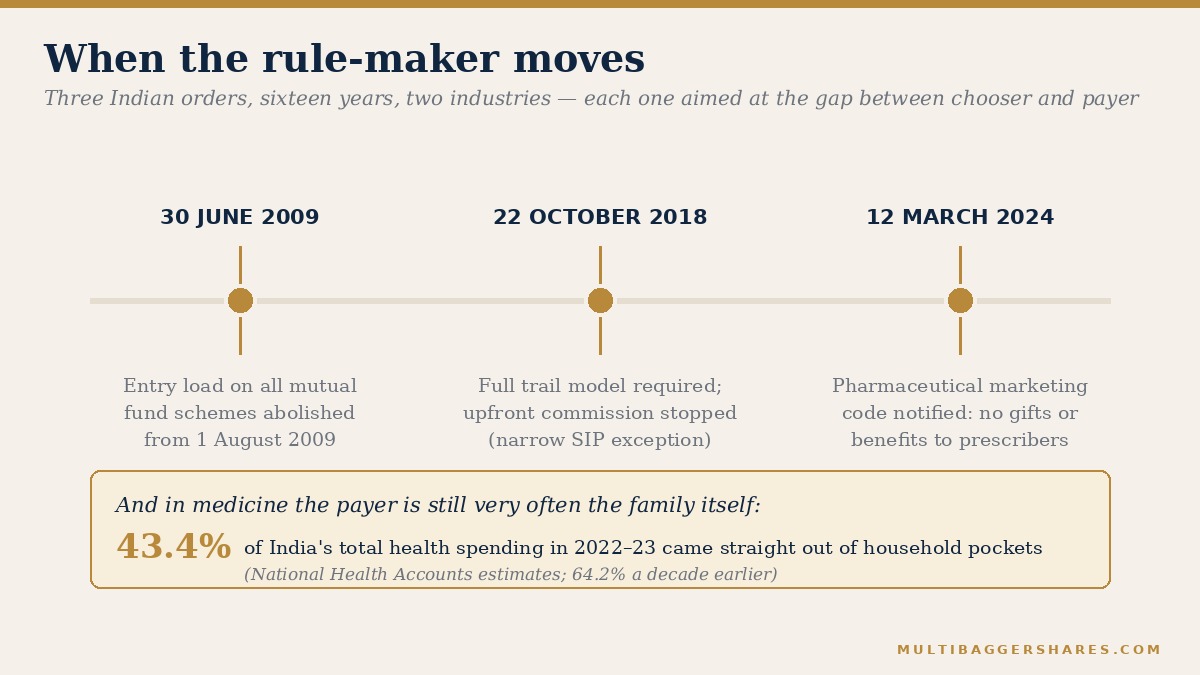
The second consequence is the one most beginners miss. An arrangement that depends on paying the chooser sits much closer to a rule-maker’s pen than a good product ever does. Nobody can ban a soap for being pleasant to use. But a payment from a company to the person who chooses on somebody else’s behalf can be restricted, capped, or forbidden outright by a single order, and the company wakes up the next morning with one of its roads to a sale closed. This is not a theoretical worry. In India it has happened three times in sixteen years, in two completely different industries.
Three times the rule changed in India
2009. Until the summer of that year, when an Indian investor put money into a mutual fund (a pooled savings product where many investors’ money is invested together), a slice was taken off the top before a single rupee was invested, and that slice was paid to the distributor who had recommended the fund. It was called an entry load. The investor paid it, but the investor had not negotiated it. By a circular dated 30 June 2009, India’s securities market regulator abolished the entry load on all mutual fund schemes with effect from 1 August 2009, and said that any upfront commission to the distributor would instead be paid by the investor directly, based on the investor’s own assessment of the service received. In one stroke, the person who chose stopped being paid quietly by the product and started being paid openly by the person whose money it was.
2018. Nine years later the regulator went further. By a circular dated 22 October 2018 it required fund houses to move to a full trail model — commission paid in small annual amounts for as long as the investor stays — and stopped upfront commissions, with a narrow exception for systematic monthly investments. The stated aim was to bring transparency to expenses and to reduce churning (moving an investor from one product to another simply to earn a fresh commission) and mis-selling. Read it as an incentive being deliberately re-pointed: a chooser paid once at the moment of sale has a reason to make many sales; a chooser paid a little every year has a reason to make one good one.
2024. The same logic arrived in medicine from a different direction. On 12 March 2024 the Department of Pharmaceuticals notified the Uniform Code for Pharmaceutical Marketing Practices, 2024. It prohibits pharmaceutical companies from offering any gift for the personal benefit of a healthcare professional or their family, and more widely from offering any pecuniary advantage or benefit in kind to any person qualified to prescribe or supply a drug. It also requires the chief executive of a company to file a self-declaration of compliance every year. Whatever one thinks of it, it is a rule written about exactly the gap this essay is describing — the gap between the person who chooses the medicine and the person who swallows and pays for it.
And in India that payer is very often the household itself. The National Health Accounts estimates released by the Union Health Ministry show that out-of-pocket expenditure — money families pay directly, from their own pockets, at the moment of treatment — was 43.4 per cent of the country’s total health spending in 2022–23, about ₹3,82,629 crore, or roughly ₹2,767 per person for the year. That share has fallen a long way from 64.2 per cent a decade earlier, though it rose again in that latest year from 39.4 per cent. Whichever way it moves, more than two rupees in every five spent on health in India still leave a family’s own pocket, for a product somebody else selected.
Four questions to ask about any business
One: in this business, is the person who chooses the person who pays? You can usually answer this in a minute, without any numbers at all, just by imagining the last step of the sale. Who says the brand name out loud?
Two: if they are different people, what does the company have to give the chooser, and where does it appear in the accounts? Look for the selling and distribution line and the notes about discounts, rebates and schemes. You are not looking for a number that is high or low in the abstract. You are looking at it as a share of sales, and at which direction it has moved over five years. A company that must pay the chooser a little more every year to hold the same ground is telling you something the headline sales figure is hiding.
Three: could a single rule take that road away? The three dates above are the answer to why this question is worth asking. Any arrangement that pays a chooser on somebody else’s behalf is, by its nature, an arrangement a regulator may one day take an interest in.
Four — and this is the real test of quality: if the incentive to the chooser vanished tomorrow, would the user still ask for the product by name? That is the question the first three are building towards. A business whose user genuinely wants the thing has a hold on demand that no order can cancel. A business whose sales rest on the chooser’s enthusiasm alone is renting its demand, and the rent can be raised by somebody else.
The honest answer for most good companies is somewhere in between, and that is fine. The point is not to find a villain. The point is to know which of the two things you are looking at, because they behave very differently when the weather changes.
How you can use this in an evening
Take one company you already find interesting. On a plain sheet of paper write three words down the left side — chooser, user, payer — and against each one write the name of a real human being in a real transaction. Not a category. An actual person: the painter, the family, the doctor, the patient, the purchase manager, the shift operator. If you cannot fill in all three, you do not yet understand how the company earns its living, and that alone is worth discovering.
Then open the company’s latest annual report (the document a company publishes each year describing its business and its accounts) and do three small things. Find selling and distribution expenses in the profit and loss statement, and work out what percentage of sales they are; then find the same figure from five years ago in the same report’s comparative columns or in an older report, and see which way it has travelled. Next, use the search box to look for whichever word this company uses for its chooser — dealer, distributor, channel partner, applicator, painter, contractor, architect, prescriber, adviser. The number of times it appears, and the warmth with which it is discussed, will tell you how central that person is. Finally, read the risk factors and the regulatory paragraphs, which is where a company that is exposed on this point usually admits it in careful language.
One evening, one company, one sheet of paper. You will not have valued anything, and you should not try to. You will simply understand, better than most people who own the shares, who has to be persuaded before a single rupee changes hands — and how safe that arrangement is.
Key takeaways
- Every sale contains three jobs — choosing, using and paying. Ask whether they sit with one person or with two or three.
- When the chooser is not the payer, a company can win by persuading the chooser, and that spending shows up in commissions, discounts, schemes and loyalty programmes rather than in a better product.
- That arrangement is unusually exposed to a change in the rules: India has re-pointed it twice in savings products (2009 and 2018) and once in medicines (2024).
- The quality test is simple — if the incentive to the chooser disappeared tomorrow, would the user still ask for the product by name?
- This is a different question from how many customers a company has, or how hard it is for them to leave. It asks who inside the sale is being persuaded.
— Manish Goel · multibaggershares.com
Disclaimer: This article is published by multibaggershares.com for education and general information only. It is not investment advice, investment research, or a recommendation to buy, sell or hold any security. Any companies named are discussed only as illustrative examples. Markets carry risk; please do your own research or consult a qualified professional before making any investment decision.