The Baker Who Grows His Own Wheat: How to Judge a Business That Owns Its Own Supply

The Sweater Shop in July: How to Judge a Business Whose Sales Arrive All at Once
August 30, 2026
The Shop That Sells Only One Thing: How to Judge a Business That Lives Off a Single Product
September 1, 2026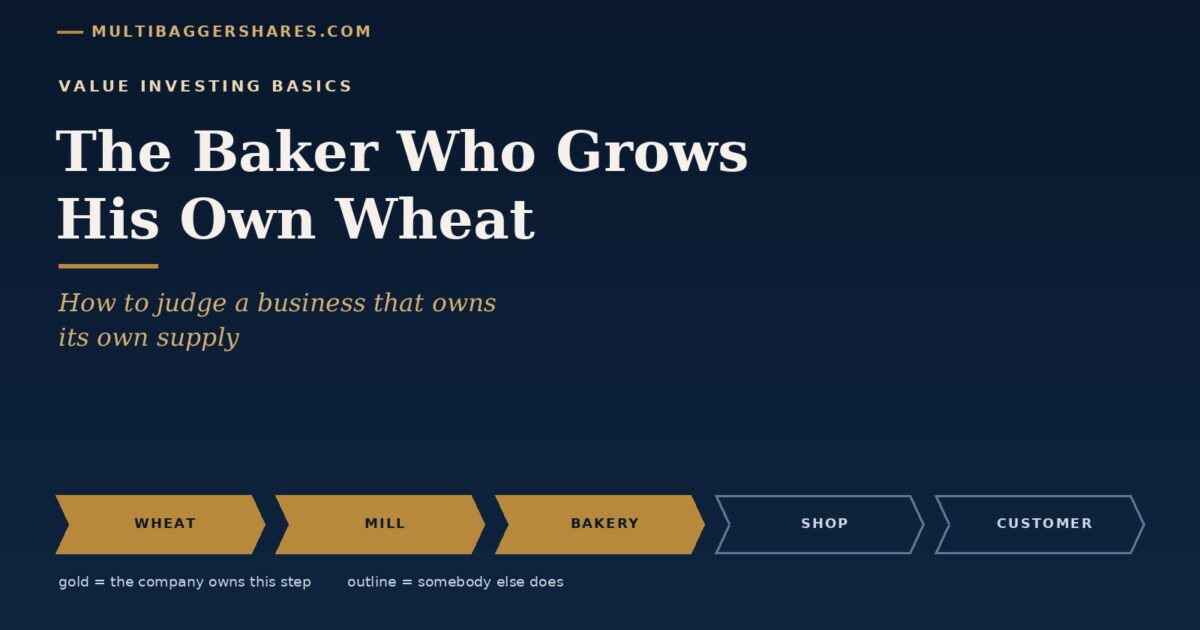
Two bakers on the same street
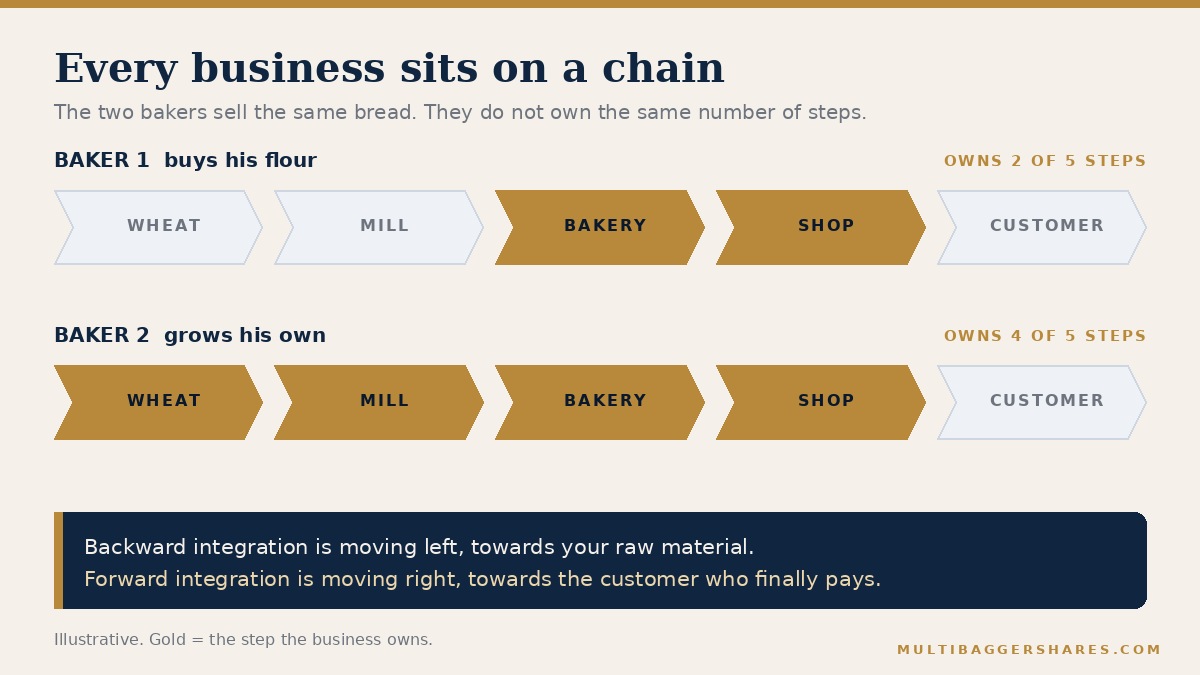
Imagine two bakeries on the same street in your town. Both sell the same bread at the
same price. Both have the same oven, the same shop, the same queue on a Sunday morning.
The first baker buys his flour every week from a trader in the market. Whatever the
trader charges, he pays. When wheat is scarce, the trader raises the price, and the baker either
raises the price of his bread or earns less on every loaf. He usually earns less, because the shop
across the street has not raised its price yet.
The second baker owns a small wheat field and a mill behind his shop. He grows some of his
own wheat, grinds it himself, and bakes with it. When wheat is scarce in the market, his cost
barely moves. He can hold his price steady while the first baker scrambles.
Now, most weeks, you would not be able to tell these two bakeries apart. The bread looks
the same. The queue looks the same. It is only in a bad year for wheat that you discover they were
never the same business at all.
That difference has a name, and once you learn to look for it, you will see it everywhere.
What owning your own supply really means
Every business sits somewhere on a chain. At one end are raw materials (the basic inputs a
company starts with — iron ore, milk, wheat, cotton, crude oil). At the other end is the customer
who finally pays. In between sit a series of steps: mining, refining, manufacturing, packaging,
transporting, wholesaling, retailing.
Most companies occupy only one or two of those steps. They buy from a supplier (the company
that sells them what they need) at one end, add something, and sell to the next link in the chain.
Some companies decide to own more of the chain than that. When a company moves backwards —
towards its own raw materials — it is doing what business writers call backward integration: the
baker buying the wheat field. When it moves forwards — towards the final customer — that is forward
integration: the baker opening his own tea stalls to sell his bread directly instead of supplying
other shops. Own enough of the chain in both directions and the company is described as vertically
integrated.
None of this is exotic. Your neighbourhood halwai who makes his own khoya rather than buying
it in is backward integrated. The farmer who takes his vegetables straight to a Sunday market
instead of selling to a middleman is forward integrated. It is one of the oldest ideas in commerce,
and it is still one of the most revealing.
Why it can work: the three things a company is really buying
When a company spends money to own another step in its chain, it is buying three things at
once, and it helps to keep them separate in your head.
The first is cost certainty. If you own the mine, the price of ore is
whatever it costs you to dig it out. It is not whatever the market decided this morning. Over a
decade, a business whose main input cannot be repriced against it has a quieter, steadier life than
one that must renegotiate every year.
The second is supply certainty. Price is one thing; availability is
another. A factory that cannot get its key input at any price simply stops. Owning the step before
you means nobody else has to say yes before you can produce.
The third is quality control — and this one is underrated. If you make the
component yourself, you decide how good it is. If you buy it, you are trusting a stranger with your
own reputation.
Henry Ford is the textbook case of all three at once. At Ford’s River Rouge complex outside
Detroit, coal, iron ore, limestone, rubber and sand went in at one end and finished motor cars came
out at the other. The ore arrived on Ford’s own freighters from Ford’s own mines in Michigan and
Minnesota; the coal came from Ford’s own mines in Kentucky. A Ford flow chart from 1940, now held in
the collections of The Henry Ford museum, was headed with the claim that a complete car could be
built in twenty-eight hours — from raw ore to a car that could be driven away.
That is what integration looks like when it works. And it is worth pausing on why it worked
there: every one of those steps was a factory process that Ford’s engineers already understood. He
was extending what he was good at, not leaping into something new.
The plantation that swallowed twenty million dollars
Which brings us to the other half of the Ford story, and the reason this essay exists.
In the 1920s, rubber was a problem for American carmakers. Britain and the Netherlands
controlled most of the world’s rubber through plantations in the East Indies, and a British scheme
in 1922 pushed the world price of rubber well above what it cost to produce. Roughly three quarters
of the rubber America imported went into cars. Ford needed tyres, and he did not like being at the
mercy of somebody else’s price.
So he did the thing that had always worked for him. He went backward down the chain. In July
1927 he took a land concession of one million hectares — about 2.5 million acres — along the Tapajós
River in the Brazilian Amazon, and in 1928 began building a rubber plantation and a whole town to go
with it. It was called Fordlandia.
It never worked. The Amazon rains washed the nutrients out of the cleared soil. Leaf fungus
and insects attacked the trees. The plantation was run by men trained in Ford factories rather than
by people who knew how to grow anything. A second site, Belterra, was opened downstream in 1933 with
proper plant scientists and did rather better — but even there, the first commercial tapping of the
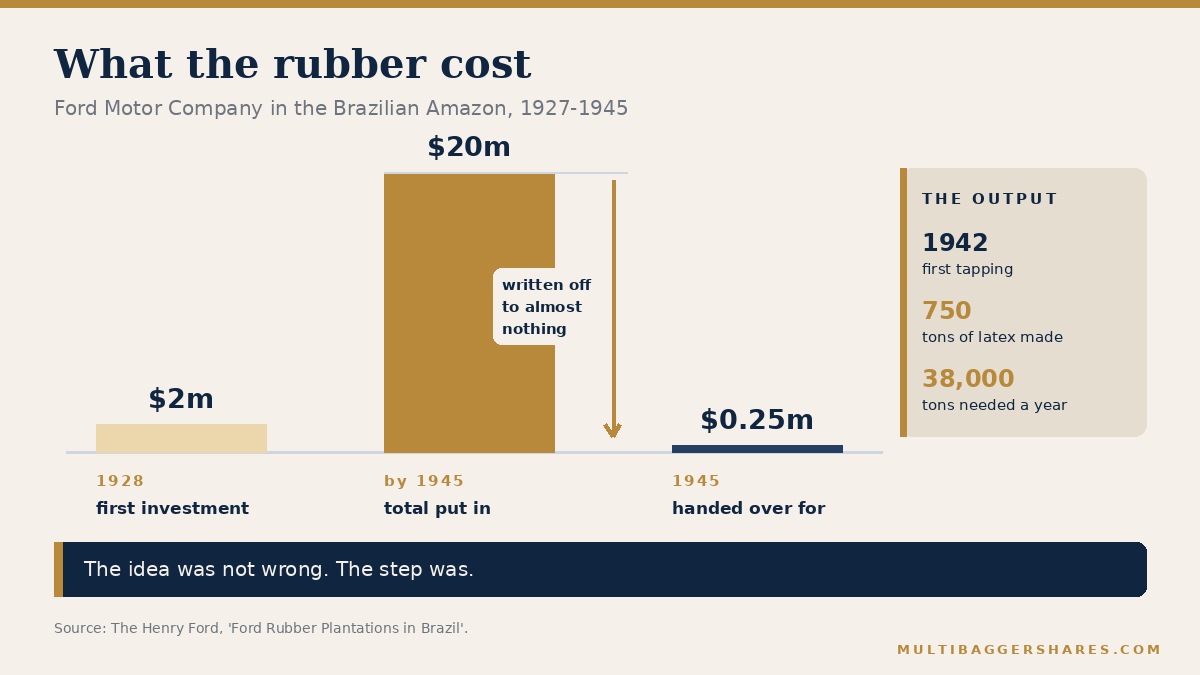
trees in 1942 yielded 750 tons of latex, against the 38,000 tons a year that Ford actually needed.
Ford put about two million dollars into Fordlandia to begin with. By the end, the total
investment across both plantations had reached about twenty million. In 1945 the Ford Motor Company
handed its Brazilian rubber interests to the Brazilian government for roughly two hundred and fifty
thousand dollars.
The most striking thing is that outsiders saw it coming. Writing in the India Rubber
Journal in January 1931 — fourteen years before the end — an observer who had spent time on the
concession put it plainly: “Mr. Ford’s presumed object is to grow his own rubber, but it only
requires a few months’ stay on the concession to realize that, although rubber may eventually be
grown there, the cost, both of bringing the area into bearing and producing the rubber will be so
fantastically enormous, that the whole scheme from a commercial point of view is doomed to failure.”
Same man. Same instinct. Same strategy of owning your own supply. Triumph in Michigan,
disaster in the Amazon. The difference was not the idea — it was whether the company had any
business being in that particular step of the chain.
What a company’s own report will tell you, if you read it slowly
Here is where this becomes practical rather than historical, because Indian companies
disclose this and most readers skate past it.
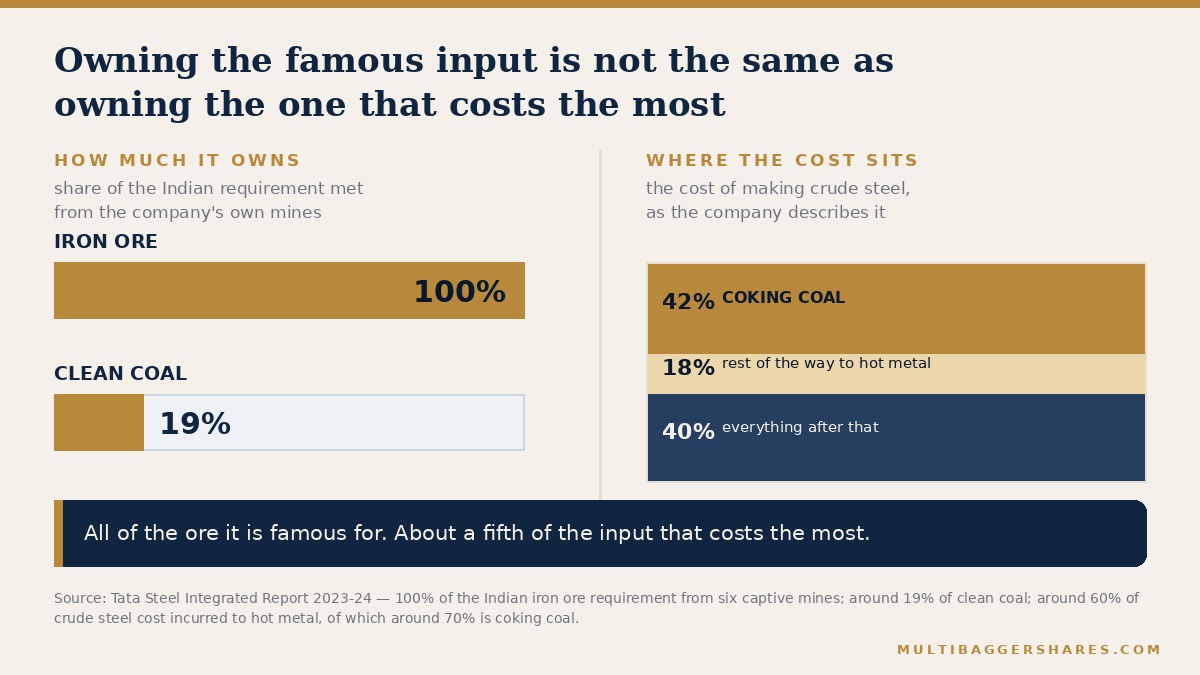
Take Tata Steel. In its integrated report for 2023-24, the company states that 100% of its
iron ore requirement in India is met through its own captive mines — six of them, at Noamundi,
Katamati, Joda East, Khondbond, Vijaya II and Koida. Read that line on its own and you would
conclude the company is insulated from raw material prices.
Now read two more lines from the same report. Around 60% of the cost of making crude steel
is incurred by the time you reach hot metal, and around 70% of that portion is coking coal. So coal
is the single biggest input cost in the whole process. And how much of its Indian clean coal
requirement does the company meet from its own pits? Around 19%.
Look at those two numbers side by side and the picture changes completely. The company owns
all of the input it is famous for owning, and roughly a fifth of the input that costs it the most.
That is not a criticism — captive coking coal of the right grade is genuinely hard to come by in
India, and the company says so. It is simply the truth of the business, disclosed by the business,
in a document anyone can download.
This is the habit worth building. When a company tells you it is integrated, the useful
question is never “is it integrated?” It is: integrated into which step, and is that the step
that actually matters? Owning 100% of a small cost and 19% of a large one is a very different
business from the reverse.
When the chain belongs to the people at the bottom of it
The most remarkable integrated business in India is not a company at all in the ordinary
sense.
Amul is built on what is called the Anand pattern, after the town in Gujarat where it began.
It has three tiers. At the village level, dairy farmers form a cooperative society (an organisation
owned by the people who use it, rather than by outside shareholders) and pour their milk into it
every morning and evening. Those village societies belong to a district union, which tests, chills
and processes the milk into butter, cheese, powder and ice cream. Those district unions in turn
belong to a state federation, the Gujarat Cooperative Milk Marketing Federation, which sells
everything under one brand name across India and abroad.
Follow the chain from the buffalo to the packet of butter in a Delhi refrigerator and it
never leaves the farmers’ hands. Around 36 lakh — 3.6 million — milk producers sit at the bottom of
it, and 18 member unions in the middle. In 2025-26 the federation reported turnover of about ₹73,450
crore, up roughly 11% on the ₹65,911 crore of the previous year, and the Amul brand as a whole was
reported to have crossed ₹1 lakh crore.
The lesson is not that cooperatives are better than companies. It is that when the people who
supply the raw material also own the brand, the usual fight over who captures the margin (the gap
between what something costs to make and what it sells for) does not happen in the usual way. The
chain is not a series of negotiations. It is one organisation.
How you can use this
You do not need a spreadsheet for any of this. You need four questions and the patience to
look up the answers.
One: what is this company’s biggest single input? Not its most famous input
— its biggest by cost. Annual reports usually say, either in the cost breakdown or in the
management’s own commentary.
Two: does the company control that input, or does somebody else? If a
supplier can raise the price at will and the company cannot pass it on, you have found the real risk
in the business, whatever the rest of the report says.
Three: if the company has integrated, was it moving into something it already
understood? Ford’s steel mill was an extension of Ford’s engineering. Ford’s rubber
plantation was farming, in a rainforest, nearly six thousand kilometres away. Integration into an
adjacent skill tends to work. Integration into an unfamiliar one tends to be costly.
Four: what did owning that step cost? Every step you own has to be paid for
and maintained. A company that buys its inputs can walk away from a bad year. A company that owns
the mine, the mill and the fleet is still paying for all of them when demand disappears. Fixed costs
(costs that continue whether or not you produce anything) are the price of control, and in a downturn
that price is charged in full.
Where this thinking can mislead you
Three cautions, because the idea is easy to over-apply.
First, integration is not automatically a sign of quality. Some of the finest businesses in
the world own almost nothing and simply design, brand and outsource. Owning your chain is one route
to a durable business, not the only one, and not always the best one.
Second, integration can hide a weak core. If a company cannot earn a decent return on the
step it is actually in, buying the step next door rarely fixes that. It usually just makes the
problem bigger and harder to reverse.
Third — and this is the one that catches people — integration locks in yesterday’s answer. A
company that has built an entire chain around one way of making something has a powerful reason to
keep making it that way, long after the world has moved on. The mill that guarantees your supply
today is the mill that makes it painful to change tomorrow.
Two bakers, same street, same bread. One is at the mercy of the wheat trader; one has a field
behind the shop. Most weeks it makes no difference at all. But you are not investing for most weeks.
You are investing for the bad year — and that is the year the difference shows up.
Key takeaways
- Every business sits on a chain from raw material to final customer. Ask how
much of that chain the company actually owns. - Owning a step buys three things — cost certainty, supply certainty and
control over quality. Each is worth something; none is free. - Ask which step, not whether. Tata Steel’s own report shows 100% of its
Indian iron ore coming from captive mines but only about 19% of its clean coal — while coal is the
larger cost. - Integration works next door, not far away. Ford’s River Rouge turned ore
into cars; Ford’s Amazon rubber plantation consumed about $20 million and was handed over for about
$250,000. - Control is paid for with fixed costs. The company that owns the chain still
pays for every link when demand falls away.
— Manish Goel · multibaggershares.com
Disclaimer: This article is published by multibaggershares.com for education and general information only. It is not investment advice, investment research, or a recommendation to buy, sell or hold any security. Any companies named are discussed only as illustrative examples. Markets carry risk; please do your own research or consult a qualified professional before making any investment decision.