When a Rival Starts Giving It Away: What a Price War Really Tests

More Packets, or a Bigger Price Tag? How to Read a Company’s Sales Growth
August 27, 2026
The Sweater Shop in July: How to Judge a Business Whose Sales Arrive All at Once
August 30, 2026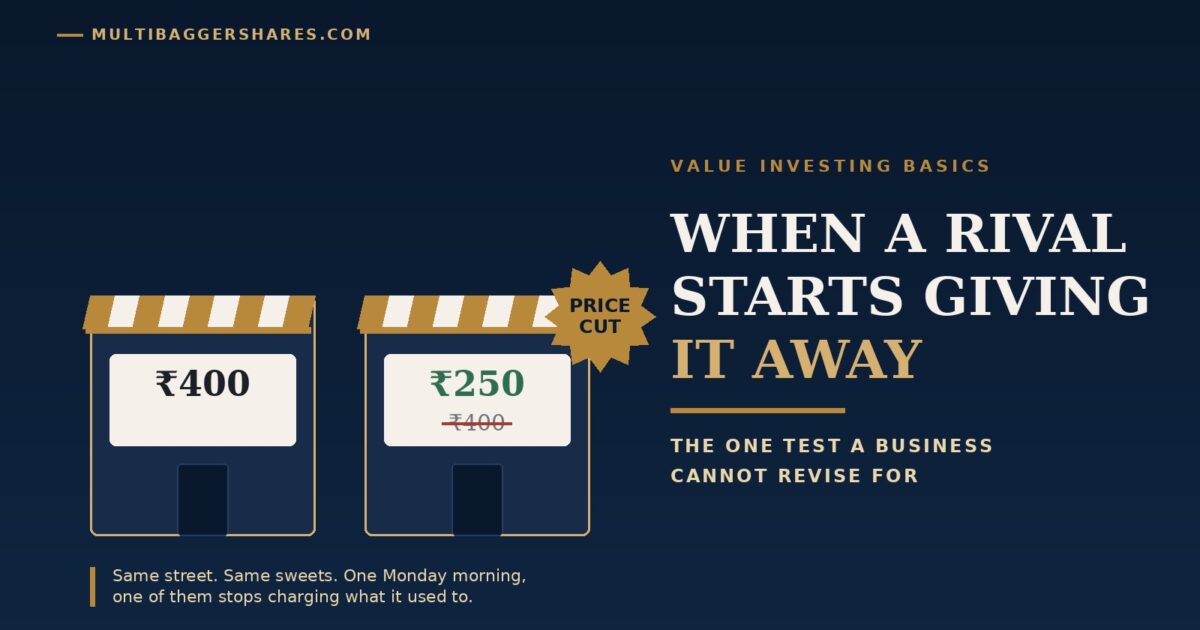
The morning the shop next door dropped its price
Imagine a small town with two sweet shops on the same street. Both have been there for
twenty years. Both sell a kilo of laddoo for four hundred rupees. Both make a modest, steady living.
Neither owner thinks about the other very much.
Then one Monday morning a sign goes up outside the second shop. Laddoo, two hundred and
fifty rupees a kilo. Not for a festival week. Not for a wedding order. Just two hundred and
fifty rupees, from now on.
The first shopkeeper now has a decision to make, and there is no comfortable answer. If he
holds his price at four hundred, he will watch a queue form next door. If he matches at two hundred
and fifty, he keeps his customers but may no longer cover his costs. Whatever he chooses, the next
two or three years of his life have just been decided by somebody else.
This is a price war — a stretch of time in which competitors in the
same trade cut their prices to take customers from one another, and then keep cutting because the
other side has cut too. It happens in sweet shops and it happens in giant listed companies. And for
an investor, it is the single most revealing thing that can happen to a business you are watching.
Most of what a company tells you about itself is a claim. The brand is strong. Customers
are loyal. Costs are under control. The team is disciplined. In a normal year, none of that can be
checked. In a price war, all of it gets checked at once, in public, by a rival who is spending real
money to prove it wrong.
What a price war actually is, and why one starts
A price war is not simply a sale or a discount. A festival discount is planned, temporary
and paid for out of a marketing budget. A price war is none of those things: it is open-ended, it is
forced on you by somebody else, and it is paid for out of your profit (what is left
of the money customers pay you after every cost of running the business has been met).
Wars like this do not start at random. Three conditions do most of the work.
Somebody arrives with a great deal of money and no customers. A new entrant
who has already spent on factories has to fill them. The fastest way to fill a factory is to be
cheaper than everyone else, and a well-funded newcomer can afford to lose money for years while it
does so.
There is more capacity than there is demand. When an industry can make far
more than customers want to buy, every producer has an incentive to cut price to keep its plant
running — because an idle factory still costs money.
Warren Buffett described the mechanism in his 1982 letter to shareholders: “If, however, costs
and prices are determined by full-bore competition, there is more than ample capacity, and the buyer
cares little about whose product or distribution services he uses, industry economics are almost
certain to be unexciting. They may well be disastrous.”
Buyers cannot tell the products apart. If a customer genuinely believes one
brand of cement, paint or mobile connection is much the same as another, price is the only thing left
to compete on. Where buyers do see a difference, a price cut next door is an irritation. Where they
do not, it is an emergency.
Why it is the most honest test a business ever faces
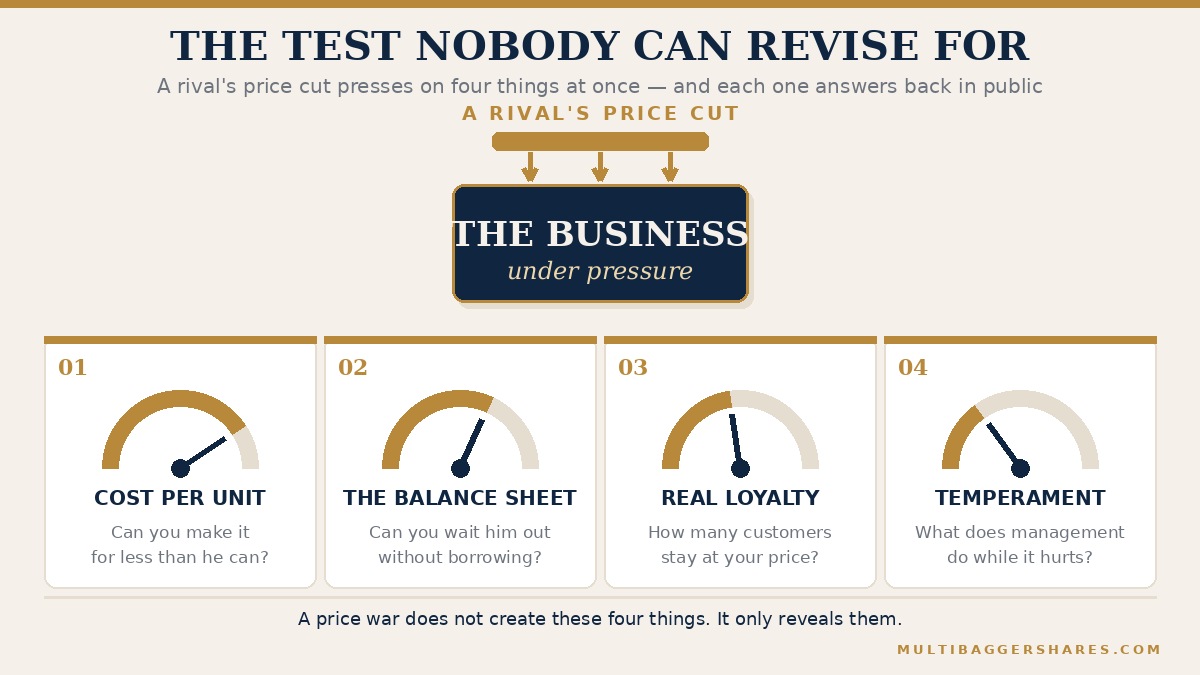
Here is the useful part for a beginner. A price war does not create the strengths and
weaknesses of a business. It only reveals them — and it reveals four things in
particular, all of which you can read about afterwards in the companies’ own announcements.
One: the cost of making the thing. When prices fall for everybody, the
producer with the lowest cost per unit is simply the last one still breathing. This is not clever;
it is arithmetic. If it costs you sixty rupees to make what your rival makes for forty, a market
price of fifty is a bad quarter for him and a slow death for you.
Two: the strength of the balance sheet. A price war is a waiting game, and
waiting costs money. A company with little debt (borrowed money on which interest
must be paid whether or not the business is doing well) can absorb two or three thin years and stay
in the fight. A heavily borrowed company cannot, because its lenders do not pause during a war.
Three: what customers actually think of you. Every company believes it has
loyal buyers. A price war is the only affordable way to find out. When a rival offers the same thing
at two-thirds the price and a large share of your customers stay anyway, you have learned something
about your business that no survey could have told you.
Four: the temperament of management. Watch what the people running the
company do while the pressure is on. Do they cut prices in a panic and then cut them again? Do they
borrow heavily to fight? Do they quietly keep spending on the things that make the business better
in five years’ time? Character shows up under pressure, in companies as in people.
The war that reshaped every phone call in India
India lived through one of the largest price wars in commercial history, and it is close
enough to remember. On 5 September 2016 a new mobile operator, Reliance Jio, began commercial
services in all twenty-two service areas of the country. Its opening offer, in the company’s
own words, made its services “completely free up to 31 December 2016”; that free period
was later extended to 31 March 2017. Domestic voice calls, the announcement said, would be free
“forever”.
The effect on the industry’s economics was immediate and brutal. The telecom regulator,
TRAI, publishes a figure called ARPU — average revenue per user, meaning the
average amount of money an operator collects from one customer in a month. In the quarter ending
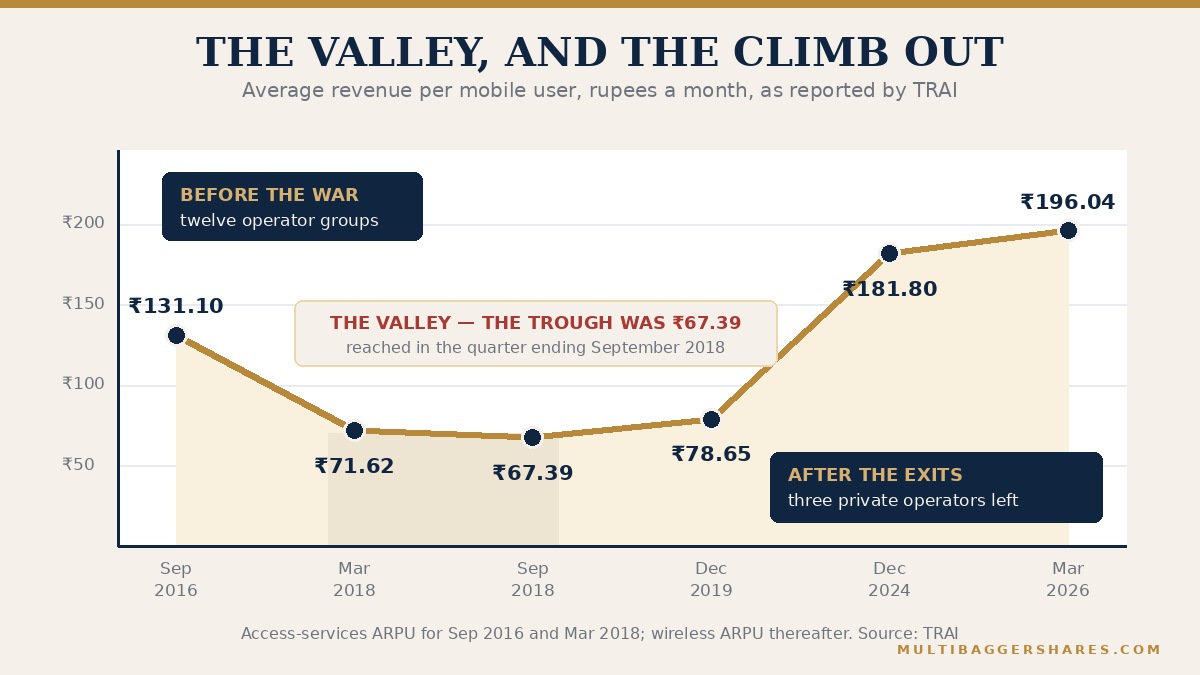
September 2016, ARPU for access services stood at ₹131.10. By the quarter ending March 2018 it
had fallen to ₹71.62. That is a drop of about forty-five per cent in eighteen months, across an
entire industry, in a country where the number of customers was rising the whole time.
It went lower still. TRAI recorded wireless ARPU of ₹67.39 in the quarter ending
September 2018 — a fall the regulator noted, in its press release of 8 January 2019, as
“19.99% on yearly basis”.
Now look at what the war did to the shape of the industry, because this is the part
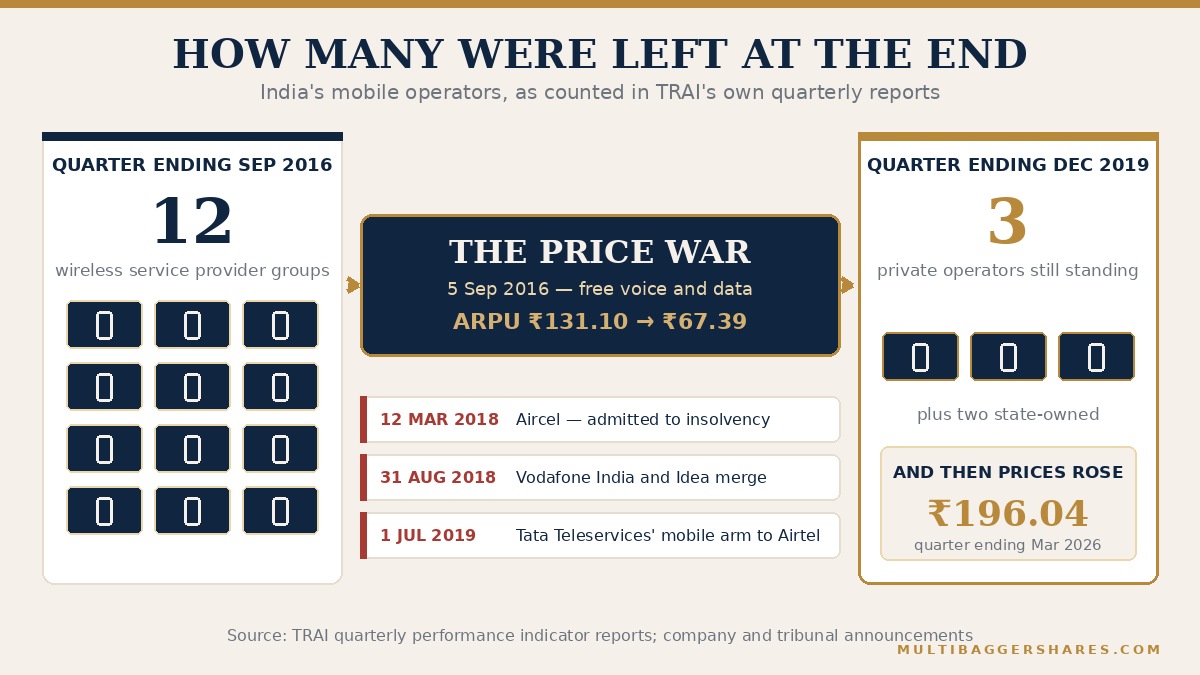
investors most often miss. TRAI’s report for the September 2016 quarter listed twelve wireless
service provider groups operating in India. By its report for the December 2019 quarter, three
private operators and two state-owned ones were all that meaningfully remained. Aircel was admitted
to insolvency proceedings on 12 March 2018. Vodafone India and Idea Cellular completed their merger
on 31 August 2018. Tata Teleservices’ consumer mobile business passed to Bharti Airtel under
schemes that took effect on 1 July 2019.
And then, as wars do, it ended. On 1 December 2019 Jio announced new plans “priced
upto 40% higher”, effective 6 December; a rival’s revised tariffs took effect on
3 December. Industry ARPU turned upward almost at once, from ₹74.38 in the September 2019
quarter to ₹78.65 in the December 2019 quarter. A second round of increases followed in July
2024. By the quarter ending March 2026, TRAI reported blended wireless ARPU of ₹196.04, with
private operators at ₹204.87.
Read that arc slowly, because it contains the whole lesson. Prices collapsed by two-thirds.
Then, over the following seven years, they climbed to roughly three times the low point. The
customers never went away; the industry simply stopped having twelve companies in it. Prices did not
recover because anyone got cleverer. They recovered because there were fewer people left to cut
them.
A second war, still being fought
You do not have to reach back to 2016. A price war has been running in Indian paint for the
last two years, and both sides have published their own numbers throughout, which makes it an unusually
good classroom.
In February 2024, Grasim Industries launched a decorative paint business under the brand
Birla Opus, describing in its own announcement “an unprecedented level of upfront investment of
Rs.10,000 Cr”. Six plants were planned with capacity of 1,332 million litres a year, which the
company called “a quantum leap of 40% addition to the current industry capacity”. Read
that sentence again with the second condition of a price war in mind. Forty per cent more paint could
now be made than before. Demand for paint did not rise forty per cent to meet it.
What happened next is written plainly in the incumbent’s own quarterly announcements.
In its results for the quarter ending March 2024, Asian Paints reported “price cuts across
product categories”; volumes in its domestic decorative business rose about ten per cent while
revenue from it fell 1.8 per cent. A quarter later, in July 2024, the company again pointed
to “price cuts implemented in previous quarter”, with volumes up seven per cent and
revenue down three.
The squeeze continued. For the quarter ending June 2025, the company reported domestic
decorative volume growth of 3.9 per cent alongside “a revenue decline of 1.2%”;
consolidated operating profit for the quarter was ₹1,625 crore, down 4.1 per cent. For the full
year to 31 March 2026, consolidated sales grew 5.1 per cent to ₹35,516 crore. Two years of
almost no growth in money terms, at a company that had been used to a great deal of it.
Then came the quarter ending June 2026, announced on 29 July. Domestic decorative volumes
grew 9.0 per cent and value 16.6 per cent. Consolidated sales rose 17.9 per cent to ₹10,521
crore. Profit attributable to owners rose 40.0 per cent to ₹1,539 crore. The operating margin
widened to 20.6 per cent from 18.2 per cent. Managing director and chief executive Amit Syngle
attributed the profitability to “measured price increases, better mix, formulation and sourcing
efficiencies and disciplined cost management”.
And the challenger? Grasim reported that Birla Opus revenue grew 52 per cent year on year in
the March 2026 quarter and that it had become the third-largest player in organised decorative
paints. It also recorded, in the same announcement, that “strategic pricing actions were
undertaken over Q4FY26 and continued in Q1FY27, narrowing the gap with the industry players”.
In plain English: the newcomer, having established itself, started raising its own prices too.
Notice that this war has so far produced a different ending from the telephone one. Nobody
has disappeared. The incumbent absorbed roughly two flat years and came out the other side; the
challenger built a real business and stopped giving as much away. That is worth remembering, because
a price war is not automatically a catastrophe. It is an examination, and businesses can pass it.
What the survivors have in common
Across both stories, and across the older ones Buffett wrote about, the same trait keeps
deciding who is still standing. It is not the cleverest marketing or the loudest advertising. It is
the boring one: making the product for less than the other fellow, or making something the other
fellow cannot easily copy.
In his 1987 letter to shareholders, writing about a business where products are hard to tell
apart, Buffett put it in a single sentence: “In such a commodity-like business, only a very
low-cost operator or someone operating in a protected, and usually small, niche can sustain high
profitability levels.” Four years later, in his 1991 letter, he added the caution that makes
this practical: “Tightness in supply usually does not last long.” Good years, in other
words, invite company.
This is why a price war is such useful reading. It is a live experiment in an industry you
follow, run at somebody else’s expense, with the results filed publicly every three months. The
company that keeps making cash through the worst of it — without borrowing heavily and without
starving the business — has told you more about itself in two hard years than in ten easy
ones.
Four things a price war cannot tell you
It is just as important to know where this test stops. It has real limits, and pretending
otherwise is how a good idea turns into a bad habit.
It cannot tell you when the war ends. The Indian telephone war ran for more
than three years before prices turned. Nobody could have circled the month in advance, and anyone who
tried was guessing.
It cannot tell you who started it, or why. Sometimes a challenger is buying
a market. Sometimes an incumbent cuts first to make life impossible for a newcomer. The announcements
rarely say, and the difference matters.
It cannot tell you what happens to the customer’s habits afterwards.
Some price cuts train buyers to wait for the next one. Michael Porter made the point in the
Harvard Business Review in January 2008: “Sustained price competition also trains
customers to pay less attention to product features and service.” A brand can win the war and
still be worth a little less than before.
And it cannot tell you anything at all about whether the shares of a company are
worth owning at today’s price. That is a separate question, with separate tools, and
this letter does not go anywhere near it. What a price war tells you is about the business
— how it is built, what it costs to run, and who is running it.
Five questions to ask when prices start falling
One. Who added capacity, and how much? A great deal of new supply arriving
in a market that is not growing as fast is the single most reliable warning that prices are about to
be tested.
Two. Did the company cut its price, or hold it? Both answers are
informative. Holding, and keeping most of the customers, says one thing. Holding, and losing them,
says another entirely.
Three. Did it keep making cash through the worst quarter? Not accounting
profit alone — cash. A business that funds itself through a bad stretch does not need anyone’s
permission to survive it.
Four. Did borrowings rise while the fight was on? Debt taken on during a
price war is the most expensive kind, because it is borrowed at exactly the moment the business is
least able to service it.
Five. When it was over, how many competitors were left? This is the
question almost nobody asks, and it is the one that pays. An industry that emerges from a war with
half as many players in it is a different industry from the one that went in.
Go back to the two sweet shops. Three years after the sign went up, one of them is shut and
the other sells laddoo at four hundred and fifty rupees a kilo. Nothing about the recipe changed.
There is simply one shop on that street now instead of two. If you had been watching, you would have
known which one it would be — not from the sign in the window, but from the far duller question
of what a kilo of laddoo cost each of them to make.
Key takeaways
- A price war is not a discount: it is open-ended, forced on a company by a rival, and paid for out of profit.
- Wars start where a well-funded newcomer arrives, where capacity exceeds demand, or where buyers cannot tell the products apart — often all three at once.
- The episode reveals four things nothing else can: cost per unit, balance-sheet strength, real customer loyalty, and how management behaves under pressure.
- Prices usually recover only after competitors leave — so count the players left standing, not just the prices.
- A price war says a great deal about the quality of a business and nothing at all about what its shares are worth today.
— Manish Goel · multibaggershares.com
Disclaimer: This article is published by multibaggershares.com for education and general information only. It is not investment advice, investment research, or a recommendation to buy, sell or hold any security. Any companies named are discussed only as illustrative examples. Markets carry risk; please do your own research or consult a qualified professional before making any investment decision.