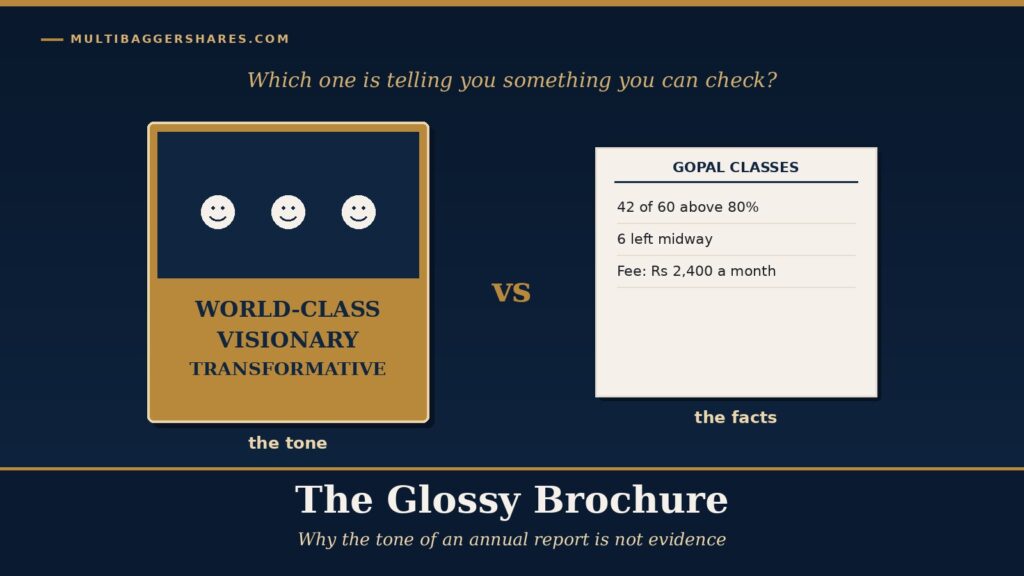
The Sweater Shop in July: How to Judge a Business Whose Sales Arrive All at Once

When a Rival Starts Giving It Away: What a Price War Really Tests
August 29, 2026
The Baker Who Grows His Own Wheat: How to Judge a Business That Owns Its Own Supply
August 31, 2026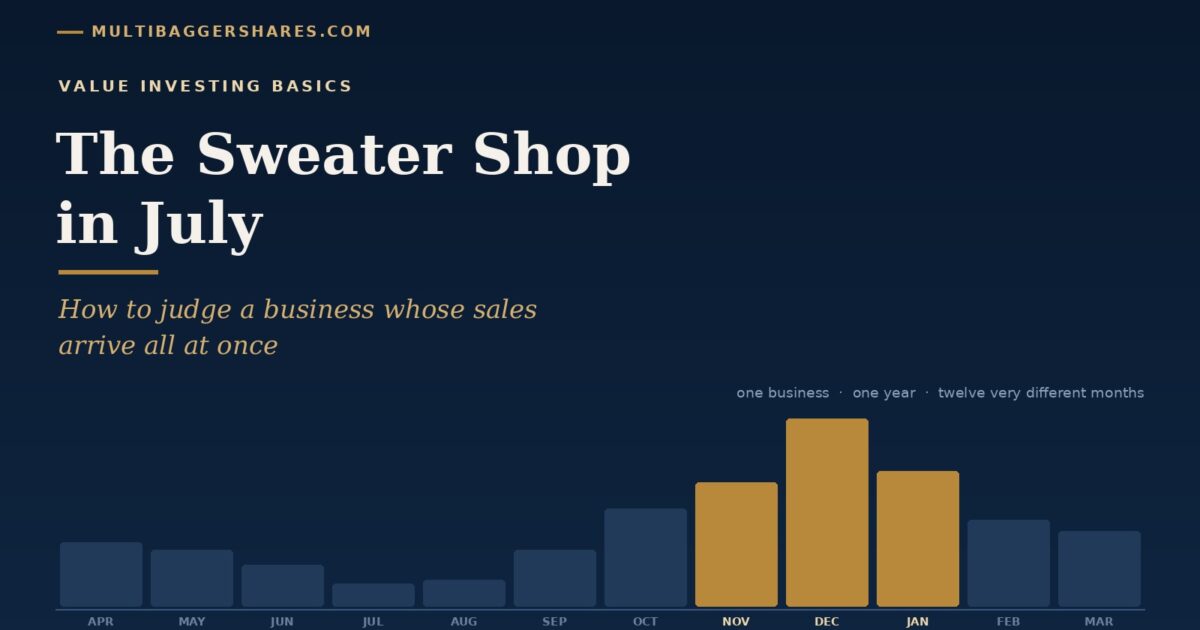
There is a sweater shop on a market street in Ludhiana. Walk past it in the second week of July and you will wonder how it survives. The shutter is half down. The shelves are covered in cloth. The owner is on a plastic chair by the door with a newspaper and a cup of tea, and in an hour nobody comes in.
Walk past the same shop in the second week of December and you cannot get through the door. There are three people behind the counter instead of one. Cartons are stacked in the aisle because the storeroom is full. The owner has no time to look up.
Which of those two visits showed you the real business? Neither did. The shop in July is not a failing business and the shop in December is not a roaring one. They are the same business, photographed at two different points in a year that was never going to be evenly spread. The only honest unit of measurement for that shop is a full year — and, better still, several of them.
This is one of the most common ways an ordinary investor gets frightened out of a decent company, or excited into a poor one. A results announcement lands, the revenue number is far below the previous quarter (a quarter is a block of three months of a company’s financial year — Indian companies report four of them: April to June, July to September, October to December, and January to March), and the reaction is instant. Something must be wrong. Very often nothing is wrong at all. The calendar moved, not the company.
What seasonality really means
Seasonality (a repeating pattern in which a business’s sales arrive unevenly across the year, in roughly the same shape every year) is not a flaw. It is a fact about what the business sells and to whom.
Something outside the company sets the rhythm. Weather sets it for air conditioners, woollens, cold drinks and umbrellas. The monsoon and the harvest set it for tractors, seeds and fertiliser. Festivals and weddings set it for jewellery, sweets, clothes and consumer durables. School terms set it for uniforms, textbooks and stationery. Tax deadlines set it for insurance policies and tax-saving funds. None of those calendars is under the company’s control, which is exactly why the pattern repeats so faithfully.
It is worth noticing how plainly well-run companies write this down. Berkshire Hathaway is a group with a long reputation for careful, unglamorous disclosure, and its annual filing with the American market regulator simply states the seasons of its businesses. Of its American utilities it says that “regulated electric revenues are higher in the summer months, while regulated natural gas revenues are higher in the winter months.” Of one of its gas pipelines it says the system “experiences significant seasonal swings in demand and revenue, with the highest demand typically occurring during the months of November through March.” Of its crane hire business it says volume is concentrated “in the warmer months.”
There is no apology in any of that, and no attempt to bury it. That is the first thing to look for. A management that tells you which months carry the year is telling you something true and slightly unflattering before you have to find it out yourself.
Why one quarter can lie to you
The clearest way to feel this is with real numbers from a single company, over a single year, selling the same things throughout.
Voltas is India’s largest seller of room air conditioners. Its cooling division — the company calls it Unitary Cooling Products — reported revenue of about ₹2,868 crore in the quarter ending June 2025, then about ₹1,215 crore in the September quarter, about ₹1,924 crore in the December quarter, and about ₹3,493 crore in the March 2026 quarter. Those four add up to roughly ₹9,500 crore for the year.
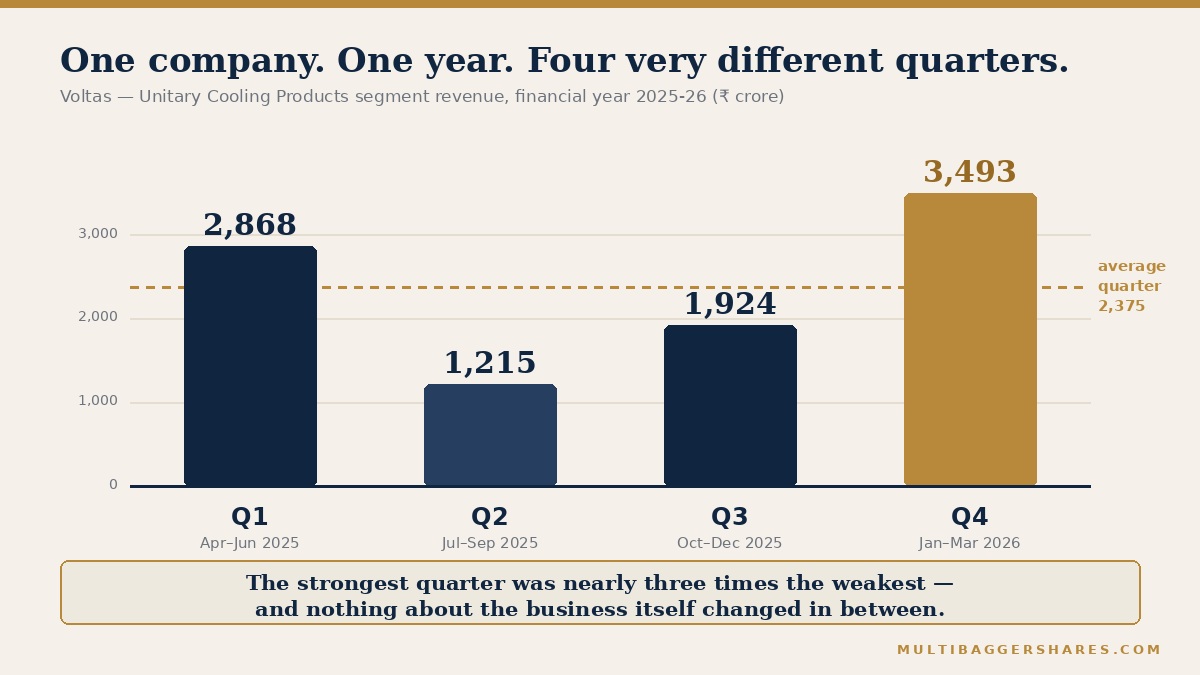
Read that line again slowly. The strongest quarter was nearly three times the weakest one. Nothing about the company changed in between. The same factories made the same air conditioners and the same dealers sold them. What changed was that India stopped needing air conditioners for a while.
Look only at the September quarter and you would conclude that a market-leading business had lost more than half its sales. Look only at the March quarter and you would conclude it was expanding at a furious pace. Both readings are nonsense, and both are available to anyone glancing at a single number.
Three habits protect you. First, compare a quarter with the same quarter of the previous year, never with the quarter immediately before it. Second, when you want to know whether a business is actually growing, use the full year. Third, never annualise a peak quarter — that is, never multiply the best three months by four and treat the answer as the size of the business. For a seasonal company that arithmetic is not optimistic; it is simply wrong.
There is a second twist, and it is the one that catches people who have already learned the first lesson. Even comparing like quarters is not perfectly clean, because the season itself varies. Voltas described its June 2025 quarter, in its own results announcement, as one “shaped by the delayed onset of summer, relatively mild temperatures, and the early arrival of the monsoon, all of which shortened the peak selling season.” Revenue in that quarter had been about ₹3,802 crore a year earlier and came in at ₹2,868 crore. A year later, in the June 2026 quarter, the same division reported about ₹3,794 crore, roughly a third higher than the weak year before.
A cool summer is not evidence of a bad company. A brutal one is not evidence of a good one. Somewhere around the third or fourth year of numbers, the weather starts cancelling itself out and the business underneath becomes visible. That is the length of runway a seasonal business needs before it can be judged at all.
When the calendar sets the pace
Air conditioning is an obvious case because everybody can feel the reason. A less obvious one is the tractor, where the rhythm is set by rain and by ritual.
Mahindra & Mahindra sells more tractors in India than anyone else, and it publishes its domestic volumes every month. In September 2025 it sold 64,946 tractors in India. In October 2025 it sold 72,071. In November the figure was 42,273, and in December it was 30,210. October was well over twice December.
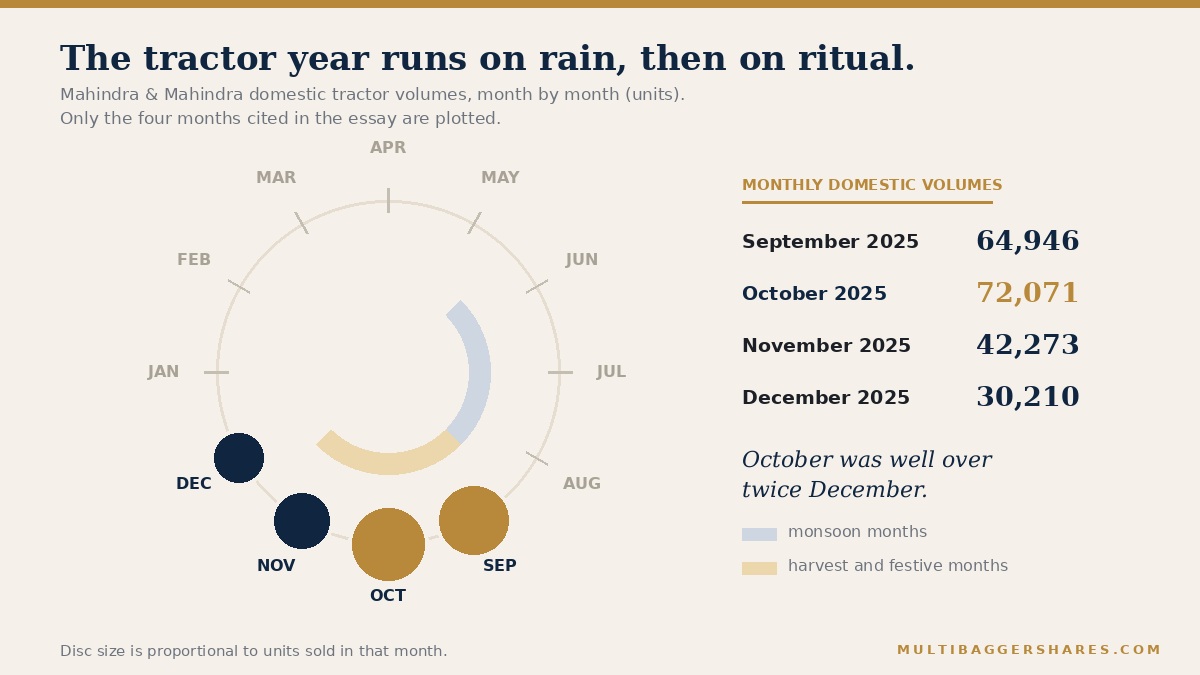
The reason is a sequence of events that has nothing to do with tractor design. The monsoon fills the reservoirs, the kharif crop is harvested, cash reaches the village, and the festive weeks arrive at precisely that moment. The company’s own announcement in November 2025 put it plainly: “A good monsoon, combined with the benefit of GST rate cut announced in September, have supported the strong performance in September & October 2025,” and it reported that for “the festive period of September & October 2025 put together, the growth is 27.4% over the same period last year.”
Notice the honest complication in that sentence. Two things moved at once — a good monsoon and a tax change. When a season and a one-off event land in the same weeks, resist the urge to credit the whole jump to either of them. The correct response is not a cleverer calculation. It is to wait for the next year, when the tax change is in both the current figure and the comparison figure, and only the season is left.
Jewellery runs on the same principle with a different calendar. Titan Company, which owns Tanishq, described its October to December 2025 quarter to the exchanges in the words of its chief financial officer as one where, “buoyed by a vibrant festive demand, the jewellery portfolio clocked a robust c.41% YoY growth.” Festivals and weddings are the engine, and everybody in the business knows it, which is why nobody in the business is surprised when the following spring looks different.
What a seasonal business has to carry
Here is where seasonality stops being a curiosity about charts and starts telling you something about the quality of a business.
If your sales arrive in a rush, you must have the goods ready before the rush. That means money leaves the company months before it comes back. The factory runs in winter to fill warehouses for summer. Dealers are loaded with stock before the first hot week. Wages, raw materials and freight are all paid up front, and the cash returns only when shoppers finally arrive.
The credit rating agency CARE Ratings described this precisely when it reviewed Blue Star, another large Indian cooling company. Its operations, the agency wrote, “are inherently working capital intensive, primarily due to the seasonal nature of the RAC business, where demand peaks in Q1 and Q4, prompting inventory buildup from December onwards.” Working capital, in plain words, is the money tied up in stock on shelves and in bills customers have not yet paid — money the company owns but cannot spend.
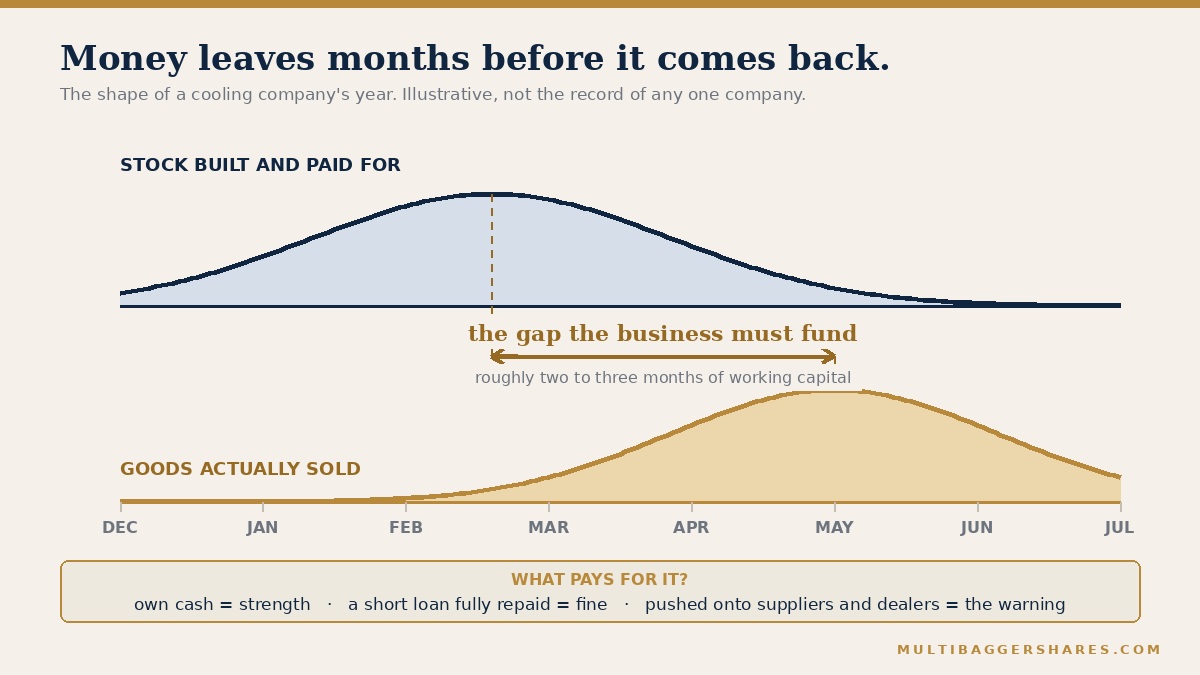
So ask the question that actually separates a strong seasonal business from a fragile one: what pays for the hump?
There are only three answers. The company funds it from its own cash, which is the sign of real strength. Or it borrows briefly and repays after the season, which is perfectly sound if the repayment genuinely happens. Or it pushes the burden onto other people — paying suppliers later and later, or forcing stock onto dealers who cannot sell it — which is the arrangement that eventually breaks.
Warren Buffett, writing about See’s Candies in his 2007 letter to Berkshire shareholders, mentioned in a single bracket that at the time of the 1972 acquisition “modest seasonal debt was also needed for a few months each year.” Two words in that sentence do the work. Modest, and months. A borrowing that swells before a season and is gone after it is a tool. A borrowing that is described as seasonal but never fully returns to zero is not seasonal at all; it is permanent debt wearing a seasonal label, and you can spot it by comparing the borrowings figure at the peak of the year with the same figure at the trough, over several years.
One more cost is easy to miss. A plant that runs flat out for four months and at half speed for eight still pays for its machines, its building and much of its staff for all twelve. Some seasonal companies solve this by making something else in the quiet months, or by selling into a country whose seasons are the opposite of ours. Others simply absorb the idle time.
A season is not a cycle
These two words get used as though they mean the same thing, and confusing them is costly.
A season repeats every year and is set by the calendar. Woollens sell in winter this year, sold in winter last year, and will sell in winter next year. A cycle runs over several years and is set by supply: when prices are good, everybody builds new capacity; the new capacity arrives together; there is suddenly too much of the product; prices fall; nobody builds for a while; eventually there is too little again.
A rough test settles it. If you can name the months, you are looking at a season. If you can only name the years, you are looking at a cycle. Cement demand is seasonal — construction slows in the monsoon — and cement supply is also cyclical, which is why the same industry can confuse people on two timescales at once.
The practical difference is patience. A poor season is corrected by the following year. A poor point in a cycle may not correct for four or five years, because factories that have already been built do not disappear just because they are unwanted.
How you can use this
None of this requires a spreadsheet model. It requires five questions, and the answers to all five are in documents the company publishes for free.
One: which months make the money? Pull three years of quarterly results and lay the revenue out in order. The shape will announce itself within a minute, and if the same two quarters lead in all three years, you have found the pattern.
Two: does the company say so itself? Search the annual report and the results releases for the words season, seasonal and seasonality. A company that names its own weak quarter in advance is behaving well. A company whose commentary is triumphant in the strong quarter and silent in the weak one is managing your impressions rather than informing you.
Three: what funds the build-up? Compare short-term borrowings and inventory at the peak of the season with the same figures at the trough. If both swell and then subside, the business is breathing normally. If borrowings climb every year and never come back down, the season is not the explanation.
Four: what happens in the off-season? Some seasonal businesses genuinely lose money for a quarter every year, and that is a fact about the calendar rather than a crisis. What you want to know is whether this year’s off-season loss is roughly the same shape as last year’s.
Five: over a full year, is it growing? Only the twelve-month figure can answer this for a seasonal company, and it should be read across several years rather than one.
Where this thinking can mislead you
Seasonality explains the shape of a year. It does not certify the quality of a business, and it is easy to let a good explanation do the work of a good investigation. A business can be perfectly seasonal and perfectly mediocre, and “it is just the season” is a comfortable sentence to hide behind.
Patterns also break. Air conditioning in India is slowly becoming a household staple rather than a summer purchase, which flattens the curve over time. Festival dates move between quarters from year to year, which can shift sales across a reporting boundary without anything real having changed. And a genuine one-off — a tax change, an election, a lockdown — can land inside one season and make the year-on-year comparison misleading in both directions.
Quarterly figures in India are also lighter than annual ones. They are not fully audited in the way the yearly accounts are, which is a further reason to let the annual number carry the weight of your conclusion.
Finally, remember that a season can be manufactured. Goods pushed onto dealers just before a quarter closes will appear as sales even if no shopper has bought anything. When a strong quarter is followed by a strangely weak one, and inventory in the system is rising, that is worth a closer look than the weather deserves.
The sweater shop is closed in July because it is July. That is the whole of the explanation, and it is also the whole of the discipline. Buffett, writing about a different matter in that same 2007 letter, described the trade-off in a way that fits a seasonal business exactly: he and his partner were, he said, “always ready to trade increased volatility in reported earnings in the short run for greater gains in net worth in the long run.” A business whose year arrives in a rush will always look uneven up close. The question is never whether the line is bumpy. It is whether, stretched across enough years, it slopes upward.
Key takeaways
- Seasonality means sales arrive unevenly across the year in a pattern that repeats — set by weather, harvest, festivals or deadlines, not by the company.
- Compare a quarter with the same quarter last year, never with the quarter before it, and never multiply a peak quarter by four.
- Even like-for-like quarters wobble, because seasons themselves vary; three or four years of figures are the minimum before a seasonal business can be judged.
- The real test is what funds the build-up of stock before the rush: own cash is strength, a briefly drawn and fully repaid loan is fine, and a borrowing that never returns to zero is not seasonal at all.
- A season is set by the calendar and corrects within a year; a cycle is set by supply and may take several. If you can name the months it is a season; if only the years, it is a cycle.
— Manish Goel · multibaggershares.com
Disclaimer: This article is published by multibaggershares.com for education and general information only. It is not investment advice, investment research, or a recommendation to buy, sell or hold any security. Any companies named are discussed only as illustrative examples. Markets carry risk; please do your own research or consult a qualified professional before making any investment decision.