The Shop That Sells Only One Thing: How to Judge a Business That Lives Off a Single Product

The Baker Who Grows His Own Wheat: How to Judge a Business That Owns Its Own Supply
August 31, 2026
Who Chooses, Who Uses, Who Pays: The Three People Hiding Inside Every Sale
September 2, 2026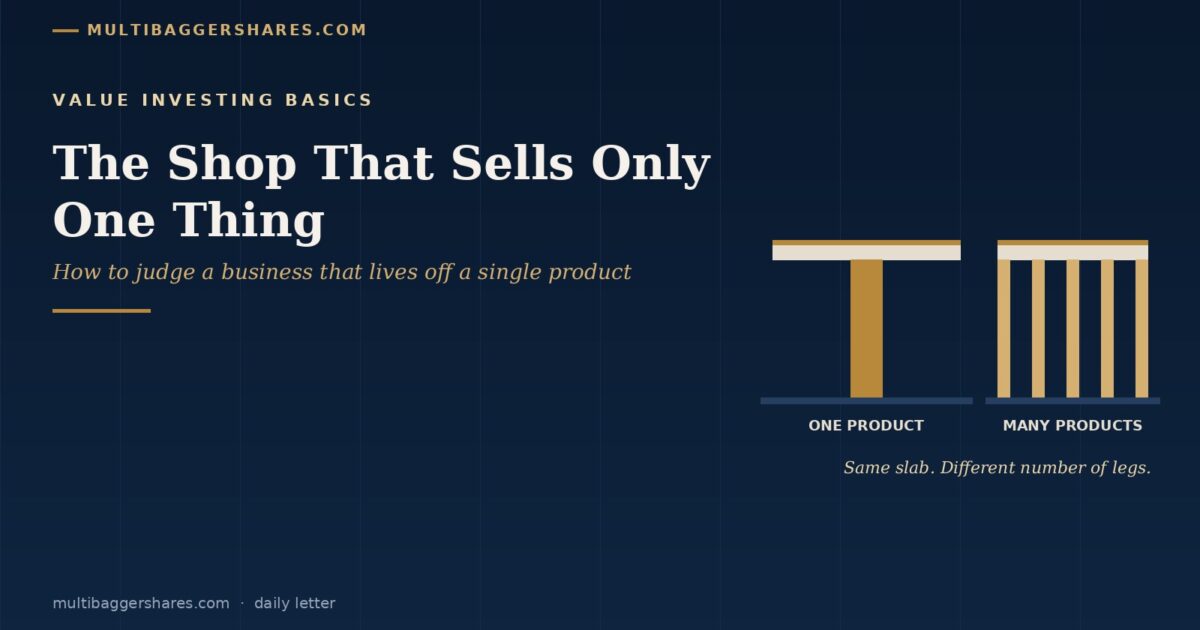
Two shops in the same lane
Picture a small market lane in any Indian town. There are two shops facing each other. The first
one sells forty different things — buckets, bulbs, brooms, plastic chairs, mugs, mosquito nets. The
second one sells only pressure cookers. That is all it has ever sold.
Ask most people which shop is safer, and they will point to the first one. Forty products feels
safer than one. If buckets stop selling, there are still bulbs. That instinct is not silly. It is the same
instinct that tells you not to keep all your money in one place.
But walk into the second shop and something interesting happens. The owner knows more about
pressure cookers than anyone within fifty kilometres. He knows which gasket lasts, which handle cracks,
which model suits a small kitchen. Because he buys in volume from one maker, he gets a better price than
the first shop ever will. Every family in three villages that wants a cooker comes to him first. He has no
range at all, and yet he is the strongest shop on the lane.
So one product is sometimes a weakness and sometimes a strength. The useful skill is not deciding
that concentration is good or bad. It is learning to tell, in a particular business, which of the two it
is. That is what this letter is about.
What a one-product business actually is
When we say a company “lives off one product”, we mean something you can measure. Take
the company’s revenue (revenue is simply the total money it collects from selling things in a year,
before any costs are taken out). Now break that revenue up by what was sold. If one product, or one narrow
family of products, brings in most of that money, the company is concentrated.
Indian annual reports make this easier than people expect. Somewhere in the report there is a
table that splits sales by product or by segment (a segment is just a chunk of the business the company
reports separately, like “paints” and “home improvement”, or “milk
products” and “prepared dishes”). The management commentary usually repeats the same
split in words. You do not need any calculation more complicated than dividing one number by another.
Two quick clarifications before we go further, because these get mixed up. Depending on one
product is not the same as depending on one customer. A company can sell forty products
to a single buyer, or one product to ten million buyers. Those are different questions with different
answers. This letter is only about the first one — what the company sells, not who buys it.
And concentration is a fact, not a verdict. A company earning ninety per cent of its money from
one product is not thereby a bad business, and one earning ten per cent each from ten products is not
thereby a good one. The number tells you where to look next. It does not tell you what you will find.
Why one product can be a strength
The first thing concentration buys is depth. A company doing one thing spends all its money, all
its factory time and all its management attention on that one thing. It gets better at it faster than a
company splitting its effort nine ways. Peter Lynch had a word for the opposite habit — good
companies wandering into businesses they did not understand — and he did not mean it kindly.
The second thing it buys, when it works, is habit. Some products get woven into ordinary life so
tightly that changing them feels like effort. Warren Buffett has spent decades looking for exactly this
kind of business. His favourite example was chewing gum. In a 1999 interview with Businessweek he
put it plainly: “Our approach is very much profiting from lack of change rather than from change.
With Wrigley chewing gum, it’s the lack of change that appeals to me.” A single product,
unchanged for generations, was the attraction, not the problem.
You can see the same thing on a much bigger scale. The first glass of Coca-Cola was sold on 8 May
1886, at a pharmacy in Atlanta, for five cents. Nearly a hundred and forty years later, in 2024, the
Coca-Cola system sold 33.7 billion unit cases worldwide, and fizzy drinks were still 69 per cent of that
volume. The company has bought and built plenty of other things. It still earns most of its living from
the drink it started with.
Notice what these two examples have in common. The product is cheap, bought often, and bought out
of habit rather than after research. Nobody compares gum brands on a spreadsheet. Nobody switches soft
drinks because of a software update. The habit is old, it is spread across millions of people, and no
single event can switch it off. That is the shape of safe concentration.
There is a third, quieter advantage, and it is the one our pressure-cooker shopkeeper was
enjoying. Doing one thing at very large volume changes the terms on which a company deals with everybody
else. It buys its raw material cheaper because it buys more of it. Its factory runs the same line all year
instead of stopping to change over. Its salesman explains one thing to the shopkeeper instead of nine. Each
of those is small. Added up over a decade they are the difference between a business that earns a decent
return on the money put into it and one that just about covers its costs.
Why one product can also be a trapdoor
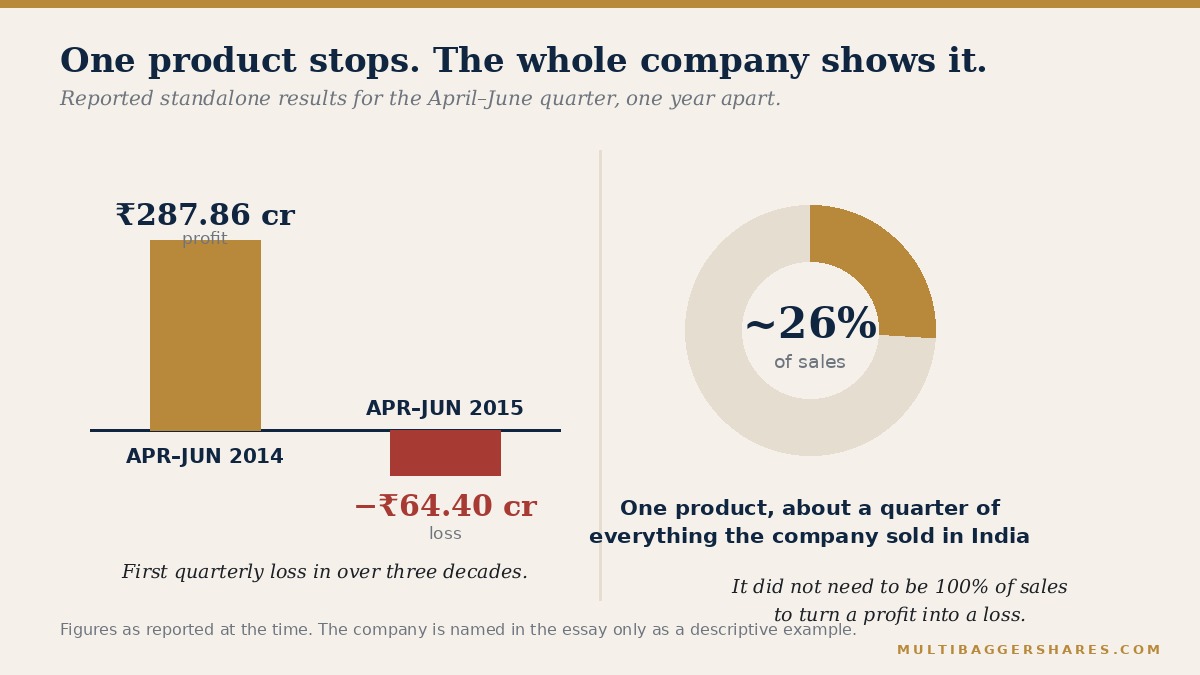
Now the other side, and India has one of the clearest examples in the world. In 2015, instant
noodles sold under a single brand were somewhere around a quarter of Nestlé India’s total
sales, and the brand held more than three-quarters of the instant-noodles market. It was, by any measure, a
strong position built on exactly the kind of everyday habit described above.
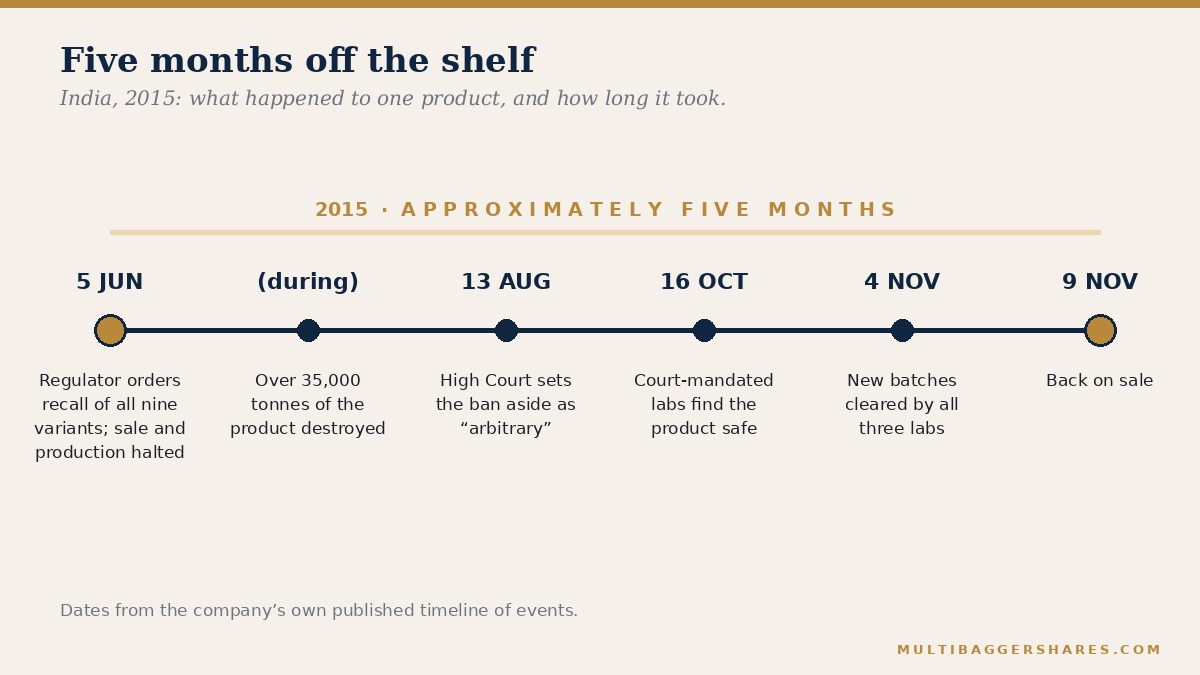
Then it stopped. On 5 June 2015, following a dispute over lead levels and a labelling claim, the
national food regulator ordered a recall of all nine variants and a halt to their sale and production. The
company’s own published timeline records what followed: while the case was argued, it destroyed over
35,000 tonnes of the product. On 13 August 2015 the Bombay High Court overturned the ban, calling it
“arbitrary” and finding that “principles of natural justice were not followed”.
Fresh tests at three court-mandated laboratories cleared the noodles in October and again in early
November. The product went back on sale on 9 November 2015 — roughly five months after it
vanished.
Look at what those five months did to the accounts. For the quarter ended 30 June 2015, the
company reported a standalone loss of ₹64.40 crore. In the same quarter a year earlier it had
reported a profit of ₹287.86 crore. It was reported at the time as the company’s first
quarterly loss in over three decades.
This is the lesson, and it is worth sitting with. The factories were fine. The staff were fine.
The brand was so loved that people posted about missing it. The management had not stolen anything or
mismanaged anything. One product simply could not be sold for a few months, and a company that had made
money every quarter for thirty years made a loss. When a business stands on one leg, everything depends on
that leg, including the parts of the business that have nothing to do with it.
A regulator is the dramatic version of this risk because it acts in a day. There is a slower
version that is easier to miss. A rival arrives with a product that is a little better or a little cheaper,
and takes two per cent of the market a year. For a company with nine products, losing ground in one of them
is an irritation the other eight absorb. For a company with one product, that same two per cent a year is
the whole business quietly draining away, and it can go on for years before it shows up anywhere dramatic
enough to make the newspapers. Habit protects against this, which is why question one below asks how old
the habit is. A habit that has survived thirty years has already seen off several rivals. A habit two years
old has not been tested at all.
The end of the story matters too. The habit survived. The brand came back and, by 2018, was
reported to hold about 60 per cent of the instant-noodles market again. Deep habits are hard to kill. But
“it recovered” is a comfortable thing to say in hindsight; the investor sitting through those
five months did not know it would.
Four questions to ask before you call it safe
Put the two halves together and you get a short test. None of it needs a model. All of it can be
done with the annual report and a little reading about the industry.
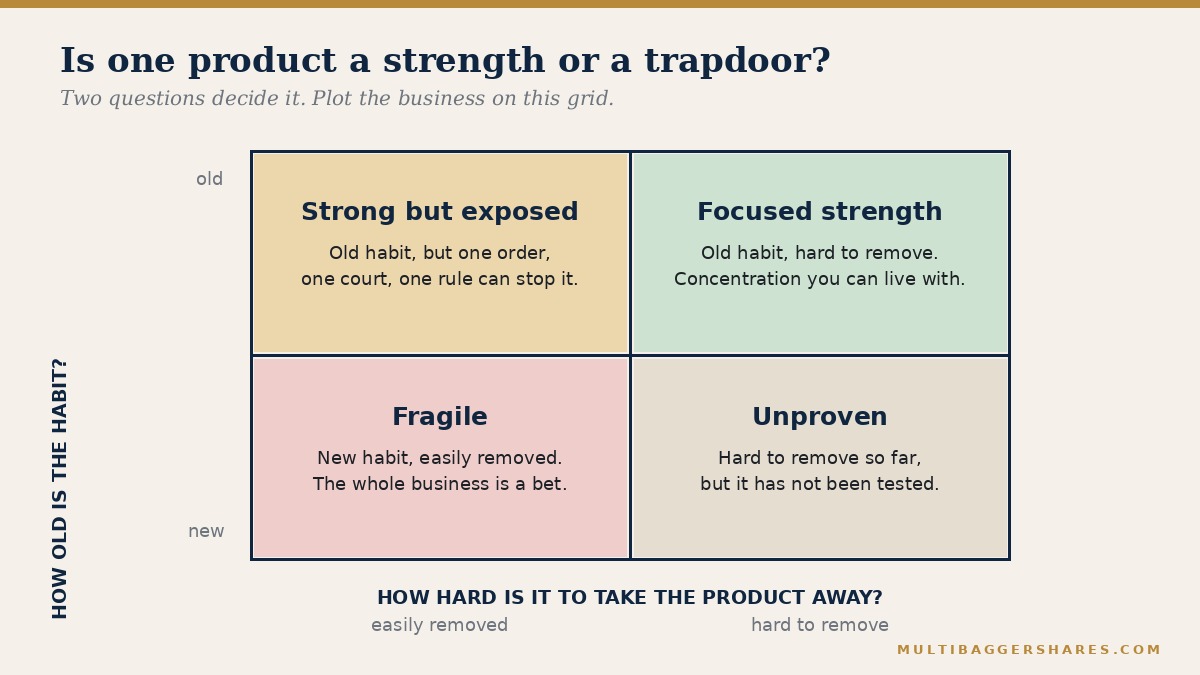
One. How old is the habit? A product people have bought the same way for thirty
years is standing on something. A product that became popular eighteen months ago is standing on a
fashion. Ask when the category was born, not when the company entered it. Chewing gum and cold drinks are
old habits. A particular flavour of protein powder is not.
Two. Who can take it away, and how quickly? List the people who could stop this
product tomorrow. A regulator can, with one order. A court can. A rival with a better version can, though
usually slowly. A new technology can, usually slowly at first and then all at once. A single large customer
can. The more of these that apply, and the faster each could act, the more fragile the concentration. A
regulator is the most dangerous of them because a regulator does not need years.
Three. Does the company own the name and the shelf? If the product is made by
the company, sold under a name the company owns, and reaches shops through a network the company built,
then the concentration comes with control. If the company merely manufactures for someone else, or sells
under a name it licenses from a foreign owner, or reaches customers only through one platform, then a
single product plus no control is a thin place to stand.
Four. Could the balance sheet survive a year of very little? A balance sheet is
the statement of what a company owns and what it owes. Look at borrowings (money the company has taken as
loans and must repay with interest). A company with almost no debt and cash in the bank can lose its only
product for a year, pay its people and come back. A company with heavy borrowings cannot — lenders
want their instalments whether or not the product is on sale. The same shock lands very differently on the
two.
A one-product business that scores well on all four is not fragile in any ordinary sense. It is
focused. A one-product business that fails two or three of them is not diversified into safety by adding a
sideline either; it is simply exposed, and the exposure should be understood rather than papered over.
How you can use this in an evening
Here is the practical routine, and it takes about an hour per company. Open the latest annual
report. Find the table that splits revenue by product or segment, and work out what share the biggest line
is. Do the same for the report from five years ago. Two numbers, five years apart, tell you whether the
company is becoming more dependent on its main product or less.
Then read the risk section. Every annual report has one, and most people skip it. In a genuinely
one-product company, the risks the management chooses to list first are usually the honest answer to
question two above. If the company is silent about a risk you can see plainly from the outside, that
silence is itself information.
Then check the borrowings and the cash. You are not doing a valuation and you are not deciding
whether the shares are cheap or dear. You are answering one narrow question: if this product were switched
off for two quarters, would the company be inconvenienced or endangered? That single question separates
concentration you can live with from concentration you cannot.
Finally, be honest about what you do not know. The four questions can be answered from published
material. Whether the habit will hold for the next twenty years cannot. That is a judgement, and the
respectable thing to do with a judgement you cannot make is to say so and move on to a business you
understand better. There are thousands of listed companies in India. You are allowed to skip most of
them.
Key takeaways
- Depending on one product is a measurable fact, not a verdict — find the revenue split in the annual report and compare it with the same table five years ago.
- Concentration buys depth and, sometimes, habit; Buffett’s attraction to a single unchanging product like chewing gum was the lack of change, not despite it.
- Concentration also removes the second leg: in 2015 one banned product turned a thirty-year run of quarterly profits at a large Indian food company into a ₹64.40 crore quarterly loss.
- Ask four questions — how old is the habit, who can take the product away and how fast, does the company own the name and the shelf, and could the balance sheet survive a quiet year.
- A regulator is the fastest way a single product disappears, and low borrowings are the cheapest insurance against that happening.
— Manish Goel · multibaggershares.com
Disclaimer: This article is published by multibaggershares.com for education and general information only. It is not investment advice, investment research, or a recommendation to buy, sell or hold any security. Any companies named are discussed only as illustrative examples. Markets carry risk; please do your own research or consult a qualified professional before making any investment decision.