The Shop With Free Rent: How to Tell a Business That Earns Its Profit From One That Is Handed It

The Shop That Says No: Why the Best Businesses Turn Away Customers
September 6, 2026
The Tree and the Size of the Field: How to Tell How Much Bigger a Business Can Still Grow
September 8, 2026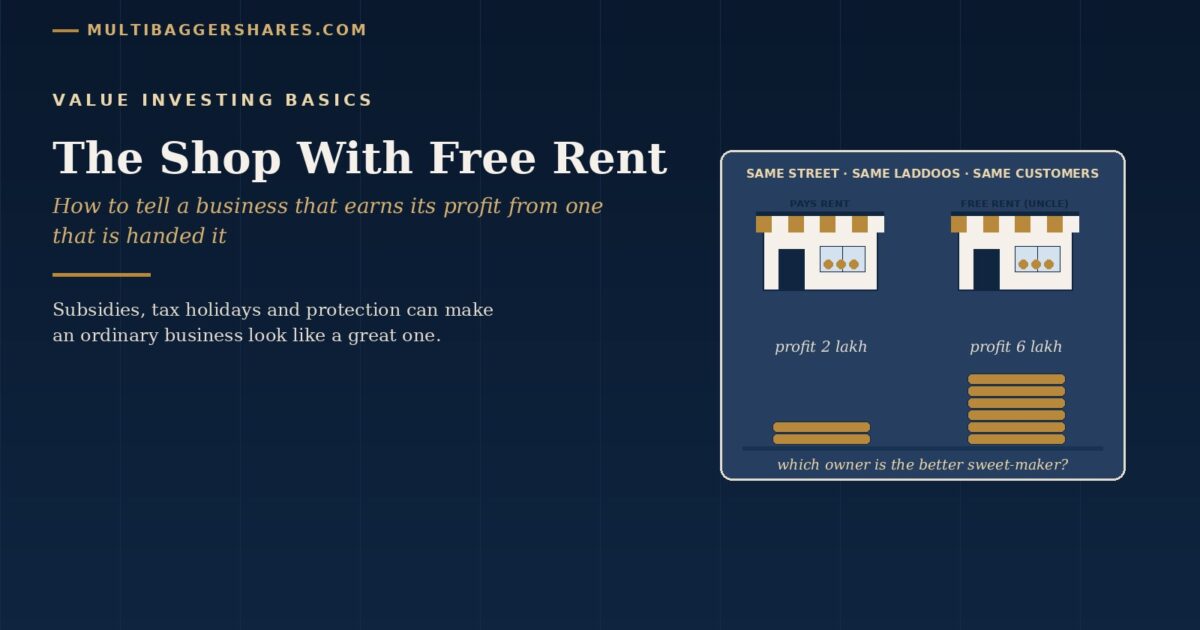
The shop with free rent
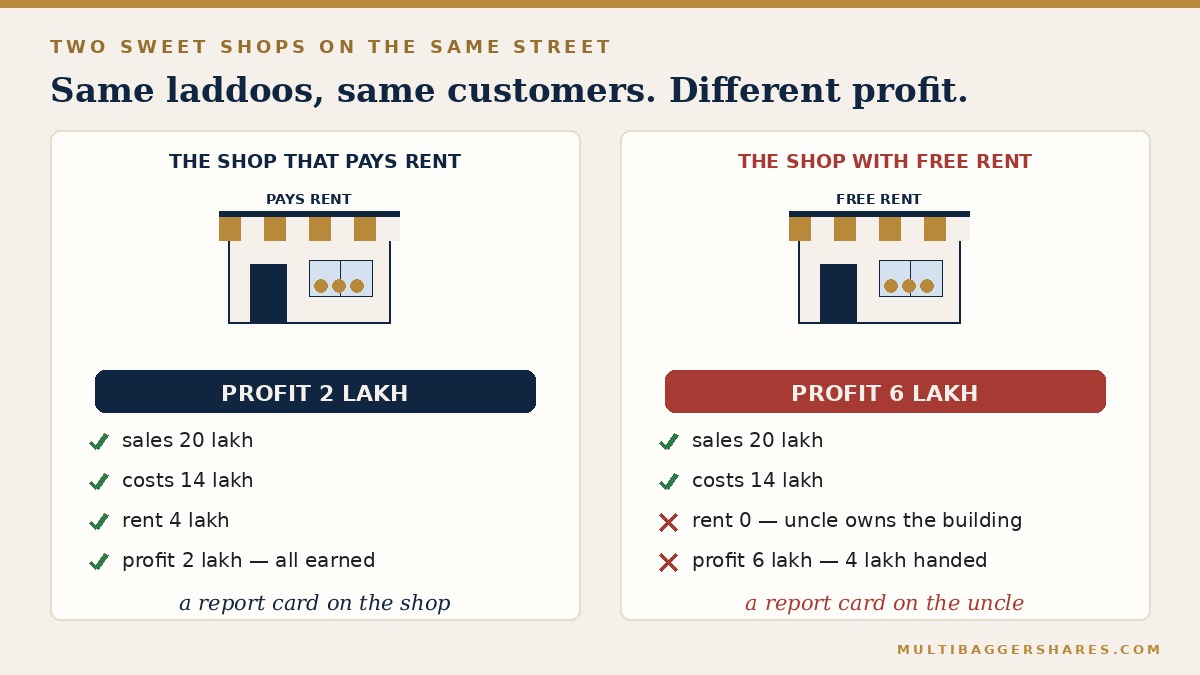
Imagine two sweet shops on the same street. Both sell the same laddoos at the same price. Both have the same number of customers. At the end of the year, both owners show you their books. The first shop made a profit (money left over after all costs are paid) of two lakh rupees. The second made six lakh.
You would naturally think the second shop is three times better. Then you learn one small fact. The second shop sits in a building owned by the owner’s uncle, and the uncle charges no rent. The first shop pays four lakh a year in rent. Take that away and the two shops are identical. The second owner is not a better sweet-maker. He simply has a generous uncle.
Now ask the question that matters. What happens when the uncle sells the building? A new landlord arrives, asks for market rent, and the six-lakh profit falls to two lakh overnight. Nothing about the shop changed. Only the gift ended.
Many listed companies (companies whose shares you can buy on the stock exchange) have an uncle. The uncle is usually the government. The gift comes in many shapes: a cash subsidy (money paid by the government to lower a product’s price or a factory’s cost), a tax holiday (a period of years during which a company pays little or no income tax), a protective duty (a tax on imports that makes foreign rivals more expensive), or a cheap loan that a normal bank would never give.
None of these is wrong. Governments give such help on purpose, to build industries they want. But for you, the small investor trying to judge quality, the help creates a trap. It makes a business look stronger than it is. This letter is about spotting the free rent before you mistake it for skill.
What it really means
Think of a company’s profit as coming from two sources. The first is earned: customers freely pay more for the product than it cost to make. The second is handed: someone other than the customer sends money, or waives a bill, because a policy says so.
Earned profit is a report card on the business. It tells you people want what the company makes, and that the company can make it cheaply enough to keep a margin (the gap between selling price and cost). Handed profit is a report card on the policy. It tells you what the government wanted that year. It says almost nothing about the company.
The trouble is that both kinds of profit look the same in the annual report (the yearly booklet in which a company reports its numbers to shareholders). Rupee for rupee, a subsidy sits next to a sale. Only when you read carefully do you find out how much of the profit would survive if the help stopped.
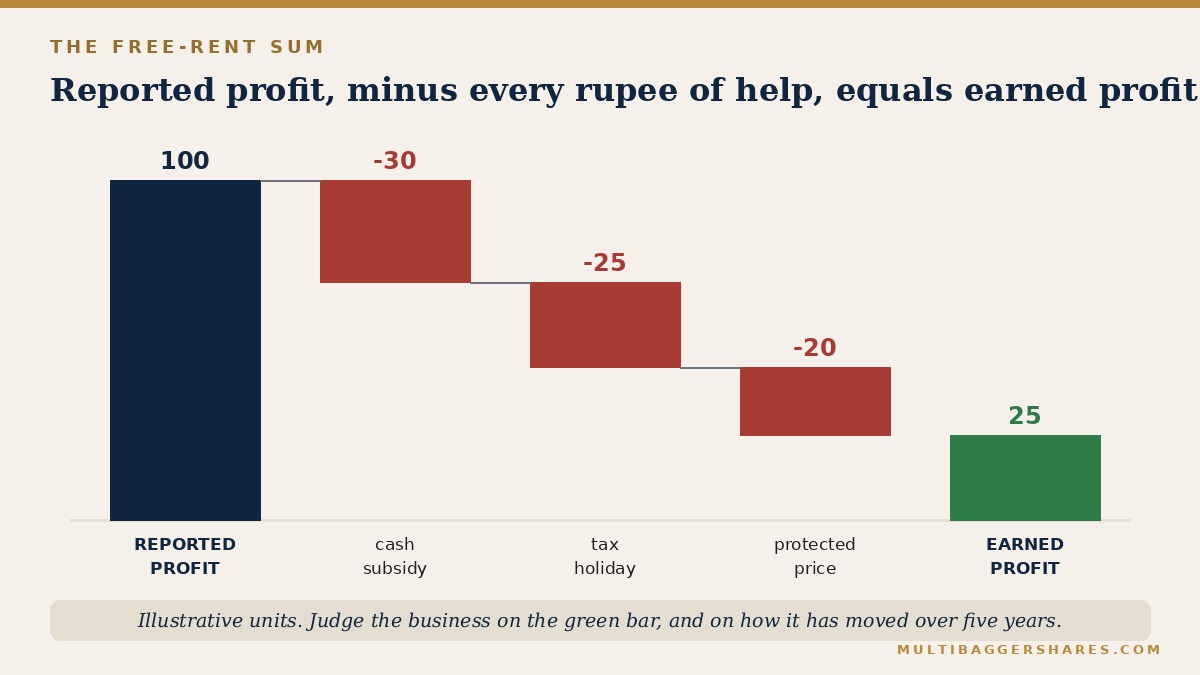
So the test is simple to state. Take the year’s profit. Subtract every rupee that came from a subsidy, a tax break, a protected price or a cheap loan. What is left is the profit the business earns on its own feet. If that number is healthy, you are looking at a real business that happens to enjoy some help. If that number is tiny or negative, you are looking at a policy with a factory attached.
There is a second question, just as important. Does the help have a date on it? Most subsidies and tax holidays are written with an end date, or a review date, or a budget that runs out. A tax holiday for ten years is a wonderful thing in year two. It is a countdown in year eight. A good investor reads the date and asks what the business will look like the morning after.
Why it works
Warren Buffett said something unusually blunt about this in May 2014. Speaking about the wind farms that his company Berkshire Hathaway was building, he said: “On wind energy, we get a tax credit if we build a lot of wind farms. That’s the only reason to build them. They don’t make sense without the tax credit.”
Read that slowly. One of the most careful investors alive was saying, in public, that a whole line of business existed because of a tax rule. He was not embarrassed by it. He was simply being honest about where the profit came from. Notice also that Berkshire’s wind farms are a small part of a huge company that earns most of its money from insurance, railways and ordinary businesses. The tax credit was a bonus on top of a strong house, not the foundation under a weak one.
That is the whole difference. A strong business can take help and grow faster. A weak business needs help just to stand. The first is a healthy person taking a vitamin. The second is a patient on a drip. From across the room, both look fine. Only one is in trouble when the drip is removed.
Why does this matter so much for a long-term investor? Because when you buy a share, you are buying a slice of the company’s future profits, for many years. A policy can change with one budget speech. A business that makes something people want, at a cost lower than they will pay, does not depend on anybody’s speech. You want the second kind, because the second kind lasts.
There is a quieter reason too. Help changes behaviour. A shop with free rent does not have to work as hard on its laddoos. A company with a guaranteed subsidy does not have to fight as hard on cost or quality. Protection from foreign rivals means nobody forces the company to improve. Over years, the supported business can grow soft in exactly the muscles it will need when the support ends.
A real example or two
Start with the electric scooters that have filled Indian roads in the last few years. Under a scheme called FAME-II (a central government programme to encourage electric vehicles), the government paid a subsidy on every electric two-wheeler sold. Until May 2023, that subsidy was worth up to 40 per cent of the scooter’s factory price. For many models it was the difference between a scooter that cost more than a petrol one and a scooter that cost less.
Then the uncle changed the rent. From 1 June 2023 the subsidy was cut to at most 15 per cent of the factory price. Makers raised their prices by roughly a fifth. Registrations of electric two-wheelers fell from about 1,05,000 in May 2023 to about 46,000 in June 2023, a drop of more than half in a single month.
Nothing about the scooters had changed. The batteries were the same. The showrooms were the same. What changed was who was paying part of the bill. The market did recover over the following year, as prices came down and buyers got used to the new sums, and electric two-wheeler sales for the full year FY24 ended well above FY23. That recovery is the useful part of the story. It showed which companies had real demand under the subsidy and which had only had the subsidy.
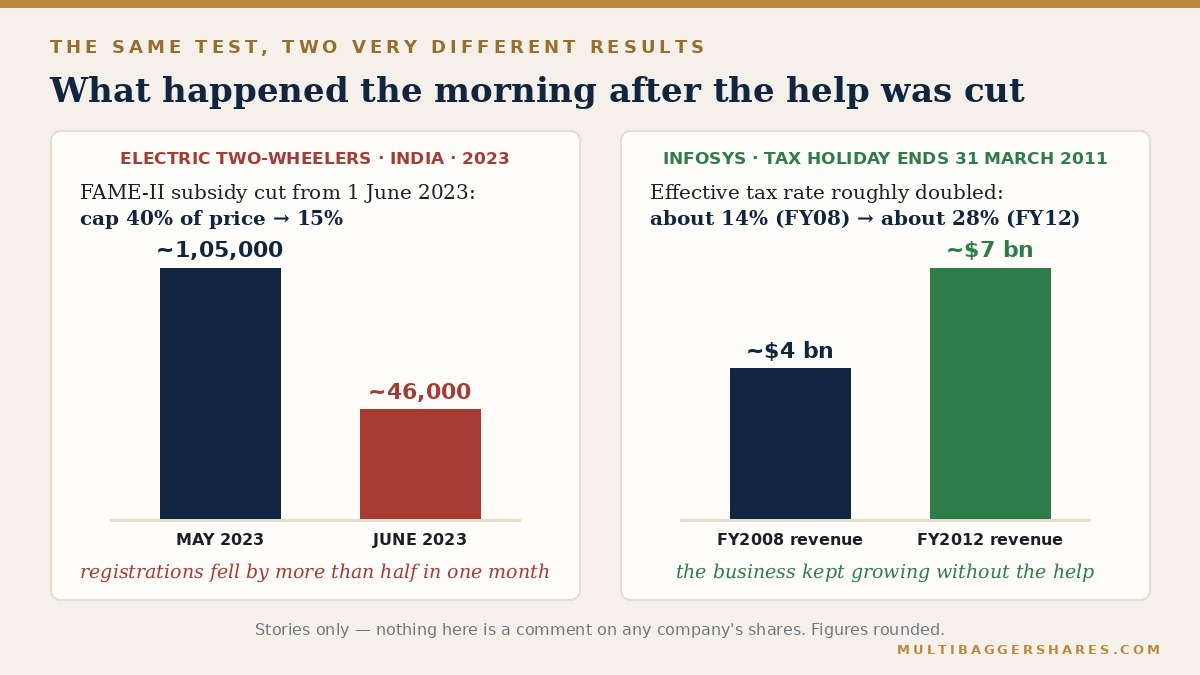
Now the opposite story, from an older industry. In the 1990s and 2000s, India’s software exporters enjoyed a tax holiday on profits earned from software technology parks. It was a large gift. Infosys, one of the biggest names in the industry, paid an effective tax rate (actual tax paid as a share of profit) of only about 14 per cent in the financial year 2008, less than half the normal company rate.
The holiday expired for all of Infosys’s older units on 31 March 2011. By the financial year 2012, the company’s effective tax rate had roughly doubled to about 28 per cent. Here was the test, in real life. A quarter of every rupee of profit now went to the tax office instead of to shareholders.
And the business barely noticed. Customers still wanted the work. Revenue kept rising, from about four billion dollars in 2008 to about seven billion in 2012. The company kept hiring, kept paying dividends, kept growing. The tax holiday had been a vitamin for a healthy person, not a drip for a patient. When it was removed, the business simply stood up and carried on.
I mention these companies only as stories. Nothing here is a comment on anyone’s shares. The lesson is in the contrast. One industry’s demand fell by half the day the help was cut. Another industry shrugged. If you had only looked at the profit numbers in the good years, you could not have told them apart. If you had asked where the profit came from, you could.
The same test applies today to the many production-linked incentive schemes (government payments tied to how much a factory produces) that have been announced for electronics, pharmaceuticals, solar panels, textiles and more. Most run for a fixed number of years. The mobile-phone scheme, for example, was a five-year programme whose final year was the financial year 2026. Every one of these schemes has a morning after. The question for an investor is never whether the scheme is good. The question is what the factory earns without it.
How you can use it
You do not need a spreadsheet for this. You need one habit: whenever a company’s profit looks unusually good, ask who is helping. Here is a plain five-step routine.
First, find the other income line. In the profit and loss statement (the page that shows sales, costs and profit for the year), look for a line called other income, or for a note titled government grants or incentives. Some companies bury subsidies inside sales; the notes to the accounts will usually say so. Compare that number with total profit. If a third or more of profit is grants, you have found an uncle.
Second, check the tax rate. Divide the tax paid by the profit before tax. If the company pays far less than the standard company rate year after year, ask why. A tax holiday is usually the answer, and it usually has an expiry date printed in the same note.
Third, look for protection. If the company makes something that would be cheaper to import, find out whether an import duty or a ban on rivals is keeping foreign products out. Protected prices can vanish with one trade agreement.
Fourth, find the date. Every scheme, holiday and duty has a term, a review, or a budget. Write the date down. Then imagine the company’s accounts on the day after. Would you still want to own it?
Fifth, do the sum. Profit minus every rupee of help equals earned profit. Judge the business on that number, and on how that number has moved over five or more years. A company whose earned profit is rising even as its help shrinks is doing something right.
Two limits, to be fair. Help is not always a red flag. A young industry sometimes needs a push, and the companies that use that push to build real scale and real skill can come out the other side strong. The Infosys story is exactly that. And some help is permanent in practice, because the policy is old and unlikely to change. The point is not to avoid every supported company. The point is to know how much of the profit is yours by right and how much is on loan from a policy.
Think of it as the difference between a salary and a scholarship. Both put money in the bank this month. Only one is likely to be there in ten years. When you own a share for the long term, you want the salary.
Key takeaways
- Profit comes in two kinds. Earned profit is paid by customers; handed profit comes from a subsidy, tax holiday or protective duty. Only the first tells you the business is good.
- Do the free-rent sum. Profit minus every rupee of help equals earned profit. Judge the company on that number and on how it has moved over five years.
- Find the date. Almost every scheme, holiday or duty has an end date or a review. Picture the accounts on the morning after before you buy.
- Help changes behaviour. A supported business can grow soft on cost and quality in exactly the muscles it will need when the support ends.
- Vitamin or drip? A strong business uses help to grow faster; a weak one needs help just to stand. Ask which one you are looking at.
— Manish Goel · multibaggershares.com
Disclaimer: This article is published by multibaggershares.com for education and general information only. It is not investment advice, investment research, or a recommendation to buy, sell or hold any security. Any companies named are discussed only as illustrative examples. Markets carry risk; please do your own research or consult a qualified professional before making any investment decision.