The Tree and the Size of the Field: How to Tell How Much Bigger a Business Can Still Grow

The Shop With Free Rent: How to Tell a Business That Earns Its Profit From One That Is Handed It
September 7, 2026
The Shop That Sells to Every Miner: Why Some Businesses Win Whoever Wins the Race
September 9, 2026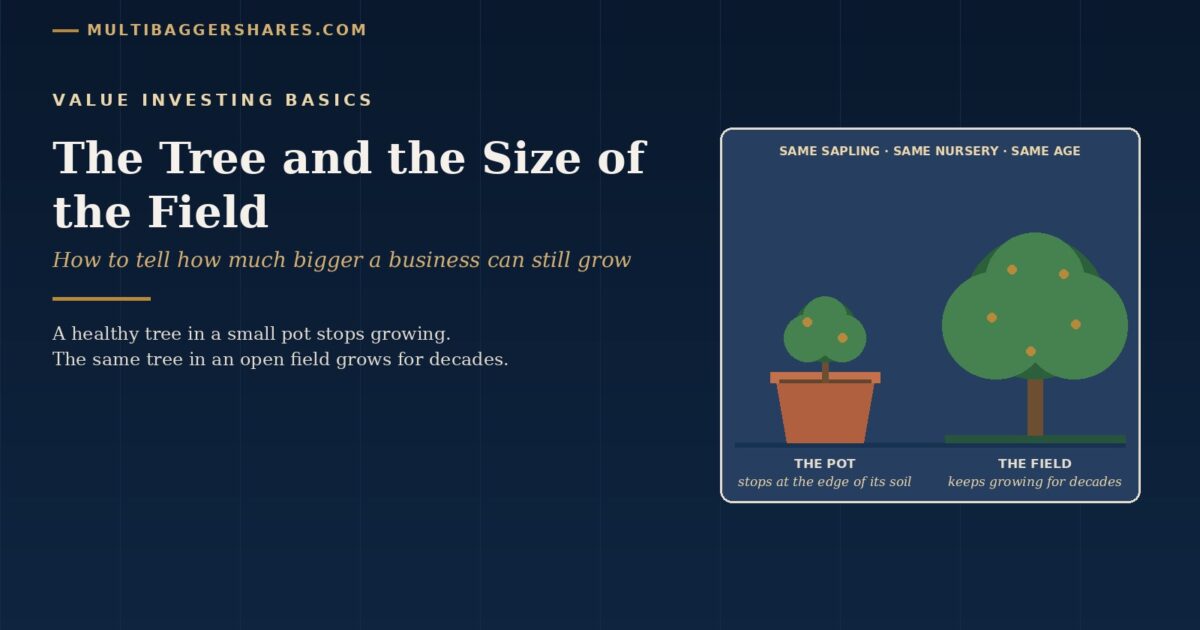
The tree in the pot
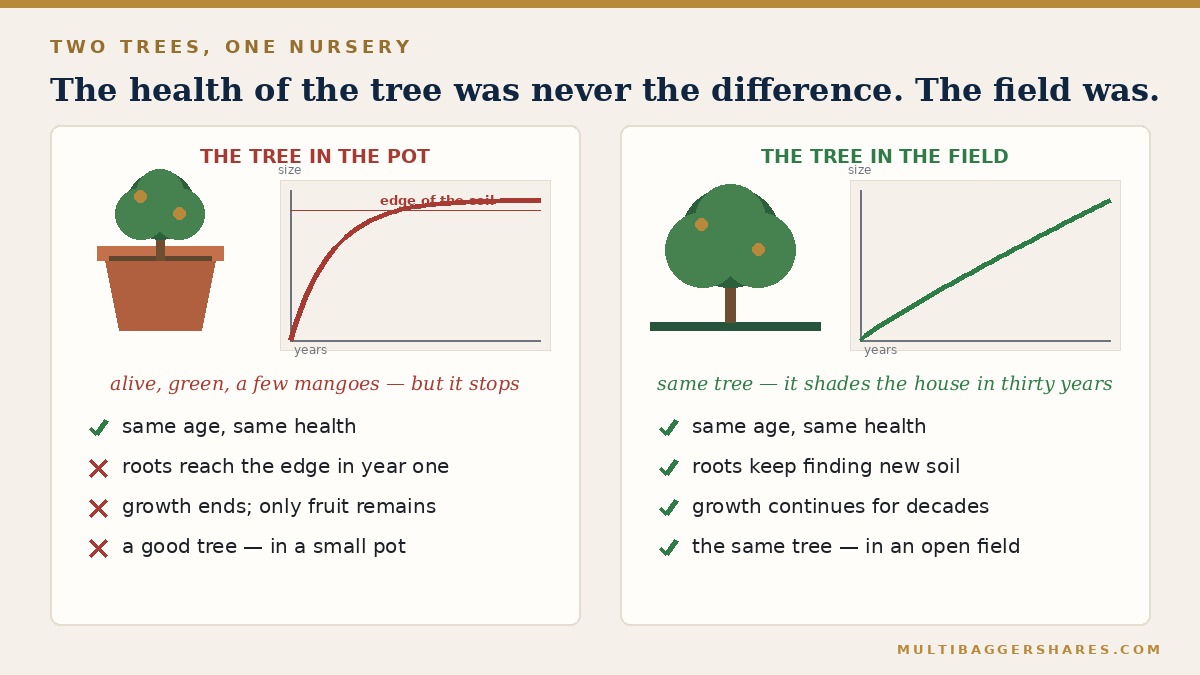
Imagine two mango saplings from the same nursery. They are the same age, the same height, and equally healthy. You plant one in a clay pot on your balcony. Your neighbour plants the other in an open field behind his house.
For the first year, the two trees look alike. Both put out new leaves. Both grow a little taller. Then something quiet happens. The tree in the pot reaches the edge of its soil. Its roots have nowhere left to go. It stays alive, it stays green, and it even gives a few mangoes each summer. But it stops growing. The tree in the field keeps going for twenty, thirty, forty years, and one day it shades the whole house.
The health of the tree was never the difference. The difference was the size of the field.
Businesses are the same. When beginners learn to judge a company, they are usually taught to look at the tree. Is it profitable? Is it honest? Does it have low debt (borrowed money that must be repaid with interest)? Does it earn a high return on capital (the profit a business makes for every rupee its owners have put in)? These are the right questions, and this letter series has spent many mornings on them.
But there is a second question that is asked far less often. How much room does this business have to grow? Where is the edge of its field? A perfectly healthy business in a small field will stop growing just like the tree in the pot. It will still be a fine business. It will simply not be a business that gets much bigger. And for a long-term investor, the size of the field decides how long the good years can last.
What it really means
Every business sells something to a group of customers. The field is the total number of customers who could reasonably buy that thing, multiplied by how often they buy it. Investors sometimes call this the addressable market (the whole pool of sales a company could win if it reached every possible customer). You do not need the term. You only need the picture. A field has edges, and a business grows until it reaches them.
Here is a kirana shop (a small neighbourhood grocery store) in a village of five hundred families. If the owner is excellent, he may win three hundred of those families as regular customers. Then what? There are only five hundred families. He can raise prices a little, add a few items, and that is the end of it. Compare a kirana shop on the edge of a fast-growing city suburb, where new flats are being built every month. The second owner does not need to be better. He simply has more field.
Warren Buffett wrote the clearest sentence on this in his 1992 letter to shareholders: “Leaving the question of price aside, the best business to own is one that over an extended period can employ large amounts of incremental capital at very high rates of return.” Read it in two halves. ‘Very high rates of return’ is the health of the tree. ‘Over an extended period’ and ‘large amounts of incremental capital’ (new money put back into the business) is the size of the field. Buffett wanted both. He added, in the same paragraph, that the first kind of business “is very hard to find”.
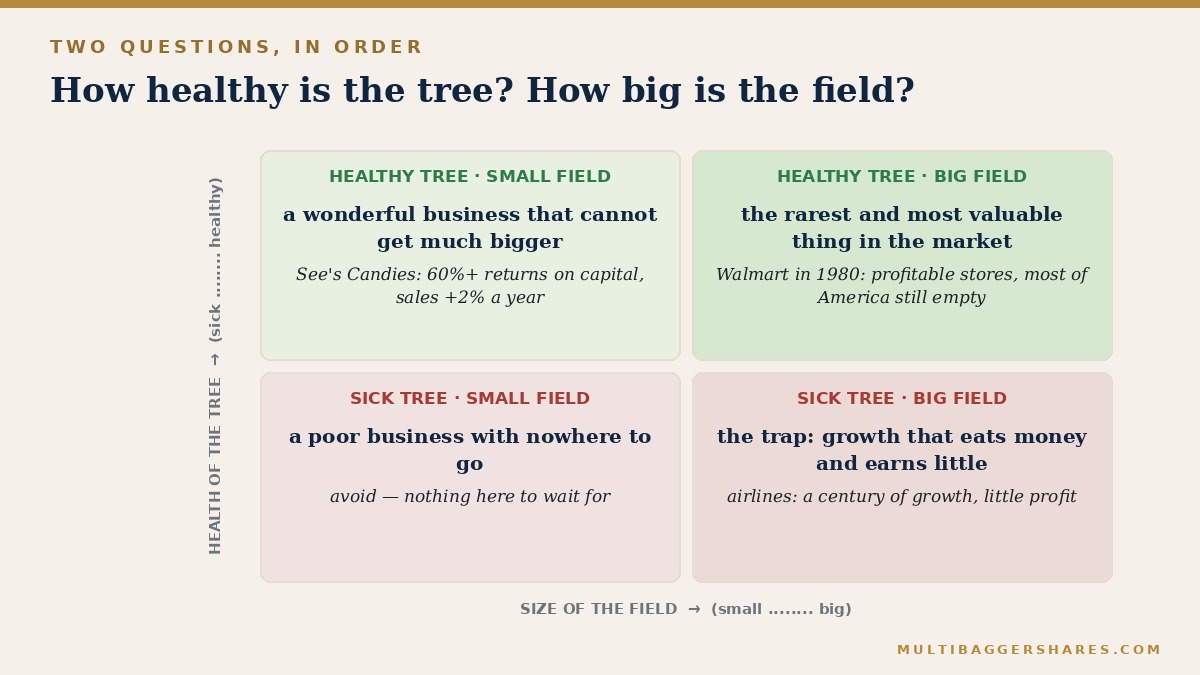
So the test has two parts, and most people only do the first. Part one: does the business earn well on the money it already uses? Part two: can it keep putting new money to work at the same good rate, year after year, because there are still many customers left to win? A business that passes both is the rarest and most valuable thing in the market. A business that passes only the first is a good tree in a pot.
Why it works
Think about where a company’s growth actually comes from. It can sell to more people. It can sell more to the same people. Or it can charge each person more. The first two depend on the field. The third depends on pricing power (the ability to raise prices without losing customers), and it has a limit too, because at some price people stop buying.
Now suppose a company has already won most of the customers it could ever win. It has reached the edge of the field. From here, its sales can grow only as fast as its customers’ own spending grows, which is roughly the speed of the economy. Its profit may still be excellent. But the days of growing at twenty or thirty per cent a year are over, no matter how good the management is. Nothing is wrong. The field is simply full.
Now suppose a second company has won only one customer in ten of the people who could use its product. Every year, it can add customers who never bought before. The same good product, the same honest management, but with nine customers still to win for every one it has. If the product is something people adopt as they get a little richer, the field itself grows every year, because more families cross the line where they can afford it.
This is why the size of the field matters so much to compounding (earning returns on your past returns, interest on interest, like a snowball rolling downhill). The snowball only grows while there is snow on the hill. A company that can reinvest its profit into new customers at a high return is a snowball on a long, snowy slope. A company that has run out of customers must hand its profit back to shareholders as dividends (a share of profit paid out in cash), because it has nowhere useful to put it. That is not bad. It is just a different, slower kind of ownership.
There is a warning inside this idea, and it is important. A big field is worth nothing if the tree is sick. Buffett made this point in his 2007 letter, describing the worst kind of business as one “that grows rapidly, requires significant capital to engender the growth, and then earns little or no money.” His example was airlines. Air travel has an enormous field. Almost everyone wants to fly more. Yet the industry as a whole has burned money for a century, because the growth needs planes, fuel and airports, and rivals keep cutting fares. So the order of the two questions matters. First the tree. Then the field. Never the field alone.
A real example or two
Start with a famous tree in a small pot. In 1972, Buffett’s company bought See’s Candies, a maker of boxed chocolates sold mostly in a few western American states. In his 2007 letter he called it “the prototype of a dream business”. It was bought for twenty-five million dollars. By 2007 it was earning eighty-two million dollars a year before tax on just forty million dollars of capital. That is an extraordinary tree.
But look at the field. Buffett wrote that per-person consumption of boxed chocolates in America “is extremely low and doesn’t grow”. See’s sold sixteen million pounds of candy in 1972 and thirty-one million pounds in 2007, a growth rate of only about two per cent a year. Over thirty-five years the business had reinvested only thirty-two million dollars in itself, because there was nothing more it could usefully do with the money. Everything else, well over a billion dollars, was sent to Berkshire to buy other businesses. See’s was a wonderful tree. Its pot was small. Buffett knew it, and he planned around it.
Now a tree in a very large field. Walmart went public in October 1970, when it was a chain of discount stores in a handful of American states. Peter Lynch, who ran the Fidelity Magellan fund and was one of the most successful fund managers of his time, has told this story many times as a lesson in patience. Ten years after the listing, Walmart still operated in only a small part of the country. Its record was already excellent, its stores were already profitable. A cautious investor who bought it then, a full decade after the listing, still made more than thirty times his money over the following years, because there were still so many towns and states without a Walmart. The tree was healthy. The field was the whole of America.
Lynch put the lesson into a single question in a December 2019 interview: “The question is, how long is the story?” He added that you want to own such a company “in the second inning of the ballgame, and out in the seventh. That could be 30 years.” Baseball has nine innings. Second to seventh is the long middle, when the field is still being filled.
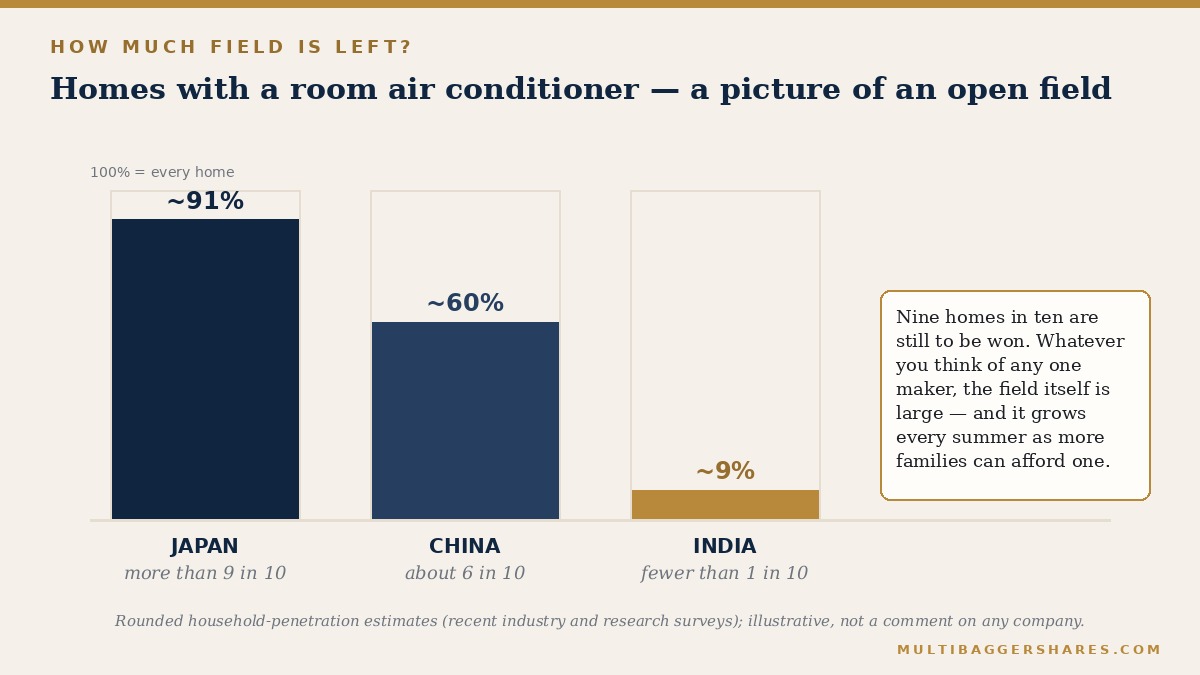
Bring it home to India. Think about the room air conditioner. In Japan, more than nine homes in ten have one. In China, roughly six in ten. In India, by most recent estimates, fewer than one home in ten has an air conditioner, in a country with some of the hottest summers on earth and a fast-growing middle class. Whatever you think of any particular company that makes them, the field itself is plainly large. Every summer, more families cross the line where an air conditioner becomes affordable. Compare that with, say, a product every Indian home already owns, like a pressure cooker or a ceiling fan, where a maker can only grow with replacements and small price rises. Both can be good businesses. Only one has a long story ahead of it.
How you can use it
You do not need a spreadsheet for this. You need a few honest questions and ten minutes with the company’s annual report (the yearly booklet in which a company reports its numbers to shareholders).
First, name the customer. Who actually buys this product, and how often? A soap is bought by every household every month. A tractor is bought by a farmer once a decade. A steel plant is bought by a handful of large companies once in a generation. The type of customer tells you the shape of the field.
Second, estimate the edge. Roughly what share of the possible customers already buy this product from anyone? Do not aim for precision. One in ten, half, or nearly all is enough. Company presentations often tell you the penetration (the share of possible customers who already own or use the product), and industry bodies publish it for most things people buy. If nearly every possible customer already buys, the field is full, and you should expect growth near the speed of the economy.
Third, ask whether the field itself is growing. Some fields grow as incomes rise: cars, air conditioners, branded clothing, insurance, hotel nights. Some fields shrink as habits change: film cameras, landline phones, printed directories. A growing field forgives many small mistakes. A shrinking one punishes even good management.
Fourth, look at what the company does with its profit. This is the most revealing sign of all. A company that keeps reinvesting most of its profit and keeps earning a high return on that new money is telling you, with its actions, that its field is still open. A company that pays out most of its profit, buys back its own shares, or starts buying unrelated businesses is telling you, whether it admits it or not, that its own field is nearly full. Neither is a sin. But you should know which one you own.
Fifth, be suspicious of growth that needs ever more money for ever less profit. Sales rising fast while returns fall is the airline pattern. That is a company running across a big field with a leaking bucket. The field is real; the harvest is not.
Two limits, to be fair. A big field attracts rivals, and rivals can trample the harvest before any one company enjoys it. Judging the field never replaces judging the moat (the durable advantage that keeps competitors out). And a small field is not a reason to avoid a company. See’s Candies was one of the best purchases Buffett ever made. The point is only to expect the right thing from it. From a tree in a pot, expect fruit. From a tree in a field, expect shade in thirty years.
Nothing here is a comment on anyone’s shares. The air conditioner, the kirana shop and the discount store are pictures, not suggestions. The lesson is the pair of questions, and the order they come in. How healthy is the tree? And how big is the field?
Key takeaways
- Two questions, in order. First, is the tree healthy (high returns, low debt, honest management)? Second, how big is the field (how many customers are still left to win)?
- The field decides how long the good years last. A business that has won nearly every possible customer can only grow with the economy, however good it is.
- Buffett’s 1992 sentence. The best business employs large amounts of new capital at high returns over an extended period. Returns are the tree; the extended period is the field.
- Watch what the company does with its profit. Reinvesting at high returns says the field is open; paying most of it out says the field is nearly full.
- A big field with a sick tree is a trap. Airlines grew for a century and earned little. Never judge the field without first judging the tree.
— Manish Goel · multibaggershares.com
Disclaimer: This article is published by multibaggershares.com for education and general information only. It is not investment advice, investment research, or a recommendation to buy, sell or hold any security. Any companies named are discussed only as illustrative examples. Markets carry risk; please do your own research or consult a qualified professional before making any investment decision.