The Shop That Cannot Close: Why an Industry Stays Poor When Its Losers Cannot Leave

The Helmet Shop Outside the RTO: When the Law Sends the Customers, Who Keeps the Profit?
September 11, 2026
Five sweet shops on one lane
Picture a short lane in an old part of any Indian city. Five sweet shops stand on it, one after the other, all turning out much the same barfi from much the same recipe. For twenty years the lane was busy: the bus stand was at the corner, offices were nearby, and on festival days every one of the five had a queue at the counter. Then the bus stand moved, a flyover took the traffic elsewhere, and two of the office buildings emptied. The lane now has enough customers for about three sweet shops. Not five.
In the tidy world of a school textbook, what happens next is simple. Two shops close. The three that remain fill their counters again, stop cutting prices at each other, and go back to earning a decent living. The industry heals itself.
Now let us see why it may not happen. The first shopkeeper paid the landlord a ten-year deposit, and he forfeits most of it if he walks away early. The second has three cooks who have worked for his family since he was a boy, and he cannot bring himself to send them home. The third would get scrap value for his giant kadhai and his cold counter, because nobody outside the sweet trade wants them. The fourth has the family name painted above the door since 1961, and his father is still alive to see it. The fifth owes money to a bank, and the bank would rather the shutter stayed up than book the loss today.
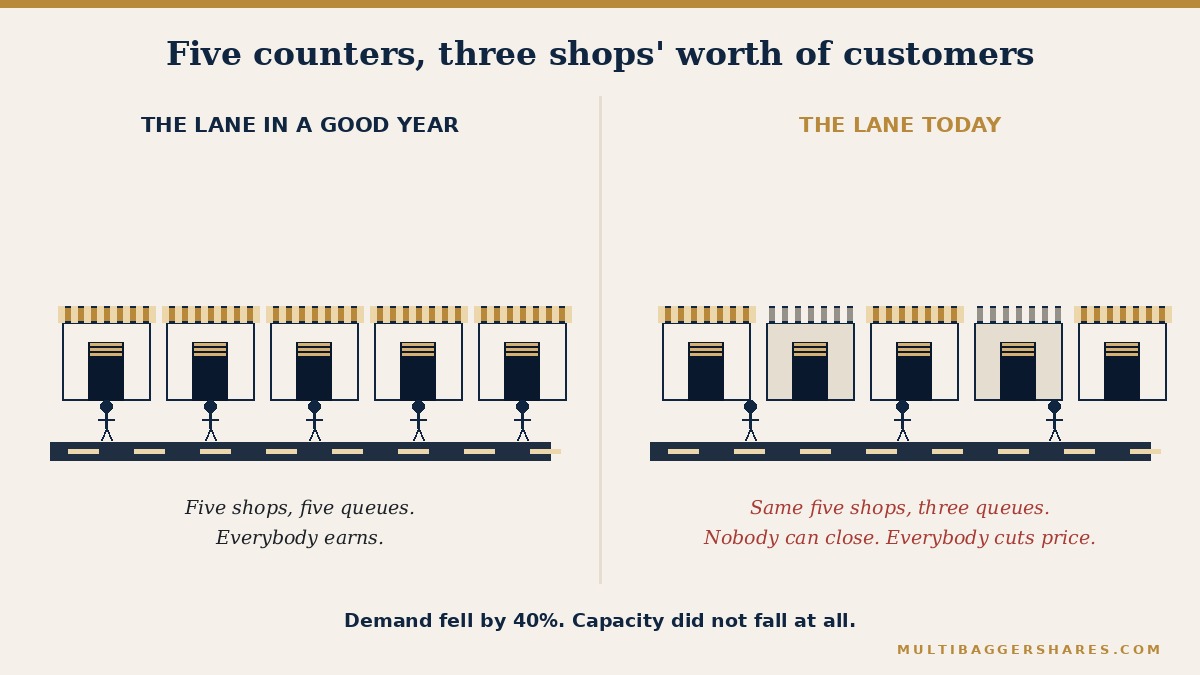
So nobody closes. Five shops go on sharing three shops’ worth of customers. Every Diwali they undercut one another, every year the margins get thinner, and this can continue for a decade or more. Notice what has happened: not one of them is badly run. The lane is poor because nobody can leave it.
That lane is an industry. And this is the half of the moat conversation most of us skip.
What “exit barriers” really means
Most investing education is about barriers to entry — the things that stop new competitors from turning up. A strong brand, a licence, a distribution network that took thirty years to build. We usually call the result a moat (a durable advantage that protects a business from competitors, like the water around a fort).
Exit barriers are the mirror image, and they are far less discussed. They are the things that stop a losing competitor from giving up and going away. The professor who named them, Michael Porter of Harvard Business School, defined them in his 1980 book Competitive Strategy as “economic, strategic, and emotional factors that keep companies competing in businesses even though they may be earning low or even negative returns on investment.”
Read that once more, slowly. Even though they may be earning low or even negative returns. These are firms that should stop, and do not. A moat keeps the enemy outside the fort. Exit barriers are a locked gate on the inside, keeping the defeated in the courtyard where they go on fighting.
Porter’s four corners
Porter put the two ideas on one small grid — entry barriers high or low along one side, exit barriers high or low along the other — and labelled the four corners by the kind of returns each tends to produce.
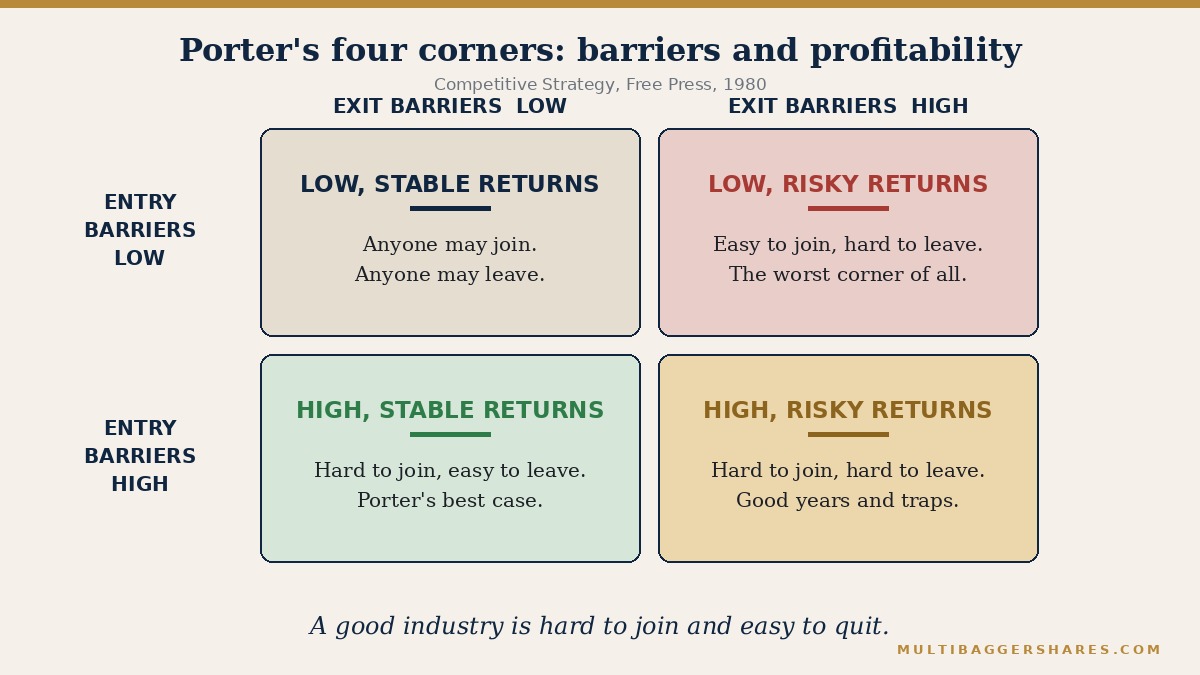
Where it is easy to get in and easy to get out, returns are low but steady. Nothing much goes wrong and nothing much goes right: a tea stall or a small kirana shop lives here, because anybody can open one and anybody can shut one in a fortnight. Where it is hard to get in and hard to get out, returns can be high, but the good years are very good and the bad years trap everybody together.
Where it is hard to get in and easy to get out — that is Porter’s best corner, the one he marks high and stable. Newcomers are kept away, and the competitors who stumble simply leave, so the survivors are not punished for someone else’s mistake.
And the worst corner is the one almost nobody thinks about: easy to get in, hard to get out. Anyone may join; nobody may leave. Porter’s own description is that capacity stacks up in the industry and profitability is usually chronically poor. Plenty of real industries live there for decades.
Put in plain words, the sentence worth remembering is this: a good industry is one that is hard to join and easy to quit.
The five things that trap a business
Porter listed five reasons a firm stays in a business it is losing money in. They are worth learning by name, because you can look for each of them in an annual report.
One: specialised assets. Machinery or a location that is useful for this one purpose and almost nothing else. A sugar mill’s crushing plant cannot be turned into anything; a cement kiln is a cement kiln. Compare that with an office building, a warehouse or a fleet of trucks, which somebody else will happily take off your hands. The test is blunt: if this business shut tomorrow, what would a stranger pay for what is left?
Two: the fixed cost of closing. Shutting down is not free. There are settlements to pay, contracts to cancel, sites to clean, and often a duty to keep supplying spare parts to old customers for years. A firm with no money is precisely the firm that cannot afford to close.
Three: strategic interrelationships. The loss-making arm shares a factory, a brand, a sales force or a lending relationship with a healthy arm of the same group. Closing the weak one hurts the strong one, so it limps on.
Four: emotional barriers. Porter, an economist, put this in his list without embarrassment — identification with the business, loyalty to employees, pride, and a manager’s fear for his own career. The name over the door has closed fewer factories than any spreadsheet ever will.
Five: government and social restrictions. Governments discourage closure because closure means job losses in a particular town. Porter noted in 1980 that this was particularly common outside the United States. India is about to prove his point at some length.
India’s long experiment in not letting anyone close
In March 1976 a new chapter — Chapter V-B — was inserted into the Industrial Disputes Act of 1947. Its section 25-O said that an employer who intended to close down an undertaking had to apply for the prior permission of the government, at least ninety days in advance, giving reasons. Closing without permission was illegal, and the workers were entitled to be paid as if the place had never shut.
The Supreme Court struck that section down in September 1978 in the Excel Wear case, holding that it went too far against the freedom to carry on a business. Parliament rewrote it in 1982 — and in the same breath lowered the size threshold from 300 workers to 100. The new version came into force in August 1984. So for roughly four decades, a factory in India with a hundred workers on its rolls needed the state’s written permission to stop.
Alongside that sat a second machine. The Sick Industrial Companies Act was passed in January 1986 and the Board for Industrial and Financial Reconstruction — the BIFR — was set up in January 1987, taking its first cases that May. A “sick” company was one whose accumulated losses had eaten up its net worth. The Board’s job was to revive such companies.
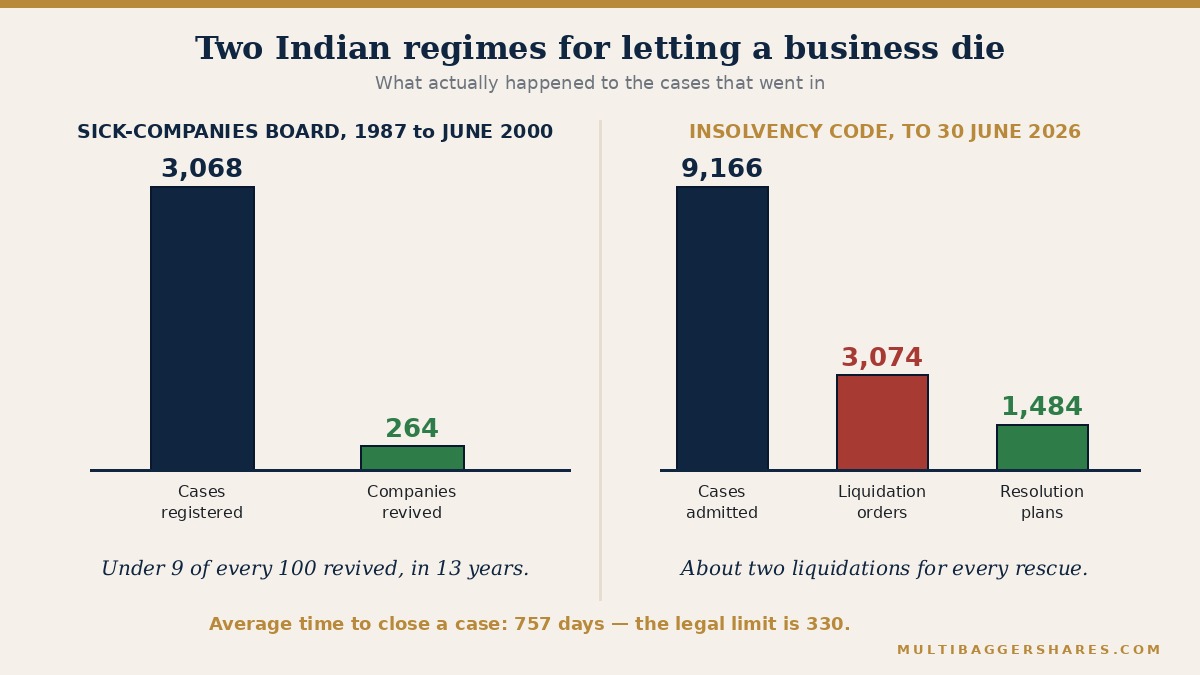
How well did it work? A government committee under Justice Eradi went through the record in 2000. Of 3,068 cases registered with the BIFR between 1987 and 30 June 2000, just 264 companies were revived — under nine in every hundred, across thirteen years. Another 1,062 were still pending and 741 had been put forward for winding up. An earlier committee, in 1993, sampled 565 decided cases and measured an average delay of 749 days between registration and decision, and said plainly that this understated the real wait, because the cases still stuck in the queue were not counted at all.
The BIFR finally stood dissolved on 1 December 2016. On the very same day, the corporate insolvency provisions of the Insolvency and Bankruptcy Code, 2016 commenced. The Code gave India something it had never really had: a timetable for failure. A case was to be finished in 180 days, extendable once by 90, with an outer limit of 330 days written in by an amendment in 2019.
The timetable is still winning slowly. By 30 June 2026, according to the insolvency regulator’s own quarterly figures, 9,166 corporate insolvency cases had been admitted since the Code began. Of those, 1,484 ended with an approved resolution plan — somebody took the business over and kept it alive — and 3,074 ended in a liquidation order, which means the assets were broken up. Roughly two funerals for every rescue. The average case took 757 days to close, more than twice the outer limit the law sets. And the regulator’s own note is the most telling line of all: about 78 per cent of the companies that ended in liquidation had either been before the BIFR already or were defunct when they arrived, with assets worth about six per cent of what they owed.
That is what a country looks like when capacity cannot leave. The businesses were not killed by the insolvency law. Most of them had been dead for years, and the law simply arrived late enough to hold the funeral. In November 2025 the Industrial Relations Code of 2020 came into force and raised the permission threshold to 300 workers, though most states have yet to notify their own rules under it. Whether that changes behaviour is a story for another decade.
Two industries, two endings
Consider sugar. Under the Sugarcane (Control) Order of 1966, a state’s cane commissioner can reserve an area of cane fields for a particular mill. Under Uttar Pradesh’s own sugarcane law of 1953, a factory that is so directed must purchase all the cane grown in that reserved area which is offered to it. The price is not the mill’s decision either. The central government fixes a Fair and Remunerative Price — for the 2026-27 season, ₹365 a quintal at a 10.25 per cent recovery rate — and Uttar Pradesh separately announces its own State Advised Price, which a Constitution Bench of the Supreme Court confirmed in April 2020 the state may set above the central minimum.
Set aside whether any of that is good policy and look only at the shape it gives the industry. The mill is told which cane it must take, largely what it must pay for it, and it cannot simply stop crushing for a season because the numbers look bad. Every one of Porter’s five traps is present at once. Whatever else this is, it is not an industry where the weak quietly withdraw.
Now consider the opposite ending. Between 1979 and 2009 the American airline industry lost roughly 59 billion dollars, in 2009 money, on its domestic flying — including about 14 billion of net losses in 2008 and 2009 alone. Then the capacity left. Between 2005 and 2016, six large network carriers and two or three low-cost carriers merged or failed their way down to four major airlines; by 2013 about 85 per cent of American passengers were flying on one of those four.
What happened next is the whole point of this letter. The United States’ scheduled passenger airlines reported after-tax profits of 24.8 billion dollars in 2015 and 14.8 billion in 2019, the seventh profitable year in a row. Same aeroplanes. Same passengers. Same fuel. Different number of competitors.
And a live example to keep an eye on: the OECD’s steel outlook published in June 2026 put world steelmaking capacity at a record 2,445 million tonnes in 2025, against excess capacity of 640 million tonnes, and expects the excess to grow to 745 million tonnes by 2028. Utilisation (how much of the capacity is actually being used) was about 76 per cent and falling. India’s own installed crude steel capacity was around 222 million tonnes a year by June 2026, up from about 144 million in 2020-21, against production of roughly 168 to 170 million tonnes. Nobody needs a view on steel to read that correctly: when an industry keeps building furnaces and never dismantles any, the price is set by whoever is most desperate.
How you can use this
You do not need a model — only five questions, whose answers usually sit in an annual report or an hour of reading about the industry’s last bad patch.
What would the assets fetch from a stranger? Land, trucks and office space have a second life. A specialised plant has almost none. The lower the resale value, the more likely a losing competitor grits its teeth and keeps producing.
Who owns the three weakest competitors? A family with the name above the door, a state government, or a lender that cannot afford the write-off — none of those three closes easily. A listed rival answering to outside shareholders will usually exit faster than a promoter answering to his grandfather’s portrait.
What actually happened in the last downturn? Did anyone truly shut a plant, or did everyone simply cut prices and wait for better weather? The last downturn is the cheapest experiment you will ever be handed, and it has already been run for you.
Is there a rule or a contract that makes stopping costly? A duty to keep supplying, a permission to be obtained, a lease with years left, a workforce that cannot be reduced without consent.
Is the industry still adding capacity while running below a comfortable level of use? Write both numbers on the same line. Growing capacity plus falling utilisation is the signature of an industry heading into a long, joyless stretch.
The habit worth building is a small change in the question you ask. Most of us ask whether competitors can copy a business. Ask, as well, what happens to this industry in a bad year. A moat that keeps newcomers out is worth a great deal less if the incumbents who ought to have died are still standing there, cutting prices to keep the lights on.
The strongest industries in the world are not simply the hardest ones to enter. They are the ones that are hard to enter and easy to leave.
Key takeaways
- Entry barriers keep rivals out; exit barriers keep failures in. Porter defined exit barriers as the “economic, strategic, and emotional factors that keep companies competing in businesses even though they may be earning low or even negative returns on investment.”
- The best industry is hard to join and easy to quit. On Porter’s grid, high entry barriers with low exit barriers is the high-and-stable corner. Easy entry with hard exit is the worst corner there is — capacity piles up and profitability stays poor.
- Five things trap a losing business: specialised assets, the cost of closing, shared facilities with a healthier sibling, pride, and the government.
- India ran the experiment for forty years. Under the old sick-companies regime just 264 of 3,068 cases were revived by mid-2000, under nine per cent. Since 2016 the insolvency code has produced 3,074 liquidation orders against 1,484 rescues, taking 757 days on average.
- Check the last downturn before you admire the last boom. If nobody shut anything the last time the industry suffered, assume nobody will next time — and treat the good years as weather rather than climate.
— Manish Goel · multibaggershares.com
Disclaimer: This article is published by multibaggershares.com for education and general information only. It is not investment advice, investment research, or a recommendation to buy, sell or hold any security. Any companies named are discussed only as illustrative examples. Markets carry risk; please do your own research or consult a qualified professional before making any investment decision.