The Thousandth Jalebi: How to Tell Real Learning in a Business From a Bigger Machine

The Name Written Into the Drawing: How to Judge a Supplier the Customer Chose Only Once
September 19, 2026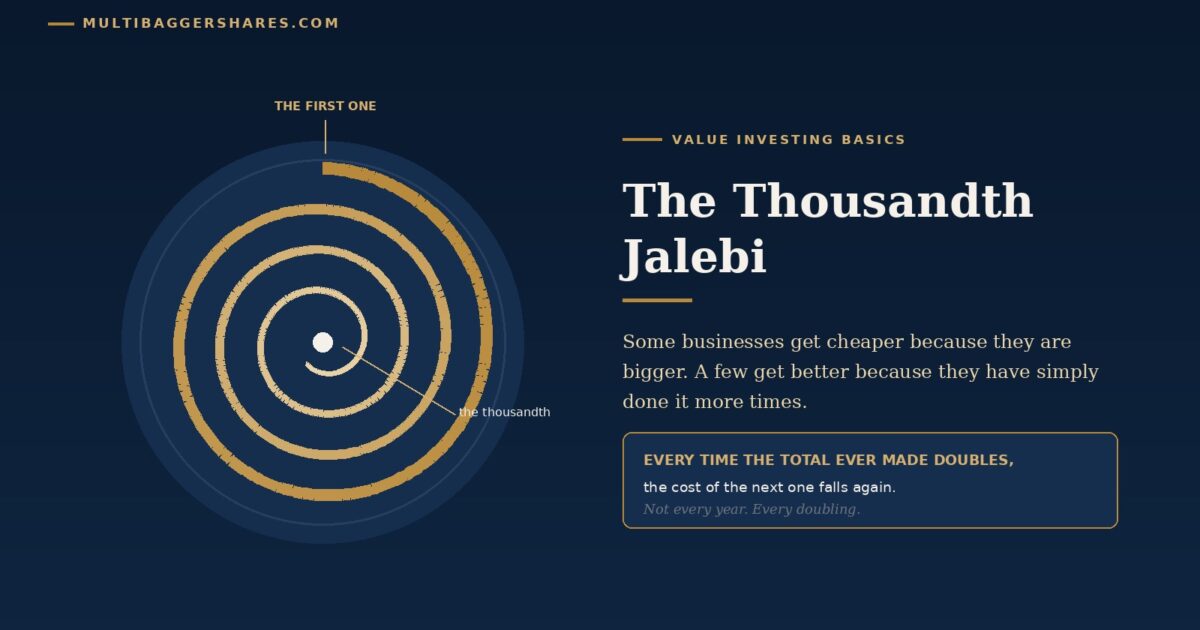
Two sweet shops stand on the same lane. Both make jalebi. Both open at seven in the morning and both charge roughly the same.
The first shop opened last year. Its owner did everything properly. He bought the best imported fryer he could find, a gleaming machine with a temperature dial, and he hired a trained cook on a good salary. The jalebis are perfectly acceptable.
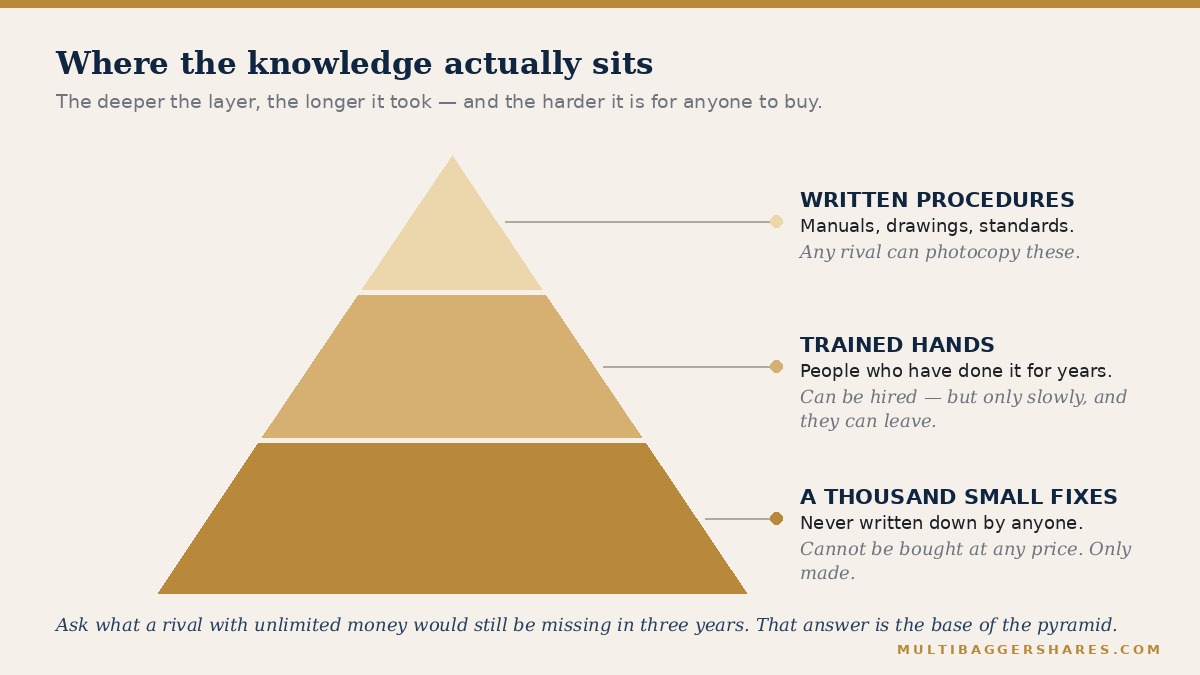
The second shop has been on that lane since 1978. The same man has stood at the same blackened kadhai for forty years. He owns no machine worth the name and one badly bent ladle. His jalebis are better, they come out faster, and they cost him less to make. Ask him how and he cannot really tell you. He knows the batter has fermented enough by the sound it makes when it drops. He knows the oil is right from the colour at the rim. He wastes almost nothing, because over forty years he has quietly stopped making every mistake there is to make.
Now ask the question an owner would ask. If you handed the first shop ten more machines and ten more cooks, would it match the second? It would certainly make far more jalebis. It would not make better ones. The thing the old man has cannot be bought this year at any price, because the only way to get it is to have made a very large number of jalebis, one after another, over a very long time.
That is today’s subject. Not a vague notion that experience is valuable, but a specific measured pattern with a number attached, almost ninety years old, and one of the few advantages money alone cannot shorten. It is also the most over-claimed advantage in business, which is why the second half of this letter is about how to check whether it is really there.
What the old rule actually says
In 1936 an aeronautical engineer named T. P. Wright, working for an American aircraft manufacturer, published a short paper in the Journal of the Aeronautical Sciences called “Factors Affecting the Cost of Airplanes”. He was chasing a very practical question: why does the same aeroplane cost less to build later than it did earlier?
His answer was simple enough to hold in your head. Every time the total number of aircraft ever built doubled, the labour time needed for the next one fell by roughly twenty per cent.
Read that once more, because one word is carrying the whole idea: doubled. Not “went up”. Doubled. The counter is cumulative (a running total that only ever goes up, counting every single unit made since the very first one, not just this year’s). Go from one hundred units ever made to two hundred, and the cost of the next one falls about a fifth. From two hundred to four hundred, another fifth. From four hundred to eight hundred, another fifth.
Notice what that shape does to a business. The early gains come fast, because doubling from ten to twenty is easy. The later gains come slowly, because once you have made a million, you need another million to earn the next step down. Learning is generous to the young and stingy to the old. This is now known as Wright’s law, and the falling line you get when you plot cost per unit against the total ever made is called the learning curve.
Three decades later, Bruce Henderson, who founded the Boston Consulting Group, pushed the idea into the language of business strategy. In a 1968 note he set it down plainly: costs decline by some characteristic amount each time accumulated experience is doubled, and he put that amount at twenty to thirty per cent, adding that the rate was surprisingly consistent even from one industry to another. He called his version the experience curve and was careful to say it was not the same thing as the learning curve. The learning curve counts only labour and production. His covered every cost a business carries to get the product to the customer — research, selling, advertising, overheads, all of it.
And then he added the warning that most people who quote him leave out. None of this happens by itself. He wrote that the falling costs were not automatic, that they depended crucially on a competent management that went looking for ways to force costs down — and that the relationship was one of normal potential rather than one of certainty. The curve is an opportunity. Somebody still has to take it.
Why this is not the same as simply being big
It is very easy to muddle this with economies of scale (the saving you get from making more units this year, so that the fixed costs — the rent, the manager’s salary, the machine that has to be paid for whether it runs or not — are spread across more pieces). Economies of scale are real and important. They are also a different thing.
Scale is about the rate: how many you make per month. Learning is about the total: how many you have ever made, counting all the way back to the first clumsy one.
That distinction decides who can catch you, which is the only question about an advantage that really matters. Scale can be bought. A rival with deep pockets builds a bigger plant and matches your monthly output inside two years. A total cannot be bought. A rival who starts today starts at one, no matter how rich he is, and the only way to reach your number is to spend the same years you spent.
Which leads to a consequence that surprises people: a small old firm can beat a large new one at one particular job. The twelve-person workshop making the same component since 1991 may quietly have a lower true cost and fewer rejects than the well-funded newcomer with better machines, simply because it has already met every way that component can go wrong.
One honest complication. The economist Ernst Berndt pointed out that in most real organisations learning and scale are so tangled together that separating them is practically impossible — the firm making the most each year is usually the firm that has made the most in total. So treat “scale or learning?” as a question worth asking, not one you can always answer cleanly.
Two long records worth knowing
The clearest modern example is the solar panel, and the numbers are startling. Measured by cost per watt of capacity, panels cost about one hundred and six dollars a watt in 1976. By 2019 they cost about thirty-eight cents. That is a fall of roughly ninety-nine and a half per cent. Across many separate academic studies the average learning rate works out at about twenty per cent for each doubling of the total capacity ever installed.
The important word there is again installed, not year, and it separates two famous patterns that get muddled. Moore’s law — that the number of transistors on a chip doubled roughly every two years — describes progress as a function of time. Wright’s law describes it as a function of experience. Time passing does nothing; units being made does everything. A technology nobody builds gets no cheaper, however many years go by.
But a sceptic should immediately object: perhaps the causation runs backwards. Perhaps prices fell first for some other reason, and cheapness is what caused people to buy more. That objection is usually impossible to settle — except once. The researchers François Lafond, Diana Greenwald and J. Doyne Farmer found a natural experiment in the Second World War, when the demand for military equipment was set by the war rather than by the price. As demand rose, cumulative production rose sharply and costs fell. When the war ended and demand collapsed, the rate of cost decline slowed back down. Experience was driving cost, and not the other way around.
The awkward case that keeps the idea honest
Now the part that most tellings of this story leave out, and the part that will actually protect you.
The most celebrated learning-curve example of all is the Liberty ship — the standard American cargo vessel mass-produced during the Second World War. The headline figures look like a miracle. The earliest ships took roughly 1.4 million man-hours and 355 days each. By 1943 the numbers were under 500,000 man-hours and about 41 days. For decades this was taught as the purest demonstration of learning by doing ever recorded.
In 2001 the economist Peter Thompson went back to the original records and published what he found in the Journal of Political Economy. Three findings, and every investor should carry all three.
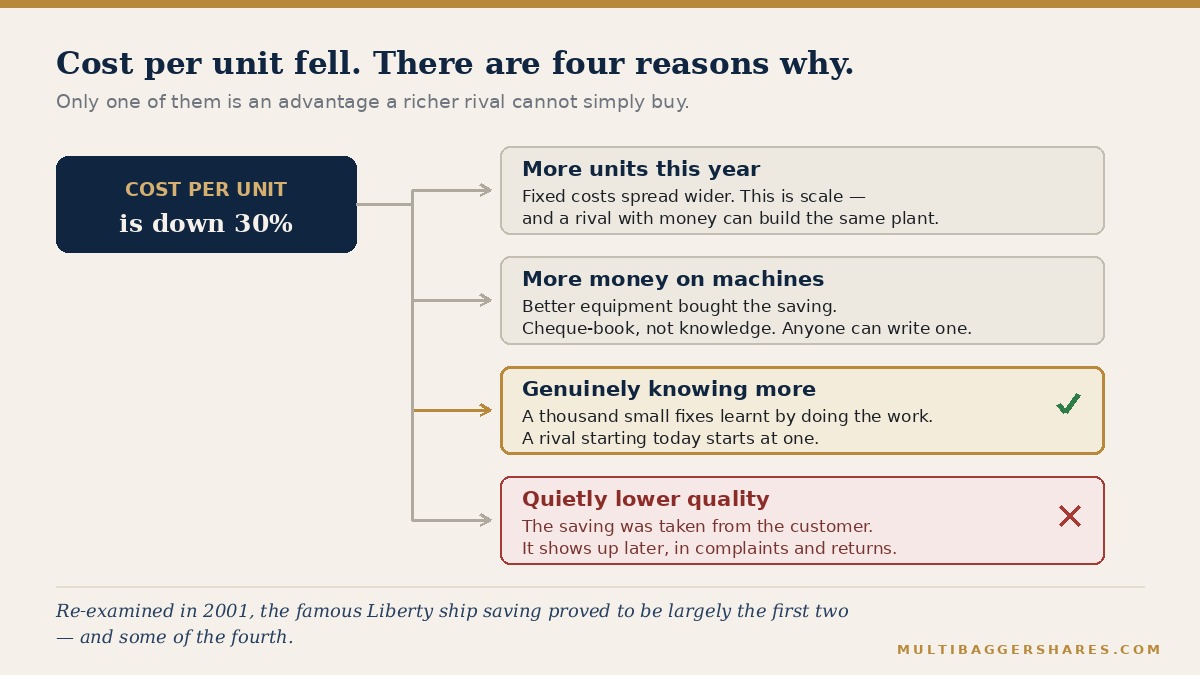
First, the yards kept buying equipment. In the language of economics this is capital deepening; in plain words, they spent heavily on more and better machinery as they went. Ships were being built before the shipyards themselves were finished, and almost two-thirds of the final stock of equipment was installed well into the programme. A large part of what looked like people getting better was simply people getting better tools.
Second, some of the speed was bought by lowering quality. Workers were paid bonuses for fast work, supervision was poor, and the welding suffered. More than one in ten of the Liberty fleet developed fractures in their hulls, some of them catastrophically.
Third, when Thompson did the arithmetic properly, learning by doing did not account for the spectacular productivity gains at the yard he examined most closely.
Sit with that. The most famous piece of evidence for the learning curve turns out, on careful inspection, to be substantially something else. Learning is not a myth — the aircraft and solar records stand. But the lesson is more useful than the legend: a falling cost per unit is not, by itself, evidence of learning. Four quite different things can push it down, and only one of them is an advantage a rival cannot buy.
Where it runs out
Even when the learning is genuine, it has four limits, and each of them has ended a great business at some point in history.
It can be made worthless overnight. When the technology underneath it changes, the old curve is thrown away and everyone starts a new one at zero together. Forty years of being the finest maker of something nobody wants any more is worth nothing, and the deeper the learning the worse this hurts, because the firm has shaped itself around the old way.
It makes a business stiff. In September 1974 William Abernathy of Harvard Business School and Kenneth Wayne published an article in the Harvard Business Review with the blunt title “Limits of the Learning Curve”. Their central finding was a trade-off: a company cannot have both the steep cost decline that comes from riding the curve and a fast rate of product innovation. The very standardisation that drives cost down is what makes changing the product hard. A firm that has spent twenty years perfecting one design has, without noticing, made itself expensive to change.
It does not travel. The learning attaches to a specific task, not to the company’s letterhead. A firm that is superb at one product is a beginner at the next one, and its own past success is often what stops it from admitting that.
And it can simply walk out of the door. Because much of the knowledge sits in hands and habits rather than in documents, a business that loses its experienced people loses part of its curve, and the loss does not appear anywhere in the accounts until the rejects start climbing.
How you can use this
There is no formula here, and anyone offering you one is selling something. But there are four questions, and they are the sort an ordinary reader can actually answer.
How old is the work, not the company? These are different numbers and the first is the one that counts. A thirty-year-old company that has changed its main product three times has less accumulated experience at what it sells today than a twelve-year-old company that has only ever made this one thing. Read the history section and count product changes, not birthdays.
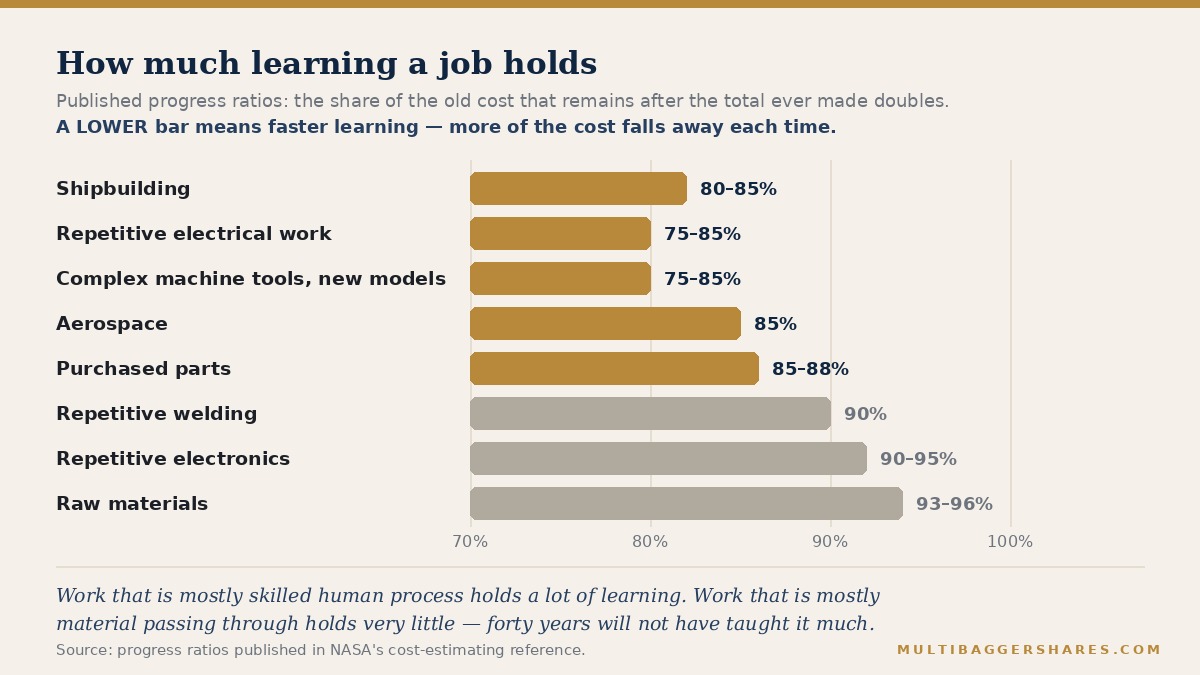
How much room is there to learn in this particular work? Published estimates of how fast costs fall per doubling differ sharply by the kind of task — very little for work that is mostly bought-in material, a great deal for complex assembly done by skilled people. If a business mainly buys material and passes it along, forty years will not have taught it much, because there was not much there to be taught.
Which of the four reasons explains the falling cost? When a company tells you its costs per unit have come down, go and look at three other things over the same years. What happened to its spending on plant and machinery — did it simply buy the saving? What happened to its output — is this just scale? And what happened to complaints, warranty claims, returns and rejects — did it quietly buy the saving from its customers, the way the Liberty yards did? If assets and volumes are flat and quality is steady or improving, what is left is the interesting kind.
What would a rich rival still be missing in three years? This is the question that settles it. Imagine a competitor with unlimited money starting tomorrow. It can buy the machines, the building, the raw material and the people’s salaries. Name the specific thing it would still not have in three years’ time. If you can name it — the reject rate that took a decade to bring down, the batch that only this team knows how to rescue, the settings nobody has ever written on paper — there is probably a real curve. If you cannot name it, there probably is not one, whatever the company’s own materials say.
Watch the people too, because the knowledge lives in them. Long-serving staff on the shop floor, low turnover among supervisors and promotion from within all suggest a business that keeps what it has learnt. Heavy churn in exactly those roles is the sound of a curve leaking away.
Finally, keep all of this in proportion. Knowing that a business has genuinely learnt its work tells you something real about that business and nothing whatsoever about anything else. It still has to earn a decent return on the capital it employs, still has to avoid owing more than it can comfortably service, still has to turn its reported profits into actual cash in the bank. A thousand jalebis behind you is a good reason to look closer. It is never a reason to stop looking.
Key takeaways
- Wright’s 1936 rule counts cumulatively: each doubling of the total ever made — not of this year’s output — cut the labour per aircraft by about a fifth.
- Scale is how many you make this year and can be bought with money. Learning is how many you have ever made and can only be bought with years, which is why it is the harder advantage to copy.
- A falling cost per unit has four possible causes — more volume, more machinery, real learning, or quietly worse quality. The Liberty ship records turned out to be mostly the first two and some of the fourth.
- Genuine learning still runs out: new technology resets the curve to zero, deep learning makes a firm stiff and slow to change, it does not carry across to a new product, and it can resign.
- The test that settles it — name what a rival with unlimited money, starting tomorrow, would still be missing in three years. If you cannot name it, there is no curve.
— Manish Goel · multibaggershares.com
Disclaimer: This article is published by multibaggershares.com for education and general information only. It is not investment advice, investment research, or a recommendation to buy, sell or hold any security. Any companies named are discussed only as illustrative examples. Markets carry risk; please do your own research or consult a qualified professional before making any investment decision.