The Name Written Into the Drawing: How to Judge a Supplier the Customer Chose Only Once

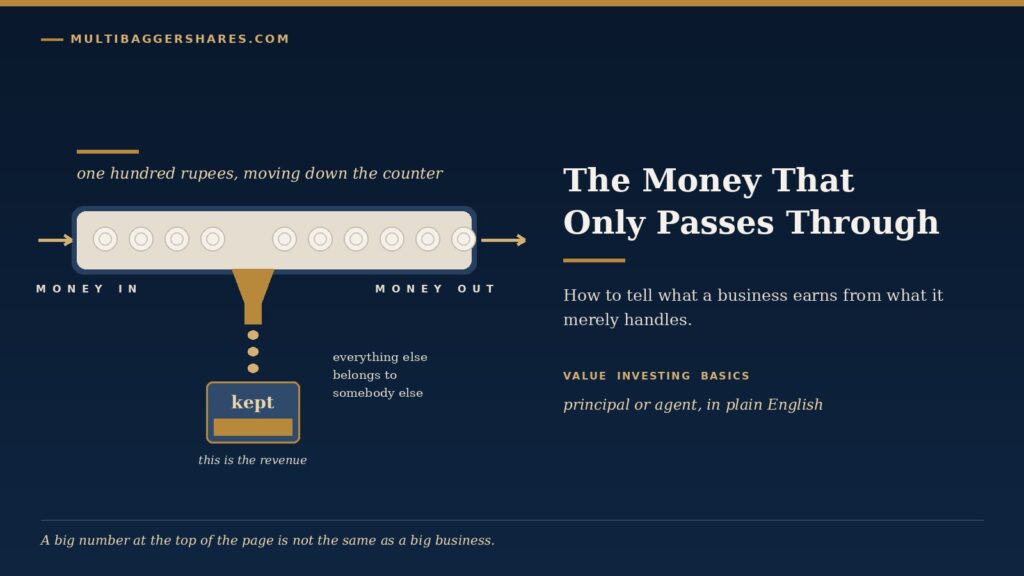
The Money That Only Passes Through: How to Tell What a Business Earns From What It Merely Handles
September 18, 2026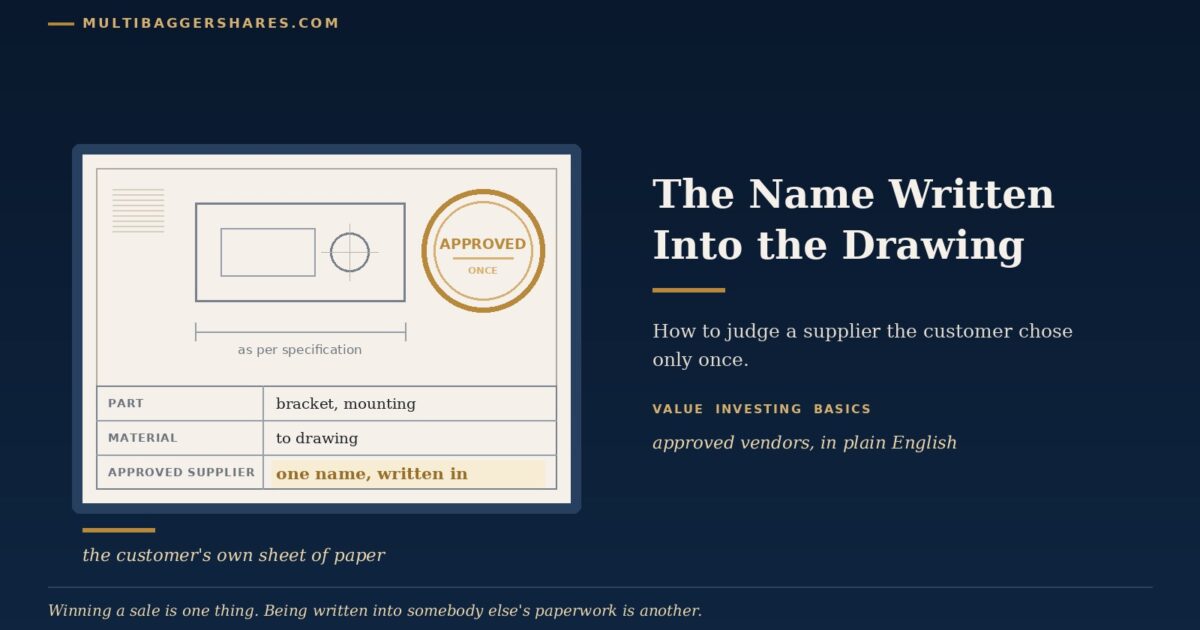
Two stationery shops stand on the same road outside a school in a small town. Both sell notebooks, pencils, chart paper and geometry boxes. Both have the same shelves, the same fan turning slowly overhead, and very nearly the same prices.
The first shop sells to whoever walks in. Every morning it begins at zero. A mother comes in, looks at three notebooks, asks the price of each, asks for ten rupees off, and may or may not buy. Tomorrow the same conversation happens again with somebody else. The shop is good at this. But it wins each sale one sale at a time.
The second shop did something different, years ago. It took its samples to the school office and sat through a long meeting. Today the school’s Class 6 circular names one particular geometry box — by brand, by model number — and that is the box this shop stocks. Every parent of every new Class 6 batch walks in already knowing what they must buy. There is no discussion about which one.
The second shop did not win four hundred parents. It won one decision, once, and that decision keeps paying every June.
Now notice the part that actually matters. Nothing stops the school from changing the circular tomorrow. But changing it means reprinting the circular, telling every class teacher, and answering the parents who have already bought the old box. The trouble of changing sits with the school, not with the shop. That small, dull fact is the whole subject of today’s letter.
In business, this is called being qualified or approved, and in its strongest form it means being written into the specification — the customer’s own written description of exactly what it will buy, sometimes naming the supplier outright. It is one of the most durable advantages a business can have. Unlike most advantages, it also leaves a paper trail, which means an ordinary reader can go looking for it.
What “approved” actually means
Three plain words first, because everything else rests on them. A specification is the written description of a part or material — its size, its strength, its purity, how it must be tested. An approved vendor list is the list a buyer keeps of the suppliers it is permitted to buy a particular item from; a supplier not on the list simply cannot be bought from, however good its offer. Qualification is everything a supplier must go through — paperwork, factory inspection, sample testing, sometimes months of trial use — before its name is added to that list.
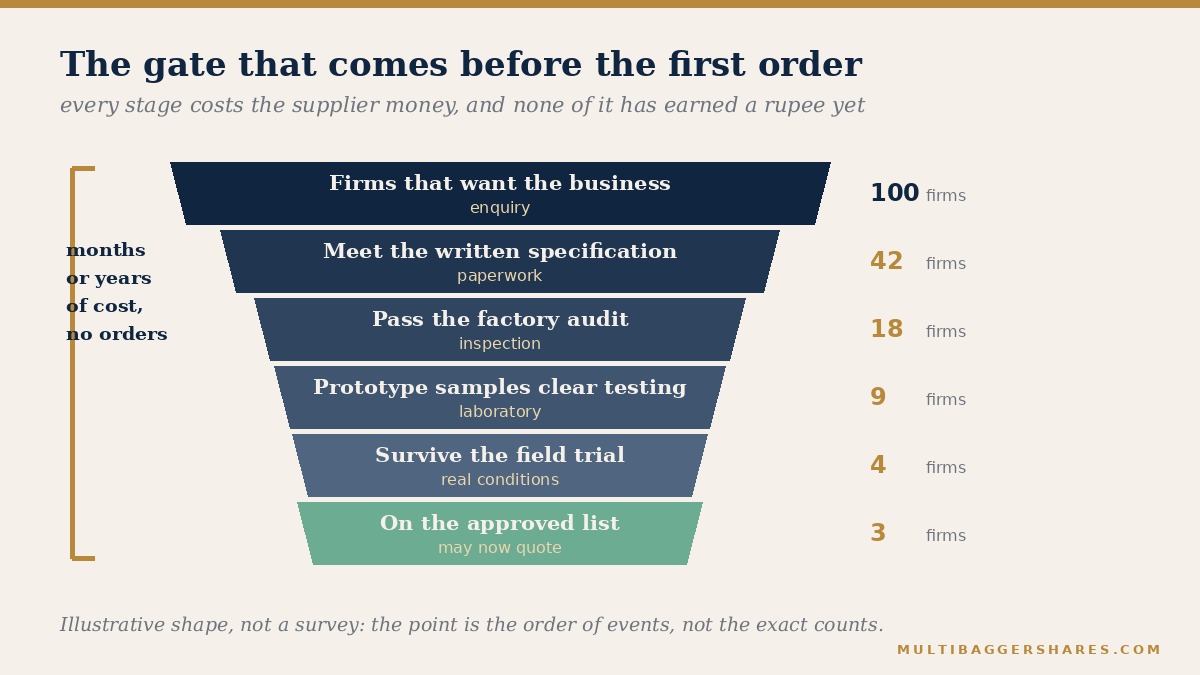
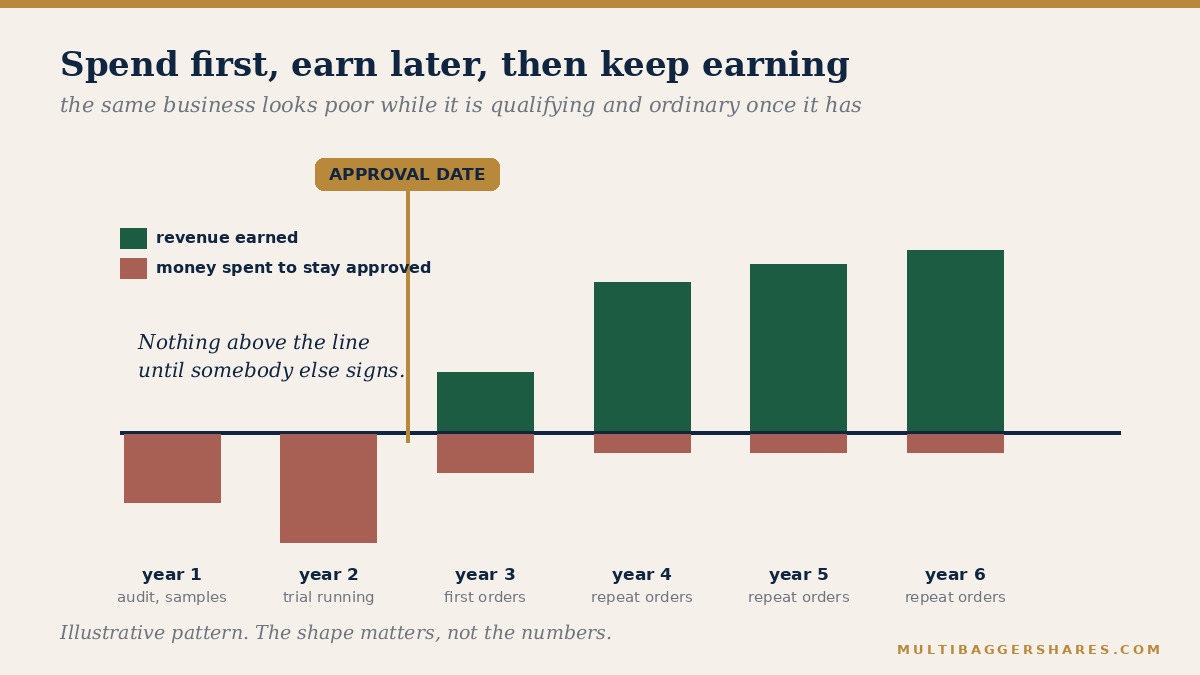
The ordinary way of selling runs in a familiar order: you offer, they buy, you deliver, and if they liked it they may come back. Qualification turns that order upside down. The customer inspects your factory, tests your samples, and sometimes runs your part in real working conditions for a year — all before it has paid you for a single production order. You spend first. You earn later. And then, if you get through, you keep earning without having to re-argue the case every year.
This is close to an idea we have looked at before — switching costs, the effort a customer would have to spend to change to somebody else. But there is a real difference worth holding on to. With ordinary switching costs, what holds the customer is usually their own habit, their own staff training, or their own data. Here, what holds the customer is a document: a drawing, a printed list, a filing with a government department. And in the strongest cases, the customer cannot change suppliers on its own authority at all. It has to go and ask a regulator first.
It is also not the same thing as a long contract with guaranteed quantities. An approval promises you nothing about volume. It does not say the customer will buy a single rupee’s worth. All it changes is who bears the trouble and the cost if the customer wants to replace you. That is a smaller claim than a guarantee — and in practice it often lasts longer, because it does not expire on a date.
Why it is so hard to undo
Three forces hold an approval in place, and it is worth understanding each one separately, because a business may enjoy only one of them or all three.
The first is plain cost. Re-testing a replacement part takes laboratory time, engineers’ time, and production stoppages that nobody budgeted for. The saving on the new supplier’s price has to be big enough to cover all of that, and then keep being big enough for years.
The second is human, and it is the strongest of the three in daily life. Think about the person inside the customer’s office who would have to sign the change. If the cheaper part works, he has saved the company two per cent on one line item and nobody will remember. If it fails in the field, it is his signature on the approval. The reward for changing is small and shared; the blame for changing is large and personal. Most people, quite sensibly, leave it alone.
The third is legal, and it is the version that turns a preference into something close to a wall. In some industries the customer is not allowed to change supplier quietly, because the supplier’s name sits inside a document filed with a government authority. Changing it means filing again and waiting for permission.
Three places you can see it written down
This is not theory. In three large industries the process is public, standardised and documented, and reading about any one of them will change how you look at a supplier company.
A part in a car. The global automotive industry runs a procedure called the Production Part Approval Process, or PPAP, published by the Automotive Industry Action Group and required under IATF 16949, the industry’s quality-management standard. A supplier assembles a package of eighteen separate documents — the drawing, the test results, measurements on sample pieces, a control plan showing how each risk is checked. The single page that summarises the lot is called the Part Submission Warrant, and it is signed by the customer, not by the supplier. Depending on the level demanded, anything from that one page to the full file plus physical samples must be handed over. Here is the detail that matters most for our purpose: approval must be obtained again whenever a new or modified component is introduced, or the manufacturing process is changed. The supplier cannot quietly move a machine to another shed.
An ingredient in a medicine. In the United States, changes to an approved medicine are governed by a rule numbered 21 CFR 314.70. It sorts every change into three buckets: major, moderate and minor. A change in the drug substance — the active ingredient itself — that has, in the rule’s own words, a substantial potential to have an adverse effect on the identity, strength, quality, purity or potency of the medicine, is a major change. For a major change, the rule says the company must obtain approval from the regulator before it distributes any medicine made using the change. Changes in how the active ingredient is made, where these may affect its impurity profile, are named in the rule as an example of exactly this kind of major change. So when a medicine maker is offered the same ingredient more cheaply, it cannot simply switch. It files, and it waits.
A component on the railways. In India, safety-critical railway items go through vendor approval by the Research Designs and Standards Organisation, RDSO. The stages are the ones you would expect and then some: scrutiny of documents, an audit of the factory itself, testing of prototype samples, and for many items a field trial — the part running under real conditions on real track — before the firm is listed in the approved vendor directory. New entrants typically begin with limited developmental orders before they are treated as regular suppliers. A company that has been through all of that has something a well-funded newcomer cannot buy in a hurry.
What this does to the numbers you can read
You cannot reduce any of this to a single ratio, and you should be suspicious of anyone who offers you one. What an approval does is change the shape of a company’s results, and shape is something a patient reader can see.
Sales become steadier than the industry around them. Because the revenue does not have to be re-won every year, a weak year for the customer usually shows up as a smaller order, not as a lost customer. Look at five or six years of sales and ask whether the dips look like a dip in demand or like somebody walking away.
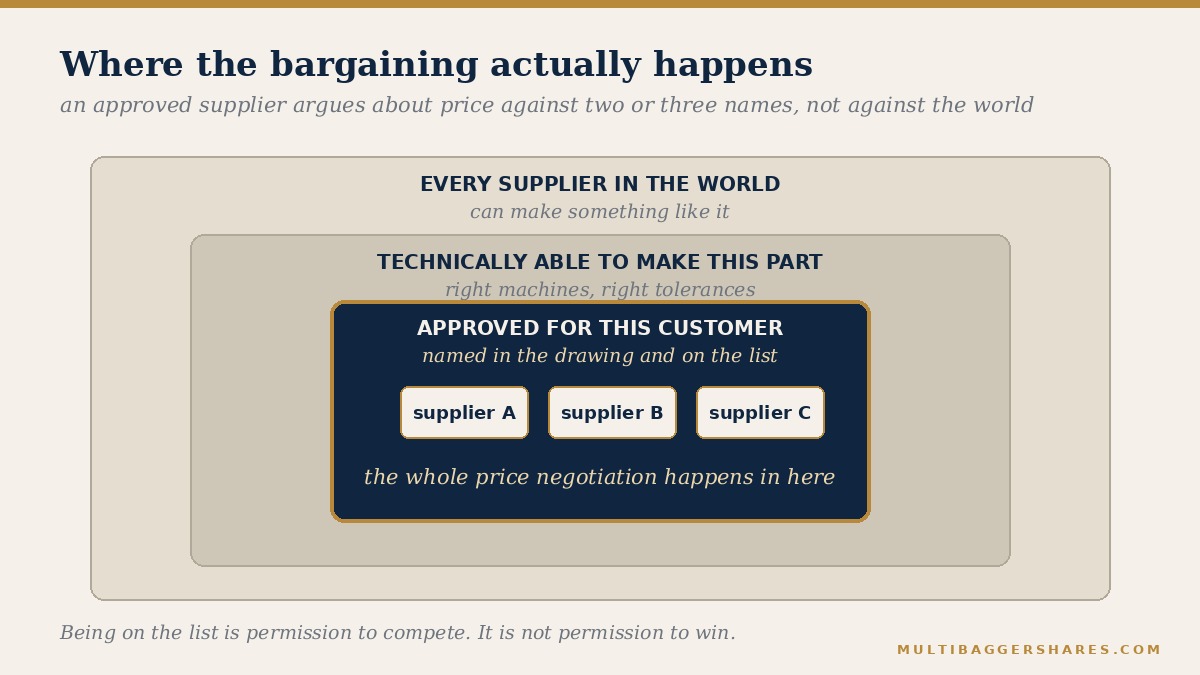
Bargaining happens inside a small room. The company is not arguing about price against every factory in the world. It is arguing against the two or three other names that are also on the list. That does not make it comfortable — but it is a very different contest, and it is why margins in such businesses often hold up better than you would expect for what looks like a plain components maker.
The customer list stops changing. In the annual report, read the words rather than only the figures. Phrases such as approved vendor, qualified supplier, customer audits, or homologation (the formal act of an authority or a customer certifying that a product meets its requirements) are the company telling you, in dry language, that it sits inside somebody else’s paperwork. Then check whether the same customers appear year after year.
And the cash arrives late in the story. Expect a long stretch of spending — on the plant, on testing, on the staff who prepare all those documents — before the first real order. A company in the middle of qualifying looks worse on paper than it is. A company that has finished qualifying looks ordinary and is not.
The other side of the same coin
Now the honest half, because an approval is not a blessing without a bill attached.
It locks the supplier too. If you cannot change your machine or your own raw-material source without going back for re-approval, then you also cannot chase every cheaper input that comes along. The wall that keeps rivals out keeps you in.
Approval is permission to compete, not permission to win. Sensible customers deliberately keep two or three approved names for the same item, precisely so that no single supplier can hold them up. Being on the list is necessary. It is not sufficient.
Lists can be edited. Fail an audit, miss deliveries, let quality slip, and a name can be suspended or removed. The very process that protected the company is perfectly capable of ejecting it.
You inherit your customer’s fate. If the model of car your part goes into stops selling, your approval for that part is worth nothing. Being written into a document is only as valuable as the thing the document describes. This is why it is worth asking not just who approved the company, but what for.
And the waiting is real money. Years of spending can go into an approval that never arrives, or arrives after the customer has changed its plans. For every company that clears the gate, others spent the same money and did not.
How you can use it
The practical test has only two questions, and you can ask them about any supplier company you come across.
First: does somebody else’s document name this company? Not a friendly relationship, not a long association — an actual drawing, list, filing or circular. Second: if the customer wanted to remove that name, who would have to do the work? If the answer is the customer, at its own cost, and in some cases only with a regulator’s permission, then you have found something genuinely uncommon.
Two follow-up questions sharpen the picture. How long did the approval take? A qualification that took two years is a stronger wall than one that took two months, for the simple reason that a rival must now also spend two years. And has the company been approved by more than one demanding customer? One approval can be luck or a favour. Three, from customers who do not know each other, suggests the underlying capability is real.
Finally, keep this in proportion. Knowing that a business is hard to replace tells you something important about the business and nothing at all about anything else. It still has to earn a decent return on the capital it employs, still has to avoid owing more than it can comfortably service, still has to turn its profits into actual cash. A name written into a drawing is a good reason to look closer. It is never a reason to stop looking.
Key takeaways
- Most suppliers win each sale again every time. A qualified supplier won one decision once, and the trouble of undoing it belongs to the customer.
- Qualification reverses the normal order of business: the inspections, tests and trials all come before the first paid order, so the spending comes years before the earning.
- Three forces hold an approval in place — the cost of re-testing, the personal risk carried by whoever would sign the change, and, strongest of all, a regulator who must agree first.
- It cuts both ways. An approved supplier cannot casually change its own machines or inputs either, customers keep rival names on the same list, and an approval can be withdrawn.
- Two questions do most of the work: does somebody else’s document name this company, and who would have to do the work of removing the name?
— Manish Goel · multibaggershares.com
Disclaimer: This article is published by multibaggershares.com for education and general information only. It is not investment advice, investment research, or a recommendation to buy, sell or hold any security. Any companies named are discussed only as illustrative examples. Markets carry risk; please do your own research or consult a qualified professional before making any investment decision.