The Shop With the Price List on the Wall: How to Judge a Business Whose Profit Is Decided by Someone Else

Who Pays for the Next Shop: How to Judge a Company That Grows by Lending Out Its Name
September 15, 2026
Every few weeks my neighbour walks past the fair-price shop at the end of our lane and complains about the man who runs it. The wheat is coarse. The queue is long. The shutter comes down at odd hours. What my neighbour never says — because it does not occur to him — is that the man behind the counter did not choose a single one of those prices.
The rate for every item on that shelf is fixed by the government. The shopkeeper cannot charge more when the queue is long. He cannot charge less to pull a customer away from the shop two lanes over, because there is no shop two lanes over — the licence is his. For carrying the stock, storing it and handing it out, he is paid a set commission on every quintal he sells. That is his whole income. Good month, bad month, festival, monsoon: the rate does not move.
Most people hear that and feel sorry for him. But turn it around for a moment. He cannot make a killing — and he cannot be wiped out either. No rival can undercut him. No bad season can take his margin to zero. His income is not large, but it is almost boringly certain, and he can plan his life around it.
There are companies on the Indian exchanges — some of the biggest of them — that are run on exactly this arrangement. Not the shop’s scale, but the shop’s logic. A regulator decides what they are allowed to charge, and the calculation behind that price is built so that the company earns a fixed, publicly announced return on the money its owners have sunk into it. Nothing more. Usually nothing less.
What a capped return actually means
Start with the word return. If you put ₹100 of your own money into a business and it earns ₹15 of profit in a year, your return on equity (the profit earned for every ₹100 of the owners’ own money in the business) is 15 per cent. In an ordinary company that number is an outcome. It is whatever is left after customers, competitors, costs and luck have finished with you. It can be 4 per cent one year and 26 per cent the next.
In a capped-return business, that number is an input. The regulator begins with it. It decides, in advance, that the owners of this business are entitled to earn — say — 15 per cent on the equity (the owners’ own money, as opposed to borrowed money) they have put into the asset. Then it works backwards to the price.
The working is not mysterious. The regulator adds up what it costs to run the asset for a year: operations and maintenance; then depreciation (spreading the cost of a long-lived asset across the years it will be used, so that a ₹1,000 crore line built to last forty years charges roughly ₹25 crore to each of those years); then the interest on the money borrowed to build it; and finally the allowed return on the owners’ equity. That total is the revenue the business is permitted to collect. Divide it by the units it will deliver, and you have the price on the wall.
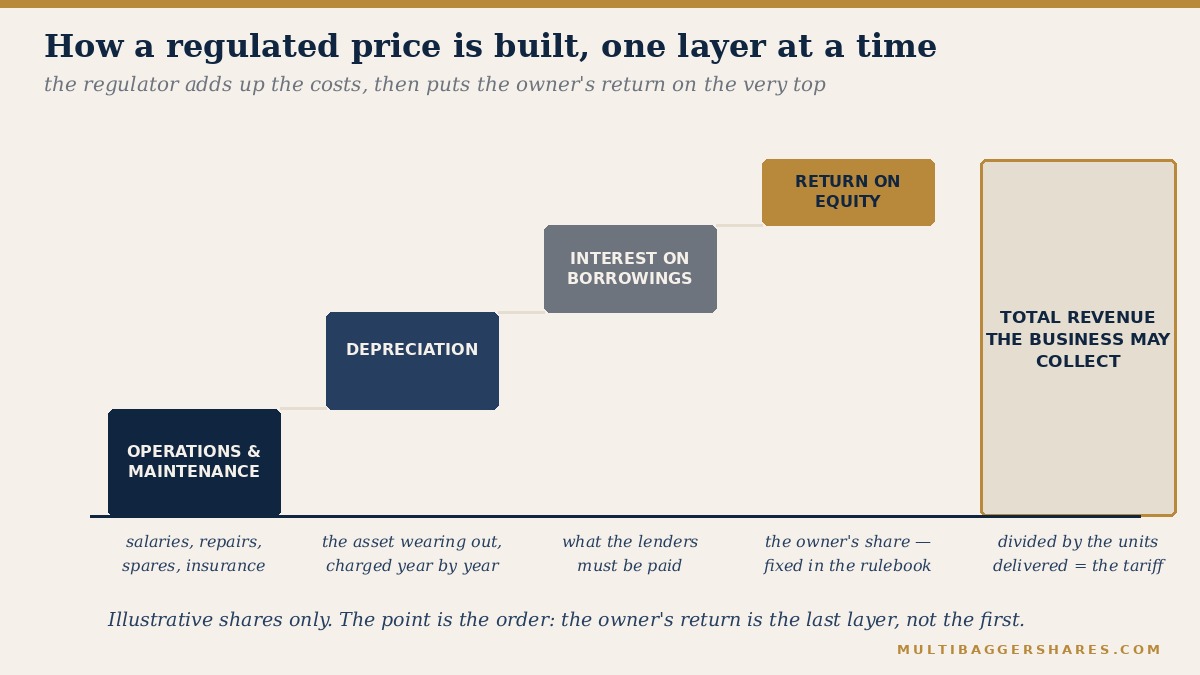
Two consequences follow, and nearly everything else in this letter comes out of them. The first: because the return is calculated on the capital the company has invested, the only honest way such a business can grow its profit is to invest more capital. It cannot grow by charging more, because it is not allowed to charge more. It grows by building another line, another pipe, another substation — and being permitted to earn the same fixed percentage on that new money too.
The second: the size of that invested pile is the number that matters, not the sales figure. Practitioners call it the regulated asset base — the approved, commissioned capital on which the company is entitled to earn. Revenue follows the asset base almost mechanically. Watch the base and you have watched the business.
Why a ceiling on profit can still be worth having
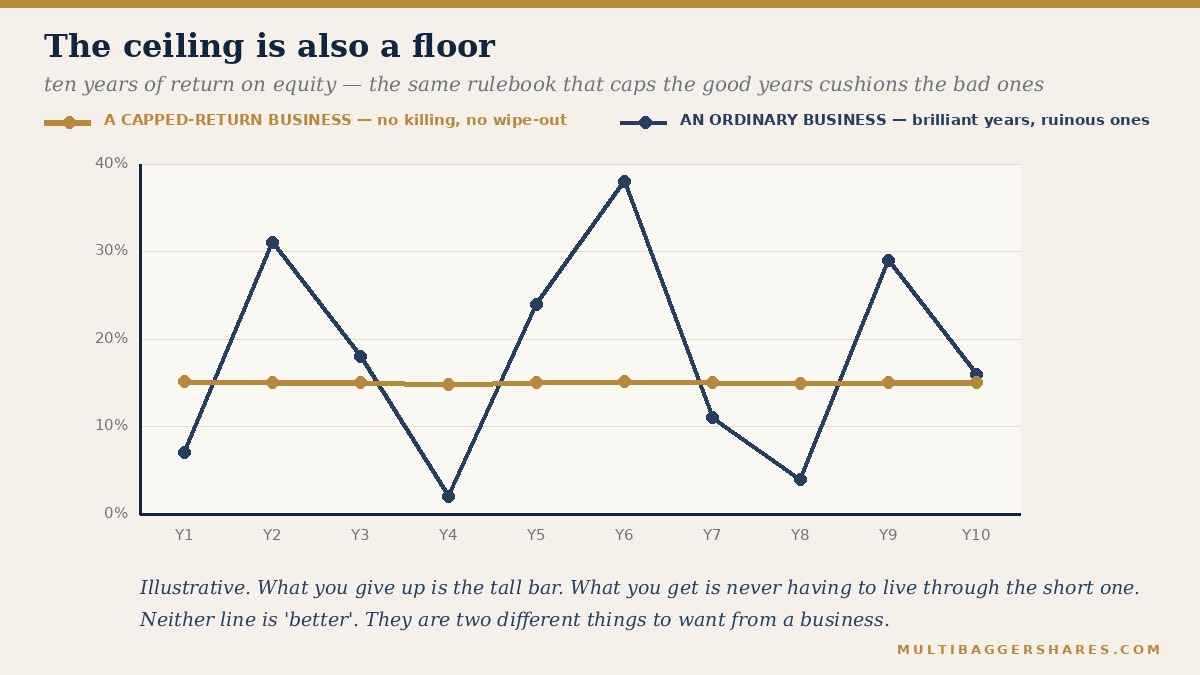
A ceiling is only half of the arrangement, and the half beginners miss is the other one: the same rulebook that stops the business earning 40 per cent also makes it very hard for the business to earn 2 per cent.
Think about what the regulator has actually promised. The permitted price already contains the company’s running costs. It contains the interest on its debt. It contains the wear and tear on its assets. Only after all of that is the owner’s 15 per cent added on top. The owner is standing at the back of a very short queue, on a road that has been closed to other traffic.
It is the difference between a farmer who sells at the mandi (the open agricultural market, where the price on any given morning is whatever the buyers feel like paying) and a farmer on a fixed-price contract signed before the sowing. The mandi farmer will have his brilliant year. He will also have the year that ruins him. The contract farmer will have neither.
That predictability is not a consolation prize. It does real work. A business whose revenue is set by formula can carry far more debt safely than a business whose revenue depends on the mood of the market, because a lender can see the cash coming years ahead. And because the return is earned on capital, a company that keeps finding approved projects to build can compound (earning returns on your past returns — interest on interest, like a snowball rolling downhill) steadily for decades.
The catch is real, though, and it should be said plainly: a steady modest rate is exactly what you get. Fifteen per cent on equity, less whatever is paid out as dividend, is not the arithmetic of a fifty-bagger. Anybody hunting for a business that multiplies many times over is looking at the wrong animal here. What this animal offers is a high probability of a decent outcome, which is a different thing to want — and a perfectly respectable one.
What India’s electricity regulator actually promises
None of this is theory in India. It is written down, in numbers, by the Central Electricity Regulatory Commission — the CERC, the body that fixes tariffs for inter-state transmission lines and for large generating stations.
Its current rulebook, the Terms and Conditions of Tariff Regulations, 2024, covers the five years from 1 April 2024 to 31 March 2029. For a project that begins commercial operation on or after 1 April 2024, it sets the base return on equity at 15.00 per cent for a transmission system, and 15.50 per cent for a thermal generating station. Pumped hydro storage and run-of-river-with-pondage projects were moved up to 17 per cent.
Read that again, because it is genuinely unusual. A company can look up, in a public document, the percentage it is entitled to earn on its owners’ money for the next five years. Almost nothing else listed on the exchange can do that.
Notice also what changed. For transmission the previous rate was 15.5 per cent; the new rulebook cut it to 15.00 for new projects. Analysts put the effect at roughly 3 per cent off post-tax earnings on an affected project, and only about 1 per cent off EBITDA (earnings before interest, tax, depreciation and amortisation — a rough measure of operating cash generated before financing and accounting charges). The point is not the size. The point is that it happened at all, and that the company had no vote in it.
India’s largest power transmission company is built almost entirely on this arrangement: roughly 95 per cent of its turnover comes from the regulated transmission business, where the tariff recovers operations and maintenance, depreciation and interest, and then adds the allowed return on equity. Its regulated equity — the owners’ money on which it is entitled to earn — is of the order of ₹82,000–83,000 crore, sitting under a gross block (the original cost of all fixed assets, before any depreciation is subtracted) of roughly ₹2,88,800 crore, with around ₹29,600 crore of work still in progress. That last figure is the interesting one for anybody trying to understand what comes next: it is a large part of next year’s asset base, still under construction.
Three ways the floor cracks
So far this may sound too safe to be true. It is not. Three things can break the promise, and every one of them has already happened somewhere.
One: the regulator can change the deal. The whole structure rests on what is sometimes called the regulatory compact — an understanding that a utility which invests heavily in assets the public needs will be allowed a reasonable return on that investment. It is an understanding, not a contract with a paying customer, and understandings move with the public mood. Writing to his shareholders in 2023 about the regulated utility business his company owns, Warren Buffett admitted he had failed to see this coming: he did not anticipate, he wrote, “the adverse developments in regulatory returns,” and called it a costly mistake. If the most patient investor of the last century can be caught by a regulator changing its mind, the risk is worth taking seriously.
Two: the customer can fail to pay. An allowed return is permission to raise a bill, not a guarantee of collecting one. India’s electricity distribution companies — the mostly state-owned discoms that buy power and sell it on to households — have been chronically late payers. On the government’s own payment-tracking portal, PRAAPTI, their outstanding dues to generators were around ₹61,600 crore for the January 2025 billing cycle and around ₹71,750 crore by April 2025. Generators allow 45 days to pay; after that the amount is overdue and usually carries penal interest. A company can be earning its full regulated return on paper and still be short of cash in the bank, because the return was recognised and the money never arrived.
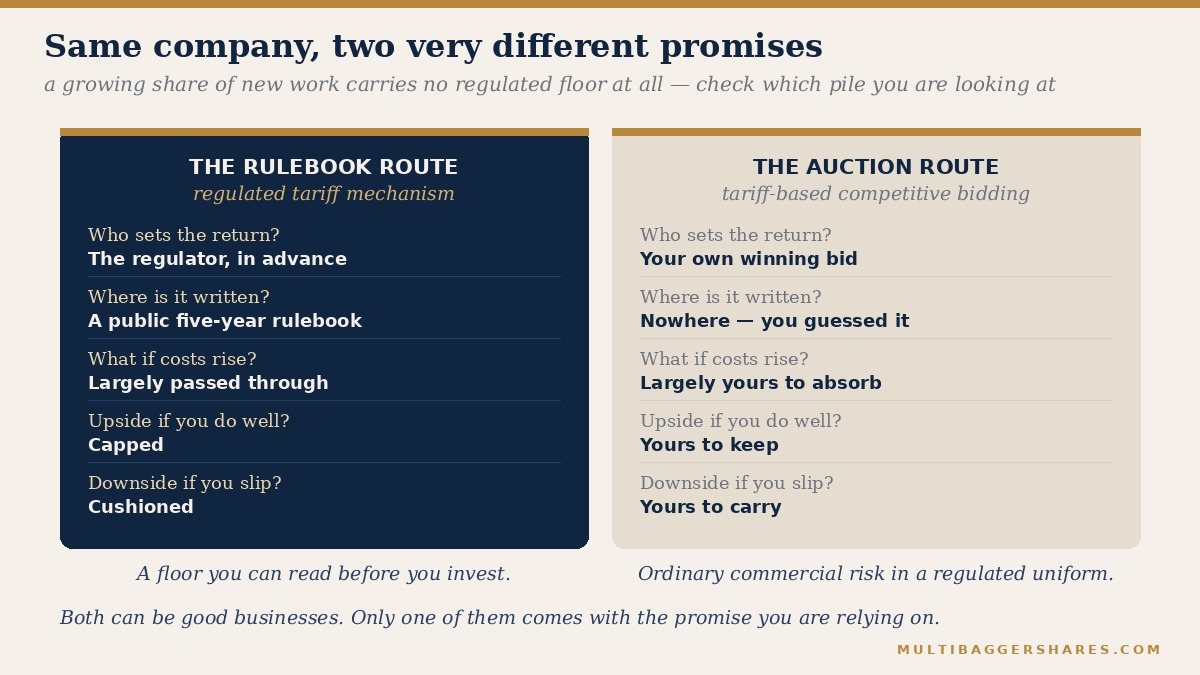
Three: the guarantee can be auctioned away. This is the change most small investors miss entirely. In transmission, most new inter-state projects are no longer handed out with a return attached. They are awarded through tariff-based competitive bidding — TBCB — in which developers bid the annual charge they are willing to accept, and the lowest bid takes the project. The winner does not receive a promised 15 per cent. It receives whatever return its own bid turns out to imply, and it lives with the result. In September 2026 India’s largest transmission company received a letter of intent for a competitively bid project to carry 6 GW of renewable power out of a Rajasthan renewable energy zone, at annual transmission charges of about ₹3,244 crore. That is a real and substantial business. It is simply not the business described in the rulebook, and it should not be judged as though it were.
The business that looks capped and is not
Now the mirror image, because the mistake runs in both directions.
India’s city gas distributors — the companies that pipe cooking gas into flats and sell CNG at pumps — are overseen by the Petroleum and Natural Gas Regulatory Board. They win their territories in competitive rounds in which the board weighs, among other things, the network tariff and compression charge they are prepared to accept. And they are granted exclusivity: no rival may build a competing network in their area for 25 years, with a shorter marketing exclusivity, commonly around five years, on top of it.
Everything about that description says capped-return business. Licence, regulator, tariff, exclusivity. Yet the board does not have the power to fix the one number that matters most to these companies — the marketing margin they add when they sell the gas on. The board has itself acknowledged that it lacks that authority. So the network tariff is regulated, and the selling margin, in practice, is not.
The lesson here is not about gas. It is that “regulated” is not one thing. Before you assume a business has a floor under it, find out which number the regulator actually controls. Sometimes it is the price. Sometimes only a slice of the price. Sometimes it is the return itself. And sometimes, as here, it is mostly just the entry ticket.
How you can use this
Work out how much of the revenue is really regulated. The annual report will normally tell you, either in the segment note or in the management discussion. A company with 95 per cent of turnover under a tariff formula is a different creature from one with 40 per cent under a formula and the rest exposed to the open market. Both may be described in the press as a regulated business.
Watch the asset base, not the order book. For a capped-return business, profit grows when approved capital grows. Put five years of gross block and capital work-in-progress side by side. If the base is flat, the profit will be too, whatever the announcements say.
Find the current tariff order and its expiry date. Rulebooks run in blocks — the Indian electricity one runs five years at a time. You should know which rate applies to the company you are reading about, and in which year the next negotiation falls due. That date is the single biggest scheduled uncertainty in the whole business.
Check whether the money is actually being collected. Look at receivables, or at debtor days (how many days of sales are sitting unpaid). In a regulated business this matters more than usual, because the profit line is reliable by construction and the cash line is not.
Separate the promised pile from the bid-for pile. If a company is winning projects at auction, those projects carry no regulatory floor. Growth from auctions is still growth. It is just ordinary commercial growth wearing the uniform of a regulated one, and it deserves ordinary commercial scepticism.
The man in the fair-price shop at the end of our lane will never get rich from that counter. But he also knows, to the rupee, what next March looks like — and there are not many shopkeepers in India who can say that. The companies built on his logic are the same. Know which of the two things you are buying into, check that the price list on the wall has not quietly been rewritten, and the arrangement can serve a patient owner very well for a very long time.
Key takeaways
- In a capped-return business the regulator sets the return on equity first and works backwards to the price — so profit is an input, not an outcome.
- Because the return is earned on invested capital, such a company grows profit only by growing its approved asset base. Watch the gross block and work-in-progress, not the announcements.
- The ceiling is also a floor: costs, interest and depreciation are recovered before the owner’s return is added, which buys predictability but rules out spectacular years.
- The promise breaks in three ways — the regulator revises the rate, the customer does not pay, or the project is won at auction with no guaranteed return at all.
- “Regulated” is not one thing. Always find out which number the regulator actually controls before assuming a business has a floor beneath it.
— Manish Goel · multibaggershares.com
Disclaimer: This article is published by multibaggershares.com for education and general information only. It is not investment advice, investment research, or a recommendation to buy, sell or hold any security. Any companies named are discussed only as illustrative examples. Markets carry risk; please do your own research or consult a qualified professional before making any investment decision.