Who Pays for the Next Shop: How to Judge a Company That Grows by Lending Out Its Name

The Tailor Whose Name Is Never on the Shirt: How to Judge a Company That Makes What Someone Else Sells
September 14, 2026
The Shop With the Price List on the Wall: How to Judge a Business Whose Profit Is Decided by Someone Else
September 16, 2026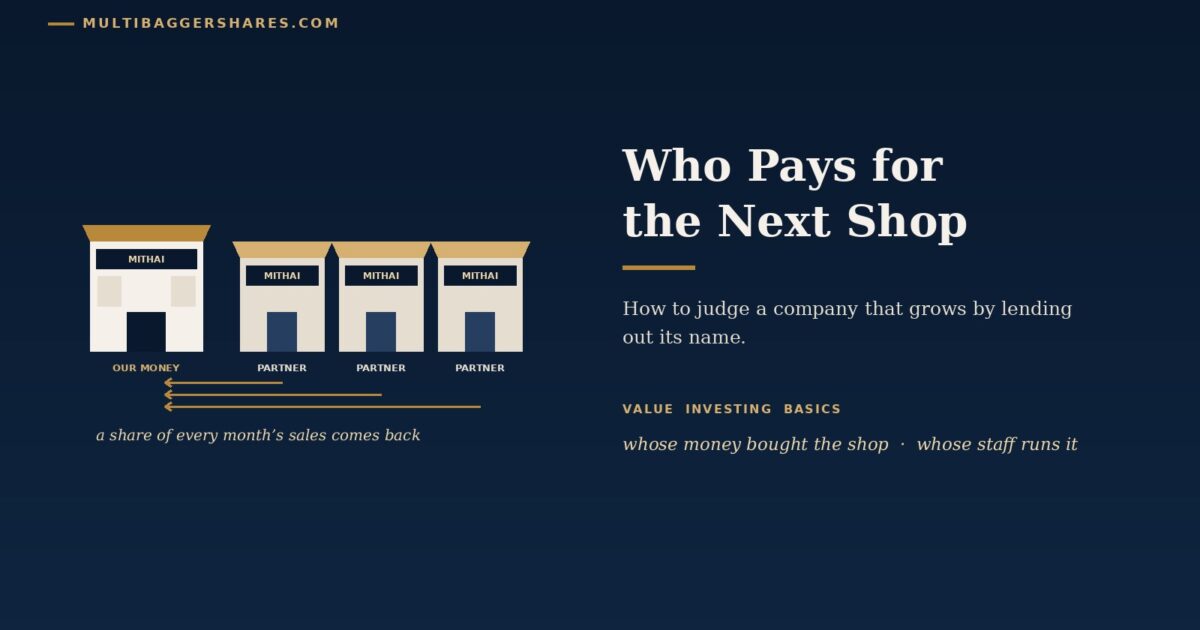
There is a mithai shop in the town where my mother grew up. One counter, two men behind it, a glass case of barfi and a steel tray of jalebi that is refilled all day. On the two days before Diwali the queue reaches the chemist four doors down. The family has been selling sweets from that counter for about forty years, and the name on the signboard means something within roughly ten kilometres of it.
A few years ago a cousin in a bigger town asked for that name. He would take a shop on rent, fit the counter, buy the glass case, hire the two men, and put the family signboard above the door. The sweets would come from the original kitchen. He would keep the profit from his own shop and send a share of his sales back to the family every month.
The family could have said no and opened the second shop themselves. It would have cost them their own savings, or a loan. Instead they said yes to the cousin. Within a few years there were four shops with that name, and the family had paid for exactly one of them.
That arrangement is one of the quietest, most powerful ideas in business, and a great many listed companies are built on it. If you can learn to spot it in an annual report — and to spot the version of it that does not work — you will understand something about the quality of a business that its share price will never tell you.
What it really means
The formal word for the cousin’s arrangement is franchising (letting somebody else trade under your name and your system, in return for a payment). The payment usually has two parts: a one-time fee to join, and then a royalty (a continuing share of that outlet’s sales, month after month, for as long as it is open).
To see why this matters to an investor, you need one more term. When a company builds a shop, a factory or a warehouse, the money it spends is called capital expenditure, or capex (spending that buys something lasting, rather than paying this month’s bills). What that money buys sits on the balance sheet as fixed assets, often shown as gross block (the total original cost of all the land, buildings, machines and fittings the company owns).
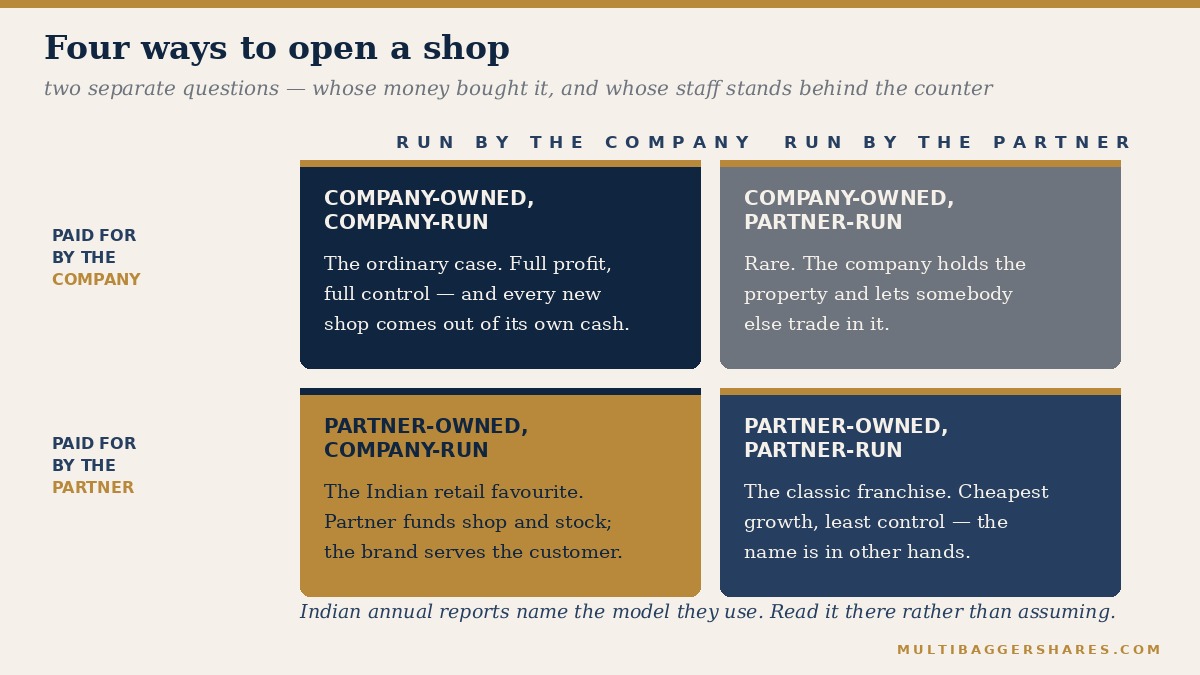
So there are really only two questions to ask about any chain of outlets, and they are separate questions. First: whose money bought the shop? Second: whose staff runs it? Put the two together and you get four combinations, and the Indian annual reports that discuss this actually use the initials.
A company-owned, company-operated outlet is the ordinary case: the company paid for it and the company runs it. A franchise-owned, franchise-operated outlet is the cousin: he paid, he runs it. In between sits the arrangement many Indian retailers prefer — franchise-owned but company-operated, where the partner puts up the money for the shop and the stock, and the brand’s own people stand behind the counter, so that the customer’s experience is identical everywhere. The partner earns a commission on what the shop sells.
A business that grows mostly through the second and third of these is described as asset-light (it grows without buying much of its own). That phrase gets used loosely in brochures. In the accounts it means something very specific and very checkable, and we will come to how you check it.
Why it works
The reason this arrangement is powerful has nothing to do with cleverness. It is arithmetic. The measure that matters is return on capital employed, or ROCE (the profit a business earns divided by the money tied up in it — what you get back each year for every rupee locked in). A shop that needs one crore of fittings and stock and earns fifteen lakh a year is earning fifteen percent on the money in it. Respectable. About what a decent business does.
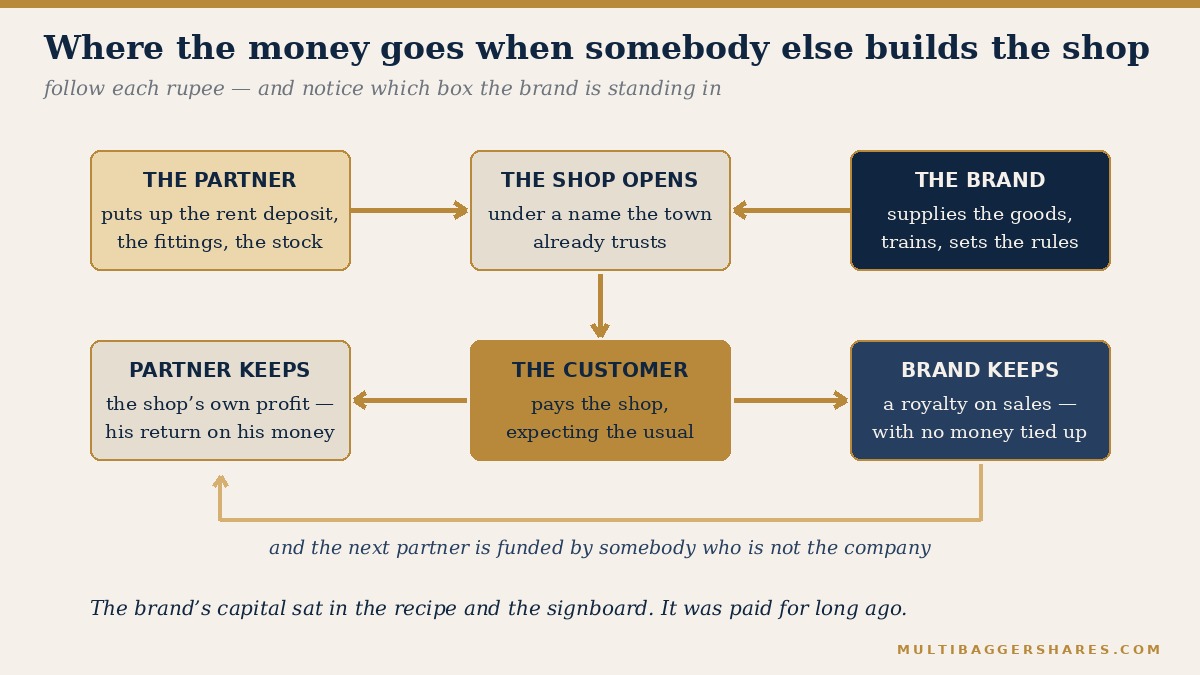
Now let the cousin put up that one crore. He earns the shop’s profit. The brand earns only its royalty — a smaller amount in rupees, perhaps six lakh instead of fifteen. But the brand has almost no money tied up in that shop. Its own capital sat in the kitchen, the recipes and the signboard, and those were paid for long ago. Divide six lakh by very little and the answer is not fifteen percent. It is a very large number.
That is the whole trick, and it has two consequences that compound over years. The first is that the brand’s return on capital rises as the chain grows, instead of being dragged back towards the return on a single shop. The second is subtler and, in India especially, more important: the speed of growth is no longer limited by the company’s own bank balance.
Think about what that removes. A chain that funds its own outlets can open only as many as its profits or its borrowings allow. In a bad year it must slow down. If it refuses to slow down, it borrows, and debt (borrowed money that must be repaid on a fixed date whatever the sales are doing) turns a slow year into a dangerous one. A chain that grows through partners faces none of this. Its growth is funded by hundreds of people who want the signboard badly enough to pay for it.
And notice what the brand is actually selling. Not sweets, in the end. It is selling the certainty that a customer walking past an unfamiliar shop already knows what she will get. That certainty took forty years to build and costs almost nothing to lend to the next shop. This is why the arrangement is a quality signal rather than a financing trick: only a business with something genuinely valuable to lend can find partners willing to fund its growth.
A real example or two
The largest example in the world is a hamburger company. At the end of 2025 there were 45,356 restaurants in the system, and about 95 percent of them were franchised — owned and run by other people. In 2025 alone the system opened 2,276 restaurants. The company did not build most of them.
What that company keeps is instructive. Its income from franchisees comes in two forms: royalty on sales, and rent, because in many locations it holds the property and the franchisee is its tenant. In 2021, of roughly 13 billion dollars received from franchisees, close to two-thirds was rent and about one-third royalty. The man who built that structure in the 1950s, Harry Sonneborn, the company’s president from 1955 to 1967, put it bluntly: “We are not in the food business. We are in the real estate business.” He was describing where the durable money came from.
India has its own versions. The country’s largest jewellery chain expands substantially through franchise-owned, company-operated stores: the partner funds the store, the brand runs it and controls the stock, and the partner earns a commission on sales. The point of that design is that the brand keeps the thing it cannot afford to lose — how the customer is treated and what she is sold — while somebody else funds the property.
The largest Indian hotel company has spent a decade moving the same way. A majority of its operating hotels are now run under management contracts rather than owned outright, and the overwhelming bulk of the hotels in its pipeline are asset-light. Its management fee income — the fee it earns for running somebody else’s hotel — grew about 22 percent in the year to March 2026. A hotel is an expensive thing to own and a cheap thing to manage.
Now the other side, because the point is not that owning outlets is a mistake. The company that operates the Domino’s chain in India builds and runs its stores itself. That is a deliberate choice — it keeps the whole profit of every store and total control of every kitchen — but it has a price in cash: the company has guided to capital spending of roughly 750 to 900 crore rupees for the year to March 2027. Growth has to be paid for, every single year, out of its own resources.
And there is a harder lesson in Indian corporate history. A coffee chain built and owned around 1,700 cafes of its own, funding that expansion largely by borrowing. By March 2019 the group carried debt of roughly 6,500 crore rupees. When revenue faltered, the cafes could not be sold quickly and the interest did not wait, and the group ran into a liquidity crisis it never recovered from. The cafes were real and often full. The financing was the problem.
Where this can go wrong
None of this makes franchised growth automatically good, and a beginner should hold four cautions in mind before being impressed by a fast-rising outlet count.
The first is that a royalty only continues if the partner is making money. A brand can sign a hundred franchisees in a year, book a hundred joining fees, and look wonderful — and then watch a third of them shut within three years because their shops never earned enough to justify the investment. A one-time joining fee is revenue that will not come again. A royalty from an outlet that is still open in year ten is the real prize. In the accounts these can sit close together, and only the notes will tell you which is which.
The second is quality. The brand has put its name in somebody else’s hands. One franchisee who cuts corners on hygiene damages a reputation that took decades to build, in every town. This is exactly why the company-operated version exists, and why you should read what a company says about how it audits and trains its partners. A brand that talks in detail about that is telling you it understands what it has lent out.
The third is cannibalisation, which has a plain-English test: same-store sales growth (the change in sales at outlets that were already open a year ago). If total sales are rising because there are more shops, but each individual shop is selling less than it did last year, then the chain is dividing the same customers among more counters. Growth in the outlet count is flattering the total while quietly weakening every shop in it.
The fourth is that asset-light does not mean cost-free. The brand still has to advertise, still has to run a supply chain that can reach four hundred towns, and still has to keep the product worth buying. Those costs sit in the profit and loss statement rather than the balance sheet, which makes them easier to miss and no less real.
How you can use it
You can settle most of this in half an hour with an annual report and a calculator, and you do not need to forecast anything. Six checks, in order.
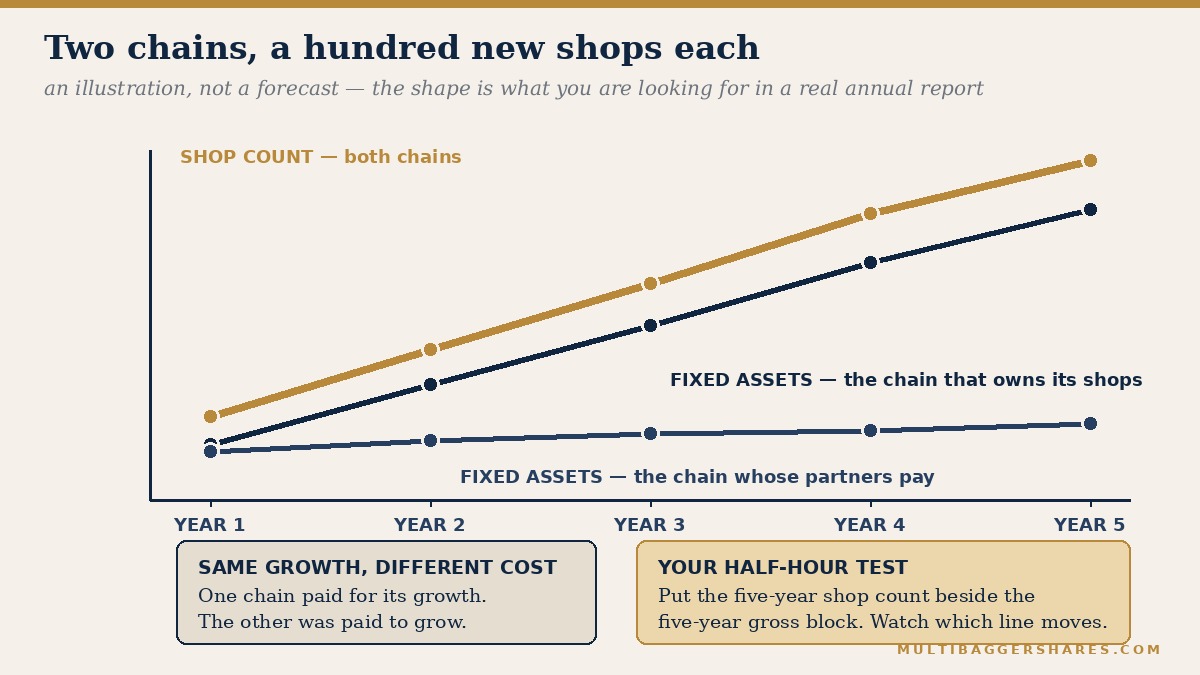
One: find the outlet count for each of the last five years, and the gross block for the same five years. If the shop count has doubled while the gross block has barely moved, somebody else is paying for the growth. If both have doubled together, the company is paying. This single comparison is the most honest test of the phrase asset-light that exists.
Two: read the note that breaks up revenue. Look for a line called royalty income, franchise fee or management fee, and watch whether it grows roughly in step with the number of outlets. If outlets grew twenty percent and royalty income grew three percent, ask why.
Three: compare the year’s capital expenditure with the year’s depreciation (the accounting charge that spreads the cost of an asset over its working life). A chain expanding through partners can add outlets while spending little more than it needs to keep its existing assets in order.
Four: track ROCE across the five years. In a healthy asset-light expansion it holds steady or improves as the chain grows. If it falls while the outlet count climbs, the new outlets are not earning what the old ones did, whoever paid for them.
Five: read the management commentary for the words payback period and franchisee profitability. A company confident in its partners gives you numbers. A company that avoids the subject entirely, while celebrating the number of signings, is telling you something by its silence.
Six — and this one catches people out — check which model the company actually uses, in its own words, rather than assuming. Two chains in the same industry, both described in the newspapers as fast-expanding, can be financed in completely opposite ways. The annual report will say. The headline will not.
The mithai family never used the phrase return on capital employed. But they understood the whole thing perfectly: the recipes and the signboard were what they owned, those were the parts nobody could copy, and everything else — the rent, the glass case, the ceiling fan — could be somebody else’s problem. Four shops, one of them paid for. That is not a financing trick. That is knowing what your business actually is.
Key takeaways
- Ask two separate questions about any chain of outlets: whose money bought the shop, and whose staff runs it. The four combinations behave very differently, and Indian annual reports name the one they use.
- Franchised growth raises return on capital because the brand earns a royalty with almost none of its own money tied up in the outlet — and it frees growth from the limit of the company’s own cash.
- The scale is real: about 95% of the 45,356 restaurants in the world’s largest burger system at the end of 2025 were owned by somebody else, and 2,276 opened in 2025 alone.
- Owning your outlets is a valid choice, not a mistake — but it must be paid for every year, and paying for it with debt is what turned one Indian coffee chain’s 1,700 cafes into a crisis.
- The half-hour test: put the five-year outlet count beside the five-year gross block. If shops doubled and gross block did not, somebody else is funding the growth — then check same-store sales to see whether the new shops are stealing from the old ones.
— Manish Goel · multibaggershares.com
Disclaimer: This article is published by multibaggershares.com for education and general information only. It is not investment advice, investment research, or a recommendation to buy, sell or hold any security. Any companies named are discussed only as illustrative examples. Markets carry risk; please do your own research or consult a qualified professional before making any investment decision.