The Bill You Cannot Check: How to Judge a Business Whose Customers Can Never Tell If the Work Was Good

The Shop That Cannot Close: Why an Industry Stays Poor When Its Losers Cannot Leave
September 12, 2026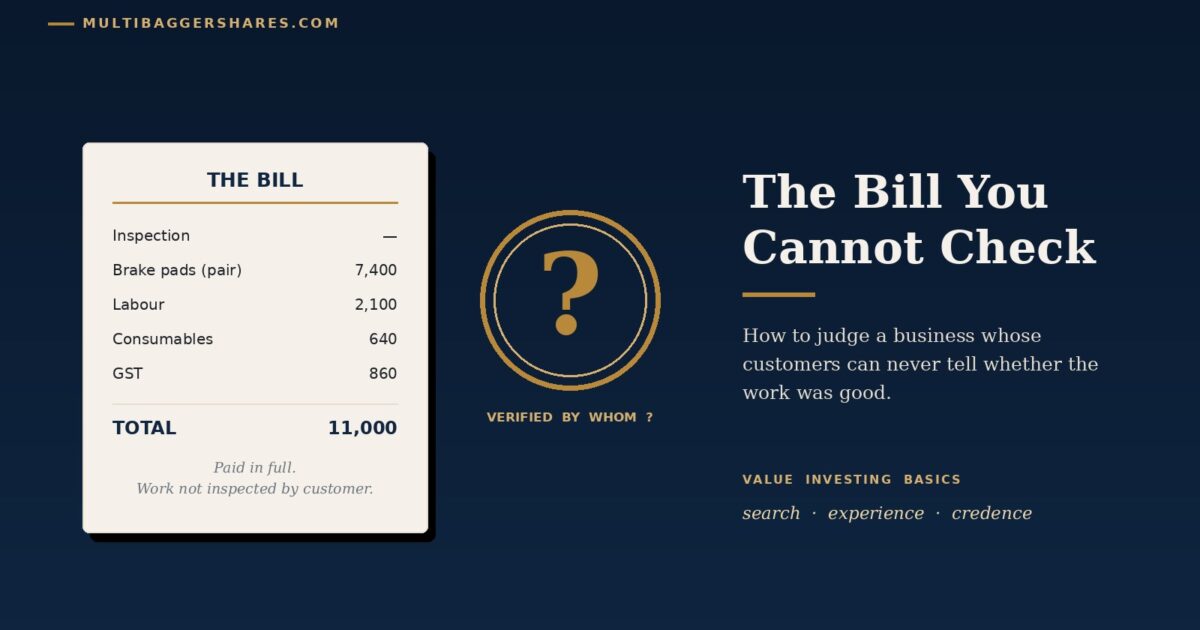
A friend of mine took his car to a garage last month. The mechanic looked underneath, came back, and said the brake pads needed changing. My friend has never held a brake pad in his hands. He nodded. The bill came to about eleven thousand rupees. He paid it and drove home.
Now here is the uncomfortable part. My friend will never know whether those brake pads were genuinely worn out. He will never know whether new ones were actually fitted, or whether the old ones were wiped clean and put back. The car works. The car worked before as well. Six months from now, if the brakes are still fine, he will have no way of saying whether that is because of the eleven thousand rupees or in spite of it.
He did not buy brake pads. He bought a promise he cannot check.
Economists have a precise name for this kind of purchase, and it is one of the most useful ideas a beginner investor can carry around. Once you can see which businesses sell promises that customers cannot check, two things start to make sense: why some plain, unglamorous companies quietly earn very good profits year after year without ever cutting prices — and why those same companies, when they get into trouble, get into trouble all at once.
Three kinds of things you buy
In 1970 an American economist called Phillip Nelson published a paper in the Journal of Political Economy (a long-established academic journal for economics) titled “Information and Consumer Behavior”. He pointed out something simple that nobody had bothered to write down clearly. The things we buy are not all alike in one specific way: how easily we can tell whether they are any good.
Some things, he said, have search qualities — qualities you can inspect before you hand over the money. You can see the rice in the sack. You can feel the cloth of a shirt, hold it against your shoulder, check the stitching. You can look at the screen of a phone in the shop. If you are willing to spend an afternoon comparing, you will know what you are getting before you pay.
Other things have experience qualities — you cannot tell in advance, but you find out soon after. A meal at a new restaurant. A shampoo. A hotel room booked from a photograph. You pay first and learn later, but you do learn, and quickly, and you adjust. You do not go back.
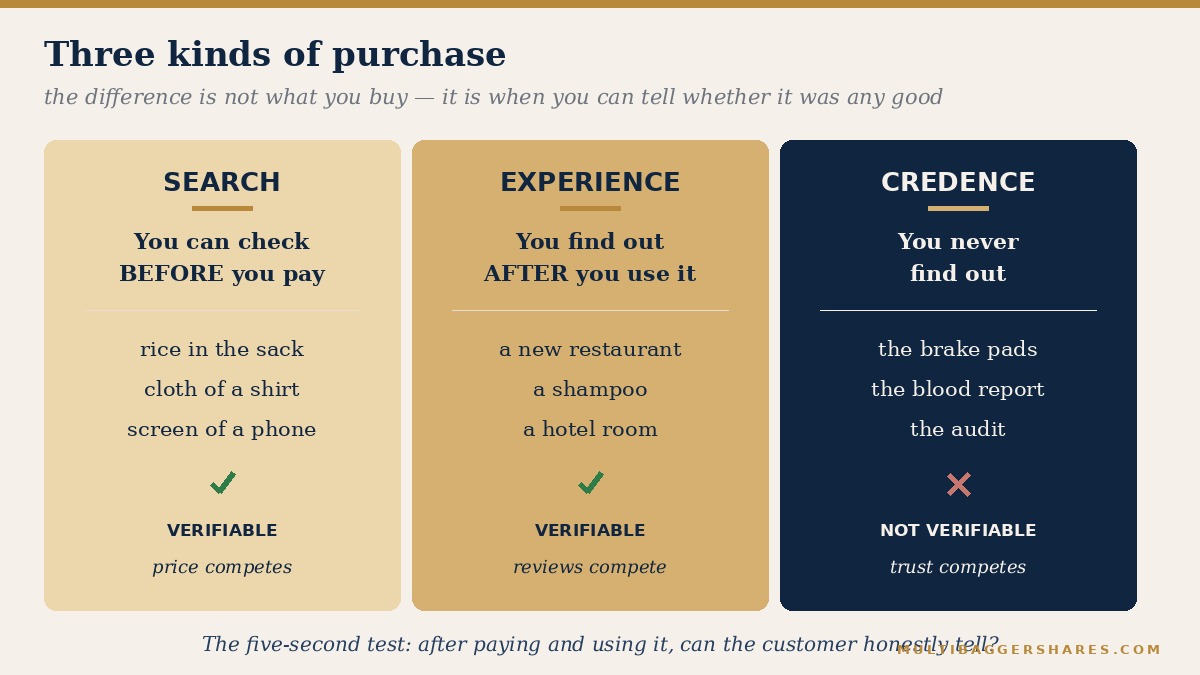
Three years later, two other economists, Michael Darby and Edi Karni, added a third box to Nelson’s two. Writing in the Journal of Law and Economics in 1973, in a paper with the wonderfully blunt title “Free Competition and the Optimal Amount of Fraud”, they described credence qualities: qualities which, in their words, although worthwhile, “cannot be evaluated in normal use” because they are expensive to judge even after the purchase is over. The word “credence” comes from the Latin for belief. You believe. You do not know.
The brake pads belong here. So does the root canal your dentist said you needed. So does the audit of a company’s accounts (the independent check that the figures are honest). So does a credit rating (an opinion on whether a borrower will repay). So does the blood test whose report you carry to your doctor, the pesticide sprayed across a field of cotton, the cement inside the pillar of your building, the insurance policy you hope never to use, the coaching class that is supposed to be better than the one down the road.
There is a single test, and you can apply it to any business in about five seconds. After the customer has paid, used the product, and lived with it for a while — can that customer honestly tell whether they got what they paid for? If yes, you are looking at a search or experience business. If the honest answer is no, you are looking at a credence business. Most companies are a mixture. What matters is which side the important part of the sale falls on.
Why this makes a business strong
Start with the obvious consequence. If a customer cannot judge quality, then the customer cannot shop on price either — because a lower price might simply mean a worse job, and there is no way to find out. The usual discipline of the marketplace, where a cheaper rival slowly takes your customers away, stops working properly.
That gives these businesses what investors call pricing power (the ability to raise prices without losing customers). Not the theatrical kind, where a famous brand charges three times the going rate. The quiet kind: the laboratory that has put its rates up by five or six per cent every year for fifteen years and nobody has left, because nobody has a way of proving that the cheaper laboratory is just as good.
It also produces unusually loyal customers, for an unusual reason. Loyalty here is not affection; it is fear. Switching means giving up a supplier you have no complaints about for one you know nothing about, and since you cannot inspect the result either way, the switch is a pure gamble with no visible prize. Most people do not take it.
A word of care here, because this is easily confused with a different idea. A good brand helps in every category on earth, including rice and shirts. What is different in a credence business is why the customer needs the name at all. In an ordinary category the brand is a shortcut — it saves you the trouble of checking. In a credence category there is no checking to be saved from. The name is not a shortcut to the information; it is a replacement for information that does not exist and never will.
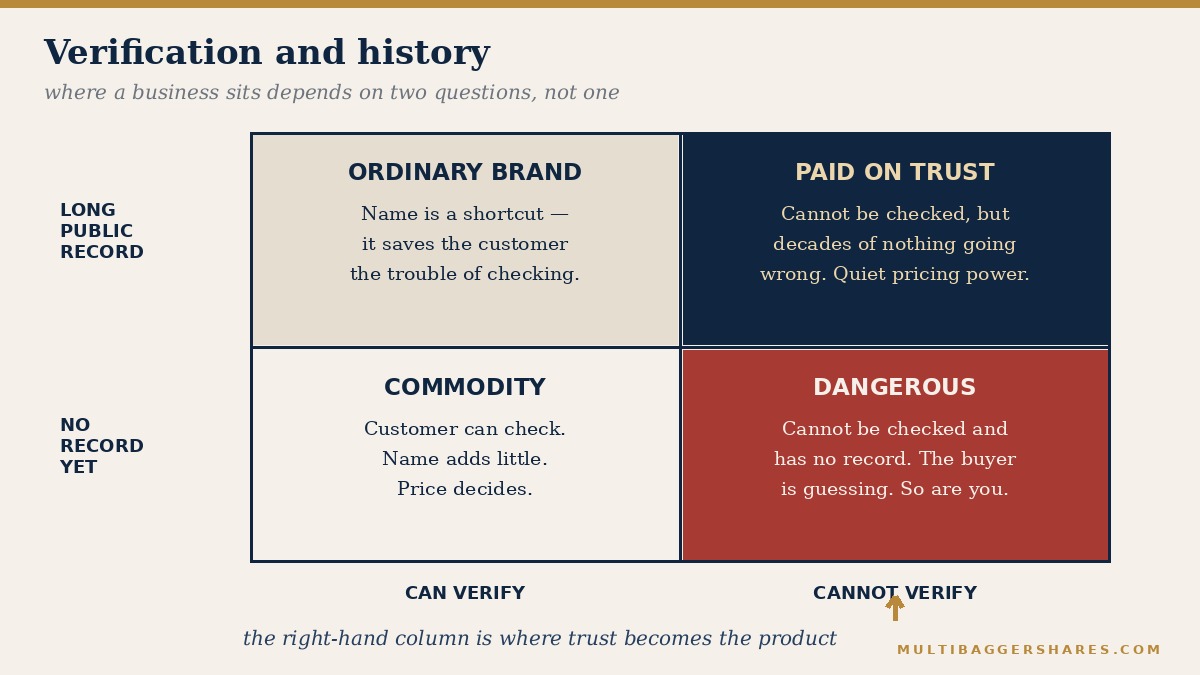
Add regulation on top and the effect gets stronger. Because ordinary customers cannot judge these products, governments usually step in with licences, accreditations and inspections. That is a cost, and small players often cannot carry it. So the field narrows. A business that is already trusted, already accredited and already on the approved list ends up competing against fewer and fewer people over time.
Put those together — prices that hold, customers who do not leave, rivals who cannot easily arrive — and you get the financial signature investors look for: a high return on capital employed (the profit a business earns for every rupee of money tied up in it), steady margins, and cash that actually turns up in the bank.
Why the same thing makes it fragile
Here is the part that beginners miss, and it matters more than the first part.
If a customer cannot verify your quality, then a customer also cannot verify your recovery. Think about what happens to an ordinary business after a bad batch. A biscuit company ships a stale lot, apologises, and sends a fresh lot. You eat a biscuit. It is fine. The matter is closed within a week, because you can check.
Now take a laboratory that is found to have reported wrong results. It apologises, replaces the machine, hires a new supervisor, and invites you back. What evidence can it offer you? A report. But the report is exactly the thing you could never verify in the first place. There is nothing the business can show you that would settle the question, because if you could settle the question you would not have needed to trust anybody. The apology has no landing place.
This is why reputations in these industries are built over decades and lost over a weekend, and why the wisest operators are close to paranoid about it. Warren Buffett put it as plainly as it can be put when he appeared before a committee of the United States Congress on 4 September 1991, as interim chairman of a securities firm in the middle of a scandal. Closing his opening statement to the employees watching, he said: “Lose money for the firm, and I will be understanding; lose a shred of reputation for the firm, and I will be ruthless.”
There is a second danger, and Darby and Karni named their paper after it. When nobody can check the work, some sellers will not do the work. Not all of them — most people are honest, and most businesses want to be around in twenty years. But the temptation is structural, it never goes away, and it is strongest exactly where the customer is least able to complain.
What this looks like in India
None of this is theory. Look at medicines. India’s drug regulator tests samples drawn from the market every year. In 2023–24, of about 1.06 lakh samples tested, roughly 3,270 were declared “not of standard quality” — a little over three in every hundred — and a further 282 were found to be spurious or adulterated. Those figures were given to Parliament in December 2024. Now ask yourself the credence question: of the people who swallowed those tablets, how many could possibly have known?
The sharpest illustration is also the saddest. In October 2022 the World Health Organization issued an alert on four children’s cough syrups made by an Indian manufacturer, found to contain unacceptable amounts of two industrial solvents and potentially linked to 66 children’s deaths in The Gambia; Indian inspectors halted production within days. In January 2023 the WHO issued a second alert on syrups from another Indian manufacturer, linked to around twenty children’s deaths in Uzbekistan, and that licence was suspended. A parent holding a bottle of cough syrup cannot test it. Nobody can. That is what a credence good is.
Or take diagnostic laboratories, an industry every Indian family uses. Industry estimates put the number of laboratories in the country at around one lakh, of which the share holding accreditation from the national accreditation board — the formal, audited certification of testing competence — has been assessed at under one per cent. You hand over a sample, you receive a number on a printed page, and you take a decision about your health on the strength of it. You cannot check the number. Which is precisely why the few laboratory chains with long, unblemished records have been able to charge more than the shop next door for years.
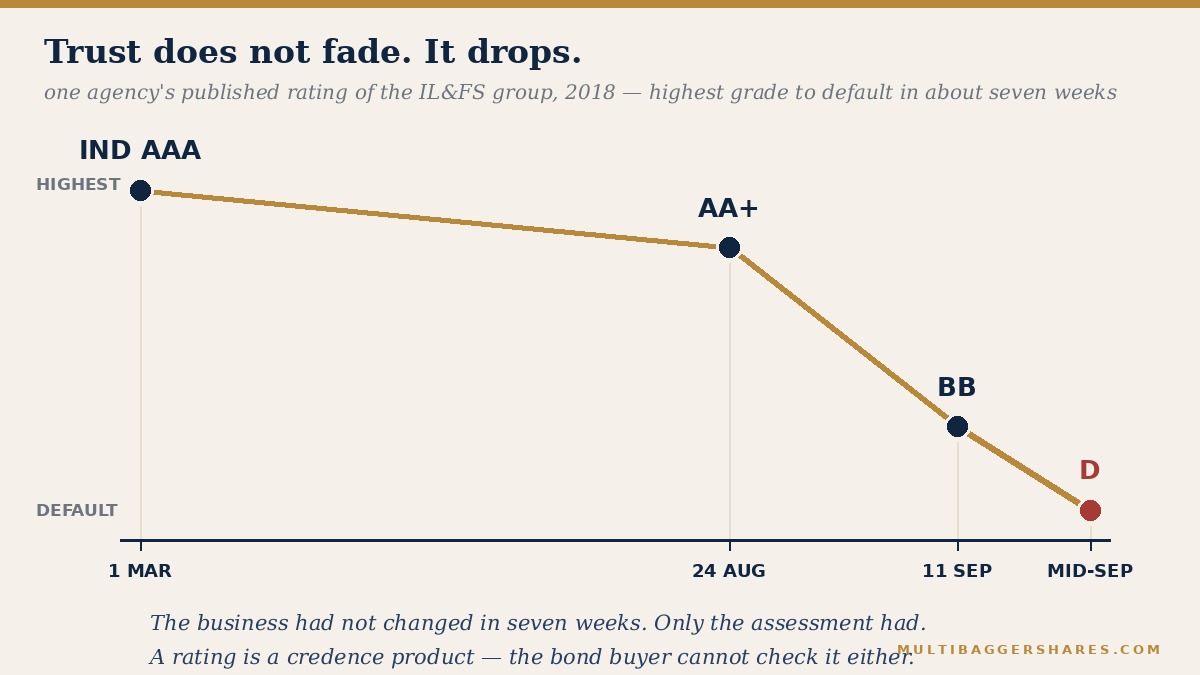
For an example of trust breaking, look at the credit rating of the infrastructure group IL&FS. Its published rating history shows one agency rating it at the very top of the scale, IND AAA, as of 1 March 2018. On 24 August 2018 it was cut to AA+. On 11 September 2018 it was cut to BB — deep into speculative territory. Within days it was at D, meaning default. From the highest grade to default in roughly seven weeks; from AA+ to default in under four. The underlying business had not changed that quickly. Only the assessment had. India’s market regulator subsequently penalised three rating agencies, imposing twenty-five lakh rupees on each in December 2019 and raising it to one crore rupees on each in September 2020.
Auditing tells the same story. After the Satyam Computer Services fraud came to light in 2009, the American securities regulator in April 2011 fined five India-based member firms of a global accounting network six million dollars for deficient audits. In India the market regulator barred the network from auditing listed companies for two years in January 2018; the appellate tribunal set that ban aside in September 2019, holding the firm negligent but not a knowing participant, while leaving a disgorgement order of more than thirteen crore rupees standing. An audit is the purest credence product there is: its entire value is the assurance that somebody competent and independent has looked.
One last one, from the fields. A 2015 study by an Indian industry chamber with a consulting firm estimated that counterfeit and sub-standard pesticides made up roughly a quarter of the Indian pesticide market by value. That estimate is a decade old and comes from an industry body rather than the government, so treat the exact number lightly — but hold on to the shape of it. A farmer sprays a field. The crop does poorly. Was it the pesticide, the rain, the soil, or the seed? He will never know. Which is exactly why farmers, who have very little money to waste, will pay a premium for a brand their father used.
How you can use this
This is not a formula, and there is no ratio to calculate. It is a lens. Here is how to hold it.
Ask the verification question before anything else. Read a company’s annual report and get to the point where you understand what it actually sells. Then ask: can the buyer tell whether they got a good one? If the answer is no, you are in credence territory, and everything below applies.
Then look for boring, old, uninterrupted history. In a category where quality cannot be proved, the only evidence available is time without incident. A twenty-five-year record of nothing going wrong is not a dull fact about a company; in this specific kind of business it is the main asset on the balance sheet, and it is the one asset that never appears there.
Look at what the company spends money on that it did not have to spend. Voluntary accreditation. In-house testing laboratories. Quality staff who report to the top rather than to the factory manager. Recalls that the company announced itself before anyone forced it to. In an ordinary business this spending is a cost. In a credence business it is the product.
Look at how the customers behave, not what they say. Do they come back without being chased? Does the company have to keep discounting to hold volumes? A trusted business in a credence category should not need to shout.
Then deliberately look for the one event. This is the discipline most people skip. Ask: what single thing, happening once, would end this company’s ability to be believed? A contaminated batch. A regulator’s letter. A family member of the founder in a criminal case. A large client discovering a false report. Then ask how concentrated that risk is — one plant, one laboratory, one approval, one signature. You are not predicting the event. You are asking whether the business would survive it.
Read the public record, because it is free and almost nobody does. Regulators in India publish a great deal: monthly lists of drug samples that failed, inspection observations, licence suspensions, product recalls, penalty orders. For a business whose whole value is that it can be believed, a pattern in those documents is the loudest signal you will ever get, and it is sitting on a government website.
And be careful with the cheap new entrant. In an ordinary category a lower price is a gift to the customer. In a credence category, a lower price is information you cannot interpret. It might mean a leaner operation. It might mean the work is not being done. Neither you nor the customer can tell — and a business built on prices that nobody can justify is a business that can lose its customers the moment one bad story appears.
The deepest point is a strange one, and worth sitting with. In most industries, the better you are at your job, the more obvious it becomes. In these industries, the better you are, the less anyone notices — because doing it perfectly means nothing ever happens. Nobody thanks an auditor for an honest set of accounts, or a laboratory for a correct result, or a syrup maker for a child who simply gets better. The reward for excellence is silence, year after year, until one day it is not. Businesses that understand this, and behave accordingly when nobody is watching, are rare — and over long stretches of time, remarkably good places for a patient owner to be.
Key takeaways
- Some products can be judged before you pay, some after you use them, and some never. Economists call the third kind credence goods — audits, ratings, medicines, lab tests, pesticides, insurance.
- The five-second test: after the customer has paid and used it, can they honestly tell whether they got what they paid for? If no, trust is the product.
- These businesses are strong because verification is impossible. Customers cannot shop on price, rarely switch, and regulation keeps new rivals out — which shows up as quiet, durable pricing power.
- They are fragile for the same reason. A business that could never prove it was good also cannot prove it has recovered, so reputation built over decades can go in a weekend.
- What to look for: a long record with nothing going wrong, money spent voluntarily on quality, customers who return unchased — and a clear-eyed answer to what single event could end the trust.
— Manish Goel · multibaggershares.com
Disclaimer: This article is published by multibaggershares.com for education and general information only. It is not investment advice, investment research, or a recommendation to buy, sell or hold any security. Any companies named are discussed only as illustrative examples. Markets carry risk; please do your own research or consult a qualified professional before making any investment decision.