The Tailor Whose Name Is Never on the Shirt: How to Judge a Company That Makes What Someone Else Sells

The Bill You Cannot Check: How to Judge a Business Whose Customers Can Never Tell If the Work Was Good
September 13, 2026
There is a tailoring workshop in a lane near my old office. Four machines, six men, a ceiling fan that has been loose since I first walked past it. They stitch shirts. Good ones — even stitching, proper collars, buttons that stay on. The shirts leave that lane in cardboard cartons, and a few weeks later they hang in an air-conditioned showroom under a name you would recognise, at a price the men at those machines would find hard to believe.
Nobody in that showroom will ever hear of the workshop. The label inside the collar carries someone else’s name. And here is the question that matters for an investor: of the money that finally changes hands in that showroom, how much reaches the lane?
The honest answer, usually, is: not much. But — and this is the whole point of today’s letter — not always. Sometimes the factory is the strong one and the famous name is the one that should be worried. Learning to tell those two situations apart is one of the more useful skills a beginner can pick up, because India is full of both kinds.
What this business is actually called
When a company makes a product that another company sells under its own name, that is called contract manufacturing (making goods to another firm’s order and design, to be sold under that firm’s brand rather than your own). You will meet the same idea under several different names depending on the industry, and the names sound more technical than the thing itself.
In consumer goods and retail it is often called private label (a shop’s own-brand product, actually made by an outside factory) — the store-brand atta or biscuits in a supermarket are almost never baked by the supermarket. In cars and machinery the phrase is OEM supply (Original Equipment Manufacturer — making parts that go into someone else’s finished machine). In electronics it is EMS (Electronics Manufacturing Services — factories that assemble phones, televisions and circuit boards for the companies whose names appear on them). In medicines it is CDMO or CRDMO (Contract Research, Development and Manufacturing Organisation — a company that develops and manufactures drugs for other pharmaceutical firms).
Four labels, one arrangement: you own the machines, someone else owns the customer.
This is not a small corner of the economy. It is, in large measure, how modern India makes things. According to the Ministry of Electronics and Information Technology, India’s electronics production rose from about ₹1.9 lakh crore in 2014–15 to an estimated ₹13.1 lakh crore in 2025–26, and mobile phones became India’s single largest export product in that year, at roughly ₹2.6 lakh crore. Almost none of those phones carry the name of the company that actually screwed them together.
Why the factory usually keeps less
Start with the uncomfortable general rule, because it is true far more often than not. Then we will look at the exceptions, which are where the interesting businesses live.
The clearest way to see it is to put a brand and its factory side by side in the same industry. Take footwear. Nike is a company that designs and sells shoes; in its own annual filing for the year ended 31 May 2026, it states plainly that it relies on independent contract manufacturers — factories it does not own or operate — to make all of the footwear it sells. Yue Yuen Industrial is one of the world’s largest makers of athletic footwear, and it is one of the factories on the other side of that arrangement; it shipped about 252 million pairs of shoes in 2025.
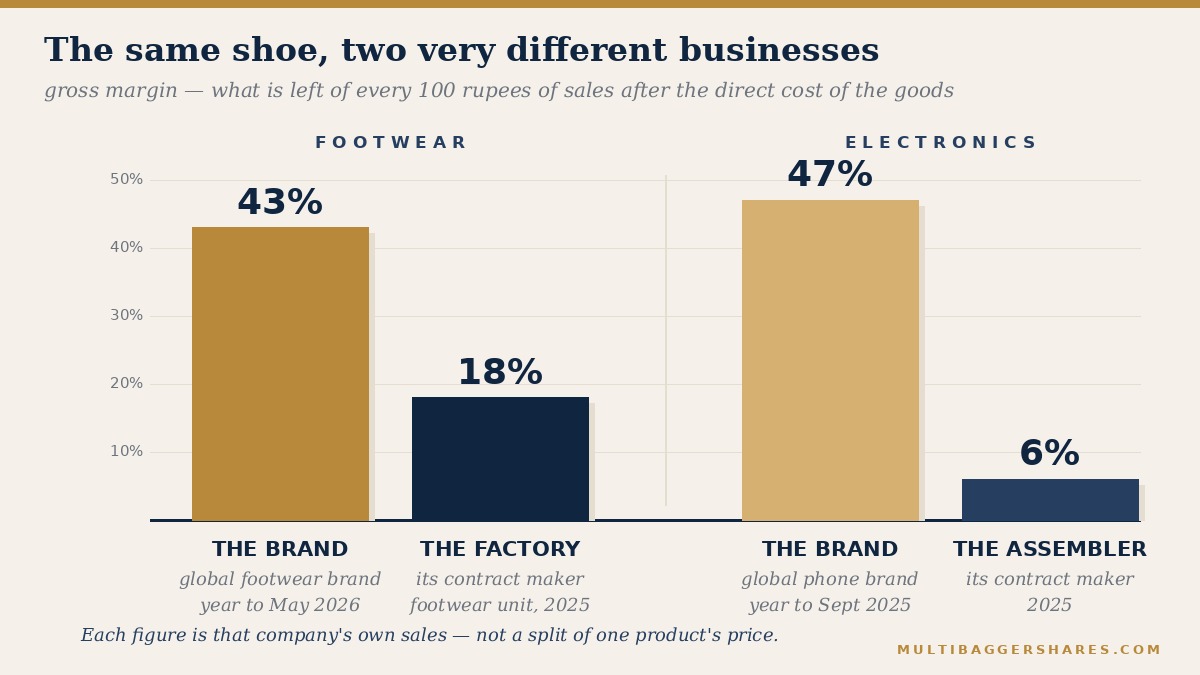
Now the numbers, from each company’s own results. Nike’s gross margin (what is left out of every hundred rupees of sales after paying only the direct cost of making or buying the goods) was about 43% in its 2026 financial year. Yue Yuen’s gross margin on its manufacturing business in 2025 was about 18%. Same shoe. Roughly two and a half times the margin on the side that owns the name.
Electronics is starker still. Apple, in the year to September 2025, reported a gross margin of about 47% and a net profit margin (what is left out of every hundred rupees of sales after paying everything, including salaries, interest and tax) of about 27%. Hon Hai Precision — the company most people know as Foxconn, and one of the largest assemblers of electronic products in the world — reported for 2025 a gross margin of about 6% and a net margin of about 2.3%. To be fair to both, these are each company’s own sales, not a split of one phone’s price. But the shape of it is unmistakable.
Why does it fall out this way so reliably? Four reasons, none of them complicated.
First, the maker does not own the customer. The shopper has a relationship with the name on the collar, not with the lane. If the brand moves its order to another workshop next season, the shopper never finds out and never objects. The factory’s entire demand can be transferred by one email.
Second, the maker is usually one of several. Brands deliberately keep two or three factories capable of the same work, precisely so that no one of them becomes essential. Every year, quietly, they can invite the others to quote a slightly lower price.
Third, the maker sells a cost, not a benefit. The brand can charge for how the shirt makes you feel. The factory can only charge for cloth, thread, electricity, labour and a thin slice on top. Costs can be compared; feelings cannot.
Fourth, the maker carries the heavy end. Machines, sheds, inventory, workers, pollution clearances, the electricity bill when orders slow down. These are what accountants call fixed costs (costs that stay the same whether you make a lot or a little). The brand carries the light end — a design studio and an advertising budget it can switch off.
Warren Buffett described the underlying preference in his 1983 letter to shareholders, long before anyone used the phrase contract manufacturing: business experience, he wrote, “produced my present strong preference for businesses that possess large amounts of enduring Goodwill and that utilize a minimum of tangible assets.” The lane has the tangible assets. The showroom has the goodwill.
And yet — sometimes the factory wins
Now hold that whole argument up and turn it around, because there is a company that demolishes it.
Taiwan Semiconductor Manufacturing Company does not sell a single product under its own name to any member of the public. It is a pure contract manufacturer: it makes chips that other companies design, and those chips go into phones and computers carrying entirely different names. By the logic above, it should be a thin-margin business scraping along on 5%.
In its 2025 financial year it reported a gross margin of about 60% and a net margin of about 45% — better, on both counts, than most of the famous brands it supplies. And according to the research firm TrendForce, in the second quarter of 2026 it accounted for roughly 72% of global chip-foundry revenue, with the next-largest company at under 6%.
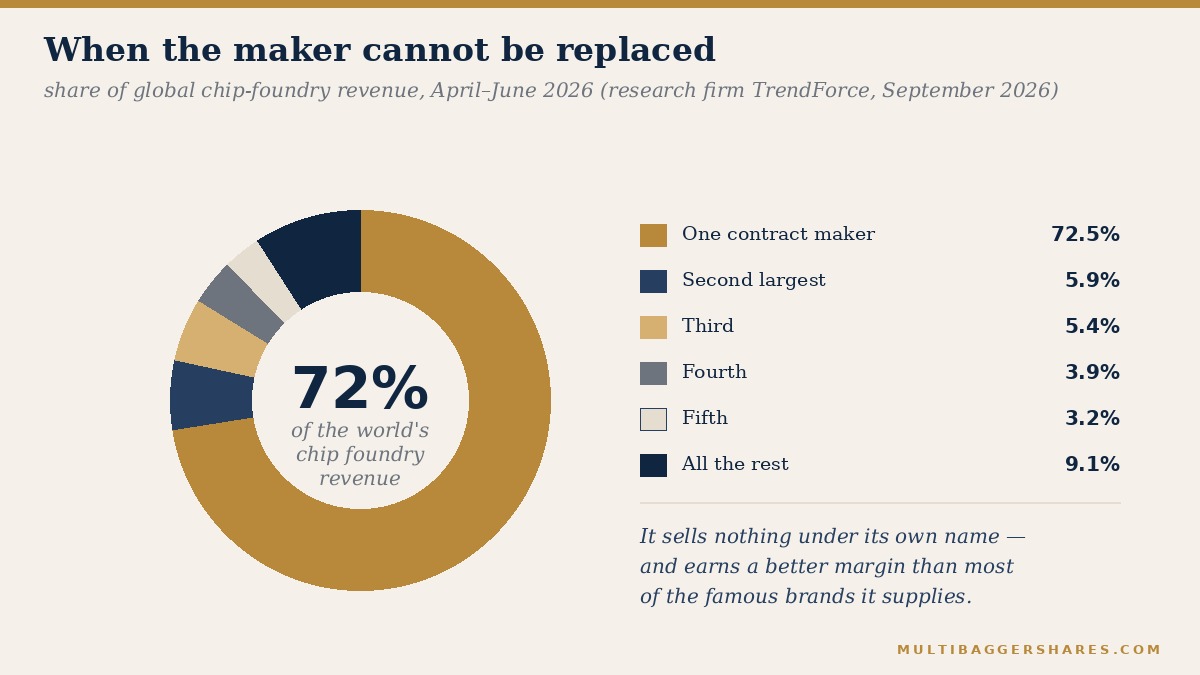
So the rule is not “factories are bad businesses.” The rule is something more precise, and far more useful: the profit goes to whichever side of the arrangement is harder to replace. Usually that is the name. Occasionally it is the maker. Your job is to work out which, and you do not need to understand a single thing about semiconductors to do it.
The five questions
Here is the sequence I find useful when I come across a company that makes things for other people. Ask them in order. The moment one of them is answered badly, you have learned most of what you needed to know.
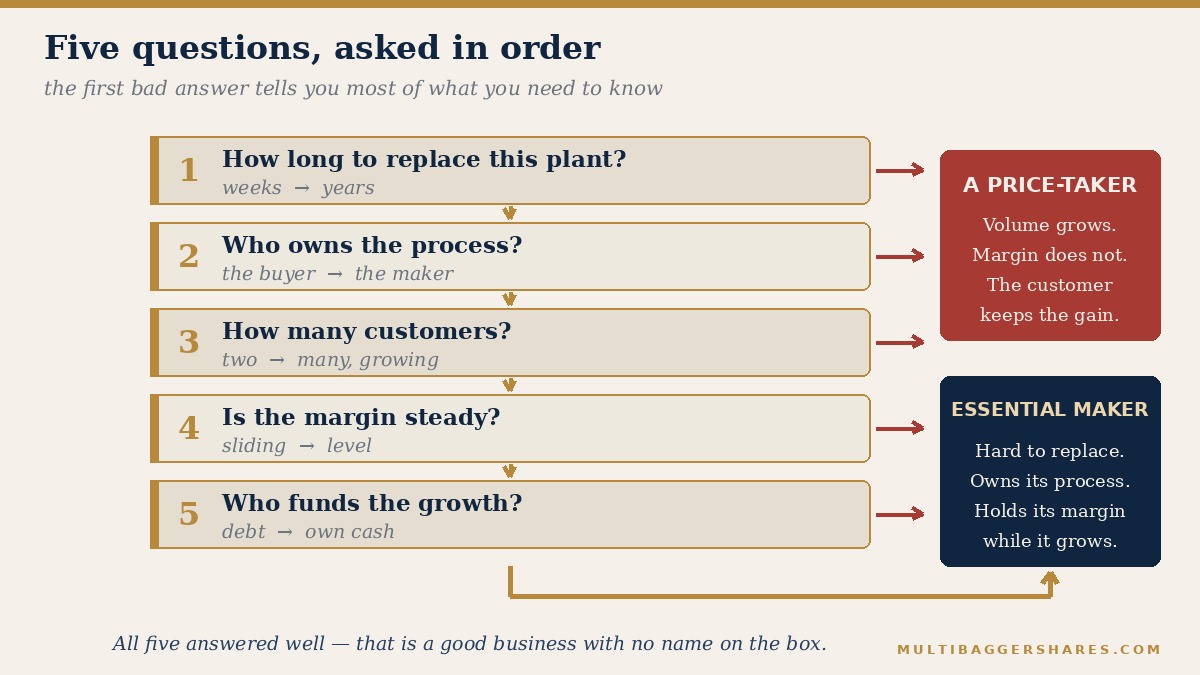
One: how long does it take to replace this factory? Not in theory — in practice. If a customer decided this morning to move the work elsewhere, would the replacement be running next month, next year, or never? Stitching a shirt: next month. Assembling a television: perhaps six months. Making a medicine that a foreign drug regulator has inspected and approved at this specific plant: often two to three years, and a great deal of money. That waiting period is the factory’s real protection, and it is worth more than any contract.
Two: who paid for the machines? If the customer supplied the tooling, the designs and sometimes even the raw material, and the factory merely provides the shed and the hands, then the factory is renting out labour. If the factory developed the process itself, and the customer cannot easily take that process away, the balance shifts. Look in the annual report for spending on research and development, and for patents held in the company’s own name.
Three: how many customers, and how well spread? Contract manufacturers usually have few customers — that is the nature of the work — so the question is not whether concentration exists but whether it has been getting better or worse. A company that has gone from two customers to nine over five years is negotiating from a different chair than one that has gone the other way. Indian listed companies disclose customer concentration in the risk section of the annual report; read it before you read anything else.
Four: is the margin steady, or does it drift down every year? This is the simplest test and the most revealing. Pull five years of operating margin (operating profit as a percentage of sales — what the business earns from its core activity before interest and tax). A maker with genuine bargaining power holds its margin roughly level while its sales grow. A maker without it shows the classic pattern: sales rising nicely, margin sliding a little each year. That slide is the customer taking the benefit of the factory’s own improvements.
Five: is the business growing on borrowed money? Factories need capital to expand, and a thin-margin factory growing fast is often growing on debt. Check whether operating cash flow — the actual cash the business collects from its day-to-day operations — is anywhere near the reported profit, and check whether debt is rising faster than profits. A low-margin business with high debt has no room at all for a bad year.
How this looks in India
Two Indian illustrations, offered only as descriptions of a business model — not as suggestions of any kind.
Dixon Technologies is one of India’s larger electronics manufacturing companies; it puts the phrase “The brand behind brands” on the cover of its own investor presentation, which is about as candid a description of contract manufacturing as you will find. Its margins are the ones the model predicts: in the quarter to September 2025 it reported an adjusted operating margin of under 4% on adjusted revenue of nearly ₹15,000 crore. Enormous volume, very thin slice. That is not a criticism of the company — it is simply what that business is.
Syngene International sits at the other end of the same family: a contract research and manufacturing company for pharmaceutical clients, where the work involves science, regulatory approvals and years of relationship-building. For the year to March 2026 it reported revenue of about ₹3,739 crore at an operating margin of about 25%. Twenty-five percent against under four percent — both of them contract manufacturers, both making things for other people’s names. Question one explains most of the gap.
And the country-level point is worth holding on to. India supplies around 20% of the world’s generic medicines, according to the Government of India. Yet in the fast-growing business of developing and manufacturing drugs under contract for others, a 2025 study by the Boston Consulting Group with an Indian pharmaceutical industry body put India’s share at only about 2–3% of a global market of roughly 140 billion dollars. Large volumes; small share of the valuable end. That gap is the whole subject of this letter, written at the scale of a nation.
What to do with this
None of this says avoid companies that make things for other people. Several of the better Indian businesses of the last decade have been exactly that, and the government’s manufacturing push has genuinely enlarged the opportunity. What it says is: when you look at such a company, do not be distracted by the size of the order book or the famous names it supplies. Those are facts about the customer, not about the business.
Look instead at the five answers. A maker that takes years to replace, that owns its own process, that is steadily adding customers, that holds its margin while growing, and that funds itself from its own cash, is a genuinely good business that happens to have no name on the box. A maker that can be swapped in a month, works to someone else’s drawings, depends on two buyers, loses a little margin every year and borrows to expand is something else entirely — however impressive the revenue line looks.
The workshop in that lane will always stitch beautiful shirts. Whether it is a good business has almost nothing to do with the stitching.
Key takeaways
- Contract manufacturing — making goods sold under another company’s name — goes by many labels (private label, OEM, EMS, CDMO) but is one arrangement: you own the machines, someone else owns the customer.
- As a general rule the brand keeps far more of the money: roughly 43% gross margin for a global footwear brand against about 18% for its factory; about 47% for a leading phone brand against about 6% for its assembler.
- The rule is not “factories are bad.” Profit goes to whichever side is harder to replace — which is why the world’s largest chip foundry earns better margins than most of the brands it supplies.
- Five questions settle it: how long to replace the plant, who owns the process, how many customers, is the margin steady, and is growth funded by cash or by debt.
- Ignore the famous names on the customer list. That is a fact about the customer, not about the business you are looking at.
— Manish Goel · multibaggershares.com
Disclaimer: This article is published by multibaggershares.com for education and general information only. It is not investment advice, investment research, or a recommendation to buy, sell or hold any security. Any companies named are discussed only as illustrative examples. Markets carry risk; please do your own research or consult a qualified professional before making any investment decision.