The Signboard Says Since 1952: Why a Business That Has Lasted Long Is Telling You Something

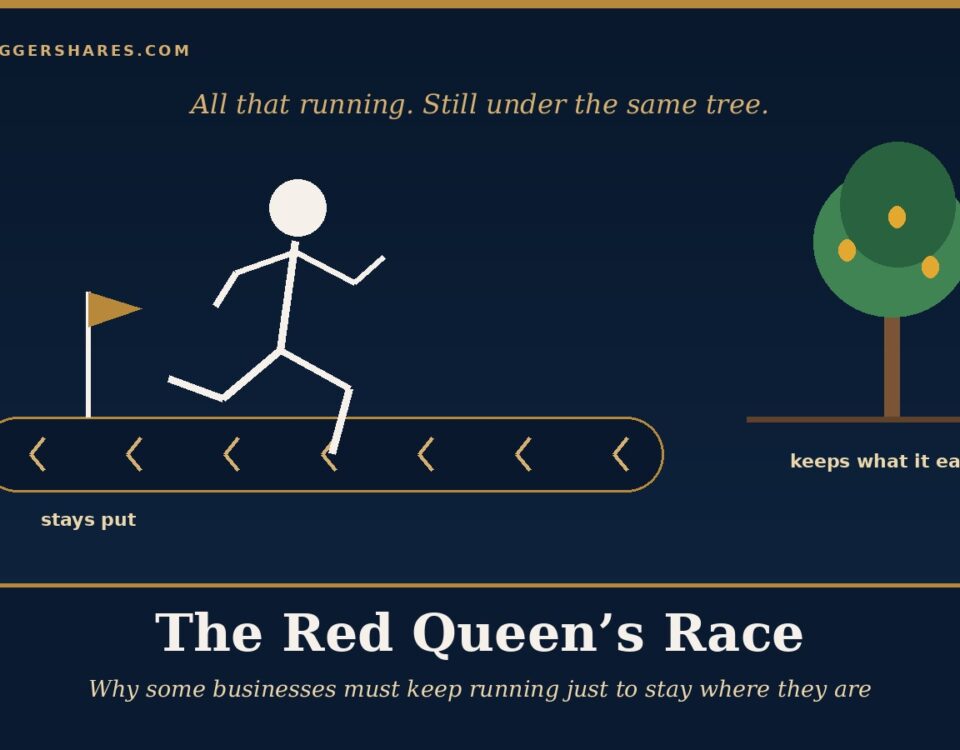
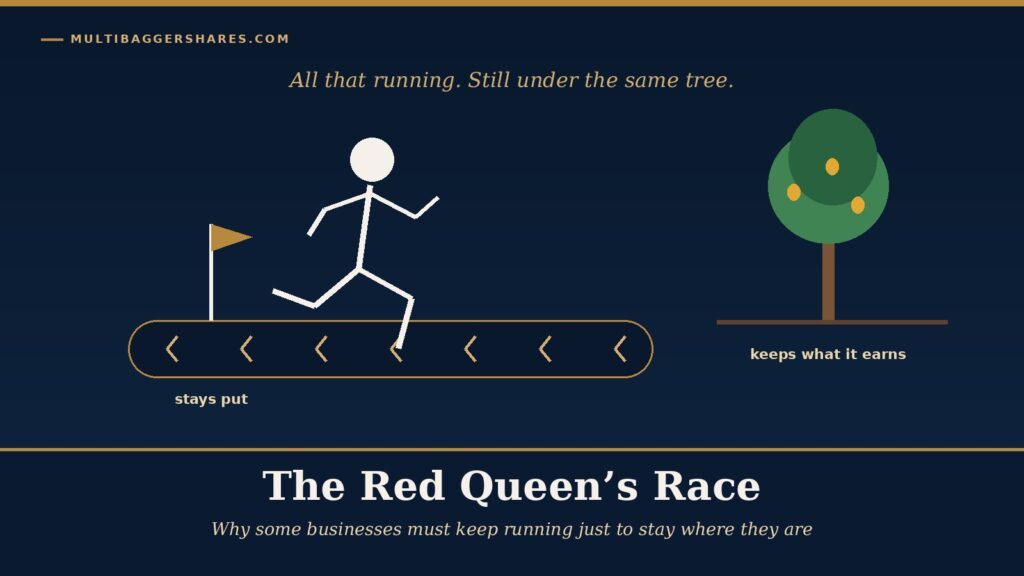
The Red Queen’s Race: Why Some Businesses Must Keep Running Just to Stay Where They Are
October 17, 2026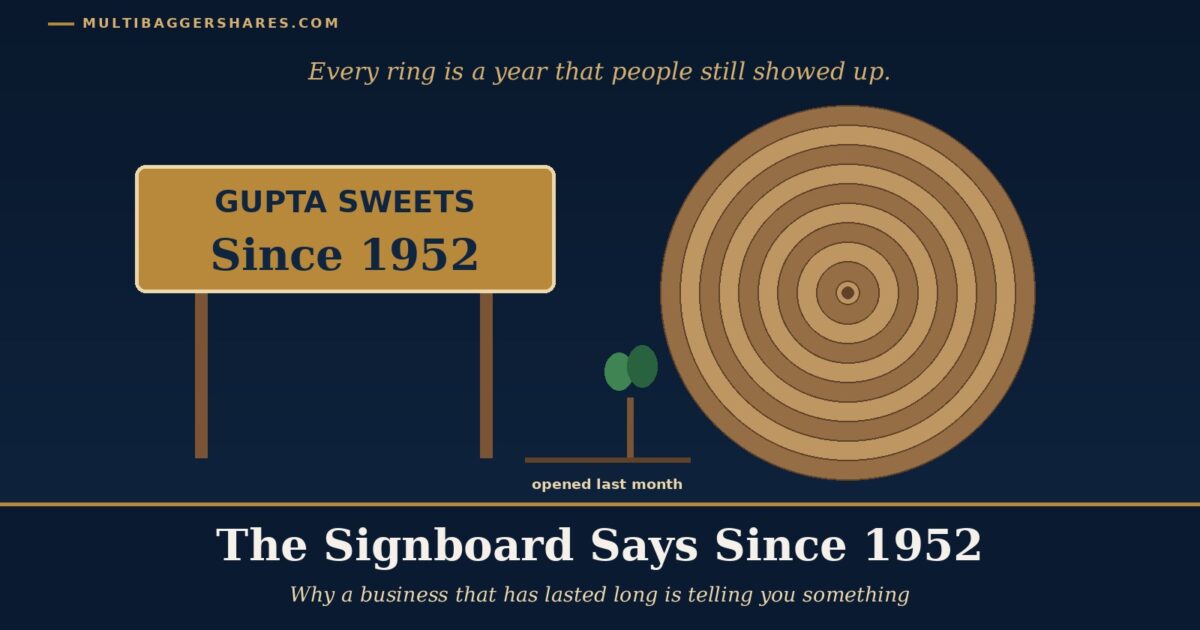
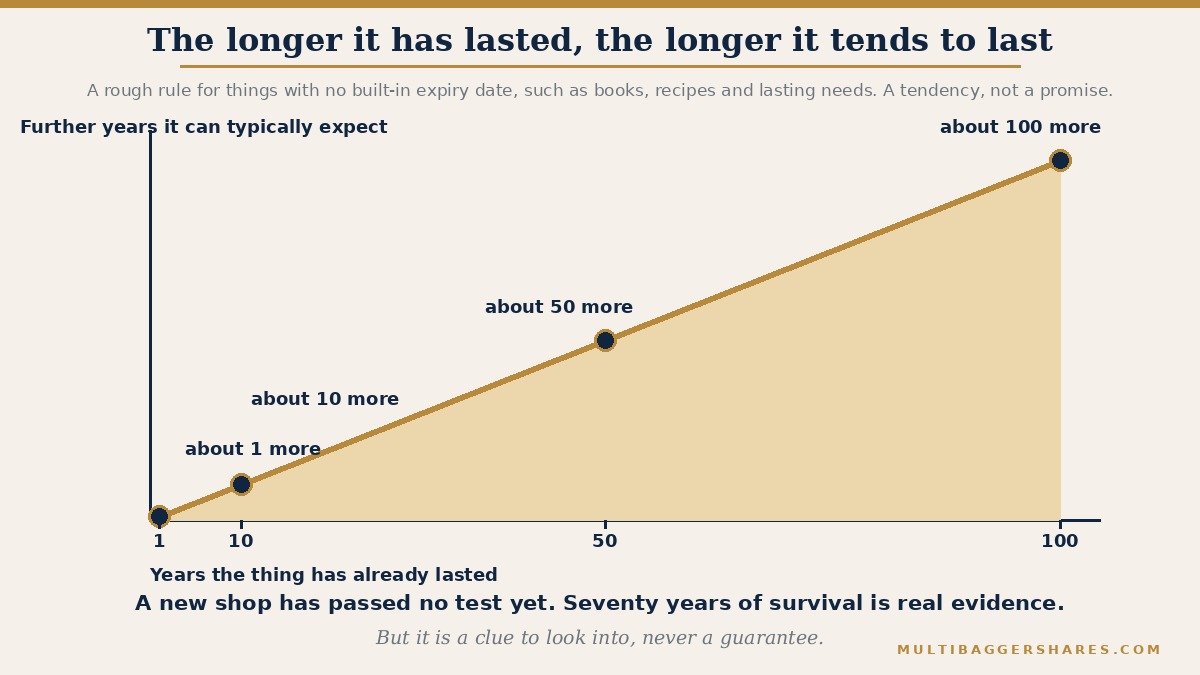
In New York, many years ago, there was a delicatessen (a shop selling sandwiches and ready food) called Lindy’s. Comedians used to sit there for hours, talking shop. They had a habit of guessing how long a show would last. If a show had run for two weeks, they said, it would probably run another two weeks. If it had run for two years, it would probably run another two years. In 1964, a writer named Albert Goldman described this habit in a magazine called The New Republic, and the idea picked up the name Lindy’s Law.
It sounds like a joke. Yet it hides a very useful way of looking at a business. When you pass an old shop with a signboard that says Since 1952, you are looking at something that has already survived seventy years of bad monsoons, price rises, new rivals and changing tastes. That survival tells you something. This lesson is about what exactly it tells you, and what it does not.
What it really means
Start with a plain idea. Some things have a built-in end date. A packet of milk goes bad in two days. A human being, sadly, grows older and weaker. For such things, age works against you: the older they are, the less time they have left.
Other things have no built-in end date. Think of a book, a recipe, a proverb or the wheel. Nothing inside them wears out. They disappear only when the world stops needing them. For this second group, the pattern runs the other way. A recipe that has been cooked for twenty years has proved itself more than a recipe invented last week. Every extra year survived is a small piece of evidence that the thing keeps meeting a real need.
India gives a lovely example. The Panchatantra stories have been told for many centuries, and children still enjoy them today. Nobody needs a report to know that a new story written this month is less proven than a tale that has been loved by grandparents, parents and children. The old tale has been tested by millions of listeners over a very long time. A good business that has lasted can be seen the same way: as something customers have tested again and again, and not rejected.
A mathematician named Benoit Mandelbrot wrote about this in 1982. For things that do not expire on their own, he said, the past life of a body of work will on average be matched by an equal additional amount of future life. Later, in his 2012 book Antifragile, the writer Nassim Nicholas Taleb gave the pattern its name, the Lindy effect, and stretched it to anything with no built-in expiry date. In everyday words: the longer such a thing has lasted, the longer it can be expected to last.
Now bring this to business. A business is not a person. It has no body that grows old. A shop can be run well for a hundred years if people keep wanting what it sells. So age, in a business, is closer to the book than to the milk packet. Each year of survival is a quiet vote from customers, year after year, that the thing is still wanted.
Why it works
The first reason is that time is a very tough examiner. A new business has passed no tests yet. An old business has passed many. It has lived through good years and bad years, honest managers and careless ones, and a lot of rivals who came and went. It is as if a bridge has stood through a hundred monsoons. You cannot be sure it will stand through the next one, but you would trust it a little more than a bridge opened last week.
The second reason is that what customers truly need changes slowly. People needed to keep their belongings safe a hundred years ago, and they need it today. They wanted something to eat with their tea then, and they do now. The tools change, but the need underneath stays put. A business built around a lasting need has a long road in front of it.
The third reason is that surviving shows a company can change when it must. This is the part people miss. A business does not last a hundred years by standing still. It lasts because, again and again, someone inside it saw the world shifting and moved with it.
The fourth reason is trust that passes down the family. A grandmother who bought sweets from the same counter tells her daughter, and her daughter tells her own children. Nobody sat down and ran a survey. The habit simply travelled from one kitchen to the next. This kind of trust takes decades to build, and a rival with a bigger advertising budget cannot buy it in a single season.
A real example or two
Let us begin with a made-up pair of shops in one lane. Gupta Sweets has a faded signboard that says Since 1952. Next door, a bright new dessert parlour opened last month. Both look busy this evening. On the surface, you cannot tell them apart. But you know one thing about Gupta Sweets that you do not yet know about the parlour: it has lasted seventy years. The parlour may well turn out to be excellent. It simply has not been examined yet. Gupta Sweets has, and it passed. Both shops are imaginary.
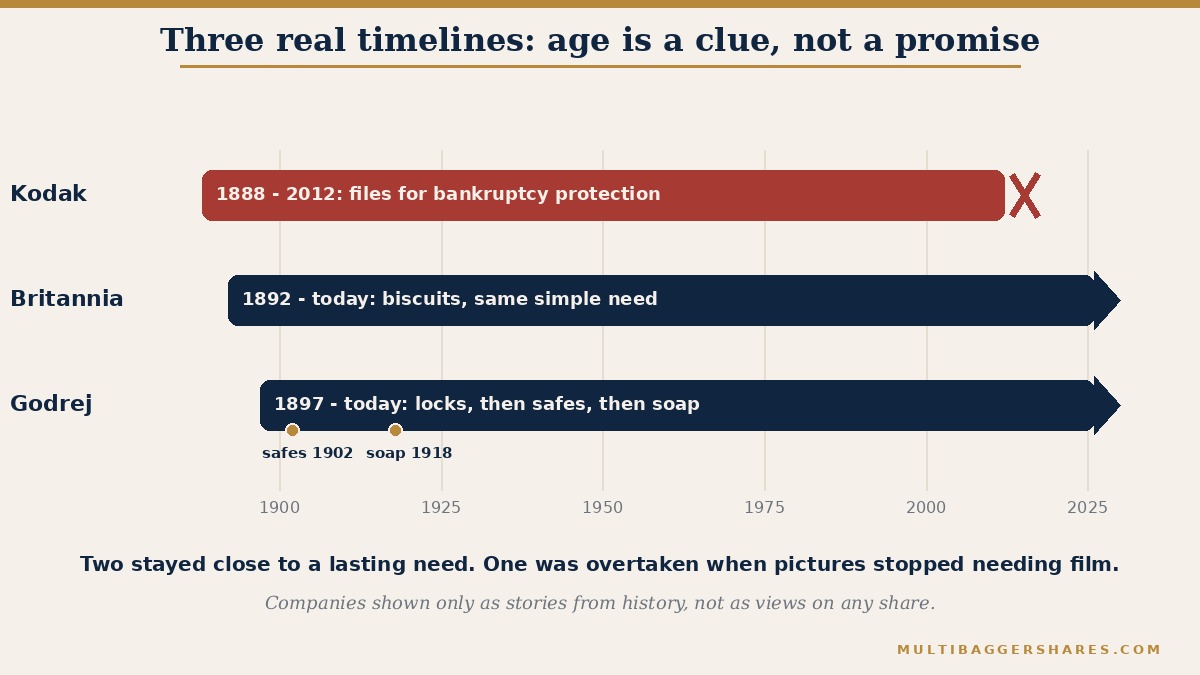
Take Britannia, the biscuit maker. It began in 1892 in Calcutta (now Kolkata), in a small house, with a very small starting sum. Over more than a hundred and thirty years it has passed from one set of owners to another, been renamed, and seen the end of British rule, the long years of strict government licences, and the opening of the Indian economy in the 1990s. Through all of this, one thing stayed the same: people kept wanting a simple biscuit with their tea. The owners changed. The need did not.
Take Godrej. In 1897, Ardeshir Godrej began making locks in a small shed in Mumbai. Locks answered a need that is still alive today: keeping valuable things safe. From there the company added safes in 1902 and a vegetable-oil soap in 1918. It did not cling to the first product. It stayed close to the need and let the products grow around it. Please note that we mention these companies only as stories from history. This lesson says nothing about what any share should cost, or whether anyone should own it.
Now the other side, because it matters just as much. Kodak was founded in 1888 and, for much of the twentieth century, it was one of the best known names in photography. In January 2012, after about a hundred and twenty-four years, it filed for bankruptcy protection (a court-supervised process used when a company cannot pay what it owes). Cameras that need no film had arrived. The need for pictures never went away. Only the way of making them did. Kodak’s great age had been a true clue. It had never been a promise.
One more caution, and it is a big one. We notice old businesses precisely because they are still here. For every shop that says Since 1952, there were many others that opened around the same time and closed quietly in 1960 or 1985. Nobody puts up a signboard saying We lasted three years. This is called survivorship bias (the habit of studying only the ones that survived and forgetting the ones that did not). So age is not magic. It is a reason to look closer, not a reason to stop looking.
How you can use it
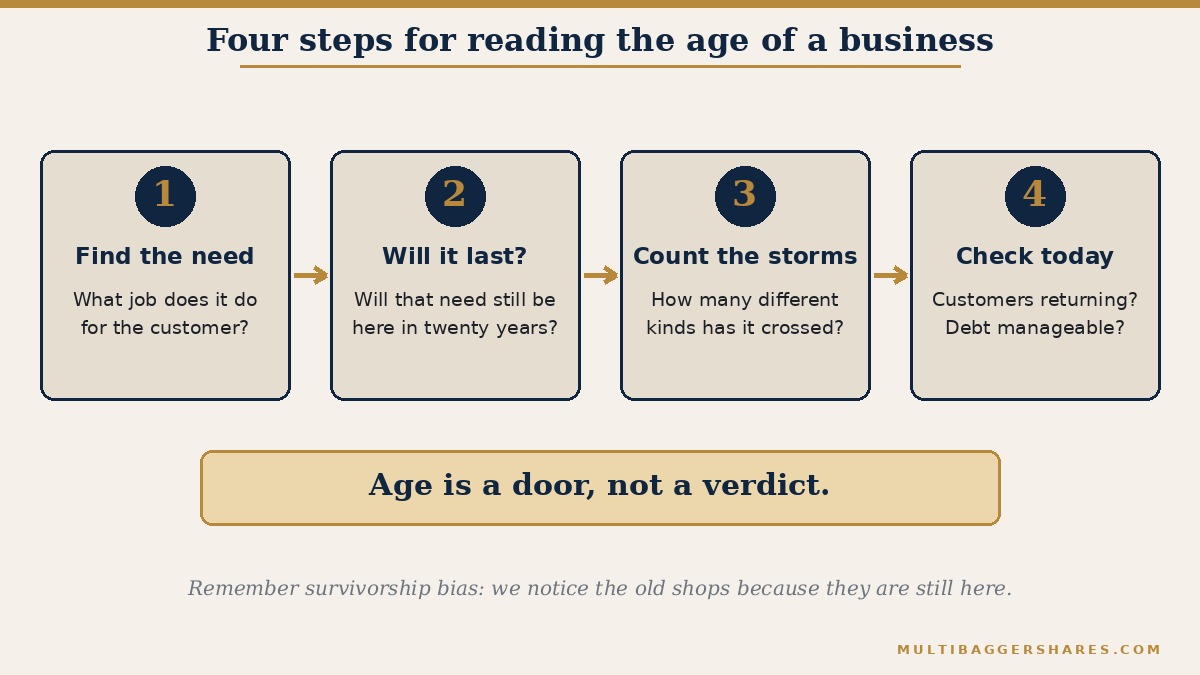
Here is a simple method in four steps. You can use it while walking down any market street, or while reading about any company.
Step one is to find the need. Forget the company name for a moment and ask what job is being done for the customer. The job might be keeping valuables safe, making tea time sweeter, or getting a parcel across the city. A need is much older than any company that serves it.
Notice that the age we care about is the age of the need, and not only the age of the product. Salt, flour, soap and locks have served people for a very long time, and people are likely to keep wanting them. A fashion colour or a gadget of this year may be gone in twelve months. A company can still last a long time by moving from one product to the next, as Godrej did, so long as the need stays close.
Step two is to ask if that need will still be here in twenty years. Be honest. The need to stay in touch with family will be here. The need for one particular kind of gadget may not. Needs that people feel every week, in every season and in every decade, are the ones that give age its meaning.
Step three is to count the storms. A business that has crossed one kind of storm is lucky. A business that has crossed many different kinds, such as a change in government rules, a sharp rise in raw material prices, a new kind of rival and a long period of falling demand, has shown real strength. Ask what the company actually did in each of those storms, and whether it came out with its good name intact.
Step four is to check the present. Age is a door, not a verdict. Ask whether the business still has customers coming back, whether it is still earning its keep, and whether it carries debt it cannot comfortably handle. A hundred-year-old shop that is slowly losing its customers is no better than a young one.
Please do not read this as a rule against young businesses. Every old business was young once. A young business has simply not been through the exam yet, so you must lean harder on the other tests: how it treats customers, how honest its people are, how careful it is with borrowed money. Age is only one clue among many. It is a good clue because it is hard to fake. A company can announce big plans in a day. It cannot announce that it has lasted forty years.
There is a second, gentler lesson hidden here for your own money. If the age of a business tells you something, then your own patience tells you something too. You cannot find out whether a business is lasting by watching it for a week. You find out by watching it for years. That is one more reason long-term investors prefer to understand a few businesses well, and give them time.
Finally, remember what this lesson is and is not. It is a way of seeing quality: the staying power of the need, and of the people who serve it. It does not tell you whether any share is cheap or costly, and it does not tell you what to do with any investment. Next time you pass a signboard that says Since 1952, smile at it. Then ask the four questions.
This article is for education only. It does not tell you what to do with any particular investment.
Key takeaways
- Things with no built-in expiry date tend to last longer the longer they have already lasted; this is the Lindy effect.
- A business is not a person, so its age is a clue that customers have kept wanting what it sells, year after year.
- Britannia and Godrej show age built on a lasting need, while Kodak shows that a great age is a clue and never a promise.
- Beware survivorship bias: we see the old shops and forget the many that quietly closed.
- Use four steps: find the need, ask if it lasts twenty years, count the storms crossed, and check the present.
— Manish Goel · multibaggershares.com
Manish Goel is a Chartered Accountant and Principal Officer of Multibagger Securities Research & Advisory Pvt. Ltd. (MSRAPL), a SEBI-registered Investment Adviser, Registration No. INA100007736. This content is published by MSRAPL for education only and is not personalized investment advice.
Disclaimer: This article is published by multibaggershares.com for education and general information only. It is not investment advice, investment research, or a recommendation to buy, sell or hold any security. Any companies named are discussed only as illustrative examples. Markets carry risk; please do your own research or consult a qualified professional before making any investment decision. |