The Second Ledger: Why the Money You Never Made Can Teach You More Than the Money You Lost

The Dog That Did Not Bark: What a Company Leaves Out Can Tell You as Much as What It Says
October 15, 2026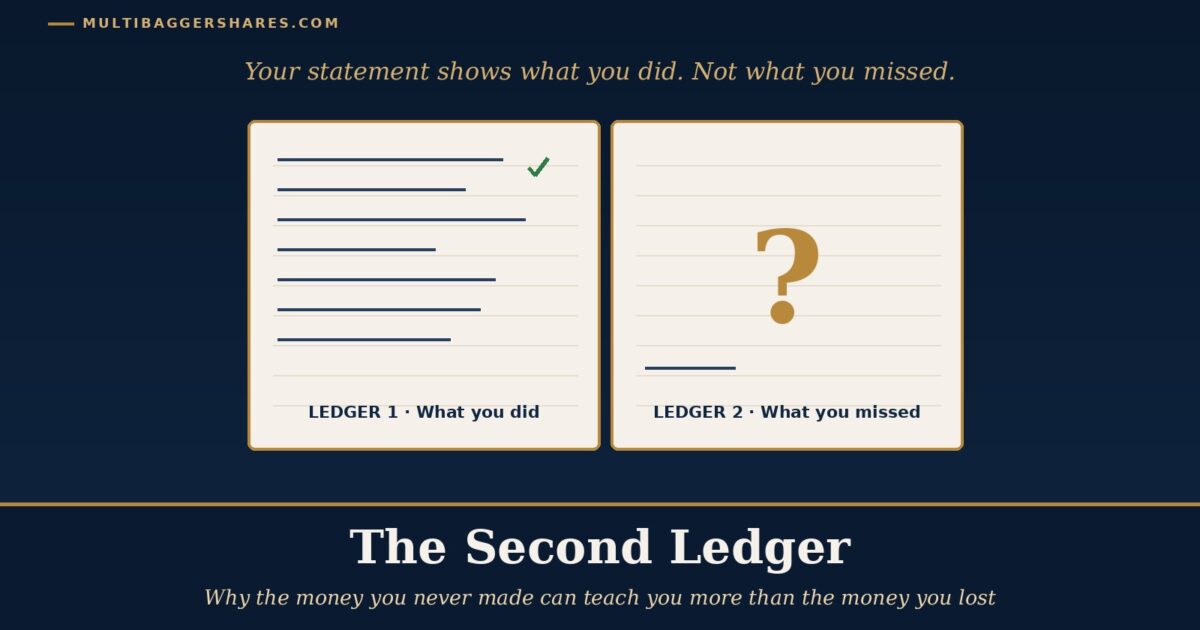
Every evening, the owner of a small shop in a busy lane sits down with a thick notebook called the ledger (a book in which money coming in and money going out is written down, line by line). He notes what he sold, what he bought and what his customers still owe him. At the end of the month he adds it all up and knows exactly whether the shop made a profit or a loss. Nothing is left to memory, and nothing is left to hope.
Now think about how most of us keep track of our investing. We have a statement from the broker or the bank. It shows what we bought, what we sold, and what our holdings are worth today. That statement is the shopkeeper’s ledger. It is neat and complete, and it shows every mistake that lost us money. But it has one serious gap. It cannot show the money we never made.
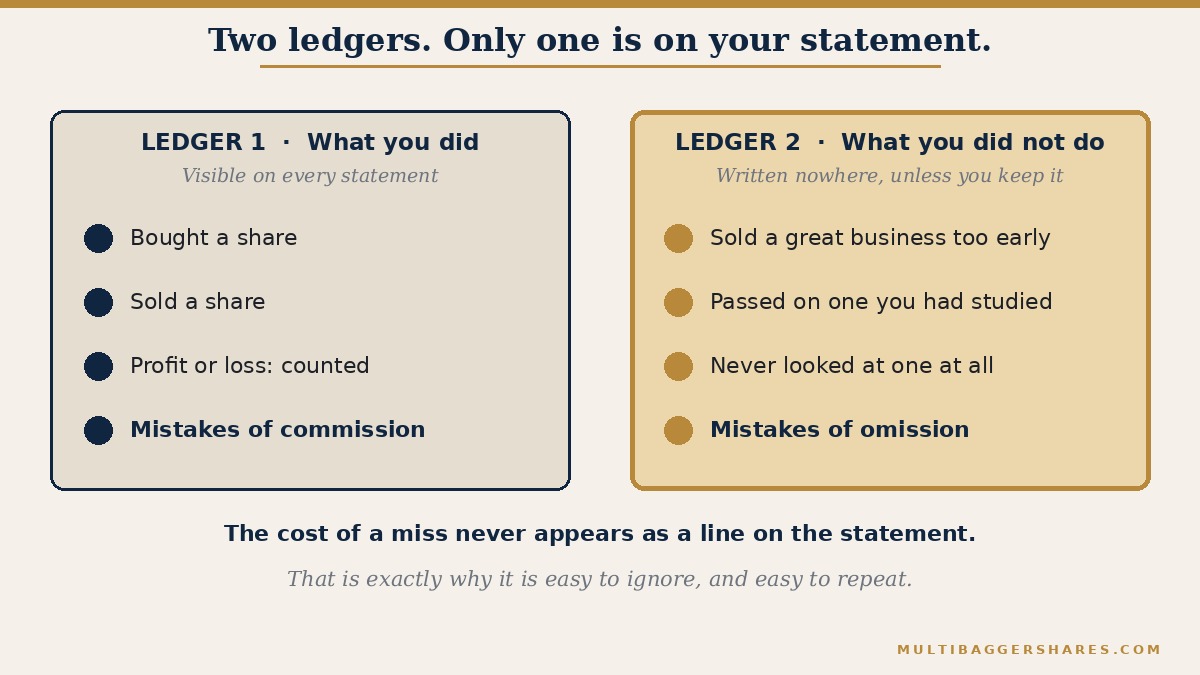
Sanjay Bakshi, a well-known Indian value investor (someone who tries to own good businesses patiently, for many years), spoke about this gap in a June 2015 interview with Microcap Club. He teaches at the Management Development Institute in Gurgaon, and he runs an investment firm called ValueQuest. In the interview he described a kind of record he calls his hall of shame. It holds, in his words, not just mistakes of commission, but also mistakes of omission.
Those two terms are easy to understand. A mistake of commission means you did something and it went wrong, such as buying a weak business. A mistake of omission means you failed to do something you should have done, such as selling a wonderful business far too early, or never studying it at all. The first kind leaves a mark on your statement. The second kind leaves no mark anywhere, and that is exactly why it is so easy to ignore.
What it really means
Bakshi gave this second record a name: the Opportunity P&L Account. A P&L account (short for profit and loss account, a summary of what you earned and what you lost) normally lists real money. His version lists the money that could have been earned and was not. He said the idea is a powerful one because it records the true tuition fee, the price paid for the education that mistakes give you.
He also gave a plain example from his own life. In the interview he said that he sold too early, and that in one instance the stock went on to rise by more than thirty times his selling price. Think about that for a moment. His first ledger would have shown a happy sale. A profit was made. The second ledger tells a very different story, and it is the second one that contains the lesson.
Cricket gives us a good picture of this. When a batsman scores eighty runs, the scorebook shows every run. But the scorebook does not show the catch that a fielder dropped when he had scored only five. That one dropped catch is the reason the batsman reached eighty. The scorer writes down what happened. He has no column for what almost happened, or for what should have happened.
A kirana shop has the same blind spot. Suppose the owner turned down a large wedding order because he feared the bill might not be paid. His ledger will not show a single line about that order. The shop looks perfectly healthy. Yet if the bill would have been paid in full, he has made a real mistake, and he will repeat it every wedding season, because no page ever tells him so.
Why it works
The first reason is simple. What is not written down is not learned. We are quick to study the stocks that lost us money, because the statement forces us to look at them. We seldom study the ones that quietly made someone else rich. A second ledger gives those misses a page of their own, so that they become something we can read and learn from.
The second reason is the way our minds work. A loss we can see hurts. An opportunity we missed does not hurt in the same way, because we never held it in our hands. Psychologists call the first feeling loss aversion (the habit of feeling a loss far more strongly than an equal gain). Because the pain of a miss is missing, the lesson is also missing, and we cheerfully repeat the same error. The ledger puts the missing pain back, gently, in the form of a written lesson.
The third reason is that patterns appear only on paper. One missed opportunity feels like bad luck. Five missed opportunities that share the same cause form a pattern. Perhaps you always sell after the first fifty per cent gain. Perhaps you always skip businesses whose names you cannot pronounce. You cannot see a pattern that lives only in your memory, and memory has a habit of rewriting itself so that we look wiser than we were.
The fourth reason is the way Bakshi frames it. In the same interview he said that calling losses a tuition fee for lessons learnt has really helped him. Tuition is money we are glad to pay, as long as we come away having learnt something. A mistake that is recorded, understood and turned into a rule has been paid for once. A mistake that is ignored will be paid for again and again.
One honest warning belongs here. The second ledger is not a place for regret. Looking back, everything seems obvious, and psychologists call this hindsight bias (the feeling that you knew it all along, after the facts are known). Most missed opportunities could not have been known in advance. So the question to ask is not, why did I not buy it? The right question is, what was my reason at that time, and was it a good reason? We judge our thinking, never our luck.
A real example or two
Our first example comes straight from the interview. Bakshi has said that he sold a great business too early, and that the stock later rose to more than thirty times the price at which he sold. The point for us is not that he regrets one decision. The point is that he kept a record, learnt from it, and was willing to say so in public. Most investors would rather forget such a page.
Our second example is made up, so that we can look at the numbers calmly. Meet Arjun, a young engineer in Pune. In his first year of investing, he buys shares of an imaginary spice maker called Sundari Masalas Limited at 100 rupees each. A year later the price is 150 rupees. He is delighted and sells. His statement says that he made a profit of 50 rupees on every share, which is a gain of fifty per cent. His first ledger is perfectly happy.
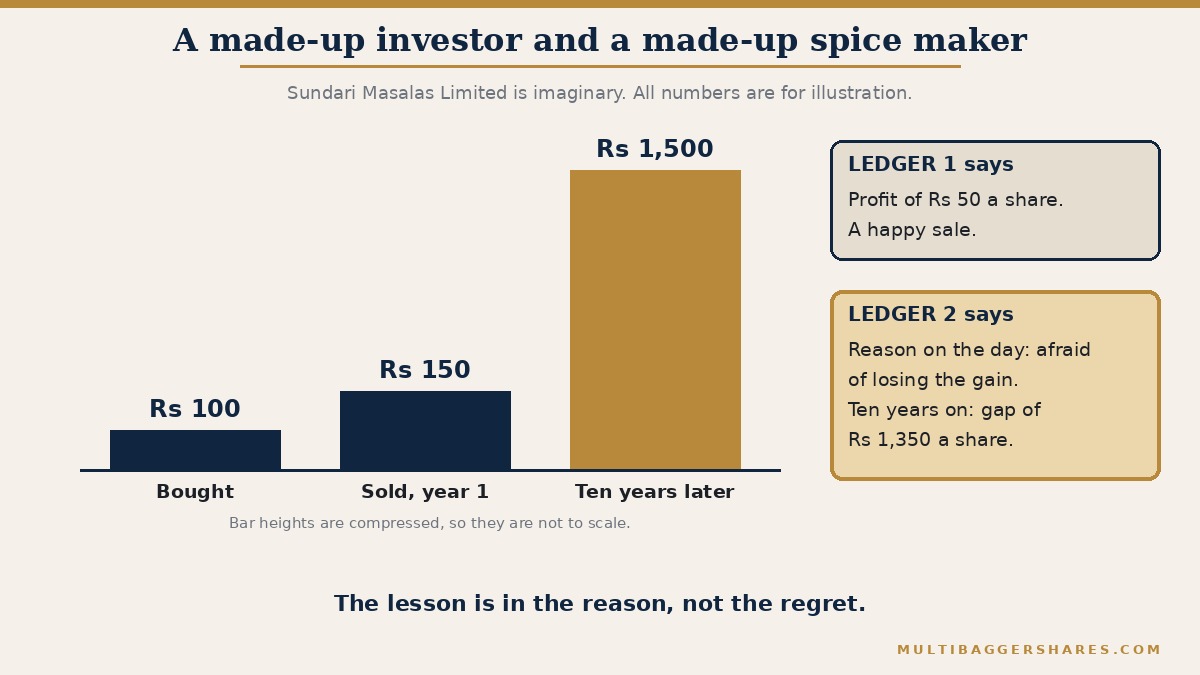
Ten years pass. Sundari Masalas has kept growing its sales, has opened in many more cities and has not borrowed heavily. Its shares now stand at 1,500 rupees each. Arjun’s first ledger has not changed at all. It still says, fifty rupees profit. But if Arjun had opened a second ledger on the day of the sale, he would have written the reason in his own hand: the price rose fifty per cent, so I sold, because I was afraid of losing the gain. Ten years later he would add the result next to it. The shares have gone on to 1,500 rupees, a gap of 1,350 rupees per share. All of these numbers are made up, to show the idea.
Notice what the second ledger does and does not say. It does not say that Arjun should have held forever, or that every sale is a mistake. It says something much more useful. Arjun sold because of a fear of losing a gain, and not because the business had changed. That is a reason about his feelings, not about the company. Seen on paper, the reason is easy to spot, and next time Arjun can ask a better question before he sells: has the business itself changed, or only my mood?
Suppose Arjun keeps the habit for a few years. Soon his second ledger has other lines. One is about a packaging company that he read about in a newspaper and never studied, because it seemed boring. Another is about a shop-fitting business that he looked at for a day and dropped, because the founder was a stranger to him. Three entries, three different stories, and one common thread: he stops looking whenever something feels unfamiliar. That thread would never have shown up in his broker statement.
How you can use it
You do not need any software. A simple notebook or a single page on your phone is enough. Draw five columns. In the first, write the date. In the second, write what happened, for example, I sold this, I passed on that, or I never looked at it. In the third, write your reason at that time, in a sentence or two. In the fourth, leave a blank to fill in later with what happened afterwards. In the fifth, write the lesson, when you are ready.
There are three kinds of entry worth making. The first is a sale of a good business that then kept growing. The second is a business that you studied seriously and passed over. The third is a business that you never studied at all, although it kept coming up in your reading. Be selective. You will always miss thousands of companies. Write down only the decisions that you really made, or the ones that you seriously thought about.
The most important step is the one that is easy to skip: write your reason on the day itself. If you wait, your memory will quietly improve the story. A line written on the day, such as I sold because I was nervous about the market, is honest evidence. Years later it lets you judge the thinking and not the result. It also protects you from the opposite trap, which is to believe that every lucky outcome came from skill.
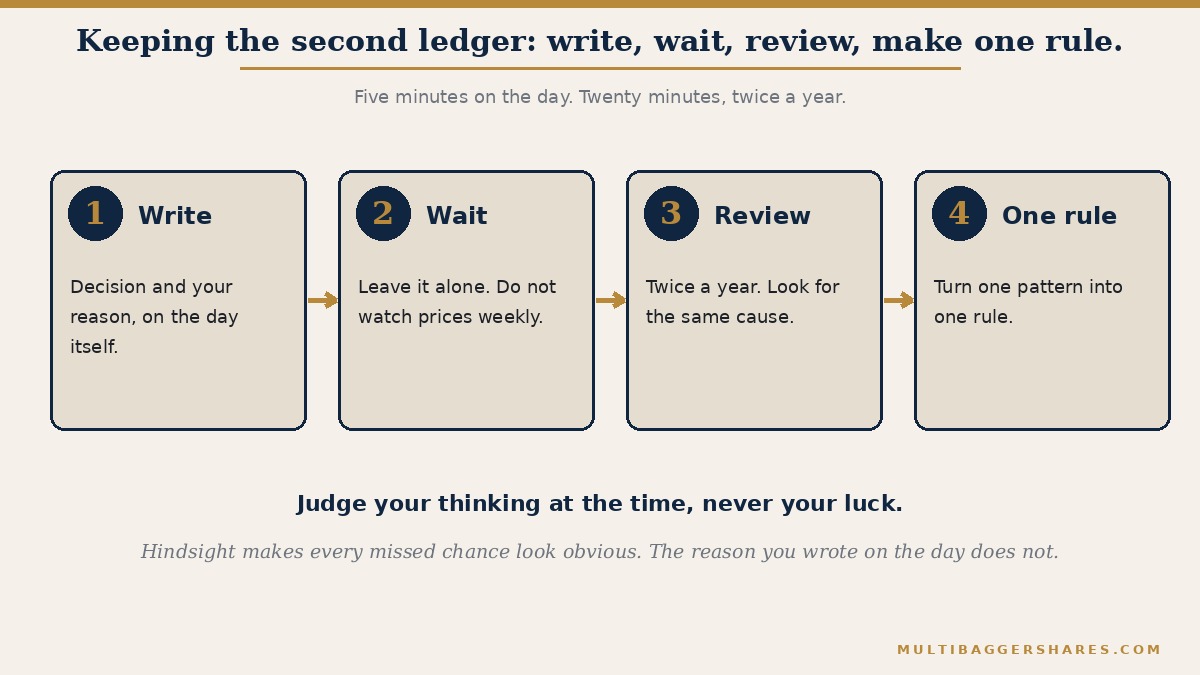
Then leave the book alone. Do not open it every week, and do not use it to watch prices. Review it twice a year, perhaps in April and in October. Read the lines from top to bottom and ask only one question: do I see the same cause appearing more than once? If it does, you have found a pattern worth acting upon.
Finally, turn one pattern into one rule. Only one, because a long list of rules is a list nobody follows. For example, if you notice that you often sell after a quick gain, your rule may be this: before I sell a business I understand, I will write down in one line what has changed in the business. If nothing has changed, I will wait a month and read the line again. The rule is yours, written in your own words, from your own tuition fees.
Keep your first ledger too. The broker statement still matters, and the mistakes of commission still deserve a page of their own. The point of the second ledger is balance. An investor who studies only the losses learns to be afraid. An investor who studies both kinds of mistakes learns to be careful and also to be brave.
This article is for education only. It does not tell you what to do with any particular investment.
Key takeaways
- Your broker statement is only the first ledger, and it never shows the money you did not make.
- A mistake of omission, such as selling a great business too early or never studying one, is real even though nothing is written on the statement.
- Sanjay Bakshi’s Opportunity P&L Account turns these misses into lessons, which he describes as a tuition fee worth paying once.
- Write your reason on the day of each decision, so that later you judge your thinking and not your luck.
- Review twice a year, look for the same cause appearing again, and turn just one pattern into one rule.
— Manish Goel · multibaggershares.com
Manish Goel is a Chartered Accountant and Principal Officer of Multibagger Securities Research & Advisory Pvt. Ltd. (MSRAPL), a SEBI-registered Investment Adviser, Registration No. INA100007736. This content is published by MSRAPL for education only and is not personalized investment advice.
Disclaimer: This article is published by multibaggershares.com for education and general information only. It is not investment advice, investment research, or a recommendation to buy, sell or hold any security. Any companies named are discussed only as illustrative examples. Markets carry risk; please do your own research or consult a qualified professional before making any investment decision. |