The Kitchen With Too Many Cooks: Why a Business Can Grow Past the Size Where Bigger Means Cheaper

The Laddoo That Lost Its Ghee: Why Businesses That Aim Past Profit Often Earn the Most
November 27, 2026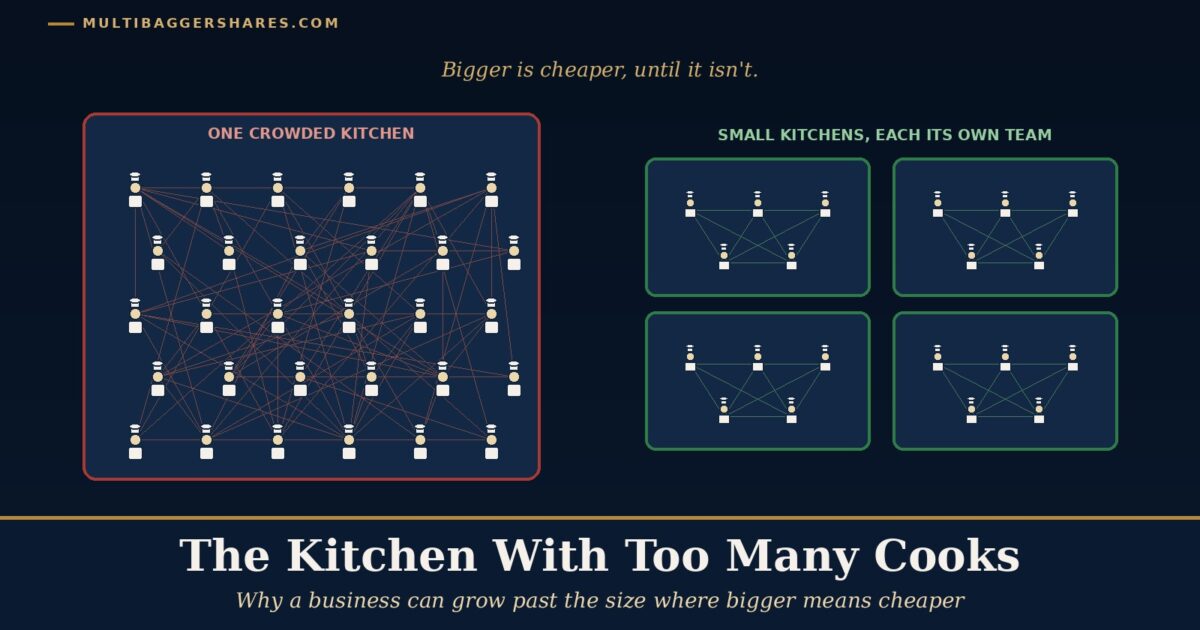
In Nagpur, two caterers started out the same year, each with a small kitchen and eight cooks. Suresh-bhai and Leela-ben cooked for weddings, office lunches and festivals. Both charged about Rs 110 a plate. Both were good at it, and both grew.
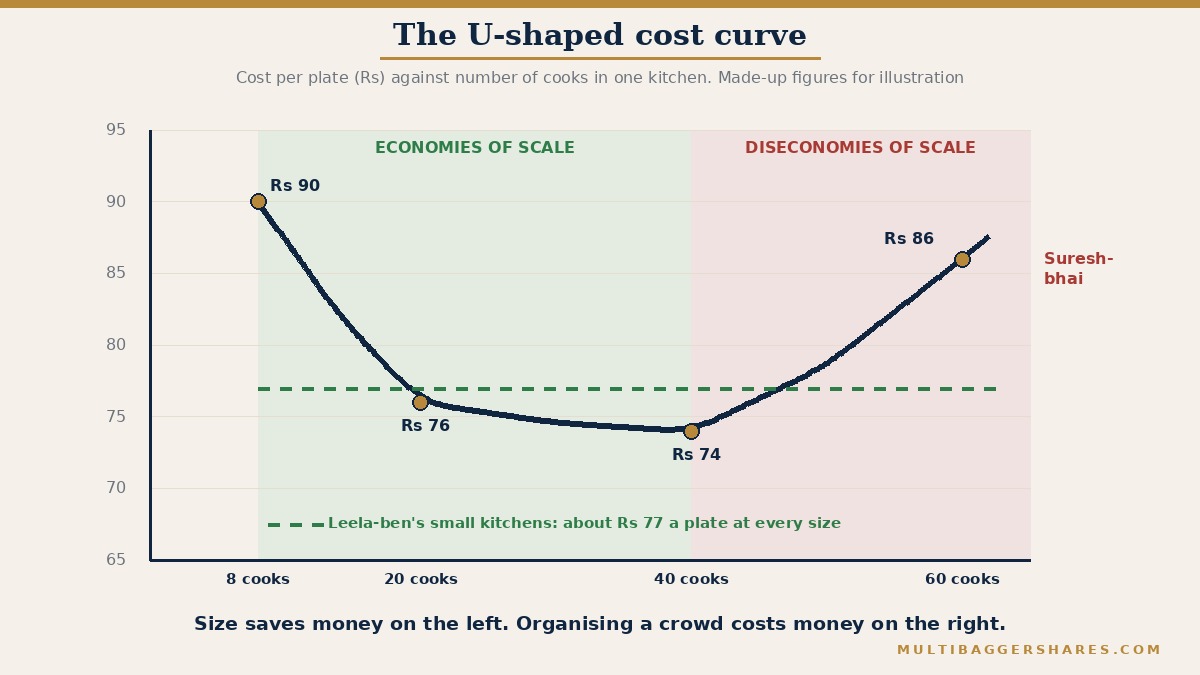
Suresh-bhai grew the simple way. Every time orders went up, he hired more cooks into the same big kitchen. Eight cooks became twenty, then forty, then sixty. At first this worked beautifully. He could buy rice and oil by the sack instead of by the kilo, so they came cheaper. One big tandoor (clay oven) served many cooks. His cost per plate (everything it costs to make one plate, from food to wages to gas) fell from about Rs 90 to about Rs 74.
Then something odd happened. Somewhere past forty cooks, the cost per plate started to rise again. Nobody had raised prices on him. The rice was still cheap. But he now needed three supervisors to watch the cooks, a store manager to track the stock, and a man just to plan who used which stove when. Orders got mixed up. Two cooks would make the same dal while nobody made the raita. Food was wasted. Small decisions waited for Suresh-bhai, who was always busy. At sixty cooks, his cost per plate was back up to about Rs 86.
Leela-ben grew a different way. Whenever her kitchen reached about fifteen cooks, she stopped adding people to it. Instead she opened a second, separate kitchen in another part of the city, with its own head cook who was free to run it. Later she opened a third and a fourth. She still bought rice and oil together for all four, so she kept most of the savings of size. But each kitchen stayed small enough that every cook knew every other cook, and the head cook knew every order. Her cost per plate stayed at about Rs 77.
By the end, both caterers had about sixty cooks. They sold at the same price. Yet Leela-ben kept about Rs 33 on every plate, while Suresh-bhai kept about Rs 24. The figures are made up to keep the arithmetic simple. The pattern is real, and it is today’s lesson.
What it really means
Most beginners learn one rule about size: bigger is cheaper. Economists call it economies of scale (the cost of making each unit falls as you make more units, because big fixed costs like machines, rent or advertising are spread over more of them). It is true, and it is one of the strongest forces in business. A soap factory making a crore bars costs far less per bar than one making a thousand.
But there is a second rule that gets far less attention. Past a certain size, a business can start to suffer from diseconomies of scale (the cost of making each unit rises as the business gets bigger, because it becomes harder and costlier to organise). The savings from size do not vanish. They just get eaten by a new kind of cost: the cost of keeping a large group of people informed, coordinated and pulling in the same direction.
Put the two rules together and you get a curve shaped like the letter U. On the left, as the business grows, cost per unit falls. At the bottom sits the best size, where the savings of size and the costs of size balance out. On the right, cost per unit climbs again. Suresh-bhai walked right up the far side of that U without noticing. Leela-ben found a way to stay near the bottom while still growing.
Think of a family cooking dinner. Two people in the kitchen are faster than one. Four may be faster still. But put twelve people in the same kitchen and they bump into each other, argue over the stove and wait for the one knife. The old saying, too many cooks spoil the broth, is a fairly good summary of diseconomies of scale.
Why it happens
Diseconomies of scale do not come from one big mistake. They creep in quietly, through four everyday channels.
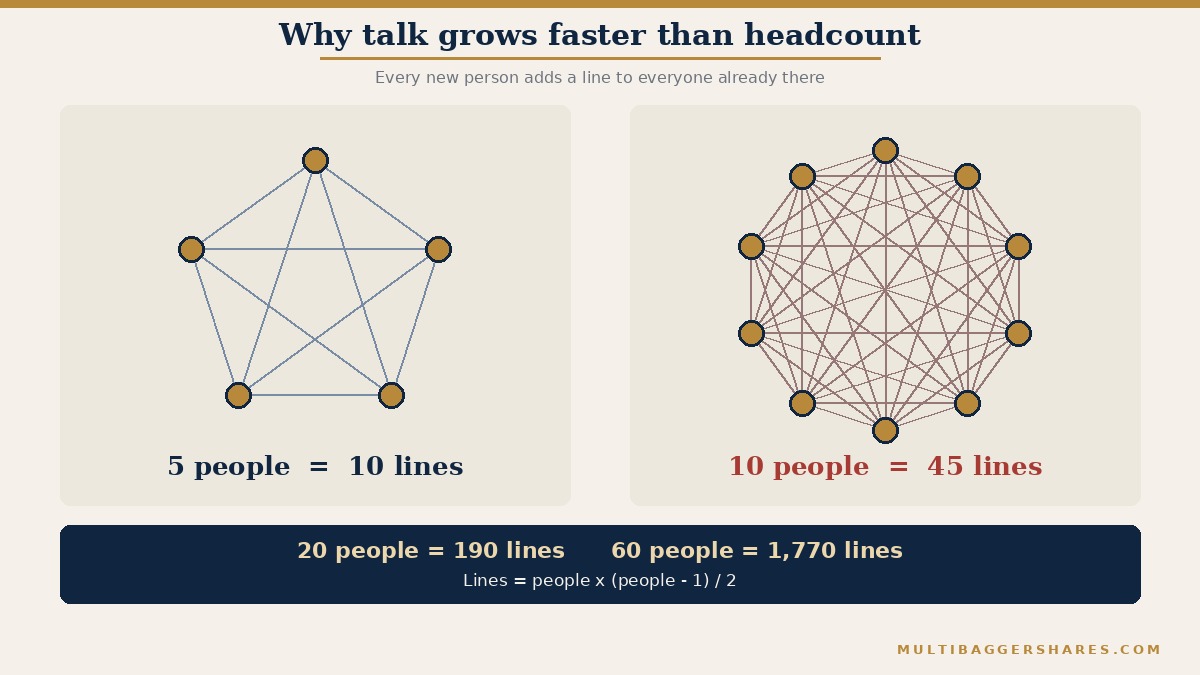
1. Talk grows faster than headcount. In a group of five people, there are 10 different pairs who might need to talk to each other. In a group of ten, there are 45. At twenty people there are 190 pairs, and at sixty there are 1,770. The number of people went up twelve times; the number of possible conversations went up more than a hundred and seventy times. Every one of those lines is a chance for a message to be late, lost or misunderstood. A business fixes this with meetings, reports, forms and managers, and every one of those costs money and time.
2. Layers push the boss away from the customer. In a small kitchen, the owner tastes every dish and hears every complaint. In a large one, a complaint passes from a waiter to a supervisor to a manager before it reaches anyone who can act. Each layer softens the message a little. By the time it reaches the top, a serious problem can sound like a minor one. Big businesses can be the last to know what their own customers think.
3. Decisions slow down, and responsibility blurs. When everything has to be approved by someone above, small choices wait in a queue. And when a job belongs to a whole department, it can quietly belong to nobody. In Suresh-bhai’s kitchen, the raita was everyone’s job, so on some days nobody made it. A small team cannot hide a missing raita. A crowd can.
4. Overheads start feeding themselves. Overheads (the costs of running the business that are not directly part of making the product, such as offices, managers, planners and software) tend to grow on their own once a business is large. New managers hire assistants. New departments create new reports for other departments to read. None of it is wasteful by itself, but together it can grow faster than sales, and every rupee of it comes out of profit.
There is also a quieter human cost. In a small team, each person’s effort is visible and matters. In a very large one, it is easy for people to feel like a small part in a big machine, and to care a little less. That never shows up as a line in the accounts, but it shows up in quality, in waste and in how fast good people leave.
A real example or two
This idea is old, and some sharp minds have written about it. In 1937 a young British economist named Ronald Coase published a famous paper called ‘The Nature of the Firm’ in the journal Economica. He asked a simple question: if markets are so good at organising work, why do companies exist at all? And if companies are so useful, why is the whole world not run by one giant company?
His answer, in plain words, was that running work inside a company saves the cost of bargaining in the market each time, but organising has costs of its own, and those costs rise as the company grows. The boss has more to keep track of and starts to make more mistakes. So a company tends to keep growing only until doing one more job inside costs as much as buying it from outside. Coase was awarded the Nobel Prize in economics in 1991, in part for this idea. In other words, there is a natural limit to how big a company can usefully get, and that limit depends on how well it organises itself.
The second example comes from software, where the problem is easy to see. Fred Brooks managed one of the biggest software projects of the 1960s at IBM. In his 1975 book The Mythical Man-Month he wrote a line that became known as Brooks’s law: “Adding manpower to a late software project makes it later.” His point was that new people must be trained, and every new person adds lines of communication to everyone already on the team. Past a point, more hands mean more talking and less building. It is the same thing Suresh-bhai discovered with his sixtieth cook.
The third example is a company that took the lesson seriously. Bill Gore left his job as a scientist at DuPont and started W. L. Gore and Associates in 1958. The company later became known for Gore-Tex, the waterproof fabric used in jackets and shoes. It is widely reported that Gore kept its plants small on purpose. A 2004 IndustryWeek profile put it this way: the company’s style of working operates best “when plants are kept to a size of no more than 150 or 200 associates.” The writer Malcolm Gladwell made this story famous in his 2000 book The Tipping Point. In effect, Gore did what Leela-ben did: it grew by adding more small units, not by making one unit huge.
You will see the same pattern in many well-run groups. Big companies that stay nimble often split themselves into smaller units, each with its own leader, its own profit and loss account (the statement that shows what a unit earned and spent) and freedom to act. They keep the savings of size where size really helps, such as buying, brand and borrowing, and keep things small where smallness helps, such as serving customers and making decisions.
Note the difference from two earlier lessons on this site. ‘The Dosa That Travelled Too Far’ was about growing faster than quality can follow; that is a problem of speed. ‘Cheaper Because Bigger’ was about the savings of size; that is the left side of the U. Today’s lesson is about the right side: a business can grow at a careful pace and still find that size itself has started to cost more than it saves.
How you can use it
You cannot walk into a large company’s kitchen. But the annual report (the yearly book a listed company publishes about its business and accounts) and a little patience will show you most of what you need. Here are five checks.
1. Are overheads growing faster than sales? Compare sales growth with the growth of employee costs and other expenses outside raw materials, over five to ten years. If sales double but these costs triple, the business may be climbing the right side of the U. A single bad year means little. A steady pattern means a lot.
2. Is return on capital falling as the business grows? Return on capital (the profit a business earns for every rupee invested in it) tells you whether growth is still paying. If each year the company is bigger but earns less on each rupee it uses, something is getting in the way. It may be competition, or it may be the business tripping over its own size.
3. Is the biggest player really the cheapest? In a healthy industry with real economies of scale, the largest company usually has the best margins (the share of each rupee of sales left as profit). If a mid-sized rival steadily earns better margins than the giant, the giant may already be past its best size.
4. How are decisions made? Read how management describes the organisation. Does it talk about small units, local leaders and people close to the customer who can decide things themselves? Or does every decision go up to head office? Neither is always right, but a large business run entirely from one desk is asking for Suresh-bhai’s problems.
5. Are there signs of slowness? Look for new products arriving later than rivals’, rising customer complaints, frequent reorganisations, and management talking a lot about ‘complexity’ or ‘simplifying the structure’. When a company says it must become simpler, it is often admitting that size has started to bite. That can be a good sign if the fix is real, so watch whether the numbers in checks one to three improve afterwards.
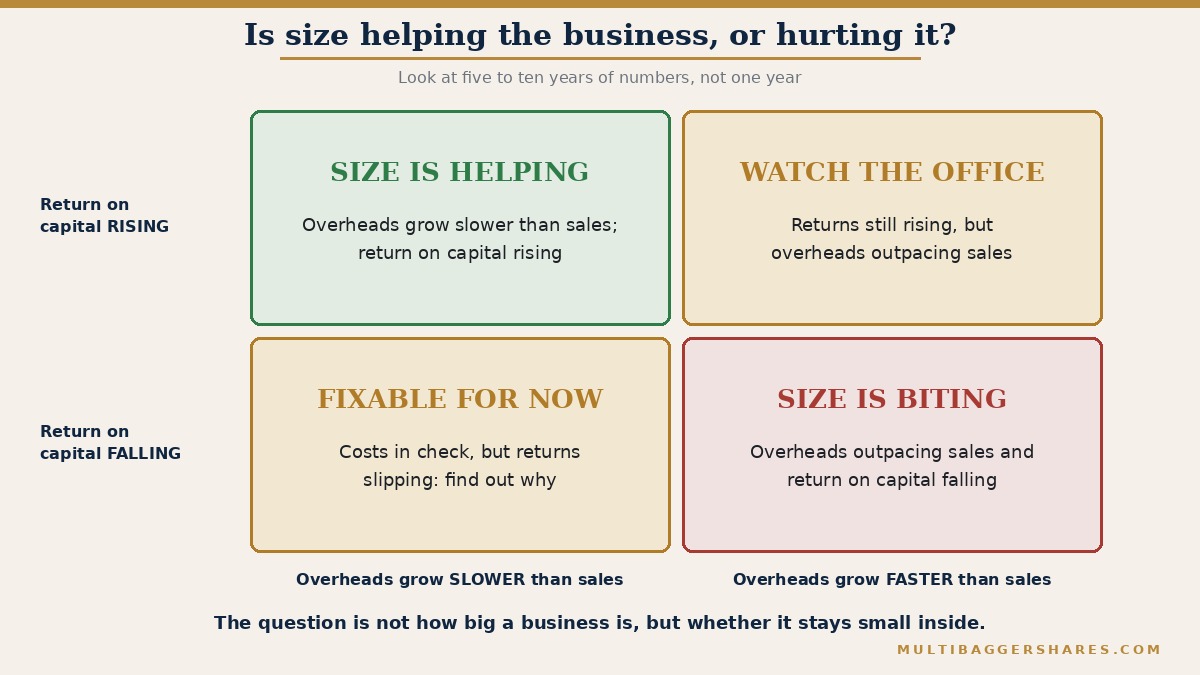
One word of balance. Diseconomies of scale do not mean that big is bad, or that small is always better. Size brings real strengths: cheaper buying, stronger brands, easier borrowing and the ability to survive a bad year. Many of the finest businesses in the world are very large. The question is not how big a business is, but whether it has learned to stay small inside while it grows outside, the way Leela-ben did.
This is a way to judge the quality of a business, not a way to guess what any share price will do. Suresh-bhai and Leela-ben ended up the same size, selling the same food at the same price. One built one huge kitchen. The other built many small ones. The difference was all in how the work was organised, and it showed up, year after year, in what each of them kept from every plate.
Key takeaways
- Economies of scale make each unit cheaper as a business grows, but only up to a point.
- Past that point, diseconomies of scale set in: more talk, more layers, slower decisions and swelling overheads.
- Conversations grow much faster than headcount; sixty people have 1,770 possible pairs to keep in touch.
- Well-run large businesses often stay small inside, growing by adding small units with their own leaders.
- Check overheads versus sales, return on capital, margins against smaller rivals and signs of slowness. Education only.
— Manish Goel · multibaggershares.com
Manish Goel is a Chartered Accountant and Principal Officer of Multibagger Securities Research & Advisory Pvt. Ltd. (MSRAPL), a SEBI-registered Investment Adviser, Registration No. INA100007736. This content is published by MSRAPL for education only and is not personalized investment advice.
Disclaimer: This article is published by multibaggershares.com for education and general information only. It is not investment advice, investment research, or a recommendation to buy, sell or hold any security. Any companies named are discussed only as illustrative examples. Markets carry risk; please do your own research or consult a qualified professional before making any investment decision. |