The Laddoo That Lost Its Ghee: Why Businesses That Aim Past Profit Often Earn the Most

The Shop That Sews by Friday: Why a Business That Responds Faster Than Its Rivals Wastes Less and Wins More
November 26, 2026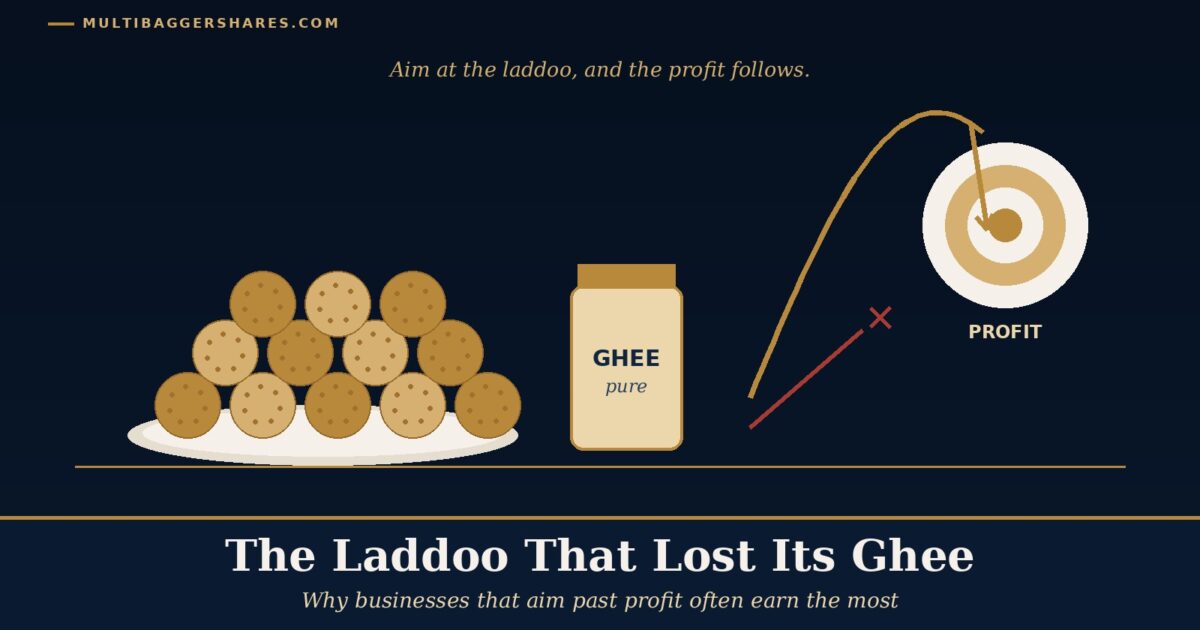
In an old market in Indore, two sweet shops stand on the same lane. Both sell besan laddoos (round sweets made from roasted gram flour, sugar and ghee, which is clarified butter). Both were started by families who arrived in the same year. For a long time they sold about the same number of boxes, at about the same price, to the same kind of customers.
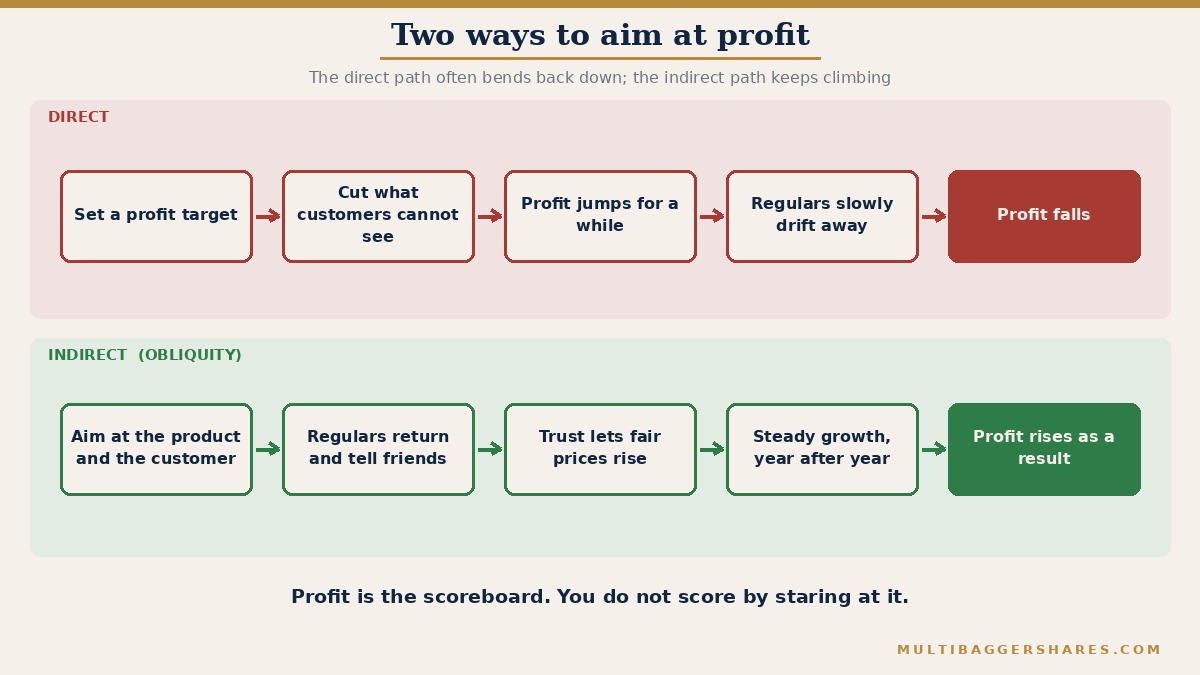
Mr Verma runs the first shop. A few years ago he decided to run it the modern way. He wrote a number on a card and stuck it above his cash box: the profit he wanted every single day. Every evening he checked the card. Every month he looked for ways to reach a bigger number. He mixed cheaper oil into the ghee. He made each laddoo a little smaller. He roasted the flour for a shorter time to save gas. Each change was small, and most customers could not see it.
Kamla-ji runs the second shop. She has no card above her cash box. What she watches is different. Does the laddoo still taste the way her mother made it? Did the family from the next street come back this Diwali? When a customer frowns, she asks why. When ghee prices went up, she kept the pure ghee and raised her price a little, slowly, and explained why to anyone who asked.
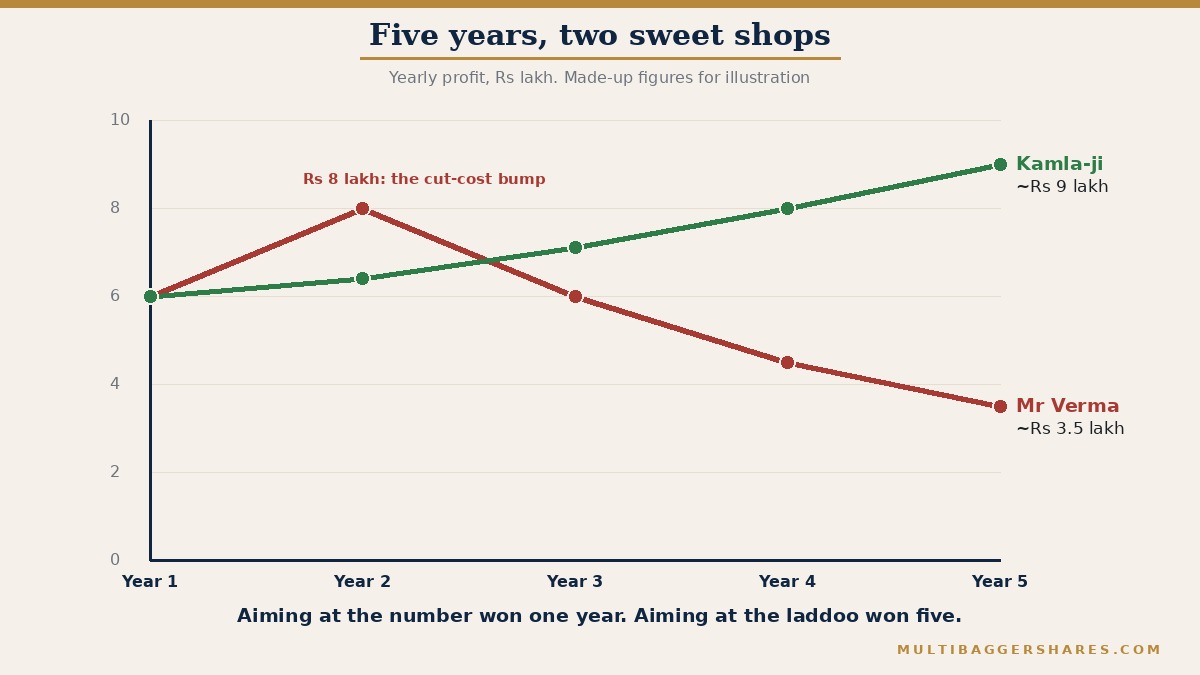
For a year, Mr Verma looked like the clever one. His profit jumped from about Rs 6 lakh a year to about Rs 8 lakh. Kamla-ji’s barely moved. Then something quiet began to happen. Old customers said the laddoos were not what they used to be. Wedding orders went to the other shop. Mr Verma cut more costs to protect his number, which made the laddoos worse again. By the fifth year his profit had fallen to about Rs 3.5 lakh. Kamla-ji, who had never aimed at profit directly, was earning about Rs 9 lakh.
The shops and numbers are made up, but the pattern is very real. The owner who aimed straight at money ended up with less of it. The owner who aimed at something else, the laddoo and the people who eat it, ended up with more.
What it really means
The British economist John Kay gave this pattern a name: obliquity (reaching a goal indirectly, by aiming at something else). He explained it in lectures and essays from the 1990s onwards and later in a book called Obliquity (2010). His idea is simple. Some goals are best reached by going the long way round.
Think about happiness. Kay liked to quote the old English thinker John Stuart Mill, who found that happiness came most surely to people who were busy with something else, such as their work, their family or helping others, and who did not chase happiness head-on. A person who wakes up every morning asking “Am I happy yet?” is rarely the happiest person in the room.
Kay argued that profit in a business works in a similar way. In one essay he put it in a single line: success in creating shareholder value (the wealth a company creates for its owners) is best achieved when it is not pursued directly. A business that aims at making an excellent product, treating customers well and keeping good people tends to make money as a result. A business that aims only at the money often damages the very things that produce it.
A cricket example makes it clear. A batsman who keeps staring at the scoreboard, counting runs, tends to get out. A batsman who watches the ball, ball after ball, finds that the runs arrive by themselves. The scoreboard matters. It is how you know who won. But you do not score by looking at it.
This is not a claim that profit does not matter. It matters a great deal. A business that never earns a fair profit cannot pay its people, cannot invest, and will not survive. Obliquity is about where a business points its daily attention. Profit is the result to measure. It is usually a poor thing to aim at, day after day, on its own.
Why it works
Why should aiming past profit lead to more profit? There are four simple reasons, and each can be seen in the laddoo shops.
First, the most valuable things in a business are slow and hard to see. Trust, taste, skill, a good name and loyal customers take years to build. They do not show up clearly in this month’s accounts. A business chasing a number this month will be tempted to spend them, a little at a time, because spending them makes the number look better. Mr Verma’s cheaper oil did exactly that. It turned the slow asset of trust into a quick bump in profit.
Second, the world is too uncertain for a straight line. Nobody knows exactly which product, price or idea will earn the most in five years. Kay pointed out that complicated goals in an uncertain world are rarely reached by tackling them head-on. A business that keeps asking the simpler question, “Are our customers better off with us than without us?”, adjusts naturally as the world changes. A business that only asks “How do we hit the number?” can hit the number while slowly losing its way.
Third, a narrow target invites shortcuts. When people are judged only on one number, they find clever ways to move that number, whether or not the business really improves. Prices are pushed up too far. Repairs are put off. Training is cut. Each shortcut helps the number for a while and harms the business for longer.
Fourth, good people stay where the work means something. A cook who is proud of the laddoos works with care. A cook who is told only to make them cheaper stops caring, or leaves. Over the years, a business that aims at doing good work keeps better people, and better people make better products.
Put these together and you get a quiet kind of compounding (growth on top of growth, like a snowball rolling downhill and picking up more snow). Each happy customer brings another. Each year of trust makes the next price rise easier to accept. Kamla-ji’s profit grew slowly at first, then faster, because it rested on something that kept growing underneath.
A real example or two
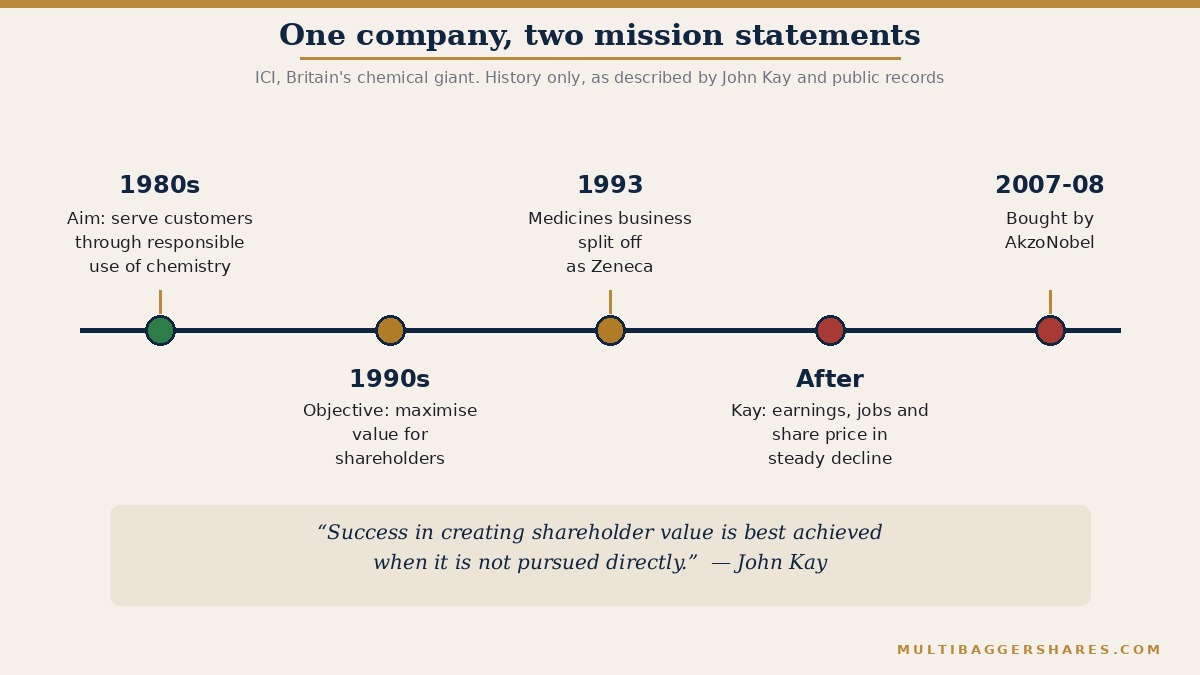
John Kay’s favourite example was a British company called ICI (Imperial Chemical Industries), once one of the largest and most respected companies in Britain. In the 1980s, Kay noted, ICI described its aim as being the world’s leading chemical company, serving customers through the innovative and responsible application of chemistry. In plain words, its purpose was to be very good at chemistry and useful to its customers.
About ten years later, the stated aim had changed. ICI now said its objective was to maximise value for its shareholders. In 1993 it split off its medicines business into a separate company called Zeneca. It then set out to sell its older, heavy chemical businesses and buy newer, more exciting ones. Kay’s verdict was blunt. He wrote that the company found it easier to buy new businesses than to sell the old ones, and that its earnings, its number of jobs and above all its share price went into steady decline. The company dropped out of Britain’s leading share index, and its chief executive resigned. In 2007 ICI agreed to be bought by the Dutch company AkzoNobel, and the deal was completed in 2008. A company that set out to maximise value for its owners did not do it.
The opposite attitude can be heard in a famous talk by George W. Merck, who led the American medicine maker that bears his family name. Speaking at the Medical College of Virginia around 1950, he said, as the company’s own history records, that medicine is for the people, not for the profits, and that the profits follow, and have never failed to appear when the company remembered this. He was not saying profit was unimportant. He was saying where the aim should point.
Perhaps the most surprising voice is Jack Welch, the long-time head of the American giant General Electric, who was famous for chasing growth in profits. In March 2009, after the financial crisis, he told the Financial Times that, on the face of it, shareholder value is the dumbest idea in the world. He explained that shareholder value is a result, not a strategy, and that a company’s main focus should be its employees, its customers and its products.
These are stories from history, told only to show the idea. They are not views on any company’s shares today.
How you can use it
You cannot read a manager’s mind. But a business shows where it is really aiming in many small ways. Annual reports, results, and the way management talks hold many clues. Here are five simple questions a beginner can ask.
1. What does management talk about first? Read the chairman’s or managing director’s letter in the annual report (the yearly book a listed company publishes for its owners). Does it begin with customers, products, quality and people, with real numbers behind them? Or does it begin and end with profit targets, share price and “value unlocking”? Neither is proof on its own, but the order of attention tells you something.
2. Are the targets short and narrow? Be careful with a business that promises a fixed profit growth every quarter, year after year. Real businesses are lumpy. A management that must hit a smooth line is under pressure to take shortcuts, like Mr Verma with his card above the cash box.
3. What is management paid for? The annual report explains how top managers are paid. If most of their reward depends on next year’s profit or share price, they have a reason to think short-term. Rewards linked to longer periods and to things like customer satisfaction or return on capital (the profit a business earns on the money invested in it) point the aim further ahead.
4. When costs are cut, what gets cut? Cutting waste is good. Cutting quality is not. Watch for falling spending on product development, repairs, training or customer service while profits rise. That pattern can mean a business is spending its slow assets to flatter its numbers, the way cheaper oil flattered Mr Verma’s.
5. Has the business ever chosen to earn less now so its customers are better off? Look for moments when a company kept prices fair in a shortage, fixed a fault at its own cost, or kept quality high when cheaper ways were available. Businesses that do this are planting trees whose shade they expect to sit in later.
One word of balance. Obliquity does not mean that a business should ignore money, or that any company which talks about customers is a good one. Talk is cheap. Some managers use warm words about purpose to hide poor results. Always check the words against the numbers over many years: steady returns on capital, healthy cash flow, low debt and customers who keep coming back. When the words and the numbers point in the same direction, you have found something worth understanding.
This is a way to judge the quality of a business, not a way to predict what any share price will do. Mr Verma and Kamla-ji sold the same laddoos on the same lane. One aimed at the number on his card. The other aimed at the taste of the laddoo and the faces of her regulars. Over the years, the one who looked away from the money ended up with more of it.
Key takeaways
- Obliquity, John Kay’s word, means some goals are best reached indirectly, by aiming at something else.
- Businesses that aim at great products and happy customers often earn more than those that chase profit head-on.
- Chasing a number tempts a business to spend slow, hidden assets like trust, quality and skill for a quick bump.
- Profit still matters; it is the result to measure, not the only thing to aim at every day.
- Check what management talks about, how it is paid, what it cuts and whether its words match the numbers. Education only.
— Manish Goel · multibaggershares.com
Manish Goel is a Chartered Accountant and Principal Officer of Multibagger Securities Research & Advisory Pvt. Ltd. (MSRAPL), a SEBI-registered Investment Adviser, Registration No. INA100007736. This content is published by MSRAPL for education only and is not personalized investment advice.
Disclaimer: This article is published by multibaggershares.com for education and general information only. It is not investment advice, investment research, or a recommendation to buy, sell or hold any security. Any companies named are discussed only as illustrative examples. Markets carry risk; please do your own research or consult a qualified professional before making any investment decision. |